
Llansadwrn (Anglesey) Weather
Diary 2003

|
|
Llansadwrn (Anglesey) Weather
|
|
Where you see these icons click for a pop-up graphic


Most pop-up graphics on this page are self-closing on next click of mouse..
Times are GMT.


1st: It was a mild start to the new year with the temperature warming through the night reaching a maximum (for the past 24-h) at 0900 GMT. It was misty with poor visibility. Pressure 990 mb was falling with low (975 mb) to the W of Ireland. Rain was falling heavily in the SW {Culdrose 42 mm, Cardiff 32 mm, Milford Haven 24 mm}, Brittany and the Channel Islands {Scilly 42 mm} and patchily in the Midlands and the London area adding to the possibility of flooding. More flood warnings were issued bringing the number to 120. Here the morning brightened with the sun trying to break through thinning cloud at times. The afternoon was similar with the W coast having a little sunshine. The temperature decreased gradually through the day, as cooler air came in over Scotland from Scandinavia, with the light wind backing W'ly. [Rain 0.1 mm; Max 10.2C; Min 3.5C; Grass 0.4C]
 "Weather chart at 06 GMT on 2 January 2003.") 2nd: Pressure was 983 mb with complex low N Ireland and Cornwall. With the cooler air meeting warmer there was some convection taking place and cumulonimbus were seen in the vicinity. At 1015 GMT there a heavy shower of rain and ice pellets in Beaumaris. With somewhat lower temperatures there was a chance of wintry showers on the mountaintops in Snowdonia. The day remained showery but there was a dry and sunny spell early in the afternoon before another moderate shower at 1515 GMT. With further heavy rain in England the Swan, in Upton upon Severn, was again under several inches of water. The pub is flooded on a regular basis the worst in 1947 when the level rose to over 6 ft. The number of flood warnings rose to 130 during the day. At Chertsey (Surrey) 100 homes were inundated with flood water from the River Bourne. Here the night was showery at first and, with a cold front passing just after midnight, the temperature fell 5C to the minimum of 1.9C. Persistent wintry showers, some prolonged and moderate, gave 13.1 mm precipitation by morning, the 2nd largest fall in the month. [Rain 13.1 mm; Max 9.4C; Min 6.0C; Grass 3.6C]
2nd: Pressure was 983 mb with complex low N Ireland and Cornwall. With the cooler air meeting warmer there was some convection taking place and cumulonimbus were seen in the vicinity. At 1015 GMT there a heavy shower of rain and ice pellets in Beaumaris. With somewhat lower temperatures there was a chance of wintry showers on the mountaintops in Snowdonia. The day remained showery but there was a dry and sunny spell early in the afternoon before another moderate shower at 1515 GMT. With further heavy rain in England the Swan, in Upton upon Severn, was again under several inches of water. The pub is flooded on a regular basis the worst in 1947 when the level rose to over 6 ft. The number of flood warnings rose to 130 during the day. At Chertsey (Surrey) 100 homes were inundated with flood water from the River Bourne. Here the night was showery at first and, with a cold front passing just after midnight, the temperature fell 5C to the minimum of 1.9C. Persistent wintry showers, some prolonged and moderate, gave 13.1 mm precipitation by morning, the 2nd largest fall in the month. [Rain 13.1 mm; Max 9.4C; Min 6.0C; Grass 3.6C]
 "Snow was falling in the Nant Ffrancon Pass on the morning of 3 January 2003. View from the weather station.")
 "Backlit cumulus clouds, with crepuscular rays, seen across the River Cefni at Malltraeth on 3 January 2003. There were showers of snow pellets from 1815 GMT.") 3rd: Sleet then showers of 1 mm snow grains at 0900 GMT. Light snow was lying as low as 500 ft near Bethesda in the Nant Ffrancon Pass. Snow was less to the W around Yr Wyddfa. Soon another shower of small flat star shaped (six pointed) ice crystals up to 2 mm diameter that melted quickly so I could not get a photograph. Pressure 999 mb had risen with low (983 mb) at midnight over the Irish Sea now filling Wales (993 mb). A band of precipitation on the cold front had moved on to the Midlands and there were snow showers in the N Scotland. Here the morning brightened with a few more light wintry showers and a little sunshine between. The first few snowdrops had popped up on a sunny lawn. The afternoon was sunnier but with cumulus clouds around showers of hail returned to coastal parts (snow pellets in Malltraeth at 1815 GMT and later) in the west during the evening. Here the evening and night was partly cloudy but free of showers. [Rain 0.4 mm; Max 4.2C; Min 1.9C; Grass 1.3C]
3rd: Sleet then showers of 1 mm snow grains at 0900 GMT. Light snow was lying as low as 500 ft near Bethesda in the Nant Ffrancon Pass. Snow was less to the W around Yr Wyddfa. Soon another shower of small flat star shaped (six pointed) ice crystals up to 2 mm diameter that melted quickly so I could not get a photograph. Pressure 999 mb had risen with low (983 mb) at midnight over the Irish Sea now filling Wales (993 mb). A band of precipitation on the cold front had moved on to the Midlands and there were snow showers in the N Scotland. Here the morning brightened with a few more light wintry showers and a little sunshine between. The first few snowdrops had popped up on a sunny lawn. The afternoon was sunnier but with cumulus clouds around showers of hail returned to coastal parts (snow pellets in Malltraeth at 1815 GMT and later) in the west during the evening. Here the evening and night was partly cloudy but free of showers. [Rain 0.4 mm; Max 4.2C; Min 1.9C; Grass 1.3C]
 "Snow cover from Dartmoor to the Highlands but with some cloud central Scotland, S Wales, S and E coast. NOAA 17 image at 1059 GMT on 4 January 2003.") 4th: A bright start to the day with sunny spells and a temperature of 2.1C (dewpoint -0.4C). Pressure 1016 mb had risen with high pressure (1019 mb) Rockall. With freezing temperatures snow was still lying thinly at 500 - 1000 ft mainly on the Carneddau Mountains. There were showers in the SW of England but with the weather turning colder and drier, levels of water in rivers were expected to hold and soon start falling, but in 3 places levels were still causing concern. Here the sky cleared to give a sunny day with the maximum reaching 4.5C. After a spectacular sunset temperatures fell rapidly under a clear sky with bright stars and there were 4.5 h of airfrost before midnight.. [Rain 0.0 mm; Max 4.5C; Min 1.8C; Grass 0.5C]
4th: A bright start to the day with sunny spells and a temperature of 2.1C (dewpoint -0.4C). Pressure 1016 mb had risen with high pressure (1019 mb) Rockall. With freezing temperatures snow was still lying thinly at 500 - 1000 ft mainly on the Carneddau Mountains. There were showers in the SW of England but with the weather turning colder and drier, levels of water in rivers were expected to hold and soon start falling, but in 3 places levels were still causing concern. Here the sky cleared to give a sunny day with the maximum reaching 4.5C. After a spectacular sunset temperatures fell rapidly under a clear sky with bright stars and there were 4.5 h of airfrost before midnight.. [Rain 0.0 mm; Max 4.5C; Min 1.8C; Grass 0.5C]
 "A frost encrusted grass thermometer on the morning of 5 January 2003.") 5th: A cold night with airfrost (-2.2C) and ground frost -7.3C, the lowest of the month, with moderate and extensive hoar frost. After a peach-coloured pre-sunrise the sun rose in a clear sky over the glistening Carneddau Mountains. The temperature at 0900 GMT was -1.4C with pressure on 1019 mb. It was a sunny day, with cloudless sky and a very light E'ly wind, followed by a clear cold night with bright stars. There were 9.6 h of airfrost 00 - 00 GMT. [Rain 0.0 mm; Max 4.5C; Min -2.2C; Grass -7.3C]
5th: A cold night with airfrost (-2.2C) and ground frost -7.3C, the lowest of the month, with moderate and extensive hoar frost. After a peach-coloured pre-sunrise the sun rose in a clear sky over the glistening Carneddau Mountains. The temperature at 0900 GMT was -1.4C with pressure on 1019 mb. It was a sunny day, with cloudless sky and a very light E'ly wind, followed by a clear cold night with bright stars. There were 9.6 h of airfrost 00 - 00 GMT. [Rain 0.0 mm; Max 4.5C; Min -2.2C; Grass -7.3C]
6th: There was more hoar frost deposited overnight. The sun rose at 0858 GMT behind cumulus clouds over the mountains giving broad upward sloping crepuscular rays that lasted for about 10 minutes. Pressure 1019 mb was unchanged. It was a sunny morning with good visibility in moderate smoke haze and a very light E'ly breeze. The snowline on the mountains was still lying around 1000 ft. The day was sunny and with the sun setting at 1555 GMT this gave nearly 7 h of sunshine. Another cold clear night but windier. There were 12.8 h of airfrost 00 - 00 GMT. [Rain 0.0 mm; Max 4.1C; Min -1.5C; Grass -5.5C]
 "Weather chart at 06 GMT on 7 January 2003.") 7th: With the SE'ly wind force 3 it was a cold start to the day with the temperature on -0.8C (dewpoint -5.0C, RH 73%). It was a drying wind and there had been no further deposition of frost. There were still patches to be seen in shady places where the sun of yesterday did not reach. The ground was frozen down to 5 cm depth (-0.8C) with the 10 cm not far behind at 0.5C. The leaves of some plants, including Hydrangea (deciduous but still has some), Rhododendron and broccoli on the vegetable plot, are already showing water stress (physiological drought due to the frozen soil). Birds too are seeking water and demand was high, when their water baths were replenished with lukewarm water, at feeding time soon after I finish the observations. They are used to the time and begin to gather when 0900 GMT arrives! Pressure was slightly higher at 1020 mb with high (1027 mb) off E Scotland and rapidly filling low (967 mb) W of Ireland. It had become windier with tighter isobars to the W. Low (993 mb) was over Italy with a lot of snow to the N with the really cold weather to the E of the Baltic. Cold too in Scotland where at Aviemore -18C was recorded overnight, only rising to -9C during the day, while Hawarden (Flintshire) saw -8C. Not quite as sunny here today as there were some small cumulus clouds being blown across the sky and rather more hanging over the mountains. Air temperature was above freezing for only 3.6 h with a maximum of 1.7C, the coldest of the month. The snowline was unchanged at 1000 ft but it was possible still to see patches as low as 500 ft. A mostly sunny day with the wind easing and becoming light and variable by dusk. A cold clear night with air and ground frost. Airfrost 00 - 00 GMT was 20.4 h. [Rain 0.0 mm; Max 1.7C; Min -1.2C; Grass -5.0C]
7th: With the SE'ly wind force 3 it was a cold start to the day with the temperature on -0.8C (dewpoint -5.0C, RH 73%). It was a drying wind and there had been no further deposition of frost. There were still patches to be seen in shady places where the sun of yesterday did not reach. The ground was frozen down to 5 cm depth (-0.8C) with the 10 cm not far behind at 0.5C. The leaves of some plants, including Hydrangea (deciduous but still has some), Rhododendron and broccoli on the vegetable plot, are already showing water stress (physiological drought due to the frozen soil). Birds too are seeking water and demand was high, when their water baths were replenished with lukewarm water, at feeding time soon after I finish the observations. They are used to the time and begin to gather when 0900 GMT arrives! Pressure was slightly higher at 1020 mb with high (1027 mb) off E Scotland and rapidly filling low (967 mb) W of Ireland. It had become windier with tighter isobars to the W. Low (993 mb) was over Italy with a lot of snow to the N with the really cold weather to the E of the Baltic. Cold too in Scotland where at Aviemore -18C was recorded overnight, only rising to -9C during the day, while Hawarden (Flintshire) saw -8C. Not quite as sunny here today as there were some small cumulus clouds being blown across the sky and rather more hanging over the mountains. Air temperature was above freezing for only 3.6 h with a maximum of 1.7C, the coldest of the month. The snowline was unchanged at 1000 ft but it was possible still to see patches as low as 500 ft. A mostly sunny day with the wind easing and becoming light and variable by dusk. A cold clear night with air and ground frost. Airfrost 00 - 00 GMT was 20.4 h. [Rain 0.0 mm; Max 1.7C; Min -1.2C; Grass -5.0C]
8th: A slight deposition of hoar frost overnight with 11.5 h airfrost after midnight and an air minimum of -2.9C, the coldest of the month. The ground is now frozen (-1.0C at 5 cm; 0.0C at 10 cm) with bare soil looking dry on the surface. Blackbirds are searching for food turning over the layer of fallen leaves in the wood; food supplied in the garden being in great demand. Pressure 1020 mb is unchanged with the low still W of Ireland now (994 mb). Fronts kept to the SW but there were snow showers down the E coast and the SE of England. Heavy showers produced up to 5 cm of snow in London {Henley -1C lowest maximum} during the day. High pressure was unchanged at (1027 mb) but now N of Scotland. The morning was mostly weakly sunny with the temperature (-0.8C at 09 GMT) slow to rise to 2.0C during the day. With the ground frozen local farmers took advantage and were spreading manure on previously waterlogged fields too wet to work. Birds were on the fields too, on 1 a large flock of seagulls and another rooks. A few redwings were spotted along with starlings on yet another. Autumn sown barley was standing 15 cm tall and looking well in another field in Llansadwrn. A red sky at sunset and a cloudy night, until 01 GMT, with the temperature continuing to rise to it's maximum of 3.9C. [Rain 0.0 mm; Max 3.9C; Min -2.9C; Grass -6.7C]
 "A foxglove seeded into a mossy wall, along with pennywort, near the weather station on 9th January 2003.") 9th: The sky cleared after midnight and it got cooler again, reaching 0.0C on the grass, and no airfrost for the first night since the 3/4th. But the -3.1C at 09 GMT yesterday stood as the 24-h grass minimum for the day. By 0900 GMT it was cloudy (6/8) but the 3.3C temperature felt no warmer in the force 3 NE'ly wind. Pressure 1026 mb had risen as intensified high 1036 mb moved to W of the Outer Isles off Scotland. There were frequent wintry showers on the Pennines and a few in Snowdonia in the morning. Here was mostly cloudy with a light shower at 1300 GMT. Frequency of snow showers on the mountains increased in the afternoon; fresh sprinklings were seen as low as 800 ft across the range. Temperatures were warmer in the N of Scotland with {8C} at Sule Skerry and Foula, {7C}in Fair Isle {6C}Valley and Llanbedr while the coldest was {-1C}at Biggin Hill. [Rain trace; Max 5.0C; Min -1.3C; Grass -3.1C]
9th: The sky cleared after midnight and it got cooler again, reaching 0.0C on the grass, and no airfrost for the first night since the 3/4th. But the -3.1C at 09 GMT yesterday stood as the 24-h grass minimum for the day. By 0900 GMT it was cloudy (6/8) but the 3.3C temperature felt no warmer in the force 3 NE'ly wind. Pressure 1026 mb had risen as intensified high 1036 mb moved to W of the Outer Isles off Scotland. There were frequent wintry showers on the Pennines and a few in Snowdonia in the morning. Here was mostly cloudy with a light shower at 1300 GMT. Frequency of snow showers on the mountains increased in the afternoon; fresh sprinklings were seen as low as 800 ft across the range. Temperatures were warmer in the N of Scotland with {8C} at Sule Skerry and Foula, {7C}in Fair Isle {6C}Valley and Llanbedr while the coldest was {-1C}at Biggin Hill. [Rain trace; Max 5.0C; Min -1.3C; Grass -3.1C]
 "Snow covered Carnedd Llewelyn and Carnedd Dafyd on 10 January 2003.")
 "A light covering of snow on Snowdon on 10 January 2003. View into the Llanberis Pass from Brynsiencyn")
 "Frozen over G. Bothnia, G. Finland and L. Ladoga: NOAA 17 image at 1042 GMT on 10 January 2003.") 10th: A dull start to the day with a brighter look towards Conwy and Llandudno. The cloud was high over the mountaintops and visibility was good. Snow lying at 1500 ft, down to 900 ft in places in shaded valleys, was deeper on the Carneddau but was sparse on Snowdon. Pressure was 1032 mb with high (1035 mb) Donegal Bay expected to sink slowly S, through the weekend, bringing warmer temperatures to the S from the N! Showers were confined to the E coast of Scotland and England. The morning was overcast at first, with a NE'ly breeze making the 4.2C (dewpoint -1.9 RH 64%) feel on the cool side, but soon turned sunny with the temperature rising to 5.9C. Highest temperatures were in the W from {9C} at Barra, {7C} at Valley and Milford Haven and {9C} at Scilly. A patch of high cloud made early afternoon duller before it partially cleared giving a sunny end to the day. The night somewhat cloudy at first cleared with heavy dew freezing and later some hoar frost deposited. It has been very cold (<-30C in parts) for some weeks in NE Europe. The Gulfs of Bothnia and Finland together with Lake Ladoga are all but frozen over. There is also ice in the Baltic that was last frozen over in 1948. Several ships are caught in the ice and are awaiting ice breakers to free them. In Russia community heating systems have broken down freezing radiators and leaving hundreds of home without heating. [Rain 0.0 mm; Max 5.9C; Min 3.3C; Grass 0.7C]
10th: A dull start to the day with a brighter look towards Conwy and Llandudno. The cloud was high over the mountaintops and visibility was good. Snow lying at 1500 ft, down to 900 ft in places in shaded valleys, was deeper on the Carneddau but was sparse on Snowdon. Pressure was 1032 mb with high (1035 mb) Donegal Bay expected to sink slowly S, through the weekend, bringing warmer temperatures to the S from the N! Showers were confined to the E coast of Scotland and England. The morning was overcast at first, with a NE'ly breeze making the 4.2C (dewpoint -1.9 RH 64%) feel on the cool side, but soon turned sunny with the temperature rising to 5.9C. Highest temperatures were in the W from {9C} at Barra, {7C} at Valley and Milford Haven and {9C} at Scilly. A patch of high cloud made early afternoon duller before it partially cleared giving a sunny end to the day. The night somewhat cloudy at first cleared with heavy dew freezing and later some hoar frost deposited. It has been very cold (<-30C in parts) for some weeks in NE Europe. The Gulfs of Bothnia and Finland together with Lake Ladoga are all but frozen over. There is also ice in the Baltic that was last frozen over in 1948. Several ships are caught in the ice and are awaiting ice breakers to free them. In Russia community heating systems have broken down freezing radiators and leaving hundreds of home without heating. [Rain 0.0 mm; Max 5.9C; Min 3.3C; Grass 0.7C]
 "Click for panoramic view across Malltraeth Marsh towards Snowdonia 1548 GMT on 11 January 2003 showing smoke (pollution) haze. Snowdon is above the white cottage.")
 "The sun setting over the railway viaduct and the River Cefni through Malltraeth Marsh on 11 January 2003. A Bangor to Holyhead train has just crossed.") 11th: After 03 GMT the temperature dipped below freezing giving 6.0 h airfrost by morning. A spectacular dawn with beautiful peach and pink colours, above the mountains and on high cirrus clouds overhead, from 0715 GMT 0815 GMT. Turning to gold the sun rose above the Carneddau Mountains now earlier at 0853 GMT and more to the E. The ground was white with frost and there was mist in the shallow valley near the source of the Afon Cadnant across fields just to the SE of here. With high 1037 mb Ireland and here 1036 mb the day was sunny with little or no wind. Visibility was moderate to good in smoke haze. Snow was reported overnight on the E Atlas Mountains in Algeria, N Africa. A cold day in England, with fog in places, Redhill {-3C}, Manston (Kent) and Pershore {-2C}; highest temperatures again in the N, Sumburgh Head (Shetland) {9C}, Aberdaron {8C} In the late afternoon, under almost clear sky with good visibility, smoke (pollution haze) could be seen from Malltraeth before the backdrop of the Snowdonia Mountains. As the sun set above the railway viaduct crossing the River Cefni at 1548 GMT the coloration was enhanced by the haze. Coolest around 1700 GMT (0.5C) with frost on the grass (-3.2C) then cloudier with rising temperature through the night reaching 5.2C by morning. [Rain 0.0 mm; Max 5.7C; Min -1.8C; Grass -5.7C]
11th: After 03 GMT the temperature dipped below freezing giving 6.0 h airfrost by morning. A spectacular dawn with beautiful peach and pink colours, above the mountains and on high cirrus clouds overhead, from 0715 GMT 0815 GMT. Turning to gold the sun rose above the Carneddau Mountains now earlier at 0853 GMT and more to the E. The ground was white with frost and there was mist in the shallow valley near the source of the Afon Cadnant across fields just to the SE of here. With high 1037 mb Ireland and here 1036 mb the day was sunny with little or no wind. Visibility was moderate to good in smoke haze. Snow was reported overnight on the E Atlas Mountains in Algeria, N Africa. A cold day in England, with fog in places, Redhill {-3C}, Manston (Kent) and Pershore {-2C}; highest temperatures again in the N, Sumburgh Head (Shetland) {9C}, Aberdaron {8C} In the late afternoon, under almost clear sky with good visibility, smoke (pollution haze) could be seen from Malltraeth before the backdrop of the Snowdonia Mountains. As the sun set above the railway viaduct crossing the River Cefni at 1548 GMT the coloration was enhanced by the haze. Coolest around 1700 GMT (0.5C) with frost on the grass (-3.2C) then cloudier with rising temperature through the night reaching 5.2C by morning. [Rain 0.0 mm; Max 5.7C; Min -1.8C; Grass -5.7C]
12th: A cloudy and dull start to the day; the cloud high at first becoming lower and thicker during the morning. There was a moderate (f4) W'ly breeze. Pressure had fallen 1033 mb as high Cornwall (1038 mb) sinks further S. Low (990 mb) E of Iceland had fronts over W Scotland and N Ireland where there was rain in the morning. The day remained overcast, with temperatures slowly increasing; there was light rain at 1630 GMT and a little more at 05 GMT as a weak front passed over. There are some new-born lambs in the field near the weather station, these are not the first in the area as I saw some nearby at the end of December. [Rain 0.7 mm; Max 8.5C; Min 0.0C; Grass -3.2C]
 "Frontal cloud over Wales with extensive orographic waves giving some sunny breaks in the afternoon: NOAA 16 image at 1231 GMT on 13 January 2003.") 13th: The was a mild moist Atlantic airflow across the UK. Pressure 1029 mb had slowly declined with the moderate wind backing SW'ly. The high (1040 mb) had moved to be off Cape Finisterre and would lows S of Greenland to move towards Scotland. The cloud, a uniform status, was lying about 2000 ft on the mountains but visibility was good underneath. The temperature 8.5C was at its highest since 2 January. The morning remained dull and damp but by afternoon there were some breaks in the cloud giving a few glimpses of sunshine. A cloudy night with little change in temperature. [Rain trace; Max 9.5C; Min 5.2C; Grass 3.0C]
13th: The was a mild moist Atlantic airflow across the UK. Pressure 1029 mb had slowly declined with the moderate wind backing SW'ly. The high (1040 mb) had moved to be off Cape Finisterre and would lows S of Greenland to move towards Scotland. The cloud, a uniform status, was lying about 2000 ft on the mountains but visibility was good underneath. The temperature 8.5C was at its highest since 2 January. The morning remained dull and damp but by afternoon there were some breaks in the cloud giving a few glimpses of sunshine. A cloudy night with little change in temperature. [Rain trace; Max 9.5C; Min 5.2C; Grass 3.0C]
 "Weather chart at 06 GMT on 14 January 2003.")
 "Vigorous low S of Iceland with front stretching a long way into the Atlantic: NOAA 16 image at 1400 GMT on 14 January 2003.")
 "Large view of Wales and Pennines (Ch 2 + 4): NOAA 12 image at 1600 GMT on 14 January 2003.")
 "Thermal channel showing cloud temperatures: NOAA 12 image at 1600 GMT on 14 January 2003.") 14th: A dull and misty start to the day with a little drizzle at 0900 GMT. Vigorous Atlantic-low (962 mb) SW of Iceland was on track towards Scotland while low (967 mb) Norwegian Sea was giving strong winds to the N. Pressure here 1024 mb had fallen and it was windier SW'ly f5. A warm front, associated with the lows, brought heavy rain to the NW Scotland. The day was dull the cloud, ahead of the cold front, thick enough giving light drizzle from time to time and keeping the hills shrouded in mist. Orographic waves formed in the lee of the Snowdonia Mountains, the Pennines (see satellite thermal image) and the Highlands of Scotland. Temperatures as low as -70C were seen at the top of the clouds. The wind freshened through the day and was near gale force 7 in the evening and touched gale force 8 just after midnight. The front passed over during the night giving moderate rain from 02 - 05 GMT. [Rain 6.2 mm; Max 9.5C; Min 8.5C; Grass 6.5C]
14th: A dull and misty start to the day with a little drizzle at 0900 GMT. Vigorous Atlantic-low (962 mb) SW of Iceland was on track towards Scotland while low (967 mb) Norwegian Sea was giving strong winds to the N. Pressure here 1024 mb had fallen and it was windier SW'ly f5. A warm front, associated with the lows, brought heavy rain to the NW Scotland. The day was dull the cloud, ahead of the cold front, thick enough giving light drizzle from time to time and keeping the hills shrouded in mist. Orographic waves formed in the lee of the Snowdonia Mountains, the Pennines (see satellite thermal image) and the Highlands of Scotland. Temperatures as low as -70C were seen at the top of the clouds. The wind freshened through the day and was near gale force 7 in the evening and touched gale force 8 just after midnight. The front passed over during the night giving moderate rain from 02 - 05 GMT. [Rain 6.2 mm; Max 9.5C; Min 8.5C; Grass 6.5C]
15th: A fresh start to the day with a minimum temperature of 6.5C at 0900 GMT. The sky was clearing leaving cumulus clouds being blown along on a moderate W'ly. Pressure was 1014 mb rising with the low (960 mb) between NW of Scotland and Iceland, the weakening front moving SE over the Midlands and the SW. The day was bright with a few sunny spells and was partly cloudy at night but remained dry. [Rain 0.0 mm; Max 8.5C; Min 6.5C; Grass 3.6C]
16th: Pressure was 1023 mb but the next low (965 mb) was SW of Iceland. A warm front was to the N over Scotland and the morning was cloudy with mist on the mountains. The cloud and mist lifted later but the afternoon remained overcast; a clear view of the mountains for the first time in days revealed that all snow, even in N-facing gullies, had melted. The wind strengthened through the day and reached gale force 8 before midnight. [Rain 12.2 mm; Max 10.0C; Min 4.9C; Grass 0.8C]
 "Met Office chart at 06 GMT on 17 January 2003.") 17th: At midnight the still deepening twin lows (965 mb) were NW of Scotland The wind was gale force 9 from the S for after midnight and a strong gust removed a cowl from a chimney of the house. I found it at the back door when I went to do the morning observations. Lots of things in the garden blown around and pots of plants overturned. Much debris on the ground, mainly twigs broken off trees and beech-seed cases. The wind had been sustained gale-force from 23 - 06 GMT; mean wind speed in the garden was 11.3 mph over the 24-h. Pressure 1002 mb was lowest about 06 GMT when there was moderate to heavy rain and ice pellets that accumulated 12.2 mm by 0900 GMT, visibility was very poor but the wind veered W'ly and moderated force 3. Pressure 1004 mb had started rising with the front moving SE with a band of rain dying out stretching from Newcastle to Plymouth. Rain continued for a while then the day became dry but remained mainly cloudy. In the colder airstream after the front snow showers were seen on Carnedd Dafydd as the sky began to clear towards evening. The almost full moon shone for a while, with the temperature on the grass dipping to 0.7C with dew forming, before turning cloudy later. Rain 1.8 mm; Max 7.6C; Min 5.9C; Grass 5.1C]
17th: At midnight the still deepening twin lows (965 mb) were NW of Scotland The wind was gale force 9 from the S for after midnight and a strong gust removed a cowl from a chimney of the house. I found it at the back door when I went to do the morning observations. Lots of things in the garden blown around and pots of plants overturned. Much debris on the ground, mainly twigs broken off trees and beech-seed cases. The wind had been sustained gale-force from 23 - 06 GMT; mean wind speed in the garden was 11.3 mph over the 24-h. Pressure 1002 mb was lowest about 06 GMT when there was moderate to heavy rain and ice pellets that accumulated 12.2 mm by 0900 GMT, visibility was very poor but the wind veered W'ly and moderated force 3. Pressure 1004 mb had started rising with the front moving SE with a band of rain dying out stretching from Newcastle to Plymouth. Rain continued for a while then the day became dry but remained mainly cloudy. In the colder airstream after the front snow showers were seen on Carnedd Dafydd as the sky began to clear towards evening. The almost full moon shone for a while, with the temperature on the grass dipping to 0.7C with dew forming, before turning cloudy later. Rain 1.8 mm; Max 7.6C; Min 5.9C; Grass 5.1C]
18th: Overcast at dawn but some clearer patches of sky had developed by 0900 GMT. Snow was seen lying at 2900 ft on the Carneddau and Cwm Idwal near the cloudbase but Snowdon, as often, remained obscured. Pressure was 1008 mb with low (969 mb) W of Ireland. The morning was occasionally bright but we did catch a light shower of rain. The afternoon was cloudier and windier, as a front moved across from the Irish Sea, with rain from 1730 to 21 GMT. [Rain 2.7 mm; Max 9.0C; Min 4.6C; Grass 0.7C]
19th: A mist dawn then the cloud began to lift to give a bright morning, as the front and rain cleared eastwards. Cumulus clouds were left mainly over the mountains of Snowdonia. Pressure 993 mb at 0900 GMT had fallen with complex deep low-pressure (966 mb) still to the W of Ireland. But isobars over the UK were slack so the W'ly wind was light. This would change later as the low moved closer. The day was bright with some good sunny spells and improving visibility. Later in the afternoon there was a slight shower of rain, but not before I pruned the vines and cut back the chrysanthemums now that the last flowers have been cut. They have done very well this season keeping us in flowers for the house from October. During the night the temperature rose, from the minimum of 4.3C at 2030 GMT to a maximum of 10.1C near 08 GMT, as the low pressure introduced warm sector air. There was light rain from 03 GMT. [Rain 2.9 mm; Max 10.1C; Min 6.3C; Grass 4.0C]
 "Weather chart at 06 GMT on 20 January 2003.")
 "Frontal cloud clearing E with deep convective clouds developed in the W. NOAA 16 image at 1253 GMT on 20 January 2003.") 20th: Pressure 975 mb had fallen with complex low pressure (966 mb) just to the W of Ireland. The wind was S'ly force 6 and was similar or stronger in the SW. There was intermittent light rain and visibility was poor with mist, a situation in common with most of the UK today. This cleared E in the morning giving a sunny day with a maximum of 9.9C. Temperatures were >10C in many parts including {12C} at Hawarden and the Scilly Isles. Cumulus clouds developed in the W in the afternoon to give some showers, mainly over Snowdonia and thunder off Pembrokeshire near midnight. The night was cloudy and mild. [Rain 1.6 mm; Max 9.9C; Min 4.3C; Grass 0.6C]
20th: Pressure 975 mb had fallen with complex low pressure (966 mb) just to the W of Ireland. The wind was S'ly force 6 and was similar or stronger in the SW. There was intermittent light rain and visibility was poor with mist, a situation in common with most of the UK today. This cleared E in the morning giving a sunny day with a maximum of 9.9C. Temperatures were >10C in many parts including {12C} at Hawarden and the Scilly Isles. Cumulus clouds developed in the W in the afternoon to give some showers, mainly over Snowdonia and thunder off Pembrokeshire near midnight. The night was cloudy and mild. [Rain 1.6 mm; Max 9.9C; Min 4.3C; Grass 0.6C]
21st: Light showers from 04 GMT and a dull start to the day. Pressure was 974 mb with a complex low pressure system over the UK containing much cloud and numerous widespread showers. Overcast all day with just a glimpse of the sun setting with partial rainbow in one of the showers. The showers continued through the night. [Rain 6.9 mm; Max 7.1C; Min 6.1C; Grass 3.8C]
 "Twin filling lows E of the UK. NOAA 16 image at 1231 GMT on 22 January 2003.") 22nd: A light shower just after midnight with ice pellets. A showery start to the day with a few breaks appearing in the cloud just after 0900 GMT. Pressure 991 mb had risen with twin filling lows (984 mb) having crossed the UK positioned just off the E coast of Scotland and England. A dull morning with a light to moderate NW'ly wind. The afternoon remained cloudy with frequent slight showers of rain. Later in the night the sky cleared. [Rain 0.6 mm; Max 6.5C; Min 4.8C; Grass 1.1C]
22nd: A light shower just after midnight with ice pellets. A showery start to the day with a few breaks appearing in the cloud just after 0900 GMT. Pressure 991 mb had risen with twin filling lows (984 mb) having crossed the UK positioned just off the E coast of Scotland and England. A dull morning with a light to moderate NW'ly wind. The afternoon remained cloudy with frequent slight showers of rain. Later in the night the sky cleared. [Rain 0.6 mm; Max 6.5C; Min 4.8C; Grass 1.1C]
 "Clear sky over much of the UK, frontal cloud to the NW. NOAA 16 image at 1400 GMT on 23 January 2003.") 23rd: An almost clear sky at dawn with white frost on the ground (-3.3C). Pressure 1025 mb had risen with a ridge extended from Iberian high (1031 mb). Lows were well to the N near Newfoundland and Greenland but an Atlantic-front was giving some rain to the N Scotland. The day was sunny with little or no wind the temperature rising to 7.1C; the sky was clear at first but there was a little thin high later in the afternoon. It was a sunny day over many parts of the UK; Valley {7.2 h} while Falmouth (Cornwall) had the most with {7.5 h}. Towards evening cloud associated with the approaching warm front was seen in the W. The cloud encroached by 1830 GMT when temperatures began to rise from the evening minimum of 3.7C to the day's maximum of 9.1C by morning. [Rain 0.8 mm; Max 9.1C; Min 1.0C; Grass -3.3C]
23rd: An almost clear sky at dawn with white frost on the ground (-3.3C). Pressure 1025 mb had risen with a ridge extended from Iberian high (1031 mb). Lows were well to the N near Newfoundland and Greenland but an Atlantic-front was giving some rain to the N Scotland. The day was sunny with little or no wind the temperature rising to 7.1C; the sky was clear at first but there was a little thin high later in the afternoon. It was a sunny day over many parts of the UK; Valley {7.2 h} while Falmouth (Cornwall) had the most with {7.5 h}. Towards evening cloud associated with the approaching warm front was seen in the W. The cloud encroached by 1830 GMT when temperatures began to rise from the evening minimum of 3.7C to the day's maximum of 9.1C by morning. [Rain 0.8 mm; Max 9.1C; Min 1.0C; Grass -3.3C]
24th: After some heavy drizzle at 0430 GMT it was a dull start to the day. There was low cloud and mist around the coasts and Snowdonia Mountains. Pressure was steady on 1030 mb under the influence of intensified high (1040 mb) over Spain and France. Atlantic lows were, at the moment, being kept to the NW by the high pressure to the S. A warm front was over Wales and N England but, apart from the mist, it was dry with rain confined to NW Scotland. It was windier with a fresh (f5) to strong S'ly breeze. The day remained overcast with no sunshine. Rain on a developing frontal wave W of Ireland arrived just after midnight and gave moderate to heavy rain until 0630 GMT the 15.6 mm being the largest fall in the month. [Rain 15.6 mm; Max 9.6C; Min 1.5C; Grass -2.4C]
25th: The sky cleared briefly after 0630 GMT but soon after 0900 GMT it was cloudier with some blue patches remaining. Visibility was moderate, with mist and low cloud on the hills, and it was a mild 7.7C. Pressure 1026 mb was rising, after having fallen overnight, with lows (990 mb) S of Iceland and (957 mb) S of Greenland. Pressure was still high (1039 mb) to the S (Biscay/Iberia). From midmorning the day turned sunny with an almost clear sky over Anglesey early in the afternoon with a maximum of 10.0C. Later cloud encroached and there was intermittent rain on a warm front from 01 - 06 GMT. [Rain 2.5 mm; Max 10.0C; Min 7.2C; Grass 3.9C]
 "A vivid red sunset across the field near the weather station on 26 January 2003.") 26th: A mist start to the day with moderate visibility under uniform stratus cloud. It was a mild 10.0C with 96% relative humidity in a warm Atlantic airflow. Pressure was 1029 mb with low (971 mb) SE of Greenland and high pressure (1043 mb) to the SW. The day remained dull until mid-afternoon when the cloud began to lift and break up to give a sunny end to the day. There was a maximum here of 12.1C, the warmest of the month, and Bangor Harbour saw 14C but the highest of the day was at Aboyne (Aberdeenshire, Scotland) where 18C was seen in a Föhn wind. After a vivid red sunset low cloud returned with mist by morning. [Rain trace; Max 12.1C; Min 5.5C; Grass 1.2C]
26th: A mist start to the day with moderate visibility under uniform stratus cloud. It was a mild 10.0C with 96% relative humidity in a warm Atlantic airflow. Pressure was 1029 mb with low (971 mb) SE of Greenland and high pressure (1043 mb) to the SW. The day remained dull until mid-afternoon when the cloud began to lift and break up to give a sunny end to the day. There was a maximum here of 12.1C, the warmest of the month, and Bangor Harbour saw 14C but the highest of the day was at Aboyne (Aberdeenshire, Scotland) where 18C was seen in a Föhn wind. After a vivid red sunset low cloud returned with mist by morning. [Rain trace; Max 12.1C; Min 5.5C; Grass 1.2C]
27th: A misty start with very poor visibility (100% RH) in low cloud. Pressure was more or less steady on 1029 mb with Atlantic-high (1047 mb) intensifying S of Greenland. Pressure was low (982 mb) near Iceland and this would later draw cold air down from the N soon bringing a return to wintry weather. The minimum of 8.8C was the warmest of the month. The day was dull and misty at first with a moderate to fresh SW'ly; the cloud began to lift at 1130 GMT but the sky did not clear until after dark. Some clear sky around 2200 GMT but it was cloudy again by morning. In southern parts it was a sunny and warm day with 17.1C seen at East Malling in Kent. Grass lawns were being cut! [Rain 1.7 mm; Max 10.0C; Min 8.8C; Grass 6.3C]
 "Weather chart at 06 GMT on 28 January 2003.")
 "Cloud top temperatures depict showers affecting N Wales and N England: NOAA 16 image at 1523 GMT on 28 January 2003.") 28th: The UK was between the large Atlantic-high (1055 mb) and another (1002 mb) over N Scandinavia. Pressure here was 1018 mb; isobars were tightening giving strong to gale-force NW'ly winds especially in the N and NE. The airflow was showery giving frequent light showers of rain that were wintry on the summits of Snowdonia. The day was occasionally bright in between the showers that were frequent after 1600 GMT. After a fall of ice pellets around 2200 GMT the night was dry. [Rain 2.4 mm; Max 6.5C; Min 4.5C; Grass 0.7C]
28th: The UK was between the large Atlantic-high (1055 mb) and another (1002 mb) over N Scandinavia. Pressure here was 1018 mb; isobars were tightening giving strong to gale-force NW'ly winds especially in the N and NE. The airflow was showery giving frequent light showers of rain that were wintry on the summits of Snowdonia. The day was occasionally bright in between the showers that were frequent after 1600 GMT. After a fall of ice pellets around 2200 GMT the night was dry. [Rain 2.4 mm; Max 6.5C; Min 4.5C; Grass 0.7C]
29th: With the sky almost clear it was a bright but windy start to the day. The wind had backed N'ly with the airflow coming directly from the North Pole. Although the temperature was 4.7C (dewpoint -1.0 RH 67%) it felt very cold in the force 6 wind. There was a light covering of snow above 2200 ft on the mountains that had cumulus clouds over them. Anglesey was almost clear of cloud with good but hazy visibility. The morning was bright and sunny with thin high cloud developing. The afternoon was cloudier but dry. A small earth tremor was heard and felt at 1725 GMT.
[Rain 2.8 mm; Max 6.5C; Min 3.8C; Grass 1.3C]
 "Weather chart at 06 GMT on 30 January 2003.")
 "Light snow covering the Carneddau and Nant Ffrancon Pass on the morning of the 30 January 2003.")
 "Snow on Snowdonia, Wicklow Mountains in Ireland, Cumbria and Midlands; the convective vortex (low) off East Anglia later brought snow to East Anglia and London. Frontal cloud now S. NOAA 17 image at 1114 GMT on 30 January 2003.") 30th: After midnight an area of precipitation on a cold front moved S and brought rain along the coast but snow pellets and snow here at 300 ft from 04 -06 GMT almost covering the ground before starting to melt. By 0900 GMT only a little was left on grass but it was lying generally at 800 ft and as low as 500 ft on the Snowdonia Mountains. Falls were light to moderate but the wind was blowing it off the slopes giving a little drifting in places. Snowfall was general over the high ground of Wales and SW England but was on some low ground too in the S. At Bracknell an average of 5 cm was reported where the maximum did not rise above {0C}. Snow was also affecting the E of Scotland (Dundee {1C}, N England and later London. Roads were badly affected (lack of gritting on the M11) and in London it was described as 'chaos'. Parts of the country were without electricity and many people took hours to walk home after abandoning their vehicles. A child was killed and several injured when a tree blew down at a school. Pressure was low (998 mb) off Norway and a low tracked down the North Sea and brought the snow to London and East Anglia. During the morning here the sky cleared giving some sunshine through the day; the N'ly wind at force 6 -7 was bitingly cold with the daytime temperature around 1C and a relative humidity of 60%. The day's maximum of 1.8C was at 0900 GMT, 2nd coldest of the month, (1.7C on the 7th). Several inland places, including Birmingham, did not rise above {1C}; others were colder with Capel Curig {0C} and Lake Vyrnwy {-2C}.. Only the SW saw warmer temperatures with {6C} at Plymouth and Is. Alderney, and Is. Scilly with the highest {9C}. [Rain 0.0 mm; Max 1.8C; Min 0.4C; Grass 0.0C]
30th: After midnight an area of precipitation on a cold front moved S and brought rain along the coast but snow pellets and snow here at 300 ft from 04 -06 GMT almost covering the ground before starting to melt. By 0900 GMT only a little was left on grass but it was lying generally at 800 ft and as low as 500 ft on the Snowdonia Mountains. Falls were light to moderate but the wind was blowing it off the slopes giving a little drifting in places. Snowfall was general over the high ground of Wales and SW England but was on some low ground too in the S. At Bracknell an average of 5 cm was reported where the maximum did not rise above {0C}. Snow was also affecting the E of Scotland (Dundee {1C}, N England and later London. Roads were badly affected (lack of gritting on the M11) and in London it was described as 'chaos'. Parts of the country were without electricity and many people took hours to walk home after abandoning their vehicles. A child was killed and several injured when a tree blew down at a school. Pressure was low (998 mb) off Norway and a low tracked down the North Sea and brought the snow to London and East Anglia. During the morning here the sky cleared giving some sunshine through the day; the N'ly wind at force 6 -7 was bitingly cold with the daytime temperature around 1C and a relative humidity of 60%. The day's maximum of 1.8C was at 0900 GMT, 2nd coldest of the month, (1.7C on the 7th). Several inland places, including Birmingham, did not rise above {1C}; others were colder with Capel Curig {0C} and Lake Vyrnwy {-2C}.. Only the SW saw warmer temperatures with {6C} at Plymouth and Is. Alderney, and Is. Scilly with the highest {9C}. [Rain 0.0 mm; Max 1.8C; Min 0.4C; Grass 0.0C]
 "Snow cover Wales, Midlands, London and SE, East Coast (Ch2+4). NOAA 17 image at 1052 GMT on 31 January 2003.") 31st: It remained dry overnight with the wind moderating around midnight as a ridge of high pressure moved across from the W. At 0900 GMT with pressure on 1025 mb and a temperature 0.9C (dewpoint -5.2C) it felt much better in the light (f2) NE'ly breeze. It was a bright start with broken cloud and some sunny spells. The surface soil and water were frozen; soil, grass and concrete were also dry. The morning was sunny with the temperature reaching 3.1C but by 1400 GMT frontal cloud arrived from the NW and it became colder. Snow showers crossed SW Anglesey and on to the mountains around Llanberis. I saw some ice crystals falling near the Post Office in Gaerwen at 1400 GMT. The rest of the afternoon was dry but rain arrived on a warm front by 1800 GMT (snow on the mountains) and continued until 2230 GMT. The temperature had risen and reached 6.0C, the day's maximum, at 2200 GMT, and led to rapid thaw of lying snow. [Rain 7.2 mm; Max C; Min 0.0C; Grass -3.1C]
31st: It remained dry overnight with the wind moderating around midnight as a ridge of high pressure moved across from the W. At 0900 GMT with pressure on 1025 mb and a temperature 0.9C (dewpoint -5.2C) it felt much better in the light (f2) NE'ly breeze. It was a bright start with broken cloud and some sunny spells. The surface soil and water were frozen; soil, grass and concrete were also dry. The morning was sunny with the temperature reaching 3.1C but by 1400 GMT frontal cloud arrived from the NW and it became colder. Snow showers crossed SW Anglesey and on to the mountains around Llanberis. I saw some ice crystals falling near the Post Office in Gaerwen at 1400 GMT. The rest of the afternoon was dry but rain arrived on a warm front by 1800 GMT (snow on the mountains) and continued until 2230 GMT. The temperature had risen and reached 6.0C, the day's maximum, at 2200 GMT, and led to rapid thaw of lying snow. [Rain 7.2 mm; Max C; Min 0.0C; Grass -3.1C]
1st: Overcast at dawn but then the sky started to clear and the temperature, that had been around 5C most of last night, stated to fall with the following cold front. This resulted in a temperature on the grass of -0.3C but it was warmer by 0900 GMT and no frost was seen (the 0.9C and -0.9C minimums were seen at 0900 GMT on the 31st January). It was misty, with only poor to moderate visibility towards the mountains, with a very light W'ly wind. Pressure 1014 mb had fallen but was steady. Pressure was high (1027 mb) to the SE over Europe and (1042 mb) in the Atlantic to the SW. Pressure continues to be low (968 mb) N of Iceland (between 65 - 70 deg N). The day was sunny at times (maximum 7.7C) with the sky clearing before sunset. After dark it was cool (4.8C and -0.2C on the grass) at first but warmed to 6.5C around midnight. After midnight a weak trough passed over with frequent showers of rain and ice pellets, some heavy 03 and 0518 GMT), until morning. [Rain 2.1 mm; Max 7.7C; Min 0.9C; Grass -0.9C]
 "Weather chart at 06 GMT on 2 February 2003.") 2nd: A showery start to the day with mixtures of rain, ice pellets and sleet. Fresh snow was lying on the mountains at 2200 ft and was lower in places (Cwm Idwal 1500 ft). Pressure 1001 mb had fallen further with low pressure (968 mb) E of Iceland with frequent wintry showers being brought to Scotland, Northern Ireland and North Wales with the showery trough in the English Channel. Yesterday's front was lying N Spanish coast, central France to Sweden and bringing more snow to France, Germany, Scandinavia eastwards. It was a blustery and showery morning here with a strong W'ly wind. Most showers contained ice pellets and there was a heavy one at 1353 GMT that was the last until next morning. The afternoon was mainly cloudy; there were some clear spells at night. [Rain 2.3 mm; Max 1.6C; Min 3.8C; Grass -0.2C]
2nd: A showery start to the day with mixtures of rain, ice pellets and sleet. Fresh snow was lying on the mountains at 2200 ft and was lower in places (Cwm Idwal 1500 ft). Pressure 1001 mb had fallen further with low pressure (968 mb) E of Iceland with frequent wintry showers being brought to Scotland, Northern Ireland and North Wales with the showery trough in the English Channel. Yesterday's front was lying N Spanish coast, central France to Sweden and bringing more snow to France, Germany, Scandinavia eastwards. It was a blustery and showery morning here with a strong W'ly wind. Most showers contained ice pellets and there was a heavy one at 1353 GMT that was the last until next morning. The afternoon was mainly cloudy; there were some clear spells at night. [Rain 2.3 mm; Max 1.6C; Min 3.8C; Grass -0.2C]
 "Foliose and crustose lichens, with mosses and ivy, growing on an ash tree in Llansadwrn on 3 February 2003.") 3rd: With cumulus clouds in the vicinity there were slight showers of <2 mm snow pellets from dawn. At 0900 GMT they were larger 2-3 mm but the fall was only slight. There was ice precipitation too (heavier) over the Snowdonia Mountains with fresh deposits seen at 1800 ft on the eastern Carneddau. Pressure was 993 mb with a light to moderate NW'ly wind. The morning was mainly sunny with a temperature of 2.4C (dewpoint -0.6C) and afternoon was bright. During the evening there was a shower of snow pellets but the amount of precipitation was very small. With low air pollution many lichens species can be found growing on trees and walls in Llansadwrn. Winter is a good time of year to look at lichens especially on trees. In the absence of leaves plenty of light and moisture reaches the lichens and they grow well. [Rain 0.3 mm; Max 6.7C; Min 1.6C; Grass -1.7C]
3rd: With cumulus clouds in the vicinity there were slight showers of <2 mm snow pellets from dawn. At 0900 GMT they were larger 2-3 mm but the fall was only slight. There was ice precipitation too (heavier) over the Snowdonia Mountains with fresh deposits seen at 1800 ft on the eastern Carneddau. Pressure was 993 mb with a light to moderate NW'ly wind. The morning was mainly sunny with a temperature of 2.4C (dewpoint -0.6C) and afternoon was bright. During the evening there was a shower of snow pellets but the amount of precipitation was very small. With low air pollution many lichens species can be found growing on trees and walls in Llansadwrn. Winter is a good time of year to look at lichens especially on trees. In the absence of leaves plenty of light and moisture reaches the lichens and they grow well. [Rain 0.3 mm; Max 6.7C; Min 1.6C; Grass -1.7C]
 "Flowers on a dwarf Rhododendron in the garden on 4 February 2003.")
 "Primroses have been flowering in the garden on 4 February 2003.") 4th: Some clear spells at night with the temperature on the grass -3.0C. Snow pellets fell around 0130 GMT. A bright start to the day with cumulus clouds in the vicinity. Pressure was 1001 mb with low (977 mb) tracking down the North Sea. There were heavy snow showers in Scotland and along the east coast of England. The temperature at 0900 GMT was 2.2C (dewpoint -1.5C) and though the morning was sunny at times it felt cold in the moderate to fresh N'ly wind but did rise to 5.4C at noon. Despite spells of cold weather it has been warm enough for a white dwarf Rhododendron and purple hellebore Helleborus atrorubens to be in flower in the garden. I have been seeing primroses since the middle of January and the first leaves of bluebell have appeared in the wood. The afternoon was occasionally sunny but we caught showers of snow pellets at 1542 GMT and 1712 GMT. The latter was squally and ended with a flurry of snow. At 1620 GMT there was a boom resembling an earth tremor, lasting about 7 seconds that shook the house and made things rattle, the second within a week. This proved to be a sonic boom from the new Eurofighter aircraft being tested over the Irish Sea. Just before 22 GMT there was sleet and later a little more snow. [Rain 1.5 mm; Max 5.4C; Min 0.8C; Grass -3.0C]
4th: Some clear spells at night with the temperature on the grass -3.0C. Snow pellets fell around 0130 GMT. A bright start to the day with cumulus clouds in the vicinity. Pressure was 1001 mb with low (977 mb) tracking down the North Sea. There were heavy snow showers in Scotland and along the east coast of England. The temperature at 0900 GMT was 2.2C (dewpoint -1.5C) and though the morning was sunny at times it felt cold in the moderate to fresh N'ly wind but did rise to 5.4C at noon. Despite spells of cold weather it has been warm enough for a white dwarf Rhododendron and purple hellebore Helleborus atrorubens to be in flower in the garden. I have been seeing primroses since the middle of January and the first leaves of bluebell have appeared in the wood. The afternoon was occasionally sunny but we caught showers of snow pellets at 1542 GMT and 1712 GMT. The latter was squally and ended with a flurry of snow. At 1620 GMT there was a boom resembling an earth tremor, lasting about 7 seconds that shook the house and made things rattle, the second within a week. This proved to be a sonic boom from the new Eurofighter aircraft being tested over the Irish Sea. Just before 22 GMT there was sleet and later a little more snow. [Rain 1.5 mm; Max 5.4C; Min 0.8C; Grass -3.0C]
 "Partially thawed and refrozen 2-3 mm snow pellets lying on the ground on 5 February 2003.")
 "An excellent image showing snow cover from Wales northwards: NOAA 16 image at 1316 GMT on 5 February 2003.")
 "Click for panoramic view of Snowdonia Mountains at 1338 GMT on 5 February 2003 taken near the weather station.") 5th: A shower of snow pellets at 0130 GMT were still lying frozen, after partial melting, on the ground at 0900 GMT. With the air temperature down to -1.4C it was the 7th airfrost this year equally the total number seen last year. Above the grass it was -5.2C. It was bright with a very light NW'ly wind. Pressure 1013 mb had risen but the morning was mainly cloudy with a showers of small ice pellets from 1045 GMT. By afternoon the sky had almost cleared over Anglesey and it was sunny {4.9C} with good views of the Snowdonia Mountains. At first at night it was calm and became cold with air and ground frost but became cloudier later, as a warm front approached from the Atlantic with the wind veering E then SE, the temperature rose to 5.5C by morning. [Rain 0.4 mm; Max 5.5C; Min -1.4C; Grass -5.2C]
5th: A shower of snow pellets at 0130 GMT were still lying frozen, after partial melting, on the ground at 0900 GMT. With the air temperature down to -1.4C it was the 7th airfrost this year equally the total number seen last year. Above the grass it was -5.2C. It was bright with a very light NW'ly wind. Pressure 1013 mb had risen but the morning was mainly cloudy with a showers of small ice pellets from 1045 GMT. By afternoon the sky had almost cleared over Anglesey and it was sunny {4.9C} with good views of the Snowdonia Mountains. At first at night it was calm and became cold with air and ground frost but became cloudier later, as a warm front approached from the Atlantic with the wind veering E then SE, the temperature rose to 5.5C by morning. [Rain 0.4 mm; Max 5.5C; Min -1.4C; Grass -5.2C]
6th: A grey uniform blanket of stratus cloud low enough to brush the mountaintops. A very fine drizzle at 0900 GMT but around the W coast there was light rain and drizzle since 04 GMT. A little snow fell early on at 1500 ft on the mountains where it was still just cold enough, but not for long as temperatures rose leading to rapid thaw. Low (959 mb) between Greenland and Iceland had an associated warm front over the W of the UK with a following cold front to the W of Ireland. Pressure was unchanged at 1013 mb with the temperature 5.5C (RH 84%) and the wind a light S'ly. With high pressure there was little rain on the front, just a little drizzle until a shower at 23 GMT giving the most. [Rain 1.3 mm; Max 8.6C; Min -1.5C; Grass -5.3C]
7th: A dull and damp start to the day but there was just a hint of blue sky showing through the cloud at 0900 GMT. Pressure 1017 mb had risen a little 1017 mb and we were still in the mild moist SSW'ly airflow. With the tail of a weak cold front over Snowdonia it was a mild morning at 7.3C. It remained cloudy and sunless here all day but, clearance in the lee of the mountains in Conwy, Llandudno and Colwyn Bay, it was sunny. Colwyn Bay reported the most sunshine with {4.8 h}. Penzance (Cornwall) was the warmest with {14C}. There was a little light rain here between 18 - 19 GMT with the night cloudy but windier. [Rain 1.2 mm; Max 9.4C; Min 5.5C; Grass 3.5C]
8th: After a little rain at 06 GMT it became brighter towards 0900 GMT with little blue sky in a minor lee-clearance in a fresh S'ly wind. There were cap clouds and cumulus over the mountaintops with some lee-waves clouds to the SE over the Menai Strait for about an hour. With deep low (954 mb) N of Iceland pressure here was 1014 mb. A cold front was to the NW and it was raining in the W Ireland and NW Scotland and this slowly moved towards us. The morning was dry but by afternoon there was some drizzle that preceded 12.5 h of moderate rain from 1600 GMT that accumulated 23.5 mm, the largest and only significant fall of the month. [Rain 23.5 mm; Max 9.1C; Min 7.0C; Grass 5.8C]
 "Weather chart at 06 GMT on 9 February 2003.")
 "Looking SE there were towering cumulus over the Snowdonia Mountains at 1342 GMT on 9 February 2003. The weather station is over the tree-lined ridge to the S.")
 "Frontal rain to E with ridge of high pressure W UK and low 960 mb W of Ireland. NOAA 16 image at 1412 GMT on 9 February 2003.")
 "Clear skies over Anglesey and lines of cumulus clouds over Snowdonia and to the S. NOAA 16 image at 1412 GMT on 9 February 2003.") 9th: After the rain there was a fast clearance leaving cloud and mist only over the mountains at 0900 GMT. The temperature had fallen to 3.8C and -0.4C above the grass. Pressure 1013 mb was rising with a ridge of high pressure over the Irish Sea. To come is Atlantic-low (960 mb) currently S of Greenland. The overnight rain had moved rapidly SE to London, East Anglia and the E coast to Scotland having already clearing the Midlands. It was a sunny morning with hardly any wind the chimney smoke drifting from the W. Later small cumulus clouds began to form overhead during the morning. The warmer weather has pushed in across Scandinavia and into Europe bringing respite to the very low temperatures there this winter. The afternoon was sunny on Anglesey {8.3 h} but there were towering cumulus clouds over the Snowdonia Mountains. As the wind was NW'ly some cloud also developed over Llansadwrn. Towards dusk the sky cleared and there was a frost on the grass -1.1C by 1700 GMT falling to -3.8C later. [Rain 0.0 mm; Max 10.2C; Min 3.8C; Grass -0.4C]
9th: After the rain there was a fast clearance leaving cloud and mist only over the mountains at 0900 GMT. The temperature had fallen to 3.8C and -0.4C above the grass. Pressure 1013 mb was rising with a ridge of high pressure over the Irish Sea. To come is Atlantic-low (960 mb) currently S of Greenland. The overnight rain had moved rapidly SE to London, East Anglia and the E coast to Scotland having already clearing the Midlands. It was a sunny morning with hardly any wind the chimney smoke drifting from the W. Later small cumulus clouds began to form overhead during the morning. The warmer weather has pushed in across Scandinavia and into Europe bringing respite to the very low temperatures there this winter. The afternoon was sunny on Anglesey {8.3 h} but there were towering cumulus clouds over the Snowdonia Mountains. As the wind was NW'ly some cloud also developed over Llansadwrn. Towards dusk the sky cleared and there was a frost on the grass -1.1C by 1700 GMT falling to -3.8C later. [Rain 0.0 mm; Max 10.2C; Min 3.8C; Grass -0.4C]
10th: Cloudier after midnight and dawn produced a red sky over the eastern mountains towards Conwy between 0710 - 0745 GMT. Pressure 1016 mb had fallen a little with deepening low (952 mb) now SW of Iceland. Isobars were tight over Ireland and W Scotland and winds had strengthened; rain had already reached there on a warm front. Here the cloud was high and it was still dry (51% RH), with the S'ly wind force 5 - 6, until 1300 GMT. During the afternoon there was drizzle then light rain from 1430 - 1700 GMT. Later the frontal cloud cleared, and the wind dropped, giving a clear sky and mist by dawn with fog patches in low-lying places. The wettest place was Milford Haven (Pembrokeshire) with {23 mm}.[Rain 2.7 mm; Max 7.9C; Min 1.0C; Grass -3.8C]
11th: Pressure 1023 mb was rising with high pressure (1026 mb) building to the SW (FitzRoy and Biscay). Yesterday's low moved to the N and an occluded front was moving E through the Midlands to Brittany with rain in London. At 0900 GMT there was just a hint of a SW'ly wind and a temperature of 4.0C with 100% relative humidity. There was sunshine through the mist that made visibility only just moderate but soon cleared to give a sunny day. The rooks were noisy and busy inspecting their nests in nearby trees. But the greater spotted woodpeckers were feeding on peanuts in the garden and not this morning doing their usual drumming on resonant branches. Some cloud overhead during the early afternoon cleared before sunset. The west had the best of the sunshine with Valley reporting {7.7 h} and the Isle of Man the most with {8.2 h}. The warmth of the afternoon sunshine melted nearly all the snow on the summits of Snowdonia. After dark the sky remained clear at first with the temperature falling (-2.7C on the grass) and mist forming later. [Rain 0.1 mm (fr/fog); Max 9.1C; Min 3.7C; Grass -0.3C]
 "Fog and low cloud in Cardigan and Liverpool Bays, over Anglesey and the Welsh Border with frontal cloud having passed to the E: NOAA 16 image at 1339 GMT on 12 February 2003.") 12th: Fog and little or no wind after midnight until morning. At 0900 GMT visibility was still very poor with 100% relative humidity at 4.1C but returned to fog (<200 m) by 1030 GMT. Fog and low cloud remained around some coastal areas most of the day where it was sunless but inland, including the mountains of Snowdonia and South Wales it was clear and sunny. Pressure 1030 mb had risen in the high pressure over the UK associated with high (1041 mb) E Europe. Inversion temperatures occurred with a maximum of 7.1C seen in Llanberis, 5.2C here in Llansadwrn with temperatures about 2C in the thicker fog. After dark the sky cleared and there was a heavy frost before fog closed in once more around midnight.[Rain tr/fr; Max 5.2C; Min 2.0C; Grass -2.7C]
12th: Fog and little or no wind after midnight until morning. At 0900 GMT visibility was still very poor with 100% relative humidity at 4.1C but returned to fog (<200 m) by 1030 GMT. Fog and low cloud remained around some coastal areas most of the day where it was sunless but inland, including the mountains of Snowdonia and South Wales it was clear and sunny. Pressure 1030 mb had risen in the high pressure over the UK associated with high (1041 mb) E Europe. Inversion temperatures occurred with a maximum of 7.1C seen in Llanberis, 5.2C here in Llansadwrn with temperatures about 2C in the thicker fog. After dark the sky cleared and there was a heavy frost before fog closed in once more around midnight.[Rain tr/fr; Max 5.2C; Min 2.0C; Grass -2.7C]
 "Sunlight filtering through trees with heavy white frost beginning to melt at 0905 GMT on 13 February 2003.")
 "Thick fog clearing to shallow fog across the fields on 13 February 2003.") 13th: Thick radiation fog (<100 m) over heavy white frost (-5.6C on the grass) at dawn. Just before 0900 GMT it started to clear leaving shallow fog across the fields. With the sun filtering through the trees the temperature had risen to 0.0C (RH 100%). Pressure was still high at 1028 mb with high (1039 mb) Europe declining a little. Low (960 mb) was near SE Greenland. The morning was sunny and although the afternoon was cloudier it was bright with some sunshine. During the night the sky cleared. [Rain 0.0 mm; Max 7.4C; Min -2.2C; Grass -5.6C]
13th: Thick radiation fog (<100 m) over heavy white frost (-5.6C on the grass) at dawn. Just before 0900 GMT it started to clear leaving shallow fog across the fields. With the sun filtering through the trees the temperature had risen to 0.0C (RH 100%). Pressure was still high at 1028 mb with high (1039 mb) Europe declining a little. Low (960 mb) was near SE Greenland. The morning was sunny and although the afternoon was cloudier it was bright with some sunshine. During the night the sky cleared. [Rain 0.0 mm; Max 7.4C; Min -2.2C; Grass -5.6C]
 "Beads of silver frost on the grass at -2.0C on 14 February 2003.")
 "An almost clear UK. Note vortex of cloud off Dublin and some snow in Scotland absent in N England and Wales. NOAA 16 image at 1316 GMT on 14 February 2003.") 14th: The temperature fell during the night and was coldest just before 0900 GMT. Just missing an airfrost it was cold enough on the grass for beads of silver frost to form. These are supercooled dewdrops that freeze as the temperature lowers; at -2.0C some of the water droplets were frozen. Pressure 1030 mb had risen keeping frontal cloud well to the W over Ireland giving the sunny start. Pressure (1036 mb) over Europe may decline with low (999 mb) S of St. Johns (Newfoundland) likely to move our way and deepen but be deflected by the blocking high pressure. The day was sunny through moderate smoke haze with just a little E'ly wind. The day's maximum was only 4.6C, the lowest of the month. The UK was almost cloudless, especially the S, I did not see any clouds overhead just a little on the horizon to the W in the afternoon (see satellite image and spiral of cloud off Dublin). At dusk with a clear sky the temperature was soon below freezing. [Rain 0.0 mm; Max 4.6C; Min 0.0C; Grass -2.0C]
14th: The temperature fell during the night and was coldest just before 0900 GMT. Just missing an airfrost it was cold enough on the grass for beads of silver frost to form. These are supercooled dewdrops that freeze as the temperature lowers; at -2.0C some of the water droplets were frozen. Pressure 1030 mb had risen keeping frontal cloud well to the W over Ireland giving the sunny start. Pressure (1036 mb) over Europe may decline with low (999 mb) S of St. Johns (Newfoundland) likely to move our way and deepen but be deflected by the blocking high pressure. The day was sunny through moderate smoke haze with just a little E'ly wind. The day's maximum was only 4.6C, the lowest of the month. The UK was almost cloudless, especially the S, I did not see any clouds overhead just a little on the horizon to the W in the afternoon (see satellite image and spiral of cloud off Dublin). At dusk with a clear sky the temperature was soon below freezing. [Rain 0.0 mm; Max 4.6C; Min 0.0C; Grass -2.0C]
 "An almost cloudfree UK. NOAA 16 image at 1305 GMT on 15 February 2003.")
 "A fire was lit to burn gorse below Carnedd Llewelyn on the afteroon of the 15 February 2003.")
 "Under Snowdon can be seen the smoke on the afternoon of the 15 February 2003.") 15th: A cold night with airfrost (-3.1C) was lowest of the month. With ground frost (-9.0C), joint lowest of the month, there was deposition of hoar frost. Aboyne saw an air minimum of -11C and Hawarden (Flintshire) -7C while Aberdeen (Dyce) saw -12C on the ground. At 0900 GMT pressure was steady on 1036 mb and the temperature -0.4 (dewpoint -6.5C with RH 63% falling to 38% by 1230 GMT). The ground surface was frozen hard although not at 5 cm depth where it was 0.5C. Another sunny morning with smoke haze in the Menai Strait to a height of 2500 ft with the mountaintops clear. Some fires were lit to burn gorse on the mountainsides in the afternoon, adding to the smoke haze. With most of the UK cloud-free, except the SE, it was sunshine all day with a maximum of 8.4C but it was chilly in the shade. A clear night followed. [Rain 0.0 mm; Max 8.4C; Min -3.1C; Grass -9.0C]
15th: A cold night with airfrost (-3.1C) was lowest of the month. With ground frost (-9.0C), joint lowest of the month, there was deposition of hoar frost. Aboyne saw an air minimum of -11C and Hawarden (Flintshire) -7C while Aberdeen (Dyce) saw -12C on the ground. At 0900 GMT pressure was steady on 1036 mb and the temperature -0.4 (dewpoint -6.5C with RH 63% falling to 38% by 1230 GMT). The ground surface was frozen hard although not at 5 cm depth where it was 0.5C. Another sunny morning with smoke haze in the Menai Strait to a height of 2500 ft with the mountaintops clear. Some fires were lit to burn gorse on the mountainsides in the afternoon, adding to the smoke haze. With most of the UK cloud-free, except the SE, it was sunshine all day with a maximum of 8.4C but it was chilly in the shade. A clear night followed. [Rain 0.0 mm; Max 8.4C; Min -3.1C; Grass -9.0C]
16th: A calm start with silver frost and hoar frost on the ground. Visibility was good but smoke haze was moderate in the Strait and in Liverpool Bay. There was cirrostratus cloud to the SW, cirrus increased overhead during the morning and with thin cloud in the afternoon it was not as sunny. Pressure remained high at 1035 mb sending lows to the NW where there was a little rain, around the Outer Isles of Scotland (Barra {5.3 mm}). It was warmest in the Highlands (Altnaharra {8.7C} where the range was 17.3C having risen from a minimum of -8.6C. It was sunniest in Prestatyn {7.7 h}. During the evening the cloud was pushed away to the NW and it was another frosty night. At 22 GMT, as a result of the haze, there was a 22 deg halo around the full moon. [Rain 0.0 mm; Max 6.0C; Min -1.8C; Grass -6.8C]
17th: A little red sky in the E at dawn. It was a sunny morning but smoke haze was thicker making visibility poor at ground level but it was good above with the mountaintops in the clear. With heavy silver and hoar frosts the ground was white. There were 2 -3 mm long ice crystals on the stem of the grass minimum thermometer. Pressure was keeping high at 1037 mb and it was a sunny morning with a very light NE drift of air. With a light SE'ly around noon the temperature rose to 8.8C and the relative humidity went down to 43% indicative of a Föhn effect. {Altnaharra, Highland, reported the highest maximum of 11.5C but it was cold in Buxton where it did not rise above -1C}. The afternoon remained sunny and Valley reported {8.6 h] sunshine {Morecambe, Lancashire had the most with 9.1 h}. It was a clear night. [Rain 0.0 mm; Max 8.8C; Min -2.5C; Grass -7.9C]
 "Extensive smoke haze and orographic waves shown by forward scatter (Ch 1) NOAA 12 image at 1514 GMT on 18 February 2003.") 18th: Cold again overnight with frost on the ground of -9.0C, joint lowest of the month, and air -3.0C almost equal to the lowest seen on the 15th. Pressure 1025 mb was falling with complex low pressure to the W of Ireland (992 mb wave-depression) and high (1039 mb) Oslo now declining. The day was sunny with a very light and variable breeze though again there was widespread smoke haze. With a lot of dead dry vegetation on the mountains there was a large fire behind Llanfairfechan with smoke drifting towards Llandudno. The relative humidity was down to 38% here with a maximum temperature of 10.0C but much lower RH values were seen in Scotland. At Altnaharra, in a temperature of 9.3C, an RH of only 2% was seen. The highest temperature of 12C was seen at Altbea also in the Highlands of Scotland. At dusk cloud on the front to the W could be seen and this spread across during the night. Another gorse fire occurred at Mynydd Llandegai near Bangor (Gwynedd) at 20 GMT. The fire required the attendance of 2 fire crews from Bangor. [Rain 0.0 mm; Max 10.0C; Min -3.0C; Grass -9.0C]
18th: Cold again overnight with frost on the ground of -9.0C, joint lowest of the month, and air -3.0C almost equal to the lowest seen on the 15th. Pressure 1025 mb was falling with complex low pressure to the W of Ireland (992 mb wave-depression) and high (1039 mb) Oslo now declining. The day was sunny with a very light and variable breeze though again there was widespread smoke haze. With a lot of dead dry vegetation on the mountains there was a large fire behind Llanfairfechan with smoke drifting towards Llandudno. The relative humidity was down to 38% here with a maximum temperature of 10.0C but much lower RH values were seen in Scotland. At Altnaharra, in a temperature of 9.3C, an RH of only 2% was seen. The highest temperature of 12C was seen at Altbea also in the Highlands of Scotland. At dusk cloud on the front to the W could be seen and this spread across during the night. Another gorse fire occurred at Mynydd Llandegai near Bangor (Gwynedd) at 20 GMT. The fire required the attendance of 2 fire crews from Bangor. [Rain 0.0 mm; Max 10.0C; Min -3.0C; Grass -9.0C]
 "Pink-coloured aurographic waves in thin high cloud seen looking S from the weather station towards Moel Eilio on 19 February 2003.") 19th: In a SE'ly wind orographic waves were formed in thin high cloud to the S of here at 1715 GMT. The cloud was coloured pink by the rising sun. At 0900 GMT the temperature was 3.0C with the dewpoint -8.0C giving an RH of 44% falling to 37% at 1300 GMT. The ground was frozen and dry making it difficult for the birds in the garden to find food. Pressure 1012 mb had fallen further with high (1033 mb) S Norway in decline. The wave low (991 mb) just to the NW of Ireland was moving N while another (998 mb) just off Brest would flirt with Cornwall during the day before moving N. Here it was bright, though hazy, with weak sunshine at times especially early in the afternoon. A maximum of 8.9C here with Altbea again topping the list with {10C}. After dark it was clear at first with frost before turning cloudy by morning. [Rain 0.0 mm; Max 8.9C; Min -0.7C; Grass -5.2C]
19th: In a SE'ly wind orographic waves were formed in thin high cloud to the S of here at 1715 GMT. The cloud was coloured pink by the rising sun. At 0900 GMT the temperature was 3.0C with the dewpoint -8.0C giving an RH of 44% falling to 37% at 1300 GMT. The ground was frozen and dry making it difficult for the birds in the garden to find food. Pressure 1012 mb had fallen further with high (1033 mb) S Norway in decline. The wave low (991 mb) just to the NW of Ireland was moving N while another (998 mb) just off Brest would flirt with Cornwall during the day before moving N. Here it was bright, though hazy, with weak sunshine at times especially early in the afternoon. A maximum of 8.9C here with Altbea again topping the list with {10C}. After dark it was clear at first with frost before turning cloudy by morning. [Rain 0.0 mm; Max 8.9C; Min -0.7C; Grass -5.2C]
 "Low S Ireland with orographic waves and lee-clearance North Wales coast and Morcambe Bay. NOAA 16 image at 1350 GMT on 20 February 2003.")
 "Clearing sky with lee-waves clouds to the S of the weather station on 20 February 2003.")
 "The same view S with large mountain fire seen at 1753 GMT on 20 February 2003.") 20th: A murky start to the day with thick haze resulting in moderate visibility. Pressure was 1008 mb with filling low (998 mb) Lands End moving towards S Ireland with frontal cloud moving up through Wales. This was producing drizzle or light rain but it was cold enough for some flakes of snow on higher ground in the S. It was dry here, in a light variable wind, with some breaks in the cloud at 0945 GMT that later enlarged in a lee-clearance in a S'ly flow over the mountains. By the afternoon there was good sunshine along the Menai Strait, with lee-wave clouds, but NW Anglesey remained largely cloudy. Valley reported {1.7 h sunshine} but it was much sunnier here and in Caernarfon. The temperature here rose to 8.5C while in Llanberis it was 9.0C at 1415 GMT. Fires continue to be lit on the mountains, there was another large one just before 18 GMT that lit up the sky to the S. There were a few spots of rain in the night that damped the ground but left the raingauge bottle was dry. Rain trace; Max 8.5C; Min -0.5C; Grass -4.2C]
20th: A murky start to the day with thick haze resulting in moderate visibility. Pressure was 1008 mb with filling low (998 mb) Lands End moving towards S Ireland with frontal cloud moving up through Wales. This was producing drizzle or light rain but it was cold enough for some flakes of snow on higher ground in the S. It was dry here, in a light variable wind, with some breaks in the cloud at 0945 GMT that later enlarged in a lee-clearance in a S'ly flow over the mountains. By the afternoon there was good sunshine along the Menai Strait, with lee-wave clouds, but NW Anglesey remained largely cloudy. Valley reported {1.7 h sunshine} but it was much sunnier here and in Caernarfon. The temperature here rose to 8.5C while in Llanberis it was 9.0C at 1415 GMT. Fires continue to be lit on the mountains, there was another large one just before 18 GMT that lit up the sky to the S. There were a few spots of rain in the night that damped the ground but left the raingauge bottle was dry. Rain trace; Max 8.5C; Min -0.5C; Grass -4.2C]
 "Anglesey and Lleyn clear of cloud, persistent fog in W Midlands. NOAA 16 image at 1338 GMT on 21 February 2003.")
 "Developing cloud encroaches on SE Anglesey and thichens over Snowdonia, low cloud/fog over Lleyn. NOAA 12 image at 1540 GMT on 21 February 2003.") 21st: A warmer (7.1C dewpoint 4.3C) but still murky start to the day with the smoke haze continuing to make visibility only moderate. Pressure 1017 mb had risen with lows (982 mb) S of Iceland and (980 mb) W of Iberia tracking N. Dull at first with a light S'ly breeze the morning soon became sunny with the temperature rising to 12.2C. Similar temperatures along the North Wales coast made it one of the best places to be, but London managed 14C the UK highest. In the afternoon developing cloud over Wales spread to SE Anglesey, and thickened over Snowdonia, but the NW of the island remained sunny until evening when the sky cleared everywhere. [Rain 0.0 mm; Max C; Min 2.2C; Grass -1.2C]
21st: A warmer (7.1C dewpoint 4.3C) but still murky start to the day with the smoke haze continuing to make visibility only moderate. Pressure 1017 mb had risen with lows (982 mb) S of Iceland and (980 mb) W of Iberia tracking N. Dull at first with a light S'ly breeze the morning soon became sunny with the temperature rising to 12.2C. Similar temperatures along the North Wales coast made it one of the best places to be, but London managed 14C the UK highest. In the afternoon developing cloud over Wales spread to SE Anglesey, and thickened over Snowdonia, but the NW of the island remained sunny until evening when the sky cleared everywhere. [Rain 0.0 mm; Max C; Min 2.2C; Grass -1.2C]
22nd: Some frost on the ground but it was a sunny morning with a moderate to fresh SE'ly wind. With low (980 mb) SW of Ireland pressure here was little changed at 1019 mb but isobars had tightened up against persistent high (1033 mb) over Norway. In the SE'ly wind the temperature had been rising since midnight and was 7.5C (62% RH) at 0900 GMT. With wall to wall sunshine it was a fine day with the temperature reaching 12.4C. It was warmer on the W coast and Valley reported the highest temperature of 13.5C across the UK. The night was clear at first; frontal cloud seen low in the W at dusk moved across before midnight giving the first frost-free night since the 7/8th. From 0230 GMT there were several light rain showers. [Rain 1.0 mm; Max 12.4C; Min 1.7C; Grass -2.5C]
 "Met Office chart at 06 GMT on 23 February 2003.") 23rd: The occluded front was just to the N at 06 GMT. Bright but showery first thing with a fresh (f5) blustery S'ly wind. Pressure 1015 mb had risen a little as the low (988 mb) to the W of Ireland continued to track N and fill. The main high pressure centre (1041 mb) is now near Krakóv (Poland) allowing lows to come closer. The morning remained bright with the afternoon cloudier. During the evening the sky started to clear and there was heavy dew followed by ground frost. [Rain tr/fr; Max 10.3C; Min 5.8C; Grass 1.3C]
23rd: The occluded front was just to the N at 06 GMT. Bright but showery first thing with a fresh (f5) blustery S'ly wind. Pressure 1015 mb had risen a little as the low (988 mb) to the W of Ireland continued to track N and fill. The main high pressure centre (1041 mb) is now near Krakóv (Poland) allowing lows to come closer. The morning remained bright with the afternoon cloudier. During the evening the sky started to clear and there was heavy dew followed by ground frost. [Rain tr/fr; Max 10.3C; Min 5.8C; Grass 1.3C]
 "Frontal cloud with cirrostratus and orographic waves looking S towards Moel Eilio on the mainland on the morning of 24 February 2003.")
 "Cloud spilling over into the Nant Ffrancon Pass on the morning of 24 February 2003.") 24th: With the sun now rising just to the E of Foel-fras at 0733 GMT by 0900 GMT the heavy frosted dew was melting. The temperature in Llanberis was 7.3C and here it had risen from a minimum of 2.0C to 4.0C, that was to be the lowest of the next 24-h, before rising to a maximum of 13.3C. With the temperature inversion smoke haze was trapped in the Menai Strait as it has been for several mornings this month. Frontal cloud could be seen low to the S and W while cirrostratus and waves were above. Pressure was 1021 mb with another low (989 mb) SW of Lands End tracking N with high (1038 mb) over Europe persisting. The morning was sunny, with little or no wind, but the afternoon turned cloudier and remained so overnight. [Rain 0.0 mm; Max 13.3C; Min 2.0C; Grass -2.4C]
24th: With the sun now rising just to the E of Foel-fras at 0733 GMT by 0900 GMT the heavy frosted dew was melting. The temperature in Llanberis was 7.3C and here it had risen from a minimum of 2.0C to 4.0C, that was to be the lowest of the next 24-h, before rising to a maximum of 13.3C. With the temperature inversion smoke haze was trapped in the Menai Strait as it has been for several mornings this month. Frontal cloud could be seen low to the S and W while cirrostratus and waves were above. Pressure was 1021 mb with another low (989 mb) SW of Lands End tracking N with high (1038 mb) over Europe persisting. The morning was sunny, with little or no wind, but the afternoon turned cloudier and remained so overnight. [Rain 0.0 mm; Max 13.3C; Min 2.0C; Grass -2.4C]
 "Weather chart at 06 GMT on 25 February 2003.")
 "Lee-clearance and orographic (wave) cloud over the Menai Strait at Beaumaris on the morning of the 25 February 2003.") 25th: Clearer sky in the E led to pink and red colorations before a weak sunrise behind thin high cloud. Pressure was 1014 mb with the slow-moving low SW of Ireland. Pressure continued high over Europe, where there was freezing fog, with a ridge extending to S Scandinavia. It was a mostly cloudy morning with a slight ESE'ly wind with a patch of rain over the Irish Sea but it continued dry here although the cloud thickened. In Beaumaris the view up the Menai Strait was hazy but there was a patch of blue sky in a lee-clearance with orographic clouds above. The day remained mainly cloudy but dry until 2000 GMT when there was a shower of rain that contained a deposit of dark-grey coloured dust tinged with orange. Following trajectory analysis at NOAA Air Resources Laboratory (S. Burt, COL Bulletin No. 394, February 2003) it was shown that this dust originated from the Great Western Desert in Algeria. [Rain 0.3 mm; Max 12.4C; Min 4.0C; Grass 1.0C]
25th: Clearer sky in the E led to pink and red colorations before a weak sunrise behind thin high cloud. Pressure was 1014 mb with the slow-moving low SW of Ireland. Pressure continued high over Europe, where there was freezing fog, with a ridge extending to S Scandinavia. It was a mostly cloudy morning with a slight ESE'ly wind with a patch of rain over the Irish Sea but it continued dry here although the cloud thickened. In Beaumaris the view up the Menai Strait was hazy but there was a patch of blue sky in a lee-clearance with orographic clouds above. The day remained mainly cloudy but dry until 2000 GMT when there was a shower of rain that contained a deposit of dark-grey coloured dust tinged with orange. Following trajectory analysis at NOAA Air Resources Laboratory (S. Burt, COL Bulletin No. 394, February 2003) it was shown that this dust originated from the Great Western Desert in Algeria. [Rain 0.3 mm; Max 12.4C; Min 4.0C; Grass 1.0C]
 "SKIRON wet deposition dust forecast for 12 GMT on 26 February 2003.")
 "Dust fall gathered up on corner of the Stevenson screen roof on the morning of 27 February 2003.") 26th: Some spots of rain at times early on had left the ground damp by morning; there were the deposits of dark-grey coloured dust tinged with orange that fell yesterday. Pressure 1006 mb was steady but the high pressure over Europe (1034 mb) was declining and this would let low (964 mb) S of Greenland to track E. Warm frontal cloud over North Wales (overnight minimum 7.7C the highest of the month) and the Midlands is slow-moving and brought the first rain with a succession of cold fronts to follow. The wind was a light SE'ly at times and the cloud occasionally showed signs of breaking up when it became brighter. The afternoon was brighter as the cloud remained high and thinned with the maximum reaching a warm 14.9C the highest of the month; highest in the UK was London with 15.7C. The day's mean was 11.3C ranking 3rd warmest on record here. There was light rain from 2130 to 2315 GMT containing moderate to heavy amounts of this time dark-orange or reddish-brown dust. Preliminary indications, looking at the SKIRON model dust forecast done by the University of Athens, indicated dust in a narrow band from Algeria through the Pyrenees, W of France up to the Irish Sea. A later trajectory analysis (S. Burt, COL Bulletin No. 394, February 2003) confirmed that some of the dust originated this time from the Great Eastern Desert in Algeria. The amount of fall was equivalent that seen here on 14 October 2001. [Rain 1.6 mm; Max 14.9C; Min 7.7C; Grass 4.5C]
26th: Some spots of rain at times early on had left the ground damp by morning; there were the deposits of dark-grey coloured dust tinged with orange that fell yesterday. Pressure 1006 mb was steady but the high pressure over Europe (1034 mb) was declining and this would let low (964 mb) S of Greenland to track E. Warm frontal cloud over North Wales (overnight minimum 7.7C the highest of the month) and the Midlands is slow-moving and brought the first rain with a succession of cold fronts to follow. The wind was a light SE'ly at times and the cloud occasionally showed signs of breaking up when it became brighter. The afternoon was brighter as the cloud remained high and thinned with the maximum reaching a warm 14.9C the highest of the month; highest in the UK was London with 15.7C. The day's mean was 11.3C ranking 3rd warmest on record here. There was light rain from 2130 to 2315 GMT containing moderate to heavy amounts of this time dark-orange or reddish-brown dust. Preliminary indications, looking at the SKIRON model dust forecast done by the University of Athens, indicated dust in a narrow band from Algeria through the Pyrenees, W of France up to the Irish Sea. A later trajectory analysis (S. Burt, COL Bulletin No. 394, February 2003) confirmed that some of the dust originated this time from the Great Eastern Desert in Algeria. The amount of fall was equivalent that seen here on 14 October 2001. [Rain 1.6 mm; Max 14.9C; Min 7.7C; Grass 4.5C]
27th: A dull and wet start to the day with intermittent light rain. At 0900 GMT with pressure on 1008 mb there was little or no wind with a drift from the SE. Pressure was low (965 mb) S of Greenland with the near-continental high now much reduced (1015 mb). The morning remained murky with visibility moderate to good with a few spots of rain from time to time. The afternoon was similar except that it was dry with the sky clearing by 22 GMT but it was mild. [Rain 0.1 mm; Max 10.6C; Min 7.3C; Grass 5.6C]
28th: At dawn the sky was cloudier and it was a golden sunrise. Cloud continued to increase so that at 0900 GMT there were just a few breaks (7 oktas) to the S and NE. Pressure 1008 mb was falling quickly as a wave-depression associated with a large area of rain approached from the SW. It was a mild 10.3C with a slight S'ly breeze at first but soon increasing to force 3. The morning was cloudy with rain over Ireland, South Wales and SW England reaching here by 1115 GMT. Amounts were slight at first but there was a spell of moderate rain from 15 - 2030 GMT; the sky then cleared to give a starlit night. [Rain 7.1 mm; Max 11.8C; Min 6.6C; Grass 2.8C]
 "Thermal image showing cloud top temperatures of deep convective clouds over North Wales. NOAA 12 image at 1546 GMT on 1 March 2003.")
 "Storm clouds just clearing leaving a sprinkling of snow on the Carneddau Mountains at 1700 GMT on 1 March 2003.") 1st: At dawn the sky was becoming cloudy with the approach of a trough from the SW. At 0900 GMT pressure was little changed at 1006 mb but the wind had strengthened to a fresh (f5) S'ly. There were some light showers before 1030 GMT then it was bright with a little sunshine. Another more active trough (with heavy rain showers and isolated thunder) was over S Ireland, Pembrokeshire and the Channel Islands and further showers reached here at 1350 GMT. Showers were heavy and prolonged in places and over Snowdonia {Capel Curig 20.8 mm} where, when it cleared at 1645 GMT, a sprinkling of snow was seen above 2800 ft across the range. Rainfall here in the lee of the mountains was only 3.3 mm and mainly in the period 1500 - 1700 GMT. [Rain 3.3 mm; Max 10.9C; Min 5.3C; Grass 2.5C]
1st: At dawn the sky was becoming cloudy with the approach of a trough from the SW. At 0900 GMT pressure was little changed at 1006 mb but the wind had strengthened to a fresh (f5) S'ly. There were some light showers before 1030 GMT then it was bright with a little sunshine. Another more active trough (with heavy rain showers and isolated thunder) was over S Ireland, Pembrokeshire and the Channel Islands and further showers reached here at 1350 GMT. Showers were heavy and prolonged in places and over Snowdonia {Capel Curig 20.8 mm} where, when it cleared at 1645 GMT, a sprinkling of snow was seen above 2800 ft across the range. Rainfall here in the lee of the mountains was only 3.3 mm and mainly in the period 1500 - 1700 GMT. [Rain 3.3 mm; Max 10.9C; Min 5.3C; Grass 2.5C]
 "Lines of convective clouds across S UK. NOAA 12 image at 1522 GMT on 2 March 2003.")
 "Towering cumulus clouds over Snowdonia in the afternoon of 2 March 2003.") 2nd: After midnight under a clearing sky there was a touch of ground frost. At dawn there was shallow fog across the fields and a little cloud that soon cleared from Anglesey, but cumulus clouds continued to envelop the mountains of Snowdonia. Pressure 1010 mb was rising with a light SW'ly breeze. The day was sunny on Anglesey but lines of cumulus clouds, sometimes towering, persisted all day over Snowdonia. The night was clear, with heavy dew and a touch of ground frost, and lit by bright stars before it became overcast as cloud encroached from the W after 04 GMT. [Rain tr/dew; Max C; Min 2.5C; Grass -1.6C]
2nd: After midnight under a clearing sky there was a touch of ground frost. At dawn there was shallow fog across the fields and a little cloud that soon cleared from Anglesey, but cumulus clouds continued to envelop the mountains of Snowdonia. Pressure 1010 mb was rising with a light SW'ly breeze. The day was sunny on Anglesey but lines of cumulus clouds, sometimes towering, persisted all day over Snowdonia. The night was clear, with heavy dew and a touch of ground frost, and lit by bright stars before it became overcast as cloud encroached from the W after 04 GMT. [Rain tr/dew; Max C; Min 2.5C; Grass -1.6C]
3rd: Some brightness in the E at sunrise. It was overcast with high cloud that was thin enough at times for the sun to be seen. Lower and thicker cloud to the W came across just after 09 GMT. The temperature was 5.5C and was the lowest of the next 24-h. There was a large area of mainly light rain or drizzle over S Ireland and the Irish Sea but heavier on a front Lands End to Cork. Pressure was steady on 1013 mb with ridge high pressure (1021 mb) France. Complex low pressure and plenty of fronts were in the Atlantic to the SW. The morning was overcast with little or no wind and it remained dry. Light drizzle moved on to the W coast at Malltraeth at 1600 GMT but did not reach here until dusk. [Rain 3.2 mm; Max 11.3C; Min 3.7C; Grass -0.7C]
 "Weather chart at 06 GMT on 4 March 2003.") 4th: The band of drizzle and rain moved slowly N on warm fronts through the night with intermittent light rain from 0515 GMT. Pressure 1006 mb had fallen a little and we were in warm sector air giving a temperature of 10.1C at 0900 GMT. It was misty with moderate visibility and a fresh (f5) SW'ly wind. Pressure was low (990 mb) to the NW of Scotland, winds were strong to gale-force in the NE, while it was high (1026 mb) over Spain. The morning was dull with a little rain or drizzle at times with the afternoon drier and somewhat brighter. A mild and windy night (force 6/7) night at first but becoming cooler and less windy towards morning. [Rain 0.8 mm; Max 10.8C; Min 5.5C; Grass 4.7C]
4th: The band of drizzle and rain moved slowly N on warm fronts through the night with intermittent light rain from 0515 GMT. Pressure 1006 mb had fallen a little and we were in warm sector air giving a temperature of 10.1C at 0900 GMT. It was misty with moderate visibility and a fresh (f5) SW'ly wind. Pressure was low (990 mb) to the NW of Scotland, winds were strong to gale-force in the NE, while it was high (1026 mb) over Spain. The morning was dull with a little rain or drizzle at times with the afternoon drier and somewhat brighter. A mild and windy night (force 6/7) night at first but becoming cooler and less windy towards morning. [Rain 0.8 mm; Max 10.8C; Min 5.5C; Grass 4.7C]
5th: A little brightness following dawn but the mountains were obscured in low cloud and mist. The chart looked hardly changed with complex low pressure between Iceland and NW Scotland, but the high pressure (1024 mb) was centred over Algeria. Pressure here 1007 mb and it was cooler at 7.1C at 0900 GMT. Close to a front over the Midlands, with rain in the SW, the morning was mainly cloudy and occasionally bright. From noon there were some sunny spells here, and SW Anglesey including Malltraeth. It remained overcast around Holyhead with Valley reporting only {0.1 h} sunshine. The sky was cleared by 2200 GMT. [Rain 0.0 mm; Max 9.4C; Min 5.9C; Grass 3.8C]
6th: Heavy overnight dew and a slight ground frost with silver frost on the grass by morning. A golden sunrise and only 3 oktas cloud cover, mainly cirrus and cirrostratus low to the SW, at 0900 GMT. Pressure 1014 mb was rising slowly with ridge from high (1025 mb) over Spain. Pressure remains low to the NW (986 mb) between Iceland and Scotland and frontal-waves forming W of Ireland keeping the weather unsettled. The day was sunny, with a light SW'ly breeze, and Valley reported {9.6 h} sunshine. It became cloudy overnight and with a strengthening wind but was dry until a few minutes before 09 GMT the next day. [Rain trace; Max 11.1C; Min 3.2C; Grass -0.8C]
 "Active frontal cloud over the UK with vortex SW Ireland. NOAA 17 image at 1105 GMT on 7 March 2003.")
 "Deep convective storm clouds over Anglesey and Wales. NOAA 12 image at 1640 GMT on 7March 2003.") 7th: A cloudy start to the day with a fresh to strong (f5-6) S'ly wind. It was starting to rain (few spots to slight) before 0900 GMT as patchy rain moved in on an active cold front from the Irish Sea. Pressure 1004 mb was falling with a vortex of cloud (low 995 mb) just SW of Ireland. And low (970 mb) S of Greenland was deepening and would dominate the weather here over the next few days. It was a hazy outlook with cloud descending the slopes of the mountains. There was some rain before noon and it was cold enough to fall as snow on the mountains above 2500 ft. Then the sky cleared with some sunshine before it turned showery later with deep convective clouds over Anglesey, S and mid Wales. Pressure was lowest 999 mb between 15 - 18 GMT and it was blustery particularly at 1610 GMT when there was heavy rain and ice pellets. After a minor clearance in the W further frontal cloud encroached giving moderate to heavy rain between 04 - 08 GMT. [Rain 13.8 mm; Max 8.6C; Min 5.2C; Grass 3.5C]
7th: A cloudy start to the day with a fresh to strong (f5-6) S'ly wind. It was starting to rain (few spots to slight) before 0900 GMT as patchy rain moved in on an active cold front from the Irish Sea. Pressure 1004 mb was falling with a vortex of cloud (low 995 mb) just SW of Ireland. And low (970 mb) S of Greenland was deepening and would dominate the weather here over the next few days. It was a hazy outlook with cloud descending the slopes of the mountains. There was some rain before noon and it was cold enough to fall as snow on the mountains above 2500 ft. Then the sky cleared with some sunshine before it turned showery later with deep convective clouds over Anglesey, S and mid Wales. Pressure was lowest 999 mb between 15 - 18 GMT and it was blustery particularly at 1610 GMT when there was heavy rain and ice pellets. After a minor clearance in the W further frontal cloud encroached giving moderate to heavy rain between 04 - 08 GMT. [Rain 13.8 mm; Max 8.6C; Min 5.2C; Grass 3.5C]
8th: A grey, wet and windy start to the day, after the rain water there were pools of water on the fields. Pressure 1008 mb was falling with fronts and troughs in the W. Low (995 mb) was near Shetland but the low S of Greenland had deepened significantly (934 mb) and was tracking slowly NE; ships in the vicinity were reporting hurricane force winds (f12). Pressure was high (1029 mb) over Spain. The day was misty (poor visibility) with almost continuous light to moderate rain until 1900 GMT (12.5 mm). In the mountains it was very wet, rivers and streams burst their banks and roads were awash with runoff water making driving slow and difficult. Capel Curig reported {87.6 mm} including 80 mm 06 - 18 GMT. It was windy, SW'ly force 6 - 7 with strong gusts during the day. Around the coasts, including Aberdaron, and on high ground it was gale force 8, or more, most of the day. There were speed restrictions on the Britannia Bridge and fast ferries on the Irish Sea were curtailed. Here the wind rose to force 7 and reached gale force 8 by the evening. It was mild with the temperature range only 1.5C in the period from 09 - 09 GMT 8/9th. [Rain 12.5 mm; Max 9.5C; Min 3.4C; Grass 0.2C]
 "Met Office chart at 06 GMT on 9 March 2003.")
 "Deep but filling Atlantic-low. NOAA 17 image at 1200 GMT on 9 March 2003.")
 "Enlarged central spiral of the Atlantic-low. NOAA 17 image at 1200 GMT on 9 March 2003.") 9th: A shade less windy after midnight but it was winding up again by 0900 GMT (SW'ly f7) and to gale force 8 with strong gusts by 1030 GMT. Pressure here 1008 mb was unchanged, deep Atlantic-low (946 mb) had moved nearer but was filling and tracking more N than E. Lows near this position can cause a tidal surges (see Diary: 2 February 2002) around our coasts but the spring passed safely on the 7th. The morning was dull, hazy and windy with a cold front to the W of Ireland. Dry in most places but there was heavy rain around Fort William and W Scotland most of the day {Lusa, Isle of Skye 41.9 mm}. Light rain reached here about 1400 GMT but the sky was brightening in the W at 1700 GMT and was clear at 2200 GMT. It was cloudier again later. [Rain 0.8 mm; Max 9.6C; Min 8.0C; Grass 6.9C]
9th: A shade less windy after midnight but it was winding up again by 0900 GMT (SW'ly f7) and to gale force 8 with strong gusts by 1030 GMT. Pressure here 1008 mb was unchanged, deep Atlantic-low (946 mb) had moved nearer but was filling and tracking more N than E. Lows near this position can cause a tidal surges (see Diary: 2 February 2002) around our coasts but the spring passed safely on the 7th. The morning was dull, hazy and windy with a cold front to the W of Ireland. Dry in most places but there was heavy rain around Fort William and W Scotland most of the day {Lusa, Isle of Skye 41.9 mm}. Light rain reached here about 1400 GMT but the sky was brightening in the W at 1700 GMT and was clear at 2200 GMT. It was cloudier again later. [Rain 0.8 mm; Max 9.6C; Min 8.0C; Grass 6.9C]
; "Sferics recorded 00 - 18 GMT on 10 March 2003. Courtesy of Georg Mueller at Top Karten.")
 "Convective clouds Ireland to N England with jet stream cirrus to the S. NOAA 12 image at 1528 GMT on 10 March 2003.") 10th: It was a grey, showery and still windy start to the day. Pressure 1010 mb had risen a touch with our low (966 mb) S of Iceland. Pressure was high (1030 mb) over France and Spain where it is sunny and warm with temperatures around 20C at noon. Moving E were heavy showers with thunder and lightning on a trough to the W, over Ireland to N England. The wind was SSW'ly force 5 - 6 but gusted to force 8 in a squall at 0920 GMT then subsided again. This was the pattern for the day as frequent squalls passed over especially in the afternoon when they were prolonged the wind reaching gale force at times, but there were a few bright spells and little in the way of precipitation. It was a different matter in Durham, N of England where, between 15 - 16 GMT, thunder and lightning, hail and sleet was reported. No thunder was heard here. The night continued blustery but dry. [Rain 0.4 mm; Max 10.7C; Min 8.0C; Grass 6.4C]
10th: It was a grey, showery and still windy start to the day. Pressure 1010 mb had risen a touch with our low (966 mb) S of Iceland. Pressure was high (1030 mb) over France and Spain where it is sunny and warm with temperatures around 20C at noon. Moving E were heavy showers with thunder and lightning on a trough to the W, over Ireland to N England. The wind was SSW'ly force 5 - 6 but gusted to force 8 in a squall at 0920 GMT then subsided again. This was the pattern for the day as frequent squalls passed over especially in the afternoon when they were prolonged the wind reaching gale force at times, but there were a few bright spells and little in the way of precipitation. It was a different matter in Durham, N of England where, between 15 - 16 GMT, thunder and lightning, hail and sleet was reported. No thunder was heard here. The night continued blustery but dry. [Rain 0.4 mm; Max 10.7C; Min 8.0C; Grass 6.4C]
11th: The sky was clearing slowly from dawn but visibility remained poor in thick haze. Pressure was 1007 mb with the matured low pressure (987 mb) N of Scotland. Pressure was high (1030 mb) in the Mediterranean, and Atlantic, with a small shallow low near Biscay with a warm front bringing rain to N France and Belgium. Most of Anglesey had cleared of cloud but here, near the mountains, it was mostly sunny but there were cumulus clouds blowing along on the fresh (f5) SW'ly. These became more active during the day and Four Crosses, Menai Bridge, caught a heavy shower of rain at 1620 GMT, enough to leave water standing on the road, before tracking over the Strait to the mountains where it fell as snow. At the weather station we were on the edge of it and had little. The wind veered during the day, was WNW'ly at 17 GMT, becoming N'ly later. Partially cloudy at night but clearing by morning.[Rain 0.4 mm; Max 11.4C; Min 8.0C; Grass 6.8C]
 "Sticky buds on horse chestnut were beginning to open. Photo on 14 March 2003.")
 "Drooping bell-shaped flowers on snake's-head fritillary had formed. Photo on 14 March 2003.") 12th: The sky was clearing to give a sunny morning. Cumulus clouds and thick haze were obscuring the mountains. Pressure 1033 mb had risen with high pressure (1037 mb) to the W of Ireland that promised dry and sunny, weather. Several plants and trees were showing green buds today. The buds on our earliest sycamore tree opened 3 days ago and this morning buds were green and bursting on hawthorn, willow, snowberry and elderberry. The large 'sticky buds' on horse chestnut were also breaking and on the ground fritillaries were beginning to flower. Spring seems to be on the way but with a maximum of 8.1C it was the coldest day of the month. It was a sunny day with Valley reporting {10.3 h} sunshine the highest in the UK. The air cleared late in the afternoon giving very good visibility. A clear night with a white frost on the ground by next morning. [Rain 0.0 mm; Max 8.1C; Min 4.5C; Grass 2.1C]
12th: The sky was clearing to give a sunny morning. Cumulus clouds and thick haze were obscuring the mountains. Pressure 1033 mb had risen with high pressure (1037 mb) to the W of Ireland that promised dry and sunny, weather. Several plants and trees were showing green buds today. The buds on our earliest sycamore tree opened 3 days ago and this morning buds were green and bursting on hawthorn, willow, snowberry and elderberry. The large 'sticky buds' on horse chestnut were also breaking and on the ground fritillaries were beginning to flower. Spring seems to be on the way but with a maximum of 8.1C it was the coldest day of the month. It was a sunny day with Valley reporting {10.3 h} sunshine the highest in the UK. The air cleared late in the afternoon giving very good visibility. A clear night with a white frost on the ground by next morning. [Rain 0.0 mm; Max 8.1C; Min 4.5C; Grass 2.1C]
 "Thick pollution smoke seen to the W against low stratocumulus in the Irish Sea after sunset on 13 March 2003.") 13th: Pressure was 1039 mb with high (1043 mb) settled over N Britain. Some cloud could be seen low to the E and over the mountaintops there was a cap of rolling cumulus clouds. Anglesey was in the clear and it was another sunny day {Valley 10.7 h, highest in the UK}. But the smoke haze was back and was seen all day in Liverpool Bay and later to the W, against stratocumulus in the Irish Sea, after a peach coloured sunset. There was just a hint of a SE'ly wind through the day with the maximum reaching 11.2C. Many honey bees had been attracted out of their hives and were feeding on the Ericas that are in full flower on rockery banks in the garden. I have also seen some cluster flies about that have emerged from roof-spaces. A few were in the Stevenson screen where they gather between the louvers on cold night. There was quite a buzz about the garden for the first time this year. The night was clear and frosty and the cluster flies had returned to the screen.. [Rain 0.0 mm; Max 11.2C; Min 0.9C; Grass -4.7C]
13th: Pressure was 1039 mb with high (1043 mb) settled over N Britain. Some cloud could be seen low to the E and over the mountaintops there was a cap of rolling cumulus clouds. Anglesey was in the clear and it was another sunny day {Valley 10.7 h, highest in the UK}. But the smoke haze was back and was seen all day in Liverpool Bay and later to the W, against stratocumulus in the Irish Sea, after a peach coloured sunset. There was just a hint of a SE'ly wind through the day with the maximum reaching 11.2C. Many honey bees had been attracted out of their hives and were feeding on the Ericas that are in full flower on rockery banks in the garden. I have also seen some cluster flies about that have emerged from roof-spaces. A few were in the Stevenson screen where they gather between the louvers on cold night. There was quite a buzz about the garden for the first time this year. The night was clear and frosty and the cluster flies had returned to the screen.. [Rain 0.0 mm; Max 11.2C; Min 0.9C; Grass -4.7C]
 "Blue cloud-free skies over Llyn Parc Mawr near the cob at Malltraeth Estuary on 14 March 2003. The freshwater lake was created and is managed for wildlife.") 14th: A hard white frost on the ground (-7.0C) and an airfrost (-1.5C) both the lowest of the month. A sunny morning, with a light NE breeze, but the temperature at 0900 GMT had already risen to 3.7C. Pressure was 1035 mb with high pressure (1042 mb) over S Norway. With blue skies and the temperature rising to a Föhn-enhanced 15.3C when the wind turned SE'ly later (Valley reported 13C and was credited as the highest in the UK) it felt as if summer had arrived. The temperature range on the day was 16.8C the largest in over 5 years; 16.5C was seen on on 18 June 2000. Humidity values were low, 37% here, with some stations in England reporting values down to 25%. By nightfall there was thin cirrus cloud overhead and with a light SE'ly the temperature, after falling at first rose to 6.6C at 22 GMT. It did fall off later with a minimum of 1.1C and -5.0C on the grass. [Rain 0.0 mm; Max 15.3C; Min -1.5C; Grass -7.0C]
14th: A hard white frost on the ground (-7.0C) and an airfrost (-1.5C) both the lowest of the month. A sunny morning, with a light NE breeze, but the temperature at 0900 GMT had already risen to 3.7C. Pressure was 1035 mb with high pressure (1042 mb) over S Norway. With blue skies and the temperature rising to a Föhn-enhanced 15.3C when the wind turned SE'ly later (Valley reported 13C and was credited as the highest in the UK) it felt as if summer had arrived. The temperature range on the day was 16.8C the largest in over 5 years; 16.5C was seen on on 18 June 2000. Humidity values were low, 37% here, with some stations in England reporting values down to 25%. By nightfall there was thin cirrus cloud overhead and with a light SE'ly the temperature, after falling at first rose to 6.6C at 22 GMT. It did fall off later with a minimum of 1.1C and -5.0C on the grass. [Rain 0.0 mm; Max 15.3C; Min -1.5C; Grass -7.0C]
 "On a sunny and warm afternoon this comma butterfly was spotted feeding on pink flowered Erica carnea in the garden: 15 March 2003.") 15th: Another sunny start to the day with thin high cirrus cloud and smoke haze. Pressure was 1036 mb with high (1042 mb) well established S Norway to Denmark. The wind was variable through the day and was SE'ly for a time when the temperature reached 16.3C, this exceeded for the 2nd day the reported UK maximum of 15.2C at Lossiemouth, Scotland. With relative humidity of 42% it was indicative of a Föhn-effect. Clear at night with a ground frost. [Rain 0.0 mm; Max 16.3C; Min 1.1C; Grass -5.0C]
15th: Another sunny start to the day with thin high cirrus cloud and smoke haze. Pressure was 1036 mb with high (1042 mb) well established S Norway to Denmark. The wind was variable through the day and was SE'ly for a time when the temperature reached 16.3C, this exceeded for the 2nd day the reported UK maximum of 15.2C at Lossiemouth, Scotland. With relative humidity of 42% it was indicative of a Föhn-effect. Clear at night with a ground frost. [Rain 0.0 mm; Max 16.3C; Min 1.1C; Grass -5.0C]
16th: A very hazy but sunny morning and little or no wind. Pressure had crept up to 1040 mb as the high over Denmark and the North Sea intensified. The wind was a light NE'ly and this remained through the day and, as a result of the breeze off the sea from this direction, it was cooler with the maximum reaching 12.9C. Valley was warmer today with {14C and 10.4h sunshine} while Manchester (Hulme) saw the highest temperature of {15C}. A clear night with bright moon and stars with frost on the grass after moderate dew. [Rain 0.0 mm; Max 12.9C; Min 1.0C; Grass -5.7C]
17th: High pressure still dominates the weather over the UK. Here 1038 mb and after a calm night another sunny day again with a very light NE'ly breeze. There was thick haze but above 2600 ft the mountaintops were clear with temperatures of 10C, or more. The maximum reached 15.4C in the afternoon but the warmest was Trawscoed with {19.4C}. Capel Curig and Rhyl also reported {18C} with Llanberis on 18.9C. But at Leuchars in Scotland the maximum was only {4.3C}, here and the E coast to the Wash was affected by sea fog and low cloud all day. It has been warm in Iceland too where, after the warmest winter on record, it was 15C. With a full moon at night it was clear and bright with a moderate dew and ground frost. [Rain 0.0 mm; Max 15.4C; Min 2.5C; Grass -2.0C]
18th: A sunny start to the day here but around some of the coasts it was misty. It had been calm all night but at 0900 GMT there was just a light breeze from the S. It was 7.9C (69% RH) but Valley reported 5C with 100% RH. On Snowdon the temperature was 14C and with the temperature inversion there was thick haze across the Strait giving poor visibility. The day was sunny but with the cool wind off the sea the maximum temperature was 14.5C. At Altnaharra (Highland) the temperature rose from -8.3C to 17.9C during the day; a range of 26C and a record for the UK in March. The night was clear at first with a ground frost but after 02 GMT it became foggy. [Rain trace/fog; Max 14.5C; Min 2.3C; Grass -1.7C]
 "Fog in the Irish Sea around Anglesey and the Isle of Man. NOAA 16 image at 1349 GMT on 19 March 2003.") 19th: Calm with fog early; it was dense (<100 m) at 06 GMT and was so until just before 0900 GMT when it began to disperse. The temperature inversion at 0900 GMT; on Snowdon summit it was 12.7C and here 4.7C. Fog remained in some low-lying parts including the Menai Strait between the Bridges and towards Bangor until noon. Pressure was 1033 mb with the high (1034 mb) centred near Gloucester. As the fog cleared the day became mostly sunny in the W, especially in Malltraeth, with a light NW'ly wind. The fog kept near to the coast along the N and E side of the island. Towards evening the fog returned making driving on the A55 across Anglesey difficult in low-lying areas. At night there was fog at times but in some clearer spells it was cold enough for ground frost. [Rain trace/fog; Max 11.3C; Min 2.3C; Grass -1.7C]
19th: Calm with fog early; it was dense (<100 m) at 06 GMT and was so until just before 0900 GMT when it began to disperse. The temperature inversion at 0900 GMT; on Snowdon summit it was 12.7C and here 4.7C. Fog remained in some low-lying parts including the Menai Strait between the Bridges and towards Bangor until noon. Pressure was 1033 mb with the high (1034 mb) centred near Gloucester. As the fog cleared the day became mostly sunny in the W, especially in Malltraeth, with a light NW'ly wind. The fog kept near to the coast along the N and E side of the island. Towards evening the fog returned making driving on the A55 across Anglesey difficult in low-lying areas. At night there was fog at times but in some clearer spells it was cold enough for ground frost. [Rain trace/fog; Max 11.3C; Min 2.3C; Grass -1.7C]
 "Low cloud and fog in North Wales, Cheshire and N England, mostly sunny elsewhere. NOAA 16 image at 1338 GMT on 20 March 2003.") 20th: With low cloud and mist visibility was very poor all day and it was sunless. Pressure 1031 remains high with frontal cloud to the W. North Wales, Cheshire and N England had low cloud and mist most of the day but other parts, especially in the S {Bristol 10.3 h}, were sunny. Here the cloud was thick enough for a little light drizzle at times in the afternoon with a maximum of 8.8C {Spadeadam, Cumbria 6C}. Ploughing for sowing of spring cereals is well underway around the village. The night was cloudy and frost-free. [Rain trace; Max 8.8C; Min 0.6C; Grass -2.2C]
20th: With low cloud and mist visibility was very poor all day and it was sunless. Pressure 1031 remains high with frontal cloud to the W. North Wales, Cheshire and N England had low cloud and mist most of the day but other parts, especially in the S {Bristol 10.3 h}, were sunny. Here the cloud was thick enough for a little light drizzle at times in the afternoon with a maximum of 8.8C {Spadeadam, Cumbria 6C}. Ploughing for sowing of spring cereals is well underway around the village. The night was cloudy and frost-free. [Rain trace; Max 8.8C; Min 0.6C; Grass -2.2C]
 "Setting sun with sun pillar on 21 March 2003.")
 "Sun pillar just after the sun had set on 21 March 2003. The view is across the A55 at Gaerwen.")
 "Larger view of the sun pillar on 21 March 2003.") 21st: Cloud was high and visibility was good. At 0900 GMT with pressure 1028 mb there was little or no wind. Low (957 mb) was W of Iceland and it was windier to the NW. The morning was cloudy at first but then became mainly sunny as the cloud dispersed overhead. From 1810 - 1900 GMT a sun pillar was observed before and after the setting sun. There was a high golden pillar that was more colourful nearer the ground. Sun pillars are halo phenomenon and the result of reflection of the suns rays off one of the six faces of columnar ice crystals lying horizontally. The ice crystals are in cirrus clouds, seen in the photographs above lower clouds behind which the sun set. The colours are due mainly to pollutants and dust in the lower atmosphere; levels have been high in past days because of the long-lasting temperature inversion. It was a clear night with heavy dew and ground frost. [Rain 0.0 mm; Max 14.5C; Min 4.2C; Grass 1.8C]
21st: Cloud was high and visibility was good. At 0900 GMT with pressure 1028 mb there was little or no wind. Low (957 mb) was W of Iceland and it was windier to the NW. The morning was cloudy at first but then became mainly sunny as the cloud dispersed overhead. From 1810 - 1900 GMT a sun pillar was observed before and after the setting sun. There was a high golden pillar that was more colourful nearer the ground. Sun pillars are halo phenomenon and the result of reflection of the suns rays off one of the six faces of columnar ice crystals lying horizontally. The ice crystals are in cirrus clouds, seen in the photographs above lower clouds behind which the sun set. The colours are due mainly to pollutants and dust in the lower atmosphere; levels have been high in past days because of the long-lasting temperature inversion. It was a clear night with heavy dew and ground frost. [Rain 0.0 mm; Max 14.5C; Min 4.2C; Grass 1.8C]
22nd: Unbelievably another sun pillar, pink coloured, observed briefly at 0620 GMT just before the sun rose at 0624 GMT. Pressure 1024 mb continues to decline slowly but the European high (1035 mb) has a ridge over the UK. A front to the NW of Ireland has a developing wave. A sunny, but hazy, day with poor visibility and a light NE'ly breeze off the sea kept the temperature down to 11.3C. A male chiffchaff arrived in the garden during the afternoon and was soon singing, the females will not be here for some days yet. No luck with the setting sun today, a deep orange colour but no pillar. Including the one this morning I have seen only 5 making it a rare event!. A clear night with light dew and frost on the ground by morning. [Rain 0.0 mm; Max 11.3C; Min 1.7C; Grass -2.0C]
23rd: A clear hazy and calm dawn. Pressure 1023 mb was little changed. At 0900 GMT the temperature was 10.2C (dewpoint 2.2C;RH 58%) the warmest since the 4th. In the morning the RH soon fell to 41% and the maximum to 15.5C before the breeze off the sea prevented a further rise. It was sunny all day but by evening frontal cloud encroached from the W. The night was mostly cloudy and mild with a short shower of rain at 0320 GMT. [Rain 0.3 mm; Max 15.5C; Min 3.6C; Grass -1.9C]
24th: Fairly bright at first but by 0900 GMT it was cloudier and duller. By the afternoon it was sunnier but visibility was moderate in smoke haze. [Rain 0.0 mm; Max 12.5C; Min 7.5C; Grass 2.8C]
25th: Pressure 1023 mb continues almost unchanged. A cloudy start to the day with poor visibility. It was sunnier in the afternoon but cloud returned by evening. Cloudy at night but clearing by morning. [Rain 0.0 mm; Max 14.2C; Min 5.6C; Grass 1.2C]
26th: Heavy dew on the grass and with just a touch of frost. Pressure 1020 mb was maintained in a ridge from the slowly declining high (1024 mb) centred near the Gulf of Finland. A day of hazy sunshine with little or no wind. [Rain 0.0 mm; Max 15.8C; Min 4.9C; Grass -0.1C]
; "Click for graph of daily mean temperature: © 2003 D.Perkins.")
 "Clear skies central UK. Low spiral NW Iberia with thundery trough SW England and Ireland. Sea fog, with waves, in North Sea and weak front N Scotland. NOAA 16 image at 1359 GMT on 27 March 2003.")
 "Large dust (sand) storm whipped up on the Arabian Desert S of the Gulf: MODIS image at 0955 GMT on 27 March 2003.") 27th: A sunny, but very hazy start to the day. The sky was covered with thin cirrus cloud and some contrails. Pressure 1018 mb had continued to decline slowly; it was a warm 11.7C at 0900 GMT with little or no wind. A thundery trough was affecting SW Ireland and SW England, associated with a low near the Iberian Peninsula, while there was a little rain on a weak front over N Scotland. The showers did not make much progress during the day; it remained sunny and warm here with a maximum of 16.0C. Daily mean temperatures over the last week have been running about 3C above average. The night was clear with dew on the grass. Rain 0.0 mm; Max 16.0C; Min 4.8C; Grass 0.8C]
27th: A sunny, but very hazy start to the day. The sky was covered with thin cirrus cloud and some contrails. Pressure 1018 mb had continued to decline slowly; it was a warm 11.7C at 0900 GMT with little or no wind. A thundery trough was affecting SW Ireland and SW England, associated with a low near the Iberian Peninsula, while there was a little rain on a weak front over N Scotland. The showers did not make much progress during the day; it remained sunny and warm here with a maximum of 16.0C. Daily mean temperatures over the last week have been running about 3C above average. The night was clear with dew on the grass. Rain 0.0 mm; Max 16.0C; Min 4.8C; Grass 0.8C]
28th: Cirrus and thickening cirrostratus clouds during the morning with hazy sunshine. A warm 12.0C (dewpoint 7.0C; RH 72%) and little or no wind at 0900 GMT. Pressure was 1013 mb with shallow complex lows (1007 mb) to the Bay of Biscay and patchy rain still to the SW. The morning was bright; the afternoon was duller as cloud thickened but the temperature reached 17.4C the warmest of the month and year here, so far. At Colwyn Bay (Conwy) it reached {18C} the highest in the UK on the day. By dusk it was very murky, but the rain dying out as it moved NE, gave a little at Milford Haven {2.0 mm} with just a few drops over Snowdonia after dark. Jersey had the most {13.7 mm} while we had none. The sky cleared briefly around 22 GMT but it was cloudy again by morning. [Rain 0.0 mm; Max 17.4C; Min 5.9C; Grass 0.3C]
29th: Cloudy, with a weak cold front over the Irish Sea, but bright with some breaks appearing in the cloud at 0900 GMT. With an Atlantic-high (1022 mb) building with a ridge over Ireland pressure 1015 mb was rising. There was a light (f2) N breeze and, with clearer air, visibility (moderate to good) improved through the day giving clear views across Anglesey and the mountains. With fresher air from the N the day's maximum was only 11.0C, and without pollutants and dust, the sunset was golden. A clear night with ground frost. [Rain 0.0 mm; Max 11.0C; Min 5.9C; Grass 2.5C]
30th: Becoming cloudy after dawn, with a golden sunrise, pressure 1020 mb was rising slowly with high (1024 mb) W of Ireland. The first flowers were seen on bluebells in the wood. Cumulus clouds hung around in the morning but by noon had dispersed over Anglesey and the afternoon was sunny. Hazier later but there was a golden sunset before another clear night with ground frost by morning. [Rain 0.0 mm; Max 11.8C; Min 2.5C; Grass -2.3C]
31st: At midnight high (1027 mb) was centred over Ireland. Shallow fog in low-lying places early in the day soon began to clear with the sun rise. Pressure was 1025 mb but deepening low (984 mb) near Iceland brought windier weather and rain to the NW later. The day was sunny with a light SW'ly wind at first that had strengthened by the end of the afternoon. The evening remained clear although cumulus clouds had developed over Snowdonia. After midnight it was windy (force 6-7) and frontal cloud arrived and moderate rain from 0345 GMT giving 15.8 mm making it the wettest 24-h of the month. [Rain 15.8 mm; Max 13.5C; Min 2.2C; Grass -3.0C]
 "With the frontal cloud moved away SE heavy showers were left in its wake in the NW. NOAA 16 image at 1304 GMT on 1 April 2003.") 1st: The dry spell was broken by rain from 0345 GMT. There was a heavy burst of rain and ice pellets at 0820 GMT, 6 mm in 10 minutes, that brought the 24-h total to 15.8 mm, this credited to the 31 March. Pressure 1007 mb had fallen overnight, as fronts moved SE across the NW, with low (973 mb) now NE Iceland. Pressure was high (1034 mb) mid-Atlantic. The morning was dull but there were some breaks in the cloud by 11 GMT; the afternoon was showery here and especially over Snowdonia where they were wintry. Another shower with ice pellets during the evening. [Rain 1.9 mm; Max 11.7C; Min 6.9C; Grass 6.0C]
1st: The dry spell was broken by rain from 0345 GMT. There was a heavy burst of rain and ice pellets at 0820 GMT, 6 mm in 10 minutes, that brought the 24-h total to 15.8 mm, this credited to the 31 March. Pressure 1007 mb had fallen overnight, as fronts moved SE across the NW, with low (973 mb) now NE Iceland. Pressure was high (1034 mb) mid-Atlantic. The morning was dull but there were some breaks in the cloud by 11 GMT; the afternoon was showery here and especially over Snowdonia where they were wintry. Another shower with ice pellets during the evening. [Rain 1.9 mm; Max 11.7C; Min 6.9C; Grass 6.0C]
 "Orographic wave clouds seen to the W of the weather station at 1837 GMT on 2 April 2003.") 2nd: A heavy shower of large ice pellets at 0545 GMT. A grey dawn but soon the sky was clearing leaving cumulus clouds passing by on the N'ly breeze. Pressure 1018 mb had risen as the Atlantic-high (1037 mb) approached the W. The morning was mainly sunny but wintry showers continued over Snowdonia with just a few drops of rain here. The afternoon was sunnier but it became cloudier again later when there was a good display of orographic wave clouds. [Rain 0.2 mm; Max 12.1C; Min 3.5C; Grass -0.4C]
2nd: A heavy shower of large ice pellets at 0545 GMT. A grey dawn but soon the sky was clearing leaving cumulus clouds passing by on the N'ly breeze. Pressure 1018 mb had risen as the Atlantic-high (1037 mb) approached the W. The morning was mainly sunny but wintry showers continued over Snowdonia with just a few drops of rain here. The afternoon was sunnier but it became cloudier again later when there was a good display of orographic wave clouds. [Rain 0.2 mm; Max 12.1C; Min 3.5C; Grass -0.4C]
 "A clearing sky over Anglesey left lines of convective cumulus clouds with cirrus above at 0949 GMT on 3 April 2003. The view is looking NW from Llangristiolus with the wind northerly.") 3rd: With frontal cloud passing SE it was overcast with mist and heavy drizzle around dawn. Beginning to clear just before 09 GMT leaving cirrus and contrails in the sky overhead with cumulus clouds over the mountains of Snowdonia but soon to form 'streets' across Anglesey. Pressure had risen 1029 mb with high (0135 mb) just to the W of Ireland. The afternoon was sunnier, especially on the W coast of the island, but became overcast by nightfall. [Rain trace/fog; Max 12.6C; Min 5.0C; Grass 0.3C]
3rd: With frontal cloud passing SE it was overcast with mist and heavy drizzle around dawn. Beginning to clear just before 09 GMT leaving cirrus and contrails in the sky overhead with cumulus clouds over the mountains of Snowdonia but soon to form 'streets' across Anglesey. Pressure had risen 1029 mb with high (0135 mb) just to the W of Ireland. The afternoon was sunnier, especially on the W coast of the island, but became overcast by nightfall. [Rain trace/fog; Max 12.6C; Min 5.0C; Grass 0.3C]
4th: Thick fog at dawn, with visibility <100 m, began to clear before 09 GMT as another weak front moved away SE. The sun was just appearing as the fog lifted leaving cumulus clouds overhead with visibility improving from moderate fog <500 m to poor (2 km). High (1036 mb) was near Dingle Bay (Ireland) and not far away here pressure was 1034 mb. The morning became sunny with the temperature rising to a maximum of 15.8C by noon. In the afternoon there was a light cooling NE'ly breeze off the sea. The night was clear with heavy dew. Indications were that the weather was set fair for the next week. [Rain 0.0 mm; Max 15.8C; Min 6.3C; Grass 1.9C]
5th: A clear sky to start the day with low-lying mist on the fields, and sea fog around some coasts and estuaries, that soon cleared in the morning sunshine. Pressure was 1035 mb, with high (1037 mb) Donegal Bay (Ireland), and the wind remained light and mostly S-SW'ly through the day. A few contrails forming cirrus drifting from the NE otherwise wall-to-wall sunshine, Valley reported {12h}, the most in the UK. During the afternoon a cool sea mist came into Red Wharf Bay but, at 351 ft (107 m), we remained mostly in sunshine. A few small cumulus clouds formed as a sea breeze front started to develop, but these soon dispersed. Some fog came rolling across the fields, and up the valley to the S of here, at 1840 GMT but it cleared by dusk. A clear night with dew, and ground frost, but there was mist by morning. [Rain 0.0 mm; Max 16.6C; Min 3.9C; Grass ]
 "A clear late afternoon on Anglesey. Sea fog in Irish Sea with stratiform cloud over England. NOAA 12 image at 1611 GMT on 6 April 2003.") 6th: Early fog was clearing by 07 GMT and it was sunny by 09 GMT. Heavy dew plus, some fog deposition, on the grass amounting to 0.26 mm. Pressure was 1032 mb with high 1035 mb now in the Norwegian Sea. Frontal cloud was along the E coast of England but here it was sunny. Some cumulus to the S and cirrostratus to the NE, with contrails overhead. The morning was sunny but haze restricted visibility to poor. Much cloudier around noon then a return to clear hazy sunshine by 15 GMT. The sky was still clear at 21 GMT but soon became overcast. [Rain 0.0 mm; Max 14.1C; Min 3.8C; Grass -1.0C]
6th: Early fog was clearing by 07 GMT and it was sunny by 09 GMT. Heavy dew plus, some fog deposition, on the grass amounting to 0.26 mm. Pressure was 1032 mb with high 1035 mb now in the Norwegian Sea. Frontal cloud was along the E coast of England but here it was sunny. Some cumulus to the S and cirrostratus to the NE, with contrails overhead. The morning was sunny but haze restricted visibility to poor. Much cloudier around noon then a return to clear hazy sunshine by 15 GMT. The sky was still clear at 21 GMT but soon became overcast. [Rain 0.0 mm; Max 14.1C; Min 3.8C; Grass -1.0C]
 "Unlucky North Wales and S Scotland covered with low cloud all day! Mostly clear and sunny elsewhere. Note frontal vortex W of Ireland. NOAA 16 image at 1337 GMT on 7 April 2003.") 7th: A dull and murky start to the day with very poor visibility. Pressure 1027 mb was still high but there was a lot of low cloud and sea fog to the W. High (1036 mb) was lying SE England to N Sweden with a small frontal low W of Ireland. There was a cool breeze from the N with a falling temperature of 7.5C at 0900 GMT. The day remained disappointingly murky and sunless with a maximum temperature of only 8.7C, elsewhere it was mostly sunny except around Glasgow, Edinburgh and Dundee. At dusk the sky began to clear and was totally clear and calm at 21 GMT. [Rain 0.0 mm; Max 8.7C; Min 5.9C; Grass 2.8C]
7th: A dull and murky start to the day with very poor visibility. Pressure 1027 mb was still high but there was a lot of low cloud and sea fog to the W. High (1036 mb) was lying SE England to N Sweden with a small frontal low W of Ireland. There was a cool breeze from the N with a falling temperature of 7.5C at 0900 GMT. The day remained disappointingly murky and sunless with a maximum temperature of only 8.7C, elsewhere it was mostly sunny except around Glasgow, Edinburgh and Dundee. At dusk the sky began to clear and was totally clear and calm at 21 GMT. [Rain 0.0 mm; Max 8.7C; Min 5.9C; Grass 2.8C]
8th: Moderate dew (0.18 mm) and ground frost (-2.7C) had whitened the grass but was soon melting in the sunshine. Inland there had been airfrost but not so here with the minimum 1.1C that would not damage hardened plants. Pressure almost unchanged on 1026 mb with high (1029 mb) S North Sea. The small developing low W of Ireland would move nearer to Shannon during the day. The day was cloudless and sunny with good visibility restricted only by moderate pollution smoke on all horizons. After a peach coloured sunset the night was clear at first with dew and ground frost. [Rain 0.0 mm; Max 11.5C; Min 1.1C; Grass -2.7C]
 "Some cloud over Snowdonia and W Anglesey. Convective clouds over England gave some wintry precipitaion in the S. NOAA 16 image at 1315 GMT on 9 April 2003.") 9th: Cloud before dawn had melted overnight frost on the grass. Declining high (1030 mb) near Lapland still had a ridge towards the UK with pressure here falling to 1020 mb. There was little or no wind but frontal cloud to the N gave a cloudy start to the day but soon cleared giving a sunny afternoon. It was the west of the island's turn to be cloudier with a line of cumulus clouds persisting well into the afternoon. Wintry showers were reported from S England. Clear and calm at night here with air and ground frost. [Rain 0.0 mm; Max 11.2C; Min 1.0C; Grass -3.3C]
9th: Cloud before dawn had melted overnight frost on the grass. Declining high (1030 mb) near Lapland still had a ridge towards the UK with pressure here falling to 1020 mb. There was little or no wind but frontal cloud to the N gave a cloudy start to the day but soon cleared giving a sunny afternoon. It was the west of the island's turn to be cloudier with a line of cumulus clouds persisting well into the afternoon. Wintry showers were reported from S England. Clear and calm at night here with air and ground frost. [Rain 0.0 mm; Max 11.2C; Min 1.0C; Grass -3.3C]
10th: Temperatures were below freezing overnight and the grass was moderately white at dawn, mostly frozen dew but there was a little hoar frost deposited as well. The first April airfrost (-1.3C) since 1999 that had 3. On the grass the temperature had fallen to -6.0C. Both air and ground temperatures were lowest of the month. Pressure 1014 mb was falling slowly with the ridge from the Lapland high (1034 mb) still persisting over the UK. Shallow low pressure is over the Atlantic and Europe with low (988 mb) SE Greenland. Fronts associated with low (1007 mb) off the Belgian coast brought wintry showers to the SE of England, but it was a sunny morning here with the temperature rising to 4.7C by 09 GMT (dewpoint -3.0, RH 57%). In clearer air visibility was good but thin cloud slowly approached from the E making the afternoon cloudier. It was sunnier to the W and Valley reported {11.2 h} sunshine. With the day's maximum only 8.4C, the lowest of the month, the daily mean was 3.6C well below the average of 8.4C on this day. The sky cleared for a while giving a touch of ground frost before becoming overcast. [Rain 0.0 mm; Max 8.4C; Min -1.3C; Grass -6.0C]
11th: A cloudy start to the day with little or no wind. Pressure 1009 mb had fallen with weakening ridge over the UK. Low (998 mb) was off NE Scotland, where there was some rain, and low (998 mb) was SW of Ireland. The morning was dull in the thin high frontal cloud but had brightened by the afternoon; it was sunny in W Anglesey and on the Lleyn before noon. Temperatures were are below freezing on the mountain summits most of the day but there has been no precipitation. It was mostly cloudy at night. [Rain 0.0 mm; Max 11.9C; Min 2.9C; Grass -0.7C]
 "A cloudy day in North Wales and some other parts. Low SW of Ireland with approaching frontal band of rain. NOAA 16 image at 1422 GMT on 12 April 2003.") 12th: An overcast and hazy start to the day but by 09 GMT overhead the cloud was dispersing forming altocumulus. Pressure was 1012 mb, the ridge now almost gone and being nudged by the deepening low (993 mb) SW of Ireland. Following behind to the SW was larger Atlantic-low (965 mb) that would bring an eventual change to the settled weather. The day did not brighten much with cloud lingering over North Wales in little or no wind. [Rain 0.0 mm; Max C; Min 4.6C; Grass 0.0C]
12th: An overcast and hazy start to the day but by 09 GMT overhead the cloud was dispersing forming altocumulus. Pressure was 1012 mb, the ridge now almost gone and being nudged by the deepening low (993 mb) SW of Ireland. Following behind to the SW was larger Atlantic-low (965 mb) that would bring an eventual change to the settled weather. The day did not brighten much with cloud lingering over North Wales in little or no wind. [Rain 0.0 mm; Max C; Min 4.6C; Grass 0.0C]
13th: There has been a little clear sky overnight allowing a touch of ground frost (-0.9C) and there was a little hazy sunshine early. By 09 GMT it was cloudier and there was a little drizzle around noon. It was warmer with a maximum of 15.7C. Most of the rain was to the W and SW, the mountains affording some shelter, and it was not until 19 GMT that there was slight rain that contained small amounts of light coloured dust of uncertain origin. The main spell of light rain from 23 - 02 GMT amounted to only 3.3 mm. [Rain 3.3 mm; Max 15.7C; Min 4.3C; Grass -0.9C]
 "Hole in cloud starting to appear over Anglesey at 1332 GMT on 14 April 2003.")
 "Sky clearing with orographic wave clouds to the S at 1335 GMT on 14 April 2003.")
 "Persistent hole in cloud over middle of Anglesey and orographic waves in frontal cloud over Wales. NOAA 12 image at 1617 GMT on 14 April 2003.") 14th: A dry but cloudy start with pressure 1007 mb. The overnight minimum temperature of 9.6C was the warmest of the year so far and at 09 GMT it was 14.1C. Cloudy and dull in the morning with a SE'ly breeze off the mountains. There was a shower of large spots of rain between 12 - 1230 GMT that included reddish brown dust and gritty sand of N. African origin. With orographic wave clouds to the S and SE holes formed in the cloud over Anglesey to give a mainly sunny afternoon. About 1430 GMT the temperature rose to 23.0C, with the relative humidity on 48% suggesting a Föhn-like wind, warmer than the highest reported 22C in Llanbedr (Gwynedd). This was the 3rd highest April maximum on record here (1987 24.0C; 1990 23.2C) After falling to 15 .0C the temperature rose to 16.1C (RH 53%) at 01 GMT, in another spell of Föhn wind, before falling to 10.3C. [Rain trace; Max 23.0C; Min 9.6C; Grass 8.5C]
14th: A dry but cloudy start with pressure 1007 mb. The overnight minimum temperature of 9.6C was the warmest of the year so far and at 09 GMT it was 14.1C. Cloudy and dull in the morning with a SE'ly breeze off the mountains. There was a shower of large spots of rain between 12 - 1230 GMT that included reddish brown dust and gritty sand of N. African origin. With orographic wave clouds to the S and SE holes formed in the cloud over Anglesey to give a mainly sunny afternoon. About 1430 GMT the temperature rose to 23.0C, with the relative humidity on 48% suggesting a Föhn-like wind, warmer than the highest reported 22C in Llanbedr (Gwynedd). This was the 3rd highest April maximum on record here (1987 24.0C; 1990 23.2C) After falling to 15 .0C the temperature rose to 16.1C (RH 53%) at 01 GMT, in another spell of Föhn wind, before falling to 10.3C. [Rain trace; Max 23.0C; Min 9.6C; Grass 8.5C]
 "Plume of sand and dust over the UK. NOAA 12 image (Ch 1+4) at 1553 GMT on 15 April 2003.") 15th: The overnight minimum of 10.3C was the warmest of the month. A mainly cloudy but bright start with cloud dispersing at 0900 GMT. Pressure was 1014 mb with a S-SE'ly flow of air around Baltic high (1036 mb). It was already a warm 16.8C and went on to reached 23.2C equalling that of 1990. Through the day the sky became increasingly milky, largely losing it blue colour, due to the large amounts of dust high in the troposphere moving W across the UK. The dust was below cirrus cloud level and these clouds were almost obscured in the afternoon. Small amounts of dust were deposited dry during the day here but in places to the E and S it was thick enough to obscure windscreens. The plume of dust was seen, clearer over water, on the NOAA 12 satellite image. [Rain 0.0 mm; Max 23.2C; Min 10.3C; Grass 4.8C]
15th: The overnight minimum of 10.3C was the warmest of the month. A mainly cloudy but bright start with cloud dispersing at 0900 GMT. Pressure was 1014 mb with a S-SE'ly flow of air around Baltic high (1036 mb). It was already a warm 16.8C and went on to reached 23.2C equalling that of 1990. Through the day the sky became increasingly milky, largely losing it blue colour, due to the large amounts of dust high in the troposphere moving W across the UK. The dust was below cirrus cloud level and these clouds were almost obscured in the afternoon. Small amounts of dust were deposited dry during the day here but in places to the E and S it was thick enough to obscure windscreens. The plume of dust was seen, clearer over water, on the NOAA 12 satellite image. [Rain 0.0 mm; Max 23.2C; Min 10.3C; Grass 4.8C]
 "Sample of dust/sand collected since 09 GMT on 15 April 2003.")
 "The glaringly white sunrise and lack of blue coloration of the sky at 0804 GMT on 16 April 2003.")
 "SKIRON dustload forecast for 06 GMT on 16 April 2003.") 16th: An unusual glaringly white, platinum coloured, sunrise through the dust that is in the atmosphere in the W of the UK . Though apparently cloudless the sky was lacking much of its normal blue colour. Pressure was 1020 mb under the influence of the S Scandinavian high (1037 mb). Continuing the unusually warm weather the temperature at 0900 GMT was 19.0C (dewpoint 8.5C, RH 50%). and went on to reach 25.3C, the highest maximum of any month since the 25.9C in July 2001. It became the highest April maximum on record here since 1979 with a daily mean 9.0C above average. But it was warm over large parts of the UK with many stations reporting 26C and Cardiff top with 26.9C. The highest April temperature in the UK is 29.4C recorded in 1949 on the 16th in London. [Rain 0.0 mm; Max 25.3C; Min 10.0C; Grass 7.5C]
16th: An unusual glaringly white, platinum coloured, sunrise through the dust that is in the atmosphere in the W of the UK . Though apparently cloudless the sky was lacking much of its normal blue colour. Pressure was 1020 mb under the influence of the S Scandinavian high (1037 mb). Continuing the unusually warm weather the temperature at 0900 GMT was 19.0C (dewpoint 8.5C, RH 50%). and went on to reach 25.3C, the highest maximum of any month since the 25.9C in July 2001. It became the highest April maximum on record here since 1979 with a daily mean 9.0C above average. But it was warm over large parts of the UK with many stations reporting 26C and Cardiff top with 26.9C. The highest April temperature in the UK is 29.4C recorded in 1949 on the 16th in London. [Rain 0.0 mm; Max 25.3C; Min 10.0C; Grass 7.5C]
 "A coloured full moon caught setting in the W near sunrise on 17 April 2003.")
 "Dust plume over the UK. NOAA 16 image (Ch 1+5) at 1326 GMT on 17 April 2003.")
 "Enlarged image. Wales and Irish Sea. NOAA 16 (Ch 1+5) at 1326 GMT on 17 April 2003.") 17th: A little cooler at first; 14.3C at 09 GMT. Pressure 1026 mb had risen with the N Scandinavian high (1043 mb) continuing to build. The morning was sunny with cloudless, but very hazy, sky after a coloured sunrise and moonset. Dust continued suspended high over the UK and the North Sea throughout the day; the sky was very milky at times with very little blue colour. In the afternoon the temperature rose to 23.6C the 4th day having 23C, or more. The relative humidity went down to 44%, the lowest of the month. [Rain 0.0 mm; Max 23.6C; Min 9.9C; Grass 5.5C]
17th: A little cooler at first; 14.3C at 09 GMT. Pressure 1026 mb had risen with the N Scandinavian high (1043 mb) continuing to build. The morning was sunny with cloudless, but very hazy, sky after a coloured sunrise and moonset. Dust continued suspended high over the UK and the North Sea throughout the day; the sky was very milky at times with very little blue colour. In the afternoon the temperature rose to 23.6C the 4th day having 23C, or more. The relative humidity went down to 44%, the lowest of the month. [Rain 0.0 mm; Max 23.6C; Min 9.9C; Grass 5.5C]
 "The view looking N from Capel Mawr across Anglesey in dust/smoke haze on 18 April 2003.")
 "Dust/sand to NW with Kinder Scout fire to the E: MODIS TERRA image at 1103 GMT on 18 April 2003.")
 "Smoke drift from the Peak District reached Anglesey: NOAA 16 image at 1315 GMT on 18 April 2003.")
 "The sky was clearing, revealing cirrus and contrails, at 1928 GMT on 18 April 2003.") 18th: The sun again looked coloured after sunrise but soon turned platinum white as it got above the still lingering dust plume. The main dust plume had moved to the NW but was still over the Irish Sea and Wales. It was cooler at 11.7C, windier force 4 from the ENE but pressure 1031 mb had risen with Scandinavian high (1043 mb) unchanged. The day was sunny and almost cloudless, but visibility was poor in a combination of dust/sand, pollution haze and smoke haze. This removed most of the blue from the sky and made contrails and any cirrus cloud invisible from the ground. With the now tinder-dry conditions there were several fires across the UK from SW England, South Wales, the Peak District and Ayrshire in Scotland. With the wind ENE'ly smoke from the large moorland fire at Kinder Scout, where the peat was alight, drifted along the North Wales coast to Anglesey. By evening there were small deposits of dust/sand and darker smudgy particles of fire ash from Kinder Scout. During the evening the sky did become clearer revealing cirrus cloud, contrails and later stars. Overnight several homes at Baglan, near Port Talbot in South Wales, were evacuated as the wind changed direction as a forest fire got out of control. [Rain 0.0 mm; Max 16.7C; Min 8.5C; Grass 5.4C]
18th: The sun again looked coloured after sunrise but soon turned platinum white as it got above the still lingering dust plume. The main dust plume had moved to the NW but was still over the Irish Sea and Wales. It was cooler at 11.7C, windier force 4 from the ENE but pressure 1031 mb had risen with Scandinavian high (1043 mb) unchanged. The day was sunny and almost cloudless, but visibility was poor in a combination of dust/sand, pollution haze and smoke haze. This removed most of the blue from the sky and made contrails and any cirrus cloud invisible from the ground. With the now tinder-dry conditions there were several fires across the UK from SW England, South Wales, the Peak District and Ayrshire in Scotland. With the wind ENE'ly smoke from the large moorland fire at Kinder Scout, where the peat was alight, drifted along the North Wales coast to Anglesey. By evening there were small deposits of dust/sand and darker smudgy particles of fire ash from Kinder Scout. During the evening the sky did become clearer revealing cirrus cloud, contrails and later stars. Overnight several homes at Baglan, near Port Talbot in South Wales, were evacuated as the wind changed direction as a forest fire got out of control. [Rain 0.0 mm; Max 16.7C; Min 8.5C; Grass 5.4C]
19th: A bright start to the day with some cumulus clouds around with good, but hazy, visibility. The ENE'ly was fresher at force 5 with falling pressure 1025 mb as Scandinavian high (1037 mb) declined. Low pressure (1007 mb) over France and Spain was expected to move N. The day was bright with some sunny spells but cooler with a maximum of 12.7C, but the daily mean 9.6C was nevertheless 1.0C above the average. The night was mainly cloudy but dry. [Rain 0.0 mm; Max 12.7C; Min 6.5C; Grass 4.4C]
20th: A cloudy start to the day but a few breaks appeared before 09 GMT then disappeared. Pressure 1014 mb had fallen and there was a fresh E'ly wind and a temperature of 8.0C; cold enough for cluster flies to be back sheltering in the Stevenson screen. Temperatures on the summit of Yr Wyddfa (Snowdon) were below freezing. Low (999 mb) was in the Bay of Biscay; a trough with showers was off Brest that tracked N to SW England, and a front France to S North Sea. The day was mainly cloudy on this part of the island. The patchy rain continued to move N, with isolated thunder and lightning, and arrived here to give 2 spells of light rain of 1.25 h each from 0215 GMT and 0615 GMT. [Rain 6.8 mm; Max 12.3C; Min 6.7C; Grass 5.8C]
 "Moderate wet dustfall shown gathered on the roof of the Stevenson screen on 21 April 2003.") 21st: There was moderate wet deposition of the reddish-brown Saharan dust that had been in the atmosphere for the past several days. It was overcast and misty with poor visibility. At 09 GMT pressure was 1006 mb with the thundery low in St. George's Channel. The temperature 7.4C and there was a light variable wind. The day remained overcast with further light showers between brighter spells. During the evening cumulus clouds looked dark and threatening and a cumulonimbus was seen. There were reports of storms ranging from 10 -30 minutes especially in N England in the afternoon where Stonyhurst (Lancashire) had 13.7 mm rain. Light showers in the evening, deposited some more dust, died out before midnight. [Rain 2.3 mm; Max 11.3C; Min 5.6C; Grass 1.9C]
21st: There was moderate wet deposition of the reddish-brown Saharan dust that had been in the atmosphere for the past several days. It was overcast and misty with poor visibility. At 09 GMT pressure was 1006 mb with the thundery low in St. George's Channel. The temperature 7.4C and there was a light variable wind. The day remained overcast with further light showers between brighter spells. During the evening cumulus clouds looked dark and threatening and a cumulonimbus was seen. There were reports of storms ranging from 10 -30 minutes especially in N England in the afternoon where Stonyhurst (Lancashire) had 13.7 mm rain. Light showers in the evening, deposited some more dust, died out before midnight. [Rain 2.3 mm; Max 11.3C; Min 5.6C; Grass 1.9C]
22nd: A brighter start with a little sunshine between cumulus clouds. Pressure 1012 mb was rising on a minor ridge from the SE. Yesterday's low was off the Western Isles of Scotland. The morning was bright and dry, with a moderate SW'ly wind, and turned sunny by afternoon. Later the sky cleared and remained so at night with heavy dew. [Rain 0.0 mm; Max 13.2C; Min 6.4C; Grass 4.4C]
23rd: High pressure (1019 mb) centred on Cumbria at midnight with calm conditions and shallow fog in low-lying areas by morning. There was no frost (1.3C on the grass), but the heavy dew (0.25 mm) made the grass glisten; animals on the fields leaving clear tracks. An orange sunrise in a clear hazy sky, there was no deposition of dust this morning. The morning was sunny, but with pressure low (997 mb) to the SW fronts were threatening unsettled weather later in the week. The day was sunny over Anglesey but there were some cumulus clouds over Snowdonia. The night was clear at first but became cloudier later. [Rain 0.0 mm; Max 14.2C; Min 3.9C; Grass 1.3C]
 "Band of frontal cloud across UK with low cloud and fog in NE and low W of Brest: NOAA 16 image at 1348 GMT on 24 April 2003.") 24th: With thin cloud it was a bright and warm at 09 GMT with 13.3C rising to 15.1C in a light E'ly breeze. But pressure 1011 mb was falling with complex low pressure to the SW. Rain-bearing fronts were already over SW Wales; it was soon duller as cloud thickened; light rain reached here by 1130 GMT and was intermittent until 1500 GMT with a fall in temperature to 8.8C. There was then a clear slot with sunshine when the temperature rose again to 12.0C; the evening clear at first before the next front brought more light rain from 01 - 03 GMT. [Rain 3.6 mm; Max 15.1C; Min 8.7C; Grass 4.9C]
24th: With thin cloud it was a bright and warm at 09 GMT with 13.3C rising to 15.1C in a light E'ly breeze. But pressure 1011 mb was falling with complex low pressure to the SW. Rain-bearing fronts were already over SW Wales; it was soon duller as cloud thickened; light rain reached here by 1130 GMT and was intermittent until 1500 GMT with a fall in temperature to 8.8C. There was then a clear slot with sunshine when the temperature rose again to 12.0C; the evening clear at first before the next front brought more light rain from 01 - 03 GMT. [Rain 3.6 mm; Max 15.1C; Min 8.7C; Grass 4.9C]
¤ 25th: Overcast and dull and pressure 1001 mb was still falling with low (990 mb) just off SW Ireland. A large area of rain crossed from the W during the morning but it was only light here. The afternoon was showery at first before turning dry but cloudy later. The night was dry and partly cloudy. [Rain 0.6 mm; Max 14.7C; Min 6.9C; Grass 3.8C]
 "Low NW of Ireland with developing convective cloud W UK: NOAA 16 image at 1325 GMT on 26 April 2003.")
 "Cloud top temperatures show location of convective showers: NOAA 12 thermal channel at 1625 GMT on 26 April 2003.") 26th: A bright but breezy morning with the S'ly force 4 to 5. With low (978 mb) close to NW Ireland pressure here was 999 mb. We were in a showery airstream and, although cumulus clouds were in the vicinity, it remained dry at first but there were several blustery showers later. There were several deep convective clouds over the Bristol Channel, where sferics were recorded, central Wales, Merseyside and N England. In the evening the wind got up to force 6 - 7 with gusts of force 8 that tore some of the new leaves from trees. Between 0230 - 0315 GMT there was 5.3 mm rain accompanied by a 3.5C temperature fall. [Rain 6.2 mm; Max 13.0C; Min 8.2C; Grass 6.5C]
26th: A bright but breezy morning with the S'ly force 4 to 5. With low (978 mb) close to NW Ireland pressure here was 999 mb. We were in a showery airstream and, although cumulus clouds were in the vicinity, it remained dry at first but there were several blustery showers later. There were several deep convective clouds over the Bristol Channel, where sferics were recorded, central Wales, Merseyside and N England. In the evening the wind got up to force 6 - 7 with gusts of force 8 that tore some of the new leaves from trees. Between 0230 - 0315 GMT there was 5.3 mm rain accompanied by a 3.5C temperature fall. [Rain 6.2 mm; Max 13.0C; Min 8.2C; Grass 6.5C]
27th: Cloudy at first the sky was clearing at 09 GMT. Pressure 997 mb was rising with the low (992 mb) near Rockall. Another low was forming to the SW of Ireland. The morning was bright and blustery with the afternoon mainly sunny. It was windy force 6 -7 with strong gusts. Colwyn Bay with {10.5 h} was the sunniest place. During the evening frontal cloud moved across and brought moderate rain from 2115 - 0515 GMT. Rainfall in the last 48-h here has been 23.6 mm but has been a lot larger over the mountains. Lake Vyrnwy had 51.0 mm and Capel Curig 31.2 mm. [Rain 17.4 mm; Max 14.2C; Min 6.3C; Grass 4.9C]
 "A wet and windy morning at the Blue Peter Lifeboat Station in Beaumaris on 28 April 2003.") 28th: Dull and still windy with the S'ly force 6 - 7 having recently been E - SE'ly. Pressure 983 mb was still falling with low (982 mb) and frontal complex over the Irish Sea. With the maximum of 12.4C just after 09 GMT it was a colder day. There was intermittent slight rain during the morning with the pressure 986 mb rising at noon. Intermittent slight rain or drizzle continued in the afternoon with showers into the evening. It became dry after midnight. [Rain 3.2 mm; Max 12.4C; Min 8.5C; Grass 8.0C]
28th: Dull and still windy with the S'ly force 6 - 7 having recently been E - SE'ly. Pressure 983 mb was still falling with low (982 mb) and frontal complex over the Irish Sea. With the maximum of 12.4C just after 09 GMT it was a colder day. There was intermittent slight rain during the morning with the pressure 986 mb rising at noon. Intermittent slight rain or drizzle continued in the afternoon with showers into the evening. It became dry after midnight. [Rain 3.2 mm; Max 12.4C; Min 8.5C; Grass 8.0C]
29th: After an overcast start the sky was clearing at 09 GMT to give a sunny morning. Pressure 1000 mb was rising in a minor ridge with low (986 mb) off NE Scotland where there was rain in the N. Pressure was low to the W of Ireland and it continued unsettled. The day was occasionally sunny, with showers, and the wind moderated by evening. During the night there was moderate to heavy rain before becoming showery by morning. The 17.8 mm rain was the largest 24-h fall of the month. [Rain 17.8 mm; Max 14.5C; Min 8.0C; Grass 6.4C]
30th: A bright start but showers continued with a short heavy one at 0755 GMT. Pressure was 1000 mb with complex low pressure (996 mb) W of Shannon. Cumulus clouds were plentiful but the morning was mainly sunny with a light SW'ly breeze. In the afternoon under a dark highly convective cloud the temperature dropped 5.6C off the maximum, there was a heavy shower of rain and ice pellets at 1450 GMT lasting only a few minutes but amounting to 3 mm. Later the sky cleared to give a fair evening. [Rain 3.3 mm; Max 14.2C; Min 7.8C; Grass 6.2C]
 "A mostly sunny day in the S before low W of Brest brought frontal rain later. NOAA 16 image at 1409 GMT on 1 May 2003.")
 "Bluebells were in full flower in woods on 1 May 2003.") 1st: Pressure 1006 mb was rising with slack low pressure still over the UK and high pressure (1025 mb) France to N Italy. It was a showery morning that gradually brightened to give a mostly sunny afternoon and evening. Clear sky at first but cloudier with approach of frontal cloud that brought rain by morning. [Rain 5.8 mm; Max C; Min 8.5C; Grass 8.0C]
1st: Pressure 1006 mb was rising with slack low pressure still over the UK and high pressure (1025 mb) France to N Italy. It was a showery morning that gradually brightened to give a mostly sunny afternoon and evening. Clear sky at first but cloudier with approach of frontal cloud that brought rain by morning. [Rain 5.8 mm; Max C; Min 8.5C; Grass 8.0C]
 "Low Bristol Channel with thick frontal cloud giving heavy rain N Wales and N England. NOAA 16 image at 1358 GMT on 2 May 2003.") 2nd: Grey skies and continuous moderate rain at the start of the day. Pressure was 997 mb with low (992 mb) near the Bristol Channel moving across the S during the day. Winds were strong winds in the Bristol and English Channels. Frontal cloud was thick to the S and as this moved N brought heavy rain here in the afternoon with 17 mm accumulating by 1715 GMT. Local roads were awash with water. Rainfall here for the 24-h 18 - 18 GMT was {22.5 mm}. Capel Curig had {28.6 mm} and Lake Vyrnwy {24.2 mm}. The wettest place was Cardinham in Cornwall with {37.0 mm}. The maximum temperature of 9.5C was the lowest, and only below 10C, of the month. During the evening the sky partially cleared allowing a touch of ground frost. By dawn it was becoming cloudier. [Rain 17.2 mm; Max 9.5C; Min 7.1C; Grass 3.7C]
2nd: Grey skies and continuous moderate rain at the start of the day. Pressure was 997 mb with low (992 mb) near the Bristol Channel moving across the S during the day. Winds were strong winds in the Bristol and English Channels. Frontal cloud was thick to the S and as this moved N brought heavy rain here in the afternoon with 17 mm accumulating by 1715 GMT. Local roads were awash with water. Rainfall here for the 24-h 18 - 18 GMT was {22.5 mm}. Capel Curig had {28.6 mm} and Lake Vyrnwy {24.2 mm}. The wettest place was Cardinham in Cornwall with {37.0 mm}. The maximum temperature of 9.5C was the lowest, and only below 10C, of the month. During the evening the sky partially cleared allowing a touch of ground frost. By dawn it was becoming cloudier. [Rain 17.2 mm; Max 9.5C; Min 7.1C; Grass 3.7C]
3rd: A bright start with thin high cloud increasing by 09 GMT. Overnight ground frost of -0.4C was the only frost in the month. Pressure 1012 mb was still rising slowly temporarily in a ridge with complex low pressure to the SW. Pressure was high (1027 mb) over France. The morning was dry with the cloud thickening and the S'ly wind strengthening to force 5 - 6. It was not the best of days for the start of our annual open garden sale of plants in aid of the NSPCC. By noon there were several light showers of rain before light to moderate rain started at 1300 GMT. During the evening and night in strong to gale-force wind rain was heavy accumulating 26.5 mm before stopping by 0200 GMT. Rain was heavy also in Cumbria where 39 mm was recorded at Shap and 28 mm in Keswick. In the past 72-h we have had 49.5 mm (75% of May average) with Lake Vyrnwy having 52.0 mm and Shap 48.8 mm. [Rain 26.5 mm; Max 12.2C; Min 3.9C; Grass -0.4C]
4th: With the rain cleared to the N the sky was overcast but the cloud was thinning at 09 GMT with the sun just visible. There was water standing on the fields near the weather station and there was a lot of debris blown from trees on the ground. Complex low pressure centres were off NW Scotland (986 mb) and SW of Ireland (999 mb) with pressure here falling slowly at 1003 mb. The morning was dry but windy (S'ly force 5 - 6) with a glimpse sunshine before noon. Just before 1400 GMT the dark cloud of a cold front to the SW brought a 3.5C fall in temperature over the next 2-h. There were some moderate showers, but this did not put off local gardeners visiting the garden. Showers and longer spells of rain continued through the night accumulating 11.4 mm. This brought the rainfall total for the past 96-h to 60.9 mm. It was wet around the NW with 27.0 mm at West Freugh in Scotland, just to the N of here, and in Cumbria to the NE where Shap Fell reported 15.6 mm and Keswick 20.0 mm. To the S and E it was sunny and warm with 23C in London. [Rain 11.4 mm; Max 15.2C; Min 9.5C; Grass 8.7C]
5th: Overcast with showery rain and a falling temperature with a NW'ly wind. But pressure 1006 mb was rising with filling low (988 mb) NW Scotland. A ridge to the W promised better weather over the next few days. Temperatures at over 3000 ft on the summits of the Snowdonia Mountains were around freezing where showers were wintry. Here at 350 ft, however, by 11 GMT it had become bright as the cloud cleared from the W and the afternoon was sunny. By evening the sky was clear, except for cumulus clouds over Snowdonia; the night was frost-free and remained dry. [Rain 0.0 mm; Max 13.0C; Min 6.5C; Grass 6.8C]
6th: Moderate dew on the grass at morning. Clear at first cumulus clouds began to develop (3 oktas at 0900 GMT; 6 oktas by 0930 GMT). Pressure 1021 mb was still rising under the influence of Atlantic-high ridge from the SW but there are fronts to the W of Ireland threatening. The day was mainly sunny with a light WNW'ly wind. Towards evening frontal cloud encroached from the W bringing spells of light rain from 2230 GMT and 01 GMT. [Rain 1.7 mm; Max 14.0C; Min 5.0C; Grass 0.7C]
 "Shallow fog across the fields in an early morning frontal clearance on 7 May 2003. Most the trees are now in bright green leaf and the grass is lush after recent rains.") 7th: After the rain the sky cleared and shallow fog formed across the fields before sunrise after which it became cloudier. Pressure was on 1024 mb with low (995 mb) W of Ireland tracking towards N Scotland. The morning was mainly cloudy but there was a little sunshine; the wind was a light S'ly. In the afternoon there were small amounts of intermittent light rain or drizzle and a strengthening wind. In the evening with the pressure 1014 mb the wind was near gale force 7 between 20 - 22 GMT before moderating after midnight. The night was dry after a shower of rain at 21 GMT. [Rain 0.3 mm; Max 13.5C; Min 7.3C; Grass 3.9C]
7th: After the rain the sky cleared and shallow fog formed across the fields before sunrise after which it became cloudier. Pressure was on 1024 mb with low (995 mb) W of Ireland tracking towards N Scotland. The morning was mainly cloudy but there was a little sunshine; the wind was a light S'ly. In the afternoon there were small amounts of intermittent light rain or drizzle and a strengthening wind. In the evening with the pressure 1014 mb the wind was near gale force 7 between 20 - 22 GMT before moderating after midnight. The night was dry after a shower of rain at 21 GMT. [Rain 0.3 mm; Max 13.5C; Min 7.3C; Grass 3.9C]
 "Cumulus clouds built up in the afternoon along the NE end of the Menai Strait, adjacent to the mainland mountains, at 1242 GMT on 8 May 2003. View is across the Menai Strait from Caernarfon")
 "Clouds aligned orographic in lines with old frontal cloud to the SE. NOAA 16 image at 1242 GMT on 8 May 2003.") 8th: Overcast at dawn the sky soon cleared to give a sunny start. Pressure 1019 mb was rising with low (998 mb) near the Northern Isles of Scotland. The day was mainly sunny, especially on the west of Anglesey,with a moderate W'ly wind. In the SE of the island it was cloudier with cumulus clouds forming adjacent to the mainland mountains and in orographic lines across Wales (See identically times images). The sky cleared in the evening with less wind. [Rain 0.0 mm; Max 15.7C; Min 7.5C; Grass 4.1C]
8th: Overcast at dawn the sky soon cleared to give a sunny start. Pressure 1019 mb was rising with low (998 mb) near the Northern Isles of Scotland. The day was mainly sunny, especially on the west of Anglesey,with a moderate W'ly wind. In the SE of the island it was cloudier with cumulus clouds forming adjacent to the mainland mountains and in orographic lines across Wales (See identically times images). The sky cleared in the evening with less wind. [Rain 0.0 mm; Max 15.7C; Min 7.5C; Grass 4.1C]
 "Seeds of the goat willow at the weather station were blowing away in the dry W'ly wind on the morning of 9 May 2003.") 9th: The grass was wet with moderate overnight dew; the minimum thermometer showed 2.8C. A bright morning with a fresh (f5) W'ly wind. Pressure was 1016 mb with lows (998 mb) SW Iceland and Norwegian Coast. A low was forming on a wavy front to the SW of Ireland and we were in a potentially showery SW-W'ly airflow. But it was much cleaner air than of late coming from Greenland and visibility was very good. Cumulus clouds were well developed over Snowdonia. The morning was mainly sunny but in the afternoon a line of showers crossed between 1500 - 1630 GMT before the sky cleared again. The night was mostly clear. [Rain 0.5 mm; Max 13.8C; Min 5.5C; Grass 2.5C]
9th: The grass was wet with moderate overnight dew; the minimum thermometer showed 2.8C. A bright morning with a fresh (f5) W'ly wind. Pressure was 1016 mb with lows (998 mb) SW Iceland and Norwegian Coast. A low was forming on a wavy front to the SW of Ireland and we were in a potentially showery SW-W'ly airflow. But it was much cleaner air than of late coming from Greenland and visibility was very good. Cumulus clouds were well developed over Snowdonia. The morning was mainly sunny but in the afternoon a line of showers crossed between 1500 - 1630 GMT before the sky cleared again. The night was mostly clear. [Rain 0.5 mm; Max 13.8C; Min 5.5C; Grass 2.5C]
10th: A clear dawn with heavy dew (PD 0.34 mm) but with the overnight grass minimum of 0.5C missing a frost. Pressure was 1017 mb with anchored low(996 mb) S of Iceland and a weak wave low near Lands End that took cloud and rain up the Channel to the SE later. Cumulus clouds were well-developed again over Snowdonia, while some occasionally passed over here the morning was dry and sunny. Visibility remained very good. In the afternoon the sky cleared but was windier (SW'ly f5). A clear night with the wind not moderating a lot. [Rain 0.4 mm; Max 15.0C; Min 3.3C; Grass 0.5C]
11th: Clear until 03 GMT then cloudier as a weak frontal trough brought some early morning light showers. At 09 GMT with pressure 1014 mb and wind SW'ly f4 it was bright and sunny with well-developed cumulus clouds in the vicinity. Low (994 mb) was near SE Iceland while frontal wave triple point was in the North Sea keeping N France cloudy and showery. The day here was mainly sunny with the afternoon much windier f6 with strong gusts at times. Under a large dark convective cloud there was heavy rain and large ice pellets at 1812 GMT. Another shower of rain and more ice pellets occurred at 2215 GMT with the rest of the night dry. [Rain 4.3 mm; Max 13.8C; Min 8.3C; Grass 6.8C]
 "Setting sun casts shadows on the Carneddau Mountains: View from Llansadwrn on the evening of 12 May 2003.") 12th: A bright morning with well developed cumulus clouds around hugging the mainland mountaintops at times. Pressure 1011 mb was a little lower with filling low pressure just to the N of Scotland. This was keeping the cool, and clean, showery arctic airstream down the W of the UK . But mean temperatures are only just a shade below average. At 09 GMT it was 8.7C but it was around freezing -0.3/+0.1C on Yr Wyddfa summit, but I saw no wintry precipitation. The day was mainly sunny with cumulus clouds decaying later in the afternoon. Colwyn Bay (Conwy) was the sunniest place with 11.7h. At sunset there were spectacular views of the mountains as the low sun angle depicted cliffs and cast shadows across valleys. We were not to escape showers, however, as we caught one that included ice pellets at 2215 GMT. [Rain 0.5 mm; Max 13.7C; Min 5.7C; Grass 3.4C]
12th: A bright morning with well developed cumulus clouds around hugging the mainland mountaintops at times. Pressure 1011 mb was a little lower with filling low pressure just to the N of Scotland. This was keeping the cool, and clean, showery arctic airstream down the W of the UK . But mean temperatures are only just a shade below average. At 09 GMT it was 8.7C but it was around freezing -0.3/+0.1C on Yr Wyddfa summit, but I saw no wintry precipitation. The day was mainly sunny with cumulus clouds decaying later in the afternoon. Colwyn Bay (Conwy) was the sunniest place with 11.7h. At sunset there were spectacular views of the mountains as the low sun angle depicted cliffs and cast shadows across valleys. We were not to escape showers, however, as we caught one that included ice pellets at 2215 GMT. [Rain 0.5 mm; Max 13.7C; Min 5.7C; Grass 3.4C]
 "Cumulus clouds towering over Snowdonia to the S of the weather station on 13 May 2003.") 13th: At midnight low (998 mb) was over the Faeroes and a ridge of high pressure was W of Ireland. Pressure 1014 mb at 09 GMT had risen a little and it was a sunny start. Cumulus clouds were developing once more as we were still in the showery NW'ly airflow. The day was mostly sunny although there were a few drops of rain under a couple of clouds that passed over in the afternoon. By evening the sky was clearer but we had another slight shower at 2200 GMT. [Rain 0.1 mm; Max 14.0C; Min 4.6C; Grass 1.6C]
13th: At midnight low (998 mb) was over the Faeroes and a ridge of high pressure was W of Ireland. Pressure 1014 mb at 09 GMT had risen a little and it was a sunny start. Cumulus clouds were developing once more as we were still in the showery NW'ly airflow. The day was mostly sunny although there were a few drops of rain under a couple of clouds that passed over in the afternoon. By evening the sky was clearer but we had another slight shower at 2200 GMT. [Rain 0.1 mm; Max 14.0C; Min 4.6C; Grass 1.6C]
 "Orographic cloud streaming from Snowdonia and E coast developing storm clouds. Frontal cloud to SW. Modis AQUA image at 1320 GMT on 14 May 2003.")
 "At Aberffraw dunes, W of Anglesey, it was mainly clear but lines of orographic clouds were seen further to the E at 1406 GMT on 14 May 2003.")
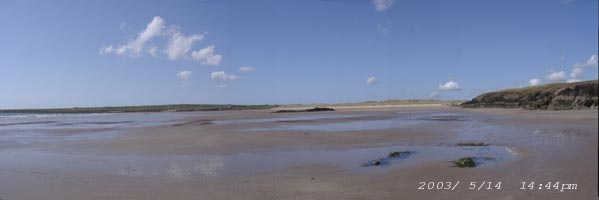 14th: With some clear sky overnight it was cool with minimums 5.1C in air and 1.9C on the grass. Sunny at first cloud soon began to build up by 09 GMT with the wind variable but generally still NW'ly. Pressure 1023 mb had risen under the influence of the Atlantic-ridge and was high (1029 mb) in Biscay and low in the North Sea. The morning was mainly cloudy here near the mountains but was clearer to the W. The afternoon was sunnier and more so towards evening when the cloud dispersed leaving frontal cloud low in the W. On reaching Anglesey air from the NW during the day was uplifted over the mountains and formed clouds that streamed down across Wales to Southampton. In the S, with added convection, the clouds grew and there were showers. Along the E coast there was more activity and widespread heavy rain, in East Anglia and the SE, with some thunderstorms. [Rain 0.0 mm; Max 14.3C; Min 5.1C; Grass 1.9C]
 "Met Office chart at 06 GMT on 15 May 2003.")
 "Frontal cloud approaching from SW. After a cloudy morning clear sky ahead of front gave a warm sunny afternoon. NOAA 16 image at 1304 GMT on 15 May 2003.") 15th: With a clear sky overnight temperatures fell (0.6C on the grass) but the wind had backed SW-S'ly and there was no frost. By 09 GMT there was still plenty of blue sky with cirrus but it was becoming cloudier from the SW as frontal cloud approached. Pressure 1022 mb was falling as the high ridge over Scotland (1024 mb) declined. Fronts massing to the W had already brought rain to Pembrokeshire where {30.7 mm} fell at Tenby. Within an hour the morning had become cloudier but by the afternoon with the wind backing S-SE'ly it mostly cleared to give sunshine. The temperature rose to 17.6C with relative humidity down to 46%, lowest of the month, in a Föhn-like wind one of the highest in the UK (Northolt, London 17C). Temperatures at Bangor Harbour and along the North Wales coast were 15C while Valley reported 14C. The rain arrived about 20 GMT and was light to moderate until morning (10.8 h duration). [Rain 16.8 mm; Max 17.6C; Min 4.6C; Grass 0.6C]
15th: With a clear sky overnight temperatures fell (0.6C on the grass) but the wind had backed SW-S'ly and there was no frost. By 09 GMT there was still plenty of blue sky with cirrus but it was becoming cloudier from the SW as frontal cloud approached. Pressure 1022 mb was falling as the high ridge over Scotland (1024 mb) declined. Fronts massing to the W had already brought rain to Pembrokeshire where {30.7 mm} fell at Tenby. Within an hour the morning had become cloudier but by the afternoon with the wind backing S-SE'ly it mostly cleared to give sunshine. The temperature rose to 17.6C with relative humidity down to 46%, lowest of the month, in a Föhn-like wind one of the highest in the UK (Northolt, London 17C). Temperatures at Bangor Harbour and along the North Wales coast were 15C while Valley reported 14C. The rain arrived about 20 GMT and was light to moderate until morning (10.8 h duration). [Rain 16.8 mm; Max 17.6C; Min 4.6C; Grass 0.6C]
16th: With the rain stopping just before 09 GMT the morning remained overcast. With low (998 mb) W of Ireland pressure 1006 mb was l falling slowly. The day was cloudy with a little rain from time to time. [Rain 0.9 mm; Max 13.3C; Min 8.9C; Grass 7.7C]
17th: Overcast and dull with drizzle and intermittent light rain. Pressure 1000 mb was lower with complex low pressure W of Ireland and much cloud and rain within the system. The day was dismal with drizzle then moderate rain from 11 - 16 GMT; visibility was poor and the temperature not exceeding 12C. It was not the best of starts of the 2-day Anglesey Vintage and Steam Rally being held for the first time at Hen Blas. By evening with the low moving towards W Scotland it was windier f5-6. [Rain 7.7 mm; Max 12.2C; Min 10.3C; Grass 9.7C]
18th: Overcast at dawn it soon turned to blustery showers with a trough crossing from the W. Low (984 mb) was just to the W of the Outer Isles and here was rising at 1000 mb. At 09 GMT it was brighter with the sun breaking through; it was windy SW'ly f6. The day was a mixture of sunshine and blustery showers that died out towards evening. With the strong gusts of wind in the afternoon it was too dangerous to work outside near trees that are now heavy in full leaf. In rough seas a man was lost overboard, and drowned, from a yacht near the island of Skokholm off the Pembrokeshire coast. [Rain 1.1 mm; Max 14.5C; Min 10.1C; Grass 9.5C]
; "Sferics recorded 00 - 23 GMT on 19 May 2003. Courtesy of Georg Mueller at Top Karten.") 19th: At midnight the low (986 mb) had drifted slowly off NW Scotland and this kept the strong SW'ly winds across the UK. By morning the wind was only a little less but had backed SSW'ly f5-6. At 09 GMT pressure was 1002 mb and there were sunny spells between quite dark looking cumulus clouds. The morning was mainly sunny but there was blustery showers and spells of rain in the afternoon. In the Midlands and E there were prolonged thunderstorms with hail in places. Storms on an active cold front tracked SE across Europe during the day and were heavy in Germany and France. Here from 2200 - 0100 GMT there was moderate to heavy rain turning intermittent and light before dawn. [Rain 11.2 mm; Max 13.6C; Min 9.0C; Grass 7.6C]
19th: At midnight the low (986 mb) had drifted slowly off NW Scotland and this kept the strong SW'ly winds across the UK. By morning the wind was only a little less but had backed SSW'ly f5-6. At 09 GMT pressure was 1002 mb and there were sunny spells between quite dark looking cumulus clouds. The morning was mainly sunny but there was blustery showers and spells of rain in the afternoon. In the Midlands and E there were prolonged thunderstorms with hail in places. Storms on an active cold front tracked SE across Europe during the day and were heavy in Germany and France. Here from 2200 - 0100 GMT there was moderate to heavy rain turning intermittent and light before dawn. [Rain 11.2 mm; Max 13.6C; Min 9.0C; Grass 7.6C]
 "Weather chart at 00 GMT on 20 May 2003.") 20th: Overcast and grey but pressure 1010 mb had risen although there seemed little prospect for much improvement. Complex low pressure about 1000 mb to the N was still keeping cloud and rain circulating within it. The wind was W'ly f5 with the temperature 10.2C at 09 GMT rising to 12.5C during the day. The morning was wet with light rain turning intermittent and stopping around 15 GMT. There were 1 or 2 bright spells with a little blue sky but there was no clearance. It was very wet in Snowdonia, with Capel Curig reporting {48.3 mm} and Lake Vyrnwy {31 mm}. The night was mainly cloudy but dry and less windy. [Rain 3.3 mm; Max 12.5C; Min 7.5C; Grass 6.8C]
20th: Overcast and grey but pressure 1010 mb had risen although there seemed little prospect for much improvement. Complex low pressure about 1000 mb to the N was still keeping cloud and rain circulating within it. The wind was W'ly f5 with the temperature 10.2C at 09 GMT rising to 12.5C during the day. The morning was wet with light rain turning intermittent and stopping around 15 GMT. There were 1 or 2 bright spells with a little blue sky but there was no clearance. It was very wet in Snowdonia, with Capel Curig reporting {48.3 mm} and Lake Vyrnwy {31 mm}. The night was mainly cloudy but dry and less windy. [Rain 3.3 mm; Max 12.5C; Min 7.5C; Grass 6.8C]
 "Atlantic-low to W with frontal cloud over UK/ France that brought prolonged rain. NOAA 16 image at 1345 GMT on 21 May 2003.") 21st: A little blue sky at dawn but this had disappeared by 09 GMT. Pressure 1020 mb had risen, with the old low in the Baltic and high (1033 mb) Spain, but a large complex but weak (1000 mb) Atlantic-low had brought frontal rain into the Irish Sea just off the Llyn Peninsular. The morning was overcast with a light SW'ly breeze but began to rain by noon and with low cloud and poor visibility continued the rest of the day. Rainfall, 27.8 mm over 18.8 h, was the wettest 24-h of the month. [Rain 27.8 mm; Max 12.2C; Min 9.2C; Grass 7.3C]
21st: A little blue sky at dawn but this had disappeared by 09 GMT. Pressure 1020 mb had risen, with the old low in the Baltic and high (1033 mb) Spain, but a large complex but weak (1000 mb) Atlantic-low had brought frontal rain into the Irish Sea just off the Llyn Peninsular. The morning was overcast with a light SW'ly breeze but began to rain by noon and with low cloud and poor visibility continued the rest of the day. Rainfall, 27.8 mm over 18.8 h, was the wettest 24-h of the month. [Rain 27.8 mm; Max 12.2C; Min 9.2C; Grass 7.3C]
22nd: It was still raining at dawn and became moderate to heavy by 08 GMT and heavy at 09 GMT. Water was standing on the garden, fields and roads. Low (999 mb) is to the NW with a slow-moving front and an area of heavy rain over North Wales (Llansadwrn {22.8 mm}, Capel Curig {36.8 mm}and Merseyside (Crosby {17.4 mm}that was almost continuous for just over 24-h. Pressure here was 1017 mb and the temperature 11.7C. There was further moderate rain during the morning with another 5 mm accumulated by 12 GMT making it the wettest May on record here since 1928. After fog the afternoon was drier and a little windier but remained overcast before becoming clearer but showery in the night. [Rain 6.3 mm; Max 12.5C; Min 11.2C; Grass 10.8C]
23rd: At midnight low had deepened (996 mb) and moved to just off the Western Isles. At 09 GMT pressure 1006 mb had fallen and it was windier (SW'ly f5) with the ground beginning to dry. It was a sunny but windy day with many passing cumulus clouds that gave a few light showers in the afternoon and into the night. [Rain 0.9 mm; Max 14.5C; Min C; Grass C]
 "Deeply convective clouds around low in the N with edge of frontal cloud in Channel and SE. NOAA 12 image at 1644 GMT on 24 May 2003.") 24th: An overcast and grey start to the day but it soon brightened with towering cumulus clouds developing by 09 GMT. Pressure 1005 mb had risen with low (999 mb) over Scotland. Showers were prevalent over the UK lessening towards the SE where it remained cloudy but dry for the test match at Lords. Here the morning was bright but cumulus and cumulonimbus clouds persisted. The afternoon was mainly sunny with a slight shower before evening and was cloudier overnight. [Rain 1.2 mm; Max 15.6C; Min 9.2C; Grass 7.3C]
24th: An overcast and grey start to the day but it soon brightened with towering cumulus clouds developing by 09 GMT. Pressure 1005 mb had risen with low (999 mb) over Scotland. Showers were prevalent over the UK lessening towards the SE where it remained cloudy but dry for the test match at Lords. Here the morning was bright but cumulus and cumulonimbus clouds persisted. The afternoon was mainly sunny with a slight shower before evening and was cloudier overnight. [Rain 1.2 mm; Max 15.6C; Min 9.2C; Grass 7.3C]
25th: A prolonged shower about 01 GMT and a cloudy start to the day. Pressure 1015 mb continued to rise as a ridge of high pressure advanced from the SW. With the wind still NW'ly cloud persisted but was beginning to disperse by 1030 GMT to give a little sunshine. The afternoon was sunnier and by evening the sky was clear. Later cloud encroached once again from the W but the day remained dry! [Rain 0.0 mm; Max C; Min 9.2C; Grass 8.6C]
26th: Overcast at dawn with some breaks appearing by 09 GMT. Pressure 1020 mb was rising in the ridge from the SW but there was frontal rain over SW Ireland. Visibility was very good but low cloud was hugging the mountaintops and persisted over Anglesey. The day was bright but the cloud did not clear. By evening it was overcast and there was a little light rain. [Rain 2.1 mm; Max 15.6C; Min 7.6C; Grass 5.0C]
 "A dull and grey morning at Beaumaris on 27 May 2003.. Across the Menai Strait low cloud and drizzle on the lower slopes of the mountains.") 27th: Low cloud and drizzle at first with fog around the coasts and lower slopes of the Snowdonia Mountains. Pressure at 0900 GMT was little changed at 1023 mb with low pressure still to the NW. Most of the UK, except East Anglia and N and E Scotland, was covered with low stratiform frontal cloud. Inland it was bright at times in the afternoon with the temperature rising here to 18.2C, but the coastal fringe remained mostly dull. The night was overcast with little wind. [Rain 0.1 mm; Max 18.2C; Min 11.4C; Grass 10.8C]
27th: Low cloud and drizzle at first with fog around the coasts and lower slopes of the Snowdonia Mountains. Pressure at 0900 GMT was little changed at 1023 mb with low pressure still to the NW. Most of the UK, except East Anglia and N and E Scotland, was covered with low stratiform frontal cloud. Inland it was bright at times in the afternoon with the temperature rising here to 18.2C, but the coastal fringe remained mostly dull. The night was overcast with little wind. [Rain 0.1 mm; Max 18.2C; Min 11.4C; Grass 10.8C]
28th: Another overcast dawn and a slight shower at 09 GMT. Pressure 1024 mb little changed with weak low (1000 mb) seemingly anchored to the NW. Pressure was high (1029 mb) in the North Sea with persistent cloud in between and patchy rain in Ireland and the Irish Sea up to SW Scotland. The morning was bright with the stratocumulus cloud dispersing into altocumulus in a light S'ly. In the afternoon the sky almost cleared overhead and it was sunny with a maximum of 20.5C. Later it turned cloudier and there were some slight showers after midnight. [Rain 0.2 mm; Max 20.5C; Min 10.2C; Grass 9.0C]
 "Thick cloud in the Irish Sea produced showers during the day mainly offshore. Fragmenting in the N with orographic waves, sunnier in ther S. NOAA 12 image at 1622 GMT on 29 May 2003.") 29th: Pressure was 1020 mb with low (998 mb) NE of Iceland. There was a trough, with showers in the Irish Sea that was keeping Anglesey cloudy, with a few spots of rain on the W coast. The morning was occasionally bright with a light NE'ly breeze. The afternoon was sunny before turning thinly overcast by evening and through the night. [Rain 0.0 mm; Max 20.0C; Min 11.8C; Grass 10.2C]
29th: Pressure was 1020 mb with low (998 mb) NE of Iceland. There was a trough, with showers in the Irish Sea that was keeping Anglesey cloudy, with a few spots of rain on the W coast. The morning was occasionally bright with a light NE'ly breeze. The afternoon was sunny before turning thinly overcast by evening and through the night. [Rain 0.0 mm; Max 20.0C; Min 11.8C; Grass 10.2C]
30th: A sunny day although with thick smoke/dust haze the sky had a very milky appearance and visibility was only poor. At 09 GMT the temperature was 21.2C and this went on to rise to a humid (RH 58%) 24.8C, the warmest of the month. [Rain 0.0 mm; Max 24.8C; Min 14.0C; Grass 11.5C]
31st: A fine start to the day with warm sunshine, the sky still looked milky in the smoke/dust haze. There had been a slight dry deposit of fine light-coloured dust over the past 24-h. But by 07 GMT low cloud with thick fog had enveloped the island. By 09 GMT visibility was very poor with occasional fine drizzle that was slow to clear on the W coast. During the morning further clearance here brought a little sunshine from time to time and more in the afternoon and evening. It was windy SW'ly f5. [Rain trace; Max 18.0C; Min 13.0C; Grass 10.9C]
1st: Bright with hazy sunshine to start the day. Pressure 1008 mb had continued to fall slowly. The day was mainly sunny and with a f3 S'ly wind the temperature reached 21.4C. By late afternoon frontal cloud encroached from the W and there was intermittent light rain from 19 - 04 GMT. [Rain 3.8 mm; Max 21.4C; Min 9.9C; Grass 7.0C]
2nd: A bright start with the sky clearing after the cold front had passed eastwards but it soon turned showery. Pressure 1006 mb was rising a little with low (986 mb) to the W of Ireland. Pressure (1021 mb) was high in the Baltic. The morning was showery and the afternoon became sunny but windy. By evening the sky was clear but soon became overcast as frontal cloud moved over from the SW. [Rain trace; Max 17.5C; Min 10.3C; Grass 9.4C]
 "Low off Brest tracking N up the Irish Sea. Note fronts on which next day's low formed already off Iberia. Met Office chart at 06 GMT on 3 June 2003.") 3rd: Almost overcast at dawn with some orographic waves clouds as the wind was light SE'ly. With the low (990 mb) still to the NW pressure 1007 mb was falling as a small low on a frontal wave (997 mb) off Brest tracked NE during the day. This brought a large area of rain to S Ireland, the Irish Sea and towards Snowdonia. The morning became duller for a while as cloud thickened but was still dry when after noon, in a lee-clearance over the Menai Strait, there were bright spells with a maximum of 18.8C. Later the afternoon and night were mostly cloudy but it did not rain! The rain tracking N gave us a miss this time (rain sometimes seen on radar images evaporates before reaching the ground). [Rain 0.0 mm; Max 18.8C; Min 10.5C; Grass 8.1C]
3rd: Almost overcast at dawn with some orographic waves clouds as the wind was light SE'ly. With the low (990 mb) still to the NW pressure 1007 mb was falling as a small low on a frontal wave (997 mb) off Brest tracked NE during the day. This brought a large area of rain to S Ireland, the Irish Sea and towards Snowdonia. The morning became duller for a while as cloud thickened but was still dry when after noon, in a lee-clearance over the Menai Strait, there were bright spells with a maximum of 18.8C. Later the afternoon and night were mostly cloudy but it did not rain! The rain tracking N gave us a miss this time (rain sometimes seen on radar images evaporates before reaching the ground). [Rain 0.0 mm; Max 18.8C; Min 10.5C; Grass 8.1C]
 "Low vortex near Lands End with rain clouds in the W and E. NOAA 16 image at 1249 GMT on 4 June 2003.") 4th: If up at 0430 GMT you would have seen some sunshine, but by 08 GMT it was cloudier. The days maximum of 14.1C was soon after 09 GMT and was the lowest of the month. It was a repeat run with the formation of another low (1002 mb) on a frontal wave that was off Brest moving to near Lands End by 13 GMT. This time the associated area of rain was over the Irish Sea and Wales with light rain here from 1100 GMT. Another rain area moved over the Channel, London and E Midlands. The rain continued here becoming moderate until 1400 GMT when it turned showery until 1900 GMT. The night was mainly overcast but dry. [Rain 5.8 mm; Max 14.1C; Min 9.9C; Grass 8.4C]
4th: If up at 0430 GMT you would have seen some sunshine, but by 08 GMT it was cloudier. The days maximum of 14.1C was soon after 09 GMT and was the lowest of the month. It was a repeat run with the formation of another low (1002 mb) on a frontal wave that was off Brest moving to near Lands End by 13 GMT. This time the associated area of rain was over the Irish Sea and Wales with light rain here from 1100 GMT. Another rain area moved over the Channel, London and E Midlands. The rain continued here becoming moderate until 1400 GMT when it turned showery until 1900 GMT. The night was mainly overcast but dry. [Rain 5.8 mm; Max 14.1C; Min 9.9C; Grass 8.4C]
5th: Overcast and grey at dawn but brightening by 0900 GMT. Pressure 1015 mb was rising in a minor ridge over the UK. But Atlantic-low (985 mb) W of Ireland had associated fronts approaching from the SW. The morning was bright with some glimpses of sunshine but the afternoon was cloudier with the SSW'ly wind freshening to force 4-5. By evening the wind was a blustery force 7 with rain showers then intermittent rain from midnight. [Rain 1.6 mm; Max C; Min 10.4C; Grass 10.0C]
 "Weather chart at 00 GMT on 6 June 2003.") 6th: Low (982 mb) was to the NW with pressure here 1012 mb at 0900 GMT. An occluded front was over Wales and the South West, it was overcast but the rain had stopped leaving low cloud and mist on the lower slopes of the mainland mountains and around the coast. The wind was SSW'ly force 4 - 5 The day was mainly cloudy but gradually the sky cleared from the W in the afternoon to give a sunny evening. The night was mainly clear. [Rain 0.0 mm; Max 16.8C; Min 12.2C; Grass 11.2C]
6th: Low (982 mb) was to the NW with pressure here 1012 mb at 0900 GMT. An occluded front was over Wales and the South West, it was overcast but the rain had stopped leaving low cloud and mist on the lower slopes of the mainland mountains and around the coast. The wind was SSW'ly force 4 - 5 The day was mainly cloudy but gradually the sky cleared from the W in the afternoon to give a sunny evening. The night was mainly clear. [Rain 0.0 mm; Max 16.8C; Min 12.2C; Grass 11.2C]
 "An immigrant painted lady butterfly feeding on Causican crosswort (Phuopsis stylosa) at the weather station on 7 June 2003.") 7th: A sunny start with a moderate breeze (S f4) but was becoming cloudier by 0830 GMT. Pressure was 1013 mb with low (990 mb) SSW of Iceland. Frontal cloud, with some rain, was over Ireland but edging NE and dying out. The day was mostly sunny but frontal cloud approached from the SW and brought light to moderate rain by 02 GMT. In the S and SE some thunderstorms were triggered. A painted lady butterfly was seen in the garden. An immigrant from Africa and probably made the journey here assisted by the S'ly winds of recent days. [Rain 4.9 mm; Max 18.6C; Min 10.5C; Grass 8.2C]
7th: A sunny start with a moderate breeze (S f4) but was becoming cloudier by 0830 GMT. Pressure was 1013 mb with low (990 mb) SSW of Iceland. Frontal cloud, with some rain, was over Ireland but edging NE and dying out. The day was mostly sunny but frontal cloud approached from the SW and brought light to moderate rain by 02 GMT. In the S and SE some thunderstorms were triggered. A painted lady butterfly was seen in the garden. An immigrant from Africa and probably made the journey here assisted by the S'ly winds of recent days. [Rain 4.9 mm; Max 18.6C; Min 10.5C; Grass 8.2C]
 "A clearing sky over NW Anglesey in the afternoon of 8 June 2003. View is looking across the A55 from near Capel Mawr towards Holyhead Mountain some 14 miles away.") 8th: A gloomy grey dawn with intermittent light rain of drizzle. At first there was little or no wind but by 09 GMT there was a force 2 SW'ly. Pressure 1008 mb had fallen with a small low, on a frontal wave over Wales, within the influence of low (990 mb) anchored SW of Iceland. There was a narrow line of heavy rain on trough affecting the SW. The morning was dull with a little rain at times but was brightening by noon and became sunny in the afternoon. The painted lady butterfly in the garden was joined today by a red admiral, another immigrant from Africa. The night was mainly clear.[Rain 0.1 mm; Max 17.3C; Min 11.1C; Grass 9.0C]
8th: A gloomy grey dawn with intermittent light rain of drizzle. At first there was little or no wind but by 09 GMT there was a force 2 SW'ly. Pressure 1008 mb had fallen with a small low, on a frontal wave over Wales, within the influence of low (990 mb) anchored SW of Iceland. There was a narrow line of heavy rain on trough affecting the SW. The morning was dull with a little rain at times but was brightening by noon and became sunny in the afternoon. The painted lady butterfly in the garden was joined today by a red admiral, another immigrant from Africa. The night was mainly clear.[Rain 0.1 mm; Max 17.3C; Min 11.1C; Grass 9.0C]
 "Weather chart at 12 GMT on 9 June 2003 showing heavy rain over SW Ireland.")
 "Weather chart at 00 GMT on 10 June 2003 showing spread of rain NE and strong winds in the W.") 9th: A mostly clear sky at dawn but thin cloud soon encroached. At 09 GMT pressure was 1016 mb in a weakening ridge extending from high (1012 mb) France; the wind S'ly f2 backed SSE'ly later. The sun was shining weakly through the thin cloud but thicker cumulus clouds were appearing in the W. Complex low pressure was to the W of Ireland and rain on a warm front had already moved into St George's Channel and affecting Cork {28 mm} and Valentia {55 mm}. Here the morning remained bright and dry but with falling pressure in the afternoon there was intermittent light rain. We escaped any large falls of rain being in rain-shadow of the Snowdonia mountains. During the evening and night the wind veering S'ly again and strengthened to near gale force 7. [Rain 2.7 mm; Max 17.8C; Min 10.5C; Grass 9.1C]
9th: A mostly clear sky at dawn but thin cloud soon encroached. At 09 GMT pressure was 1016 mb in a weakening ridge extending from high (1012 mb) France; the wind S'ly f2 backed SSE'ly later. The sun was shining weakly through the thin cloud but thicker cumulus clouds were appearing in the W. Complex low pressure was to the W of Ireland and rain on a warm front had already moved into St George's Channel and affecting Cork {28 mm} and Valentia {55 mm}. Here the morning remained bright and dry but with falling pressure in the afternoon there was intermittent light rain. We escaped any large falls of rain being in rain-shadow of the Snowdonia mountains. During the evening and night the wind veering S'ly again and strengthened to near gale force 7. [Rain 2.7 mm; Max 17.8C; Min 10.5C; Grass 9.1C]
10th: The winds had eased but left leaves and many small developing horse chestnut seeds on the ground. With complex low pressure still to the W pressure 1003 mb at 09 GMT was falling slowly with the wind a fresh f5 S'ly. Soon after there was a moderate blustery shower then some slight before dying out by noon. The afternoon was mainly sunny, the wind remained fresh to strong, before becoming cloudier during the night. [Rain 0.9 mm; Max 17.2C; Min 12.2C; Grass 10.6C]
11th: Cloud was clearing to give a sunny start. Some well developed cumulus clouds were to the S over the mountains but overhead altocumulus was dispersing revealing cirrus above. Pressure 1015 mb was rising under the influence of high (1021 mb) France to Mediterranean. But with complex low pressure still to the NW the weather continues unsettled. The wind SW'ly force 3 and visibility good. The day was mainly sunny with the wind freshening force 5-6 in the afternoon and was cloudier later. The night was cloudy with the wind moderating. [Rain 0.1 mm; Max 18.0C; Min 11.0C; Grass 10.0C]
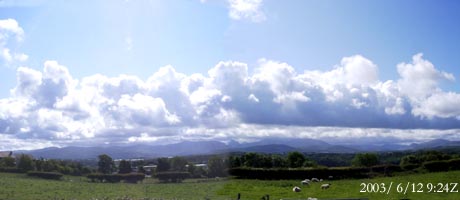
 "Line of orographic cumulus over Snowdonia persisted into the afternoon. Note smooth base on the right (westward) and disturbed base left (eastward) of the Nant Ffrancon pass. NOAA 16 image at 1259 GMT on 12 June 2003.") 12th: Overcast at dawn soon broke up with a little sunshine but cumulus clouds developed, and towered over Snowdonia, and gave a slight shower before 09 GMT. Pressure 1017 mb was rising very slowly as high (1024 mb) to the SW building. Low pressure (1001 mb) to the W of Scotland was declining. At 0924 GMT the cumulus clouds had diminished somewhat but remained in a linear orographic form through the day. Note smooth base on the right (westward) and disturbed base left (eastward) of the Nant Ffrancon Pass. The wind direction was SSW force force 4 - 5 at first. The sky cleared over Anglesey giving a sunny day but the wind again freshened to SSW force 5-6 by the afternoon. The evening was mainly clear but, preceded by some banded cirrus, became mostly cloudy by 20 GMT. [Rain 0.0 mm; Max 17.8C; Min 11.3C; Grass 9.5C]
12th: Overcast at dawn soon broke up with a little sunshine but cumulus clouds developed, and towered over Snowdonia, and gave a slight shower before 09 GMT. Pressure 1017 mb was rising very slowly as high (1024 mb) to the SW building. Low pressure (1001 mb) to the W of Scotland was declining. At 0924 GMT the cumulus clouds had diminished somewhat but remained in a linear orographic form through the day. Note smooth base on the right (westward) and disturbed base left (eastward) of the Nant Ffrancon Pass. The wind direction was SSW force force 4 - 5 at first. The sky cleared over Anglesey giving a sunny day but the wind again freshened to SSW force 5-6 by the afternoon. The evening was mainly clear but, preceded by some banded cirrus, became mostly cloudy by 20 GMT. [Rain 0.0 mm; Max 17.8C; Min 11.3C; Grass 9.5C]
13th: Mist in the Menai Strait at 0330 GMT soon cleared but the start of the day was overcast. The cloud began to break-up and had formed well-developed cumulus clouds, mainly over Snowdonia but, overhead here at times. Pressure 1024 mb continued to rise with small area of high pressure (1025 mb) Devon. The day was mainly sunny with the sky clearing over most of Anglesey in the afternoon. Some cloud remained over Snowdonia and thin high cloud associated with a thundery trough in St George's Channel encroached by evening. [Rain 0.0 mm; Max 19.2C; Min 10.1C; Grass 7.3C]
14th: It was still cloudy when blackbirds and thrushes started to sing at dawn near 03 GMT. But by 08 GMT a clearance from the W brought deep blue skies. At 09 GMT pressure 1024 mb was unchanged and the temperature [17.5C rising quickly. The morning was sunny, with a very light NE'ly breeze, with just a little cloud to the S still dispersing. The afternoon was mainly sunny, with the maximum reaching 20.2C, before coming overcast in the night. [Rain 0.0 mm; Max 20.2C; Min 11.3C; Grass 9.7C]
 "Low to NW with frontal cloud W of Ireland. Deep convective clouds over Spain. NOAA 16 image at 1406 GMT on 15 June 2003.")
 "Sea breeze front developed in the afternnon lying NW - SE across Anglesey. View looking NE up Cefni Estuary at 1425 GMT on 15 June 2003.") 15th: Overcast skies at dawn but cloud beginning to disperse in the morning leaving thin high cloud. Pressure 1024 mb unchanged near centre of high North Wales. The day was sunny at times, especially on the W coast. With breezes from NE and SW in the afternoon cloud developed on a sea breeze front in the afternoon. Later the breezes dropped and sky cleared to give a clear night. [Rain 0.0 mm; Max 18.5C; Min 10.5C; Grass 6.7C]
15th: Overcast skies at dawn but cloud beginning to disperse in the morning leaving thin high cloud. Pressure 1024 mb unchanged near centre of high North Wales. The day was sunny at times, especially on the W coast. With breezes from NE and SW in the afternoon cloud developed on a sea breeze front in the afternoon. Later the breezes dropped and sky cleared to give a clear night. [Rain 0.0 mm; Max 18.5C; Min 10.5C; Grass 6.7C]
 "Cloud over Snowdonia (bird cloud?) with milky white sky because of dust plume on 16 June 2003. View S towards Yr Wyddfa from Bwrdd Arthur.") 16th: A clear start to the day and with overnight temperature on the grass of 5.8C there was moderate dew. The sky was almost clear and blue, with only slight smoke haze on the horizon, at 09 GMT. The morning was sunny and warm the temperature rising from 17.4C in a slight NNE'ly breeze at first. Later the wind was S - SW'ly, overcoming the cool breeze off the sea, and the temperature rose to 23.9C in the afternoon, highest of the month, with a relative humidity of 54% that was the lowest. There was no sea breeze cloud formation over Anglesey as yesterday. There was some over Snowdonia and later in the day frontal cloud encroached from the W. In the afternoon the sky became increasingly milky, obscuring cirrus clouds, as a dust plume originating in north Africa moved across. Thunder storms worked their way N along the W of France during the day reaching Cornwall before midnight. [Rain 0.0 mm; Max 23.9C; Min 9.7C; Grass 5.8C]
16th: A clear start to the day and with overnight temperature on the grass of 5.8C there was moderate dew. The sky was almost clear and blue, with only slight smoke haze on the horizon, at 09 GMT. The morning was sunny and warm the temperature rising from 17.4C in a slight NNE'ly breeze at first. Later the wind was S - SW'ly, overcoming the cool breeze off the sea, and the temperature rose to 23.9C in the afternoon, highest of the month, with a relative humidity of 54% that was the lowest. There was no sea breeze cloud formation over Anglesey as yesterday. There was some over Snowdonia and later in the day frontal cloud encroached from the W. In the afternoon the sky became increasingly milky, obscuring cirrus clouds, as a dust plume originating in north Africa moved across. Thunder storms worked their way N along the W of France during the day reaching Cornwall before midnight. [Rain 0.0 mm; Max 23.9C; Min 9.7C; Grass 5.8C]
; "Sferics recorded 00 - 23 GMT on 17 June 2003. Courtesy of Georg Mueller at Top Karten.") 17th: Thunderstorms affected NE Wales after midnight (not here) before moving on to Cumbria and to the E coast. Later the SE (where property was struck by lightning) and much of Europe from France eastwards and Italy, Greece and north Africa. Here a mainly cloudy start to the day but it remained dry despite passage eastwards of the front. There was some rain over S Snowdonia. Pressure 1012 mb had been falling very slowly but started to rise a little during the morning. There was a slight dry deposit of light-coloured dust likely to have come from north Africa. The morning was bright at times but, with the wind W-NW'ly, kept orographic cloud over this SE part of Anglesey. In the afternoon, after several sunny and warmer spells, the wind backed SW'ly and the sky cleared (was back to blue) giving a sunny end to the day, but it was different by morning. [Rain 4.1 mm; Max 21.0C; Min 12.9C; Grass 10.8C]
17th: Thunderstorms affected NE Wales after midnight (not here) before moving on to Cumbria and to the E coast. Later the SE (where property was struck by lightning) and much of Europe from France eastwards and Italy, Greece and north Africa. Here a mainly cloudy start to the day but it remained dry despite passage eastwards of the front. There was some rain over S Snowdonia. Pressure 1012 mb had been falling very slowly but started to rise a little during the morning. There was a slight dry deposit of light-coloured dust likely to have come from north Africa. The morning was bright at times but, with the wind W-NW'ly, kept orographic cloud over this SE part of Anglesey. In the afternoon, after several sunny and warmer spells, the wind backed SW'ly and the sky cleared (was back to blue) giving a sunny end to the day, but it was different by morning. [Rain 4.1 mm; Max 21.0C; Min 12.9C; Grass 10.8C]
 "Frontal cloud (and rain) moving E. Lee clearance (and orographic waves) gave quite a nice day to those in the lee of the Welsh Mountains. NOAA 16 image at 1333 GMT on 18 June2003.") 18th: With low (986 mb) near western Scotland pressure here 1012 mb was falling at 09 GMT. With tightening isobars the S'ly wind was force 5 - 6. Rain, on associated fronts lying over Ireland and the Irish Sea, reached here at 0630 GMT and became moderate to heavy around 09 GMT. It was windy with the SSW'ly reaching force 6 - 7 tearing leaves and twigs off the nearby trees. The rest of the day kept overcast here with the wind gradually moderating. In the lee of the Welsh Mountains, in Merseyside and along the Marches, it was quite a nice day! [Rain 5.3 mm; Max 14.2C; Min 11.7C; Grass 9.7C]
18th: With low (986 mb) near western Scotland pressure here 1012 mb was falling at 09 GMT. With tightening isobars the S'ly wind was force 5 - 6. Rain, on associated fronts lying over Ireland and the Irish Sea, reached here at 0630 GMT and became moderate to heavy around 09 GMT. It was windy with the SSW'ly reaching force 6 - 7 tearing leaves and twigs off the nearby trees. The rest of the day kept overcast here with the wind gradually moderating. In the lee of the Welsh Mountains, in Merseyside and along the Marches, it was quite a nice day! [Rain 5.3 mm; Max 14.2C; Min 11.7C; Grass 9.7C]
19th: There was thick hill fog at 0430 GMT that only slowly improved to very poor visibility at 09 GMT. Pressure 1019 mb was rising with elongated high (1029 mb) Biscay and low (985 mb) well N of Scotland. Slow-moving frontal wave was lying E - W near Birmingham. The morning was dull and rather damp at 14.4C and 97% relative humidity and a little drizzle. At noon the temperature began a fast 5C rise to the maximum of 19.0C before falling slowly through the afternoon with clearing skies. The night mostly clear at first became overcast after midnight. [Rain trace; Max 19.0C; Min 13.0C; Grass 12.3C]
 "Orographic wave clouds in Cardigan Bay and North Wales. NOAA 16 image at 1311 GMT on 20 June 2003.") 20th: A clear sky led to a minimum of 8.5C and 5.3C on the grass, both lowest of the month. But with cloud at dawn it was warmer and reached 14.2C at 09 GMT. Pressure 1023 mb had risen with high (1027 mb) to the SW centred on St George's Channel. Cloud was breaking up and forming cumulus that remained through the morning. The wind was W'ly force 3 - 4 at first reduced during the day. By the afternoon orographic cloud kept SE Anglesey dull, with a few spots of drizzle seen, until evening. The SW and NW of the island were largely sunny, but did have thin medium to high cloud later before clearing to give a clear night, with twilight until past 22 GMT. [Rain trace; Max 16.9C; Min 8.5C; Grass 5.3C]
20th: A clear sky led to a minimum of 8.5C and 5.3C on the grass, both lowest of the month. But with cloud at dawn it was warmer and reached 14.2C at 09 GMT. Pressure 1023 mb had risen with high (1027 mb) to the SW centred on St George's Channel. Cloud was breaking up and forming cumulus that remained through the morning. The wind was W'ly force 3 - 4 at first reduced during the day. By the afternoon orographic cloud kept SE Anglesey dull, with a few spots of drizzle seen, until evening. The SW and NW of the island were largely sunny, but did have thin medium to high cloud later before clearing to give a clear night, with twilight until past 22 GMT. [Rain trace; Max 16.9C; Min 8.5C; Grass 5.3C]
 "Deep convection developed in medium level clouds over Wales and the NW. NOAA 12 image (Ch2+5) at 1523 GMT on 21 June 2003.") 21st: High Cardigan Bay was (1023 mb) at midnight. Thin medium level cloud had returned making the solstice dawn, soon after 0330 GMT, dull. But the morning was bright, with the sun just visible through the cloud, with little or no wind. In the afternoon the cloud, although still well above the mountaintops, had developed instability and thickened. There was light rain, some in heavy drops, between 1430 - 1700 GMT. In the rain there was a slight to moderate deposition of grey coloured dust, that had orangy-red overtones, likely to have had a north African origin. There have been high temperatures (40C+) in parts of S Europe in the last weeks. Today, in France, Mont de Marsan had 39.9°C, Bordeaux 38.5°C, Toulouse 37.8C and Perpignan had 36.8C. Here during the day we had only 16.8C! The night was cloudy. [Rain 0.7 mm; Max 20.6C; Min 9.5C; Grass 6.0C]
21st: High Cardigan Bay was (1023 mb) at midnight. Thin medium level cloud had returned making the solstice dawn, soon after 0330 GMT, dull. But the morning was bright, with the sun just visible through the cloud, with little or no wind. In the afternoon the cloud, although still well above the mountaintops, had developed instability and thickened. There was light rain, some in heavy drops, between 1430 - 1700 GMT. In the rain there was a slight to moderate deposition of grey coloured dust, that had orangy-red overtones, likely to have had a north African origin. There have been high temperatures (40C+) in parts of S Europe in the last weeks. Today, in France, Mont de Marsan had 39.9°C, Bordeaux 38.5°C, Toulouse 37.8C and Perpignan had 36.8C. Here during the day we had only 16.8C! The night was cloudy. [Rain 0.7 mm; Max 20.6C; Min 9.5C; Grass 6.0C]
 "Deep convective clouds from Biscay generate storms along Channel coasts of England and France. NOAA 12 image at 1638 GMT on 22 June 2003.")
; "Sferics recorded 00 - 23 GMT on 22 June 2003. Courtesy of Georg Mueller at Top Karten.") 22nd: A cloudy start but just before 09 GMT the sky almost cleared and, in a force 3 S'ly, the temperature rose to a warm 20.6C. Quite a contrast to yesterday, but it had to be credited to the 21st as readings are for the 24-h 09 - 09 GMT. With complex low pressure over western Britain pressure here had fallen but was steady on 1004 mb. The sunshine and warmth did not last as the cloudiness soon returned. Several thunderstorms were reported from Cumbria and SW England during the morning. These spread E along the Channel coasts of England, and later France, during the day with several (I saw 4) further storm-waves on almost the same track. By afternoon here there was a little light rain or drizzle, and it was blustery at times, but the amount of rainfall was unmeasureable. The night was cloud but dry. [Rain trace; Max 21.0 C; Min 12.7C; Grass 10.4C]
22nd: A cloudy start but just before 09 GMT the sky almost cleared and, in a force 3 S'ly, the temperature rose to a warm 20.6C. Quite a contrast to yesterday, but it had to be credited to the 21st as readings are for the 24-h 09 - 09 GMT. With complex low pressure over western Britain pressure here had fallen but was steady on 1004 mb. The sunshine and warmth did not last as the cloudiness soon returned. Several thunderstorms were reported from Cumbria and SW England during the morning. These spread E along the Channel coasts of England, and later France, during the day with several (I saw 4) further storm-waves on almost the same track. By afternoon here there was a little light rain or drizzle, and it was blustery at times, but the amount of rainfall was unmeasureable. The night was cloud but dry. [Rain trace; Max 21.0 C; Min 12.7C; Grass 10.4C]
 "Cloud beginning to encroach from the W on 23 June 2003. View is looking S from Twr Ellin, near South Stack NW Anglesey, with Llyn Peninsular just visible on horizon left.")
 "View looking NW from South Stack towards the lighthouse with encroaching cloud.") 23rd: A large area of rain moved up from the S in the early hours and affected the Midlands before moving into the North Sea. A cloudy dawn but before 08 GMT there were holes appearing giving a little sunshine. At 09 GMT pressure 1008 mb was rising as ridge (1019 mb) built to the SW; there was a light NW'ly breeze with a temperature of 15.3C (80% RH). The morning was bright with orographic cloud over this part of the island. To the W and NW of the island it was sunnier with cloud only encroaching later in the afternoon. A mostly cloudy but dry night. [Rain 0.0 mm; Max 18.8C; Min 12.3C; Grass 9.8C]
23rd: A large area of rain moved up from the S in the early hours and affected the Midlands before moving into the North Sea. A cloudy dawn but before 08 GMT there were holes appearing giving a little sunshine. At 09 GMT pressure 1008 mb was rising as ridge (1019 mb) built to the SW; there was a light NW'ly breeze with a temperature of 15.3C (80% RH). The morning was bright with orographic cloud over this part of the island. To the W and NW of the island it was sunnier with cloud only encroaching later in the afternoon. A mostly cloudy but dry night. [Rain 0.0 mm; Max 18.8C; Min 12.3C; Grass 9.8C]
 "Warm with hazy sunshine on Anglesey on 24 June 2003. View is of Ynys Llanddwyn and beyond Yr Eifl on the Llyn Peninsular with flowering marram grass on the dunes.")
 "The small-scale vortex of cloud in the Bristol Channel is unusual within a high-pressure system. NOAA 12 image at 1549 GMT on 24 June 2003.") 24th: With the sky clearing slowly from the W it was to be a sunny and warm day. Pressure had risen to 1020 mb as high pressure moved in from the SW. It kept warm into the evening enabling work in the garden to continue until late. A mostly clear night followed. [Rain 0.0 mm; Max 19.2C; Min 12.2C; Grass 11.4C]
24th: With the sky clearing slowly from the W it was to be a sunny and warm day. Pressure had risen to 1020 mb as high pressure moved in from the SW. It kept warm into the evening enabling work in the garden to continue until late. A mostly clear night followed. [Rain 0.0 mm; Max 19.2C; Min 12.2C; Grass 11.4C]
25th: There was heavy dew on the grass by morning but with the sun up it was drying off before 09 GMT. There was much high cirrus cloud overhead with patches of cirrostratus to the S. Pressure remained steady on 1020 mb although the high pressure centre had moved out into the North Sea. It was a warm day in the hazy sunshine with the maximum reaching 23.2C here and 25C at Colwyn Bay. Some patchy medium level cloud passed by during the day and cumulus weakly built up over the Snowdonia Mountains and to the E but it did not rain until after midnight. There were large thunderstorms over Biscay, Channel Islands and Channel , Brittany and the Massif Centrale during the day. Parts of Greece and countries bordering the NE Mediterranean were also affected. [Rain 0.5 mm; Max 23.2C; Min 9.3C; Grass 7.0C]
26th: A shower of rain at 0045 GMT amounted to 0.5 mm but soil did not look wet in the morning. Concrete was damp while grass was slightly wet. Such a small amount of rain would have a negligible effect on soil water balance. Overnight from, 20 GMT, there was 0.2 mm potential evapotranspiration; at 09 GMT the net effect of the shower was 0.3 mm. In the sunshine that would rapidly evaporate continuing the net water soil from the soil. Pressure 1017 mb had fallen with high (1025 mb) now in the Norwegian Sea. Low (991 mb) SE Greenland had fronts to the W of Ireland. There was some rain on a warm front SW Ireland and was expected to move eastwards later. Thundery weather, associated with low over NE France, was still affecting the Channel and central France in the early hours. Mostly cloudy at first it became a bit sunnier and warm at times, maximum 22.4C, with variable cloud amounts and thickness. There was a slight shower around 22 GMT. [Rain 8.1 mm; Max 22.4C; Min 13.8C; Grass 11.6C]
27th: There was rain from 0330 GMT, slight at first becoming moderate with a short heavy spell at 06 GMT. It was still raining at 09 GMT, when 8.1 mm had accumulated, and continued a while longer after. The overnight minimum of 14.4C was the warmest of the month. Cloudy and dull until mid-afternoon when there was a little brightness but no clearance came. There were some clearer spells at night before turning overcast by dawn. [Rain 1.1 mm; Max 17.5C; Min 14.4C; Grass 13.5C]
¤
 "Upper level vortex over N England keeps finger of cloud across Anglesey and UK. NOAA 12 image at 1552 GMT on 28 June 2003.") 28th: A dull start to the day, with low to moderately high cloud, with little or no wind but visibility was good. Pressure was 1016 mb with a minor ridge of high pressure over Wales from that centred near Brittany (1019 mb). Low (990 mb), that will dominate the weather for the next days, was W of Ireland tracking slowly SE. An associated slow-moving warm front had rain on it just off the Irish W coast. There was some patchy rain over Scotland otherwise it was dry. The day remained dull, with an upper vortex over northern England keeping a finger of cloud across the middle of the UK. Some breaks appeared in the cloud around 17 GMT but the evening and night kept mostly overcast. [Rain 0.0 mm; Max 17.6C; Min 10.4C; Grass 6.4C]
28th: A dull start to the day, with low to moderately high cloud, with little or no wind but visibility was good. Pressure was 1016 mb with a minor ridge of high pressure over Wales from that centred near Brittany (1019 mb). Low (990 mb), that will dominate the weather for the next days, was W of Ireland tracking slowly SE. An associated slow-moving warm front had rain on it just off the Irish W coast. There was some patchy rain over Scotland otherwise it was dry. The day remained dull, with an upper vortex over northern England keeping a finger of cloud across the middle of the UK. Some breaks appeared in the cloud around 17 GMT but the evening and night kept mostly overcast. [Rain 0.0 mm; Max 17.6C; Min 10.4C; Grass 6.4C]
 "Large mature Atlantic-low brings frontal rain by midnight. NOAA 16 image at 1451 GMT on 29 June 2003.") 29th: Some orographic cloud bands to the S early that merged later before starting to disperse at 09 GMT. Becoming bright and sunny with the maximum for the past 24-h 17.6C. Pressure was 1010 mb with low (991 mb) SW of Ireland. Rain was over SW Ireland on a slow-moving occluded front; isobars were tighter and the E'ly wind was freshening f2-3. The day became sunny with high cirrus clouds and a maximum of 20.2C, the wind backing NE'ly rising to f6 in the afternoon tore many leaves from the trees and littering the ground. The band of rain reached St David's Head in Pembrokeshire by 17 GMT and here by 02 GMT soon becoming moderate. [Rain 20.5 mm; Max 20.2C; Min 11.9C; Grass 10.7C]
29th: Some orographic cloud bands to the S early that merged later before starting to disperse at 09 GMT. Becoming bright and sunny with the maximum for the past 24-h 17.6C. Pressure was 1010 mb with low (991 mb) SW of Ireland. Rain was over SW Ireland on a slow-moving occluded front; isobars were tighter and the E'ly wind was freshening f2-3. The day became sunny with high cirrus clouds and a maximum of 20.2C, the wind backing NE'ly rising to f6 in the afternoon tore many leaves from the trees and littering the ground. The band of rain reached St David's Head in Pembrokeshire by 17 GMT and here by 02 GMT soon becoming moderate. [Rain 20.5 mm; Max 20.2C; Min 11.9C; Grass 10.7C]
30th: Continuous moderate rain led to 20.5 mm accumulated by 0900 GMT, the wettest day of the month. But at Red Wharf Bay 54.6 mm had fallen. Observer Keith Ledson reported very heavy rain 'falling like stair rods' between 05 - 07 GMT. Pentraeth AWS reported 42.5 mm with a maximum rate of more than 9.8 mm per hour just after 06 GMT. Abergwyngregin had only 10 mm while valley reported 21.5 mm, similar to here. Pressure 1002 mb had fallen but the wind had dropped and the NE'ly was again light f1. With visibility poor, and 100% relative humidity, the rain became light by 10 GMT but turned heavier again for a while. The rain, that accumulated as further 7.2 mm, stopped soon after 13 GMT becoming bright for a while late in the afternoon into the evening. At 2100 GMT shallow mist was forming on the fields. [Rain 8.8 mm; Max 17.2C; Min 12.5C; Grass 11.3C]
 "The burnet rose was in full flower in the hedgerows around Llansadwrn on 1 July 2003 was being visited by bees.") 1st: Shallow fog at times in the early hours with light rain from 0700 GMT, a further 1.6 mm. The overnight minimum of 9.2C was the coolest of the month and the only <10C. At 0900 GMT with pressure 1000 mb, and a slow-moving occluded front over Anglesey, there was little (N'ly) or no wind and visibility was still very poor in light rain. This turned to heavy drizzle later. By afternoon it was brighter and, although there was some convective cloud development to the SW that soon dispersed, there was a little sunshine. Most of the baled grass has been taken off the fields and 'muck spreading' was taking place on the yellowed aftermath. I saw 4 spreaders being worked around the village. In other fields autumn sown barley is already nearly ripe. Cattle are at this time feeding on lush grass and rank ungrazed patches were being mown off. By 1430 GMT it became overcast and there was light drizzle. The evening and night were mainly cloudy with some light showers. [Rain 1.7 mm; Max 16.5C; Min 9.2C; Grass 7.3C]
1st: Shallow fog at times in the early hours with light rain from 0700 GMT, a further 1.6 mm. The overnight minimum of 9.2C was the coolest of the month and the only <10C. At 0900 GMT with pressure 1000 mb, and a slow-moving occluded front over Anglesey, there was little (N'ly) or no wind and visibility was still very poor in light rain. This turned to heavy drizzle later. By afternoon it was brighter and, although there was some convective cloud development to the SW that soon dispersed, there was a little sunshine. Most of the baled grass has been taken off the fields and 'muck spreading' was taking place on the yellowed aftermath. I saw 4 spreaders being worked around the village. In other fields autumn sown barley is already nearly ripe. Cattle are at this time feeding on lush grass and rank ungrazed patches were being mown off. By 1430 GMT it became overcast and there was light drizzle. The evening and night were mainly cloudy with some light showers. [Rain 1.7 mm; Max 16.5C; Min 9.2C; Grass 7.3C]
 "Orographic and lee-waves clouds to the S of the weather station on the evening of 2 July 2003.")
 "A complex cloud picture looking N on the evening of 2 July 2003.") 2nd: At midnight the low (995 mb) had moved into the North Sea and there was a showery trough over Wales and N Ireland. At 09 GMT pressure had risen to 1008 mb with higher pressure to the W. The day started dull with almost unbroken medium level stratus cloud and a light N'ly breeze. In the afternoon the sky cleared slowly and there was some sunshine when the temperature rose to 20.0C. In the evening there were several lee-waves clouds hovering in the vicinity to the S with complex cloud patterns and contrails to the N. before turning cloudier. [Rain trace; Max 20.0C; Min 12.0C; Grass 10.2C]
2nd: At midnight the low (995 mb) had moved into the North Sea and there was a showery trough over Wales and N Ireland. At 09 GMT pressure had risen to 1008 mb with higher pressure to the W. The day started dull with almost unbroken medium level stratus cloud and a light N'ly breeze. In the afternoon the sky cleared slowly and there was some sunshine when the temperature rose to 20.0C. In the evening there were several lee-waves clouds hovering in the vicinity to the S with complex cloud patterns and contrails to the N. before turning cloudier. [Rain trace; Max 20.0C; Min 12.0C; Grass 10.2C]
3rd: Overcast after midnight and during the morning with slow-moving frontal cloud lying down the spine of the UK. Pressure 1013 mb continued to rise as Atlantic-high (1022 mb) built with low (990 mb) now in the Baltic. The day remained dull and overcast and under the moderately thick cloud the temperature could only reach 15.9C, but it was dry. The night was similar but by morning the cloud had thickened enough to give fine drizzle. [Rain 0.1 mm; Max 15.9C; Min 10.7C; Grass 8.4C]
4th: Under the blanket of cloud both screen air temperature and grass minimum read the same 12.2C. Pressure 1018 mb had risen with the low filling (995 mb) but still near the Baltic. Pressure was high (1027 mb) to the SW but we were still affected by circulating low cloud within the system. The day was dull, with the occasional spell of fine drizzle, and sunless. The maximum temperature 14.9C was the coolest of the month. [Rain trace; Max 14.9C; Min 12.2C; Grass 12.2C]
 "Under the blanket of cloud on 5 July 2003. View is looking towardsthe Snowdonia Mountains from Tywyn Aberffraw.")
 "A blanket of cloud over most of the UK. NOAA 12 image at 1621 GMT on 5 July 2003.")
 "Closer view Wales and the SW. NOAA 12 image at 1621 GMT on 5 July 2003..") 5th: Still under the blanket of cloud the day kept overcast and was at times dark as the cloud thickened. Pressure remained high 1020 mb under the influence of Azores high (1024 mb). Cloud covered most of the UK, but a few lucky places saw the sun including the Isle of Man with a remarkable {12.6 h}, Dee Estuary, S Llyn and N Devon. Strips of blue sky could, frustratingly, be seen to the NE over Liverpool Bay and S of Llyn. The night continued cloudy. [Rain 0.0 mm; Max 16.0C; Min 11.8C; Grass 11.4C]
5th: Still under the blanket of cloud the day kept overcast and was at times dark as the cloud thickened. Pressure remained high 1020 mb under the influence of Azores high (1024 mb). Cloud covered most of the UK, but a few lucky places saw the sun including the Isle of Man with a remarkable {12.6 h}, Dee Estuary, S Llyn and N Devon. Strips of blue sky could, frustratingly, be seen to the NE over Liverpool Bay and S of Llyn. The night continued cloudy. [Rain 0.0 mm; Max 16.0C; Min 11.8C; Grass 11.4C]
6th: Well more of the same with cloud continuing trapped within the high pressure system. Pressure up a shade to 1021 mb (1023 mb Biscay) and the wind a force 2 SSW'ly was a change. Pressure was weakly low to the W and NW (1001 mb) with fronts close to W Ireland. The afternoon brought some sunshine although it was windier f3/4. Visibility became very good, with influx of clean air; in the late afternoon sunshine cliff-faces on the mountains were picked out in sharp relief. The evening was clear at first but cloud soon encroached from the W and it kept dry. [Rain 0.0 mm; Max 19.2C; Min 12.0C; Grass 11.4C]
7th: Overnight cloud was beginning to break up at 09 GMT. Pressure 1020 mb was hardly changed with the wind SSW'ly force 4/5. There was complex low pressure to the NW. By 10 GMT there were some sunny spells developing but the wind rose to force 5/6 by afternoon. Good sunny periods gave way to encroaching cloud by 17 GM and there was light fine rain at 19 GMT. [Rain 0.3 mm; Max 19.8C; Min 13.5C; Grass 12.5C]
8th: With a complex frontal system in the vicinity there was heavy drizzle, and hill fog (<100 m) at 02 GMT, that contributed most to the 0.3 mm precipitation for the 24-h period 09 - 09 GMT. A mild night with no difference between the 14.2C recorded in the screen and on the grass. Visibility was still poor with mist but the cloud was thinning and it was occasionally bright by 09 GMT. Pressure was 1020 mb and the wind a light S'ly. A triple front was over the UK centred on Birmingham while pressure was high (1024 mb) Caen in N France. Low (993 mb) was S of Greenland tracking E. The day did not brighten up as seemed to promise earlier but it kept dry. Western coasts were often misty with fog offshore at times. Dry and overcast at night. [Rain 0.0 mm; Max 20.7C; Min 14.2C; Grass 14.2C]
 "Several contrails in a clear sky above Llansadwrn on 9 July 2003.")
 "A sunny afternoon in Castle Street Beaumaris on 9 July 2003. View is of the Town Hall, complete with hanging baskets.") 9th: Sea fog around some of the coasts but here it was a sunny start to the day. It was warm with a temperature of 18.9C in a S'ly breeze at 09 GMT. Several contrails had drifted across the sky, unusual for here, more like the vicinity of Manchester Airport. The day had variable amounts of cloud with some good sunshine early in the afternoon when the temperature rose to 21.7C. Later cloud moved over and the evening and night were cloudy. [Rain trace; Max 21.7C; Min 14.8C; Grass 12.2C]
9th: Sea fog around some of the coasts but here it was a sunny start to the day. It was warm with a temperature of 18.9C in a S'ly breeze at 09 GMT. Several contrails had drifted across the sky, unusual for here, more like the vicinity of Manchester Airport. The day had variable amounts of cloud with some good sunshine early in the afternoon when the temperature rose to 21.7C. Later cloud moved over and the evening and night were cloudy. [Rain trace; Max 21.7C; Min 14.8C; Grass 12.2C]
 "A band of frontal cloud and a little rain was crossing the UK with clearer skies reaching the W. NOAA 16 image at 1600 GMT on 10 July 2003.") 10th: In low cloud there was fine drizzle and 100% humidity from 0730 GMT. Occluded frontal cloud was lying Anglesey to NE Scotland with a cold front over Ireland. Pressure 1016 mb was falling only very slowly. In the morning the cloud thinned a little, and it was bright for a while, but by noon dark threatening clouds had returned as the cold front approached. There was a short spell of rain from 1312 GMT with the afternoon remaining cloudy. Later there were some breaks in the cloud and will cooler air from the NW the temperature overnight was 10.8C falling to 7.3C on the grass. [Rain 0.3 mm; Max 17.9C; Min 16.5C; Grass 14.9C]
10th: In low cloud there was fine drizzle and 100% humidity from 0730 GMT. Occluded frontal cloud was lying Anglesey to NE Scotland with a cold front over Ireland. Pressure 1016 mb was falling only very slowly. In the morning the cloud thinned a little, and it was bright for a while, but by noon dark threatening clouds had returned as the cold front approached. There was a short spell of rain from 1312 GMT with the afternoon remaining cloudy. Later there were some breaks in the cloud and will cooler air from the NW the temperature overnight was 10.8C falling to 7.3C on the grass. [Rain 0.3 mm; Max 17.9C; Min 16.5C; Grass 14.9C]
11th: A bright start to the day with pressure 1020 mb rising with the approach of Atlantic-high pressure (1026 mb) to the SW. The day remained mostly cloudy with a moderate W'ly wind. [Rain 0.0 mm; Max 16.8C; Min 10.8C; Grass 7.3C]
12th: Overnight on the grass the minimum fell to 6.8C, the coldest of the month. A bright but cloudy start to the day with the altocumulus gradually dispersing through the morning. Pressure was 1023 mb and the wind a light S'ly. In the afternoon the sky cleared with sunshine into the evening. Celebrated the weather station's Silver Jubilee, 25th year of observations, with a barbecue for family and deputy observers who have helped in my absence. Everyone was amazed I had picked such a good day! Clear at night. [Rain 0.0 mm; Max 22.1C; Min 10.5C; Grass 6.8C]
13th: A clear sky to start the day with good visibility although there was moderate smoke haze. Pressure 1020 mb was declining a little. The temperature during the day rose to 22.5C; 1 or 2 small clouds appeared in the afternoon but they soon dispersed to give another clear evening. During the night there was a spectacular light-orange coloured full moon low in the sky to the S between midnight and 02 GMT. Later some patchy cloud obscured it. [Rain 0.0 mm; Max 23.3C; Min 11.0C; Grass 7.8C]
; "Sferics recorded 00 - 23 GMT on 14 July 2003. Courtesy of Georg Mueller at Top Karten.")
 "SKIRON wet deposition dust forecast for 06 GMT on 15 July 2003.")
 "Thermohygrograph chart over the on 14-18 July 2003..")
 "Upwardly sloping crepuscular rays seen in the evening sky on 14 July 2003.") 14th: A sunny warm start to the day with the temperature rising to 23.3C at 09 GMT. Pressure 1014 mb was still declining and there was frontal cloud over Ireland that built up convectively during the day. Sferics were recorded along the line of the front and dark clouds were seen to the W over the Irish Sea. In a S or SE'ly breeze the day became hot with the temperature reaching 31.2C the highest temperature recorded in July at this station and the 2nd highest of any month. Cardiff reported 32.9C the highest in the UK. St Athan and Llanbedr both reported 31C with Valley 29C. At Red Wharf Bay station, just 2.5 miles NNE of here, a constant light breeze off the sea kept the temperature down to 25.6C. Relative humidity was down to 41% during the day but a few light spots of rain from moderately high cloud fell in the W of the island around 18 GMT. With decaying cumulus clouds there was a good display of upwardly sloping crepuscular rays from 1745 GMT. [Rain 0.1 mm; Max 31.2C; Min 15.8C; Grass 11.2C]
14th: A sunny warm start to the day with the temperature rising to 23.3C at 09 GMT. Pressure 1014 mb was still declining and there was frontal cloud over Ireland that built up convectively during the day. Sferics were recorded along the line of the front and dark clouds were seen to the W over the Irish Sea. In a S or SE'ly breeze the day became hot with the temperature reaching 31.2C the highest temperature recorded in July at this station and the 2nd highest of any month. Cardiff reported 32.9C the highest in the UK. St Athan and Llanbedr both reported 31C with Valley 29C. At Red Wharf Bay station, just 2.5 miles NNE of here, a constant light breeze off the sea kept the temperature down to 25.6C. Relative humidity was down to 41% during the day but a few light spots of rain from moderately high cloud fell in the W of the island around 18 GMT. With decaying cumulus clouds there was a good display of upwardly sloping crepuscular rays from 1745 GMT. [Rain 0.1 mm; Max 31.2C; Min 15.8C; Grass 11.2C]
15th: There was a showers of large heavy drops of rain at 0148 GMT that wettest the concrete but soon dried. Distant lightning was seen but thunder not heard. When dried by morning a slight deposit of light-coloured dust was observed on clean surfaces. A plume of Saharan dust had been making its way up across France to reach here. It was a sunny morning but there were moderately high clouds and cirrus. There was moderate smoke haze and probably dust too, making the good visibility look very hazy. The blue sky became increasingly milky through the day with the temperature reaching 27.7C. In the afternoon a convective cloud developing overhead cooled us for a while, no rain, passing eastward later giving a sunny end to the day. Thunderstorms in SW France, Les Landes and the Charente-Maritime around Bordeaux, near Royan caused 80 injuries and 3 deaths as heavy rain (53 mm in 2h), strong winds (up to 99 mph) and lightning struck camp sites in the area bringing down trees. Lightning stated several forest fires in the regions. [Rain 0.0 mm; Max 27.7C; Min 18.5C; Grass 15.0C]
 "Storm clouds gather Ireland, through Wales, and S to Normandy. Low cloud spiral SW of Iceland. NOAA 12 image at 1654 GMT on 16 July 2003.")
; "Sferics recorded 00 - 23 GMT on 16 July 2003. Courtesy of Georg Mueller at Top Karten.") 16th: The overnight minimum of 18.9C was the warmest of the month. A bright start with moderately high weak cumulus clouds. Pressure was 1006 mb and falling slowly as a thundery low (1003 mb) made its way N from France. The day became mostly sunny with the temperature rising to 26.5C. In the late afternoon it became overcast and murky and distant thunder was heard during the evening. At 2140 GMT further rumbles were heard to the SE and a storm, with thunder and lightning, passed over here at 2209 GMT. It was accompanied by large-drop rainfall, that soon turned light, but the amount of precipitation was small (1.5 mm). Thunder and lightning continued to the SE and NE until after midnight and it became misty later. [Rain 1.7 mm; Max 26.5C; Min 18.9C; Grass 15.6C]
16th: The overnight minimum of 18.9C was the warmest of the month. A bright start with moderately high weak cumulus clouds. Pressure was 1006 mb and falling slowly as a thundery low (1003 mb) made its way N from France. The day became mostly sunny with the temperature rising to 26.5C. In the late afternoon it became overcast and murky and distant thunder was heard during the evening. At 2140 GMT further rumbles were heard to the SE and a storm, with thunder and lightning, passed over here at 2209 GMT. It was accompanied by large-drop rainfall, that soon turned light, but the amount of precipitation was small (1.5 mm). Thunder and lightning continued to the SE and NE until after midnight and it became misty later. [Rain 1.7 mm; Max 26.5C; Min 18.9C; Grass 15.6C]
17th: Pressure 1008 mb had risen as the low in Liverpool Bay filled. It was calm and misty with very poor visibility. Distant thunder had been heard again at 0445 GMT with further outbreaks over the eastern mountain range of North Wales. The temperature at 09 GMT was 17.7C and was the warmest of the next 24-h. The day remained dull and misty and later in the afternoon, in drizzle, moderate fog. There was a spell of moderate rain from 1500 - 2100 GMT with light rain continuing until midnight. [Rain 6.2 mm; Max 17.7C; Min 15.5C; Grass 14.5C]
18th: Stratus cloud 8/8 at first but by 09 GMT it was clearing as a clear slot as frontal cloud moved away NE. Pressure was 1015 mb in a temporary ridge from high pressure (1023 mb) over Belgium with low (998 mb) SW of Ireland. Visibility was very good, in clean air, and the morning became sunny although cumulus clouds over SE Anglesey were slow to clear. By afternoon the sky was clear but became cloudier again by 1530 GMT and overcast by evening as cloud encroached from the W. [Rain 0.0 mm; Max 22.4C; Min 12.4C; Grass 10.8C]
19th: Pressure 1012 mb at 09 GMT was lower but it was a bright morning. It was windy with the S'ly force 5. The multi-layered cloud was moderately high and included cumulus. These developed during the day giving a few spots of rain from time to time. But from 17 GMT showers became heavier and more frequent through the night. Rain 5.9 mm; Max 21.8C; Min 16.3C; Grass 15.6C]
20th: A heavy shower at 0530 GMT contributed most (4 mm) to yesterday's total of 5.9 mm. It was a blustery morning with the showers continuing as troughs moved to the SE. Cloud was low, with mist on the lower slopes of the mountains, but there were a few short sunny spells. After 2030 GMT the showers ceased and the night was dry. [Rain 5.1 mm; Max 18.9C; Min 13.6C; Grass 12.2C]
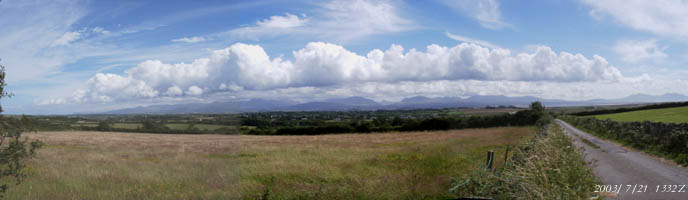 21st: A bright start to the day particularly in the W with the cloud slower to clear here. Pressure was 1015 mb with low pressure centred just N of Malin Head. By afternoon most of Anglesey was clear, but a line of moderately-developed cumulus clouds remained over the mountains of Snowdonia. It was windy with the SW'ly keeping at force 5/6 through the day only moderating during evening. It became cloudier again later. [Rain 0.0 mm; Max 20.2C; Min 13.3C; Grass 12.3C]
 "A sunny morning in Beaumaris on 22 July 2003. The Market Square was looking resplendent with potted plants and hanging baskets.") 22nd: With low pressure (1004 mb) now N of Scotland pressure 1015 mb here was rising. It was quite a bright morning with occasional sunshine. Although clouds were more frequent from time to time it kept dry until 19 GMT when there were just a few spots of rain. The night was cloudy but dry. [Rain trace; Max 20.6C; Min 14.2C; Grass 13.2C]
22nd: With low pressure (1004 mb) now N of Scotland pressure 1015 mb here was rising. It was quite a bright morning with occasional sunshine. Although clouds were more frequent from time to time it kept dry until 19 GMT when there were just a few spots of rain. The night was cloudy but dry. [Rain trace; Max 20.6C; Min 14.2C; Grass 13.2C]
23rd: Overcast and dull with a few spots of rain early on that were insufficient to wet grass or soil. Pressure 1011 mb at 09 GMT was falling with low (997 mb) W of N Ireland. Several low pressure systems were to the NW as well with several fronts at hand. The wind was force 5 S'ly and there was a light shower just after. The morning was dull and blustery with some drizzle around noon. The afternoon was brighter with a glimpse of sunshine later before turning cloudier again. There was a light shower at 0115 GMT. [Rain 0.2 mm; Max 19.0C; Min 13.7C; Grass 13.1C]
 "After a dry and bright day cloud and rain encroached from the SW by 1530 GMT. NOAA 16 image at 1330 GMT on 24 July 2003.") 24th: Cloud was moderately high at dawn with a few small breaks appearing by 09 GMT. Pressure 1011 mb had risen a little, but with persistent low pressure (994 mb) N of Scotland it remains unsettled with fronts moving across from the W. The day was dry and bright with a moderate SW wind and some sunny spells at first in the afternoon. Later with pressure falling it turned cloudier and light rain began soon after 1530 GMT. The rain was heavy around midnight, with frontal triple point in the vicinity, before turning light then to drizzle by 06 GMT. The rainfall 24-h total of 12.7 mm was the most in the month. [Rain 12.7 mm; Max 20.1C; Min 12.7C; Grass 11.7C]
24th: Cloud was moderately high at dawn with a few small breaks appearing by 09 GMT. Pressure 1011 mb had risen a little, but with persistent low pressure (994 mb) N of Scotland it remains unsettled with fronts moving across from the W. The day was dry and bright with a moderate SW wind and some sunny spells at first in the afternoon. Later with pressure falling it turned cloudier and light rain began soon after 1530 GMT. The rain was heavy around midnight, with frontal triple point in the vicinity, before turning light then to drizzle by 06 GMT. The rainfall 24-h total of 12.7 mm was the most in the month. [Rain 12.7 mm; Max 20.1C; Min 12.7C; Grass 11.7C]
25th: A dull, grey and misty start to the day with fairly low ragged clouds and some drizzle. With pressure on 1003 mb and a light SW'ly it remained mostly cloudy through the day. [Rain 0.3 mm; Max 17.9C; Min 14.1C; Grass 14.0C]
26th: The day was mostly cloudy with several slight showers. In the afternoon clearer sky over Anglesey did give some sunny spells with cumulus clouds remaining over Snowdonia. In the night it was clear with bright stars at first but it became cloudier by dawn. [Rain trace; Max 18.6C; Min 13.0C; Grass 11.3C]
27th: A bright start as cloud began to disperse. Cumulus clouds were in the vicinity but in the afternoon, although well-developed, were largely confined to the mountains and it was mainly sunny with the maximum reaching 19.8C. By evening there was a little more cloud but still sunny. The night was partly cloudy and dry. [Rain 0.0 mm; Max 19.8C; Min 11.0C; Grass 7.5C]
 28th: A bright start with slight overnight dew quickly evaporating in the moderate S'ly wind. Pressure 1014 mb at 09 GMT had risen but frontal-wave low (1004 mb) SW Ireland brought rain to Ireland and in Irish Sea. The morning remained bright although there were a few drops of rain reported in Pentraeth at 1030 GMT and here from 1100 GMT. The day's maximum in the morning was 18.2C but became cooler in light rain from 1300 GMT. The rain eased at 1600 GMT but it remained cloudy through the night was a shower at 2330 GMT. [Rain 1.8 mm; Max 18.2C; Min 12.8C; Grass 10.9C]
 "Storm clouds approaching Anglesey with vortex N of Malin Head. NOAA 12 image at 1637 GMT on 29 July 2003.")
 "The France Var fires of September 1990 seen from near St Tropez.")
 "After the fires had been doused with water, picked up by plane in the Gulf of St Tropez, cumulus clouds formed in an otherwise clear sky.")
 "After the fire the blackened ground and trees that subsequently regenerated.")
 "Attention au Feu!") 29th: An overcast and dull start to the day with cloud hugging the mainland mountaintops. Pressure 1015 mb was hardly changed with complex low-pressure (1000 mb) just to the W of Ireland and (1009 mb) near Cape Wrath. Fronts over Ireland had patchy rain associated with them moving across St George's Channel and Irish Sea. There was heavy rain approaching Cornwall, here the morning began dull with a few spots of rain at times. Later this became heavy drizzle and light rain from 10 - 16 GMT, occasionally heavier. At 1736 GMT there was thunder and lightning as an active storm cloud that developed over the Irish Sea passed over. The day was sunless and by 1845 GMT there was moderate fog. There was more rain from 0430 - 0645 GMT with more fog. In the Var region of France a series of 30 fires reportedly lit by arsonists destroyed many hectares of pine and cork oak. Also the death of a British grandmother and granddaughter near La Garde Freinet in the Maures mountains. The fires followed weeks of hot dry weather were severe at Sainte-Maxime where a campsite was destroyed. Thousands of holiday makers had to flee the flames to the coast. Fires in the area, usually arson, are not infrequent but these were the worst since 1990. Electricity supply then, as now, was cut off in St Tropez. The forests usually regenerate in a few years, with any cork oaks hardly affected the trunks being protected by their covering of cork. The fires pass through rapidly, burning tinder dry material on the ground (and houses). [Rain 10.4 mm; Max 17.5C; Min 14.5C; Grass 14.0C]
29th: An overcast and dull start to the day with cloud hugging the mainland mountaintops. Pressure 1015 mb was hardly changed with complex low-pressure (1000 mb) just to the W of Ireland and (1009 mb) near Cape Wrath. Fronts over Ireland had patchy rain associated with them moving across St George's Channel and Irish Sea. There was heavy rain approaching Cornwall, here the morning began dull with a few spots of rain at times. Later this became heavy drizzle and light rain from 10 - 16 GMT, occasionally heavier. At 1736 GMT there was thunder and lightning as an active storm cloud that developed over the Irish Sea passed over. The day was sunless and by 1845 GMT there was moderate fog. There was more rain from 0430 - 0645 GMT with more fog. In the Var region of France a series of 30 fires reportedly lit by arsonists destroyed many hectares of pine and cork oak. Also the death of a British grandmother and granddaughter near La Garde Freinet in the Maures mountains. The fires followed weeks of hot dry weather were severe at Sainte-Maxime where a campsite was destroyed. Thousands of holiday makers had to flee the flames to the coast. Fires in the area, usually arson, are not infrequent but these were the worst since 1990. Electricity supply then, as now, was cut off in St Tropez. The forests usually regenerate in a few years, with any cork oaks hardly affected the trunks being protected by their covering of cork. The fires pass through rapidly, burning tinder dry material on the ground (and houses). [Rain 10.4 mm; Max 17.5C; Min 14.5C; Grass 14.0C]
30th: Very dull and misty at the start of the day. Pressure was 1015 mb but rising with the low (1011 mb) crossed over to the North Sea. A weak ridge was to the W of Ireland but low (987 mb) was SW of Iceland with more frontal systems. The morning remained misty with the wind veered light NE'ly. By afternoon it cleared giving a sunny end to the day and clear sky at first in the night. [Rain 3.1 mm; Max 18.7C; Min 13.8C; Grass 13.5C]
31st: Frontal cloud encroached after midnight and there was rain by morning. At 09 GMT with pressure 1014 mb it was overcast with intermittent light rain or drizzle in a moderate S'ly. Low (981 mb) SW of Iceland had deepened. Pressure was high (1022 mb) in the Bay of Biscay. Cloud was low on the mainland mountains with mist on the lower slopes and the day remained sunless. . [Rain 0.3 mm; Max 16.5C; Min 12.8C; Grass 10.1C]
 "Deep low S of Iceland with cloud affecting the NW. Front clearing S UK. NOAA 16 image at 1341 GMT on 1 August 2003.") 1st: The low was still S of Iceland with cloud affecting NW UK while yesterday's front was slow-moving in the S. A few breaks were appearing overhead in the low cloud at 09 GMT. Visibility was only moderate but this improved through the day as the sky cleared. By afternoon there were good sunny spells when the temperature rose to 21.0C. Later in the evening it was cloudier again but kept dry. [Rain 0.0 mm; Max 21.0C; Min 14.0C; Grass 13.3C]
1st: The low was still S of Iceland with cloud affecting NW UK while yesterday's front was slow-moving in the S. A few breaks were appearing overhead in the low cloud at 09 GMT. Visibility was only moderate but this improved through the day as the sky cleared. By afternoon there were good sunny spells when the temperature rose to 21.0C. Later in the evening it was cloudier again but kept dry. [Rain 0.0 mm; Max 21.0C; Min 14.0C; Grass 13.3C]
2nd: At midnight pressure was rising as Iceland low continued to fill and high (1024 mb) Brest extending northwards. Overcast at dawn but some early glimpses of sunshine marked the beginning of a clearance by 09 GMT. Pressure 1021 mb had risen with high (1024 mb) English Channel. In the morning cloud amounts were variable with cumulus to the S and patchy, sometimes thinning, clouds over Anglesey. By noon it was mainly sunny with sunshine continuing into the evening before patchy cloud drifted over in the night. [Rain 0.0 mm; Max 20.1C; Min 11.9C; Grass 8.9C]
3rd: A little patchy cloud still around but soon becoming sunny and warm. Pressure was 1023 mb with high (1025 mb) central Wales. There was cloud to the NW but this kept away so it was a warm sunny day with the temperature reaching 22.2C. Overnight it was mainly clear with heavy dew forming on the grass. [Rain 0.0 mm; Max 22.2C; Min 11.8C; Grass 8.8C]
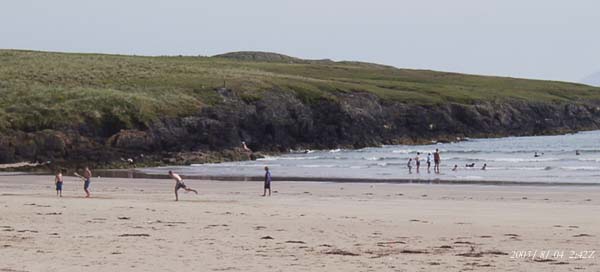 4th: Some mist on the fields early and shallow fog in some low-lying areas soon cleared away in the warm sunshine. A little cloud cloud be seen low on the horizon to the W (frontal cloud over Ireland) otherwise clear except smoke (pollution) haze built up during the last sunny days. Pressure was 1024 mb with the high (1027 mb) mid-North Sea. At 09 GMT the temperature 19.8C was rising in just a slight E or NE'ly breeze off the sea and went on to reach 23.6C during the day. During the afternoon the sky turned milky white, as a plume of dust from north Africa moved northwards, before cloud moved across from the Irish Sea. Sunshine reported at RAF Valley was {14.0 h} not far behind the most in Manchester {14.6 h} and Morecambe {14.3}. Heathrow AP was the warmest with {32C}. [Rain trace; Max 28.3C; Min 11.8C; Grass 9.2C]
 "SKIRON dustload forecast for 00 GMT on 5 August 2003.")
 "Encroaching thundery clouds cooled S Anglesey while futher N further sunshine led to record temperatures. Sea fog S Ireland moved in overnight. NOAA 16 image at 1256 GMT on 5 August 2003.")
; "Sferics intensity recorded 00 - 23 GMT on 5 August 2003. Courtesy of Georg Mueller at Top Karten.") 5th: Light showers between 04 -06 GMT developed on a trough Ireland - Anglesey - Merseyside but accumulated only a trace. There was a wet deposit of dust of north African origin that looked pale reddish-brown when dried and made clean vehicles look very dirty. Temperatures in the night were warm fluctuating from a minimum of 17.5C to 20.3C as the wind direction changed from NE/SE/S. At 07 GMT it was 22.7C; at 08 GMT 24.0C exceeding yesterday's daytime value and by 09 GMT had reached 28.3C. Pressure 1020 mb had fallen off a little with the high (1030 mb) just off the southern Norwegian coast. The morning was sometimes cloudy but continued very warm reaching 31.7C just before noon before cloud moved across. This now becomes the 2nd highest temperature of any month recorded at this station. It did not cloud over until later at Malltraeth 32.5C and Valley where a maximum of 33.0C was recorded, the highest on record at the RAF station and equal to that seen here on 2 August 1990. The highest temperature recorded in Wales is 35.2C recorded at Hawarden also on 2 August 1990. Thunderstorms occurred over SW England in the morning. Distant thunder was heard here at 1520 GMT and there were light showers from 1540 GMT the precipitation quickly evaporating (no water reaching the bottle in the raingauge). Later it was brighter again, with a little more sunshine, and kept warm into the evening. Further distant thunder was heard around 20 GMT. A low formed over Ireland, as a result of the heat, and thunderstorms developed over Northern Ireland and the western Irish Sea during the afternoon. These disrupted electricity supply and caused damage to property in Belfast. The storms later moved on to the Western Isles of Scotland where they were reported as the most spectacular for some years.. [Rain trace; Max 31.7C; Min 17.5C; Grass 16.1C]
5th: Light showers between 04 -06 GMT developed on a trough Ireland - Anglesey - Merseyside but accumulated only a trace. There was a wet deposit of dust of north African origin that looked pale reddish-brown when dried and made clean vehicles look very dirty. Temperatures in the night were warm fluctuating from a minimum of 17.5C to 20.3C as the wind direction changed from NE/SE/S. At 07 GMT it was 22.7C; at 08 GMT 24.0C exceeding yesterday's daytime value and by 09 GMT had reached 28.3C. Pressure 1020 mb had fallen off a little with the high (1030 mb) just off the southern Norwegian coast. The morning was sometimes cloudy but continued very warm reaching 31.7C just before noon before cloud moved across. This now becomes the 2nd highest temperature of any month recorded at this station. It did not cloud over until later at Malltraeth 32.5C and Valley where a maximum of 33.0C was recorded, the highest on record at the RAF station and equal to that seen here on 2 August 1990. The highest temperature recorded in Wales is 35.2C recorded at Hawarden also on 2 August 1990. Thunderstorms occurred over SW England in the morning. Distant thunder was heard here at 1520 GMT and there were light showers from 1540 GMT the precipitation quickly evaporating (no water reaching the bottle in the raingauge). Later it was brighter again, with a little more sunshine, and kept warm into the evening. Further distant thunder was heard around 20 GMT. A low formed over Ireland, as a result of the heat, and thunderstorms developed over Northern Ireland and the western Irish Sea during the afternoon. These disrupted electricity supply and caused damage to property in Belfast. The storms later moved on to the Western Isles of Scotland where they were reported as the most spectacular for some years.. [Rain trace; Max 31.7C; Min 17.5C; Grass 16.1C]
 "Sea fog to W and SW with low cloud covering N Cornwall/Devon and Wales. Frontal cloud to the W. NOAA 16 image at 1425 GMT on 6 August 2003.") 6th: After midnight it became misty with fog from 01 - 05 GMT before slowly clearing by morning. With low (1019 mb) Belfast pressure here 1020 mb was rising slightly. Sea fog and low cloud affected parts of the SW and Wales all day. Quite a contrast with this morning's temperatures being being at least 10C lower. The morning remained dull and cool in the low cloud and mist that gave only poor visibility. One or two breaks in the cloud gave some sunshine in the afternoon raising the temperature to a moderate 21.6C. Under the cloud and mist Aberdaron (Gwynedd) reported the lowest daytime temperature of 18C. In England it was hot; London had a record 35.7C while the hottest place was Gravesend with 36.4C, was a little off the UK highest 37.1C seen at Cheltenham in 1990. Here the sky cleared to thick smoke/dust haze (visibility poor) in the evening but at dusk mist returned. [Rain 0.0 mm; Max 21.6C; Min 15.7C; Grass 13.9C]
6th: After midnight it became misty with fog from 01 - 05 GMT before slowly clearing by morning. With low (1019 mb) Belfast pressure here 1020 mb was rising slightly. Sea fog and low cloud affected parts of the SW and Wales all day. Quite a contrast with this morning's temperatures being being at least 10C lower. The morning remained dull and cool in the low cloud and mist that gave only poor visibility. One or two breaks in the cloud gave some sunshine in the afternoon raising the temperature to a moderate 21.6C. Under the cloud and mist Aberdaron (Gwynedd) reported the lowest daytime temperature of 18C. In England it was hot; London had a record 35.7C while the hottest place was Gravesend with 36.4C, was a little off the UK highest 37.1C seen at Cheltenham in 1990. Here the sky cleared to thick smoke/dust haze (visibility poor) in the evening but at dusk mist returned. [Rain 0.0 mm; Max 21.6C; Min 15.7C; Grass 13.9C]
 "Low cloud/fog kept Anglesey, North Wales through Cheshire to the E coast dull and cool. Elswhere sunshine with high temperatures. NOAA 16 image at 1413 GMT on 7 August 2003.") 7th: After early fog had cleared the sun was shining through thick haze that reduced visibility to 1 km (very poor) at 09 GMT. The temperature had risen from a minimum of 15.0C to 19.5C with relative humidity on 90%. Pressure 1024 mb was rising again promised a fine day but the low cloud/fog soon returned. Although the temperature rose to 20.9C the day was dull and unpleasant with humidity 92% or more. Out of the fog, over most of the UK, some high temperatures were experienced {Cardiff 28C with Southend (Essex) highest on 31C}. At dusk the sky started to clear with shallow mist then fog formed lasting until morning. [Rain trace; Max 20.9C; Min 15.0C; Grass 12.1C]
7th: After early fog had cleared the sun was shining through thick haze that reduced visibility to 1 km (very poor) at 09 GMT. The temperature had risen from a minimum of 15.0C to 19.5C with relative humidity on 90%. Pressure 1024 mb was rising again promised a fine day but the low cloud/fog soon returned. Although the temperature rose to 20.9C the day was dull and unpleasant with humidity 92% or more. Out of the fog, over most of the UK, some high temperatures were experienced {Cardiff 28C with Southend (Essex) highest on 31C}. At dusk the sky started to clear with shallow mist then fog formed lasting until morning. [Rain trace; Max 20.9C; Min 15.0C; Grass 12.1C]
8th: Thick fog at 05 GMT with sufficient accumulated on trees to constantly drip water and, at 09 GMT, to give a trace in the raingauge. Again the sun was almost burning off the mist. Pressure was 1021 mb with high (1025 mb) over North Sea. There was a light NNE'ly breeze with some mist or cloud moving across. Smoke haze was thick to the S and W with very poor visibility. The day was mainly sunny with early misty cloud burning off during the morning leaving smoke haze. More comfortable today, though warmer - maximum 25.1C, as humidity was around 74%. In Scotland it was the hottest day for nearly 100 years. The temperature at Greycrook (Borders) rose to a new record of 32.9C just beating the previous 32.8C at Dumfries on 2 July 1908. A clear calm and warm evening with dew beginning to form on the grass at dusk becoming moderately heavy by morning. We have been lucky to see at least 5 dragonflies as well as a few damsel flies and butterflies around the garden . Wasps, so far, have been very few this summer so that sitting, eating out of doors and drinking cool beer has been pleasant. Flies have been abundant, but few biting flies in the garden, just gnats in the evening that have not been too bothersome. Horseflies have been troublesome in parts of Anglesey especially in Newborough Forest. [Rain 0.0 mm; Max 25.1C; Min 15.1C; Grass 14.2C]
9th: At midnight low (999 mb) was S of Iceland and associated slow-moving cold front was just to the W of Ireland. This is expected to move across and could begin to affect the NW later. A fine start to the day with red sunrise filtering through the trees around 05 GMT. Calm and a warm 20.5C at 0730 GMT with a light SE'ly breeze. The day became hot with the temperature 28 - 29C most of the afternoon and peaking at 29.8C. There were some cirrus clouds at times and in the evening a few small cumulus clouds formed to the SE but dispersed later. The night was clear, with a little mist at dusk, until after midnight. [Rain 1.0 mm; Max 29.8C; Min 17.7C; Grass 14.0C]
; "Sferics recorded for the 60 min to 1042 GMT on 10 August 2003. Courtesy of www.meteorologica.co.uk.") 10th: Before dawn it was cloudy as the cold front approached. There was heavy drizzle and light rain from 0600 - 0700 GMT the fog until just after 09 GMT. The rain washed out a reddish-brown dust that got mixed with some grey dust that has been appearing as dry deposition over the last few days. As the front moved east it became more active with thunder on a line across Wales (not heard here) and into the Midlands, N England and Scotland. A lot cooler here than yesterday with the temperature 16.6C ( 100% relative humidity) and occasional fine drizzle during the morning. By 1430 GMT it was becoming drier and brighter form the W. Severe and heavy thunderstorms in Birmingham resulted in 14 people being injured. In Teesside, C Durham and N Yorkshire heavy storms and rain with flooding reported in Acklam in Middlesborough. The UK highest temperature record was broken today first at London Heathrow where it rose to 37.9C (100F) and later Gravesend took it with a hot 38.1C. Later, it was found that a hotter 38.5C was recorded at Brogdale Horticultural Trust's orchards near Faversham. These were at least a whole 1 deg C above the 1990 Cheltenham record. Here just a cool 17.7C maximum! [Rain trace; Max 17.7C; Min 15.9C; Grass 13.8C]
10th: Before dawn it was cloudy as the cold front approached. There was heavy drizzle and light rain from 0600 - 0700 GMT the fog until just after 09 GMT. The rain washed out a reddish-brown dust that got mixed with some grey dust that has been appearing as dry deposition over the last few days. As the front moved east it became more active with thunder on a line across Wales (not heard here) and into the Midlands, N England and Scotland. A lot cooler here than yesterday with the temperature 16.6C ( 100% relative humidity) and occasional fine drizzle during the morning. By 1430 GMT it was becoming drier and brighter form the W. Severe and heavy thunderstorms in Birmingham resulted in 14 people being injured. In Teesside, C Durham and N Yorkshire heavy storms and rain with flooding reported in Acklam in Middlesborough. The UK highest temperature record was broken today first at London Heathrow where it rose to 37.9C (100F) and later Gravesend took it with a hot 38.1C. Later, it was found that a hotter 38.5C was recorded at Brogdale Horticultural Trust's orchards near Faversham. These were at least a whole 1 deg C above the 1990 Cheltenham record. Here just a cool 17.7C maximum! [Rain trace; Max 17.7C; Min 15.9C; Grass 13.8C]
; "Sferics recorded for the 60 min to 08 GMT on 11 August 2003. Courtesy of www.meteorologica.co.uk.") 11th: Rumbles of thunder were heard from 0455 GMT continuing until 07 GMT. These were part of the large storms on an active trough that developed to the E of here over North Wales, Merseyside and Cheshire, behind the slow-moving front. Cumulonimbus clouds were observed, but here the occasional glimpse of the sun around 09 GMT. Pressure 1021 mb had risen a little with high pressure running NE-SW across the UK. The day remained mainly overcast with a light N'ly breeze. During the night there were some clearer periods but it was cloudy again by morning [Rain 0.0 mm; Max 19.3C; Min 13.6C; Grass 10.8C]
11th: Rumbles of thunder were heard from 0455 GMT continuing until 07 GMT. These were part of the large storms on an active trough that developed to the E of here over North Wales, Merseyside and Cheshire, behind the slow-moving front. Cumulonimbus clouds were observed, but here the occasional glimpse of the sun around 09 GMT. Pressure 1021 mb had risen a little with high pressure running NE-SW across the UK. The day remained mainly overcast with a light N'ly breeze. During the night there were some clearer periods but it was cloudy again by morning [Rain 0.0 mm; Max 19.3C; Min 13.6C; Grass 10.8C]
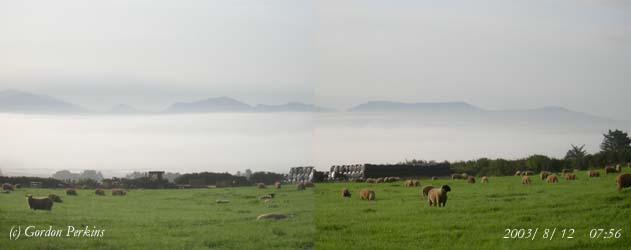 12th: Some dew on the grass, under a blanket of grey cloud, and little or no wind. At midnight pressure was high (1025 mb) SW Ireland with frontal cloud lying Scandinavia to W of Iberia. Low (1008 mb) S of Iceland also had frontal cloud affecting the NW. At 0900 GMT with pressure on 1022 mb it was still cloudy with some early coastal fog patches. The Cefni Estuary was filled with inversion fog, higher ground in Malltraeth as well as the mountains on the Lleyn Peninsular in the background were clear. With the wind N or NW encouraging orographic cloud formation in the SE of the island, the morning was cloudy, but fairly bright when it occasionally thinned, with the afternoon having more sunshine. Along the coastal fringe particularly to the W it was mainly sunny (Valley {10.6 h} . The evening was clearer but after midnight frontal cloud encroached from the NW. [Rain 0.4 mm; Max 20.6C; Min 11.9C; Grass 8.8C]
13th: Some light rain around 04 GMT had cleared away giving a bright start, but cumulus clouds were still in the vicinity. The rain led to a further deposition of grey-coloured dust. Towards 09 GMT they thickened again and soon after there was a shower. Despite 0.4 mm rainfall the soil was dry. With surface temperatures of 18.5C (5 cm) the precipitation had evaporated, but the grass was wet and concrete partially damp in places. At this time of year (when soil temperatures are enhanced) evaporation from the ground lysimeter is comparable to, or exceeds, the Piche in the screen. Orographic wave clouds persisted over the station into the afternoon when they began to disperse. Good sunny spells let the temperature rise to 22.3C. The evening was largely clear, and with the temperature falling, dew began to form on the grass. [Rain 0.7 mm; Max 22.4C; Min 13.5C; Grass 9.9C]
14th: A sunny start to the day with heavy dew on grass (min 5.4C) in which animals, crossing the fields, had left tracks. For some while leaves on beech and some sycamore trees facing the SW have been looking yellow and brown, falling and gathering on the ground. These would have damaged by salt-laden winds earlier in the year and be the first to fall. In the shelter they are looking fine and still green and, so far, not as in 1976 suffering from lack of water. But with the cooler temperatures it had the feel of autumn about this morning. Pressure was 1022 mb with high (1026 mb at 00 GMT) W of Ireland. The wind was light NNE'ly with cumulus clouds forming in the vicinity and over the Snowdonia Mountains. The day was mainly sunny with passing cumulus clouds with the afternoon having an almost clear sky later. [Rain trace; Max C; Min 9.4C; Grass 5.4C]
 "Shafts of sunlight produced interesting patterns between trees on 15 August 2003.") 15th: A clear sky in the night with dew on the grass. From 04 GMT mist formed turning to shallow fog between 05 - 07 GMT. At 0625 GMT, after the sun had risen, shafts of sunlight produced dramatic patterns in the mist through nearby trees. When this cleared cumulus clouds formed giving 6 oktas cover at 09 GMT. With pressure still high 1020 mb the day was mainly sunny but became overcast later in the evening. [Rain 0.0 mm; Max 18.0C; Min 10.1C; Grass 8.0C]
15th: A clear sky in the night with dew on the grass. From 04 GMT mist formed turning to shallow fog between 05 - 07 GMT. At 0625 GMT, after the sun had risen, shafts of sunlight produced dramatic patterns in the mist through nearby trees. When this cleared cumulus clouds formed giving 6 oktas cover at 09 GMT. With pressure still high 1020 mb the day was mainly sunny but became overcast later in the evening. [Rain 0.0 mm; Max 18.0C; Min 10.1C; Grass 8.0C]
16th: The sky cleared in the early hours with heavy dew and low mist lying over the fields at 05 GMT. The mist soon cleared and the sun rose in clear sky giving a sunny start to the day. Pressure 1020 mb was unchanged with high pressure (1023 mb at 00 GMT) persisting over the Irish Sea. The day was mainly sunny with good but hazy visibility and little or no wind. By evening it was cloudier before in a few clearer spells dew started to form. [Rain 0.0 mm; Max 21.7C; Min 10.6C; Grass 8.5C]
 "Low S of Iceland with frontal cloud approaching the W. Convective storms over Spain produced large hail and floods with a supercell developed over France. NOAA 16 image at 1401 GMT on 17 August 2003.") 17th: By 02 GMT the wind went to the SE and there was a warm wind off the mountains. The temperature reached a minimum of 13.4C before starting to rise slowly. The relative humidity declined from 93% to 70% at 05 GMT typical of a Föhn wind but on this occasion was not particularly outstanding. It did however dry off the dew that had formed on the grass so that at 09 GMT it was dry. Pressure 1015 mb had fallen as low ( mb) S of Iceland approached W Scotland. The day was bright with a little sunshine and a maximum of 22.5C, but by late afternoon was overcast with frontal cloud thickening from the W. [Rain 0.8 mm; Max 22.5C; Min 13.4C; Grass 10.5C]
17th: By 02 GMT the wind went to the SE and there was a warm wind off the mountains. The temperature reached a minimum of 13.4C before starting to rise slowly. The relative humidity declined from 93% to 70% at 05 GMT typical of a Föhn wind but on this occasion was not particularly outstanding. It did however dry off the dew that had formed on the grass so that at 09 GMT it was dry. Pressure 1015 mb had fallen as low ( mb) S of Iceland approached W Scotland. The day was bright with a little sunshine and a maximum of 22.5C, but by late afternoon was overcast with frontal cloud thickening from the W. [Rain 0.8 mm; Max 22.5C; Min 13.4C; Grass 10.5C]
18th: There was heavy drizzle and light rain from 04 - 07 GMT but it only accumulated 0.8 mm. This amount will do little to moisten the dry soil and redress the water balance. Some garden plants e.g. Hydrangeas that have not been irrigated are showing the first signs of wilting. The grass also is turning brown and the lysimeter, that has water added every day, greener in comparison. The surrounding fields look green but grass on roadside verges and in shallow rocky places has been looking browned for the last month. Pressure 1012 mb was rising again and the morning became bright. The day slowly brightened with the afternoon sunny. By evening it was cloudy and was so all night. [Rain 0.0 mm; Max 20.6C; Min 12.8C; Grass 12.5C]
19th: Low (998 mb) was just N of Scotland and Atlantic-high (1025 mb) was building from the SW. Pressure here 1020 mb was rising and we had a W'ly airflow. It was still cloudy with frontal systems lying to the NW. By 09 GMT 1 or 2 breaks were appearing in the cloud that was of moderate height hugging the tops of the Snowdonia Mountains. By the afternoon it was mainly sunny but turned cloudy again by evening. [Rain 0.0 mm; Max 20.1C; Min 12.3C; Grass 9.4C]
 "Low S of Iceland and associated frontal cloud mass to the NW. NOAA 16 image at 1328 GMT on 20 August 2003.") 20th: Developing low (994 mb) S of Iceland was moving E towards Scotland with a large frontal cloud system close to the NW. Pressure here was 1021 mb and the sky was clearing with very good visibility at 09 GMT but cloud, to the W, soon encroached. This brought heavy drizzle to Bangor and Snowdonia in the morning. After a little light drizzle here at 1230 GMT the afternoon was mostly sunny and dry. By evening frontal cloud was overhead and it was windier. [Rain mm; Max C; Min 12.0C; Grass 9.6C]
20th: Developing low (994 mb) S of Iceland was moving E towards Scotland with a large frontal cloud system close to the NW. Pressure here was 1021 mb and the sky was clearing with very good visibility at 09 GMT but cloud, to the W, soon encroached. This brought heavy drizzle to Bangor and Snowdonia in the morning. After a little light drizzle here at 1230 GMT the afternoon was mostly sunny and dry. By evening frontal cloud was overhead and it was windier. [Rain mm; Max C; Min 12.0C; Grass 9.6C]
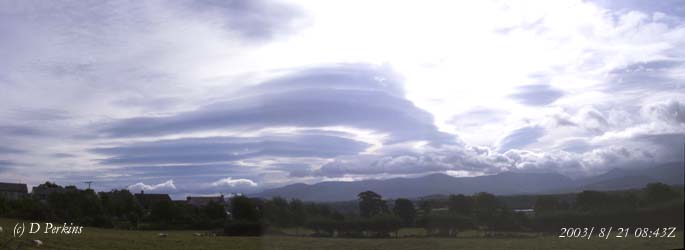 21st: An overcast start to the day with the SSW'ly force 4/5 that rose to force 6/7 during the day. Pressure 1014 mb was falling very slowly continued to track NW of Scotland. Day remained cloudy but dry with just a few spots of fine rain near the W coast. Except for some early glimpses it was almost sunless on Anglesey, but there was some in in the lee of the mountains at Llanfairfechan, Conwy and Colwyn Bay where the temperature rose to 24C the highest in the UK. The night became less windy. [Rain 1.0 mm; Max 18.5C; Min 13.9C; Grass 12.6C]
22nd: At midnight low (985 mb) was just N of Scotland with slow-moving clod front Ireland through Anglesey to Hull and the North Sea. Spells of light rain or drizzle in low cloud around dawn continuing past 09 GMT with poor visibility. Pressure 1014 mb had started to rise slowly but there was no improvement during the day with drizzle, sometimes heavy, continuing (not showing up on the rainfall radar) until 1830 GMT. The evening was drier, but the low cloud and mist remained through the night. [Rain 2.2 mm; Max 19.0C; Min 15.2C; Grass 14.8C]
23rd: Overcast and calm with moderate visibility in mist. Pressure 1019 mb had risen a little with high (1023 mb) at Brest. Improvement was slow coming with drizzle soon returning becoming heavy at times before stopping at 1300 GMT. But by 14 GMT the sky began to clear to give a sunny afternoon and mostly clear evening. [Rain 1.4 mm; Max 21.3C; Min 15.4C; Grass 15.1C]
24th: With little change here high pressure (1025 mb) established over N Scotland by midnight. Frontal cloud was to the NE but here it was a sunny start to the day. With clear air the visibility was very good across to the mountains and the Lleyn Peninsular. The wind was a light NE'ly from the direction of Traeth Goch where there was sea fog. Here in sunshine the temperature rose to 22.7C, but it was sunnier on the W coast where Valley reported 24C and {12.4 h} sunshine, the highest in the UK. Cardiff with 28C was the warmest. [Rain 0.0 mm; Max 22.7C; Min 16.7C; Grass 13.9C]
25th: Pressure was 1021 mb in a ridge of high pressure over Scotland from high (1029 mb) just S of Iceland. Another sunny start but frontal cloud drifted S during the morning and it was overcast by the afternoon. At times the cloud was thick and dark but there was no rain. [Rain 0.0 mm; Max 19.4C; Min 12.8C; Grass 9.9C]
26th: Overcast at dawn the morning was dull with a light E'ly breeze. Pressure was 1019 mb with a ridge of high pressure extending SE from high (1032 mb) SW of Iceland. Around noon some cloud began to disperse overhead and for a time the sun appeared before closing over again. Brighter than yesterday afternoon the cloud being thinner and higher. Cloudy at night at first but starting to clear after midnight. [Rain 0.0 mm; Max 17.5C; Min 13.8C; Grass 12.5C]
 "Clear on Anglesey. Low W of Brest tracking towards the Bay of Biscay. NOAA 16 image at 1350 GMT on 27 August 2003.") 27th: Clearing sky led to early dew on the grass. Remnant cirrostratus cloud was clearing away south-westwards at 09 GMT. Mature low (987 mb at 00 GMT) SW of Ireland was filling and tracking towards W France. The day was mainly sunny with a moderate NE'ly (maximum 19.4C) with just a little cirrus cloud moving across later in the afternoon. Anglesey was the sunniest place in the UK with Valley reporting {11.2 h} sunshine. Cloudier by evening and in the night. [Rain 0.0 mm; Max 19.4C; Min 11.9C; Grass 9.3C]
27th: Clearing sky led to early dew on the grass. Remnant cirrostratus cloud was clearing away south-westwards at 09 GMT. Mature low (987 mb at 00 GMT) SW of Ireland was filling and tracking towards W France. The day was mainly sunny with a moderate NE'ly (maximum 19.4C) with just a little cirrus cloud moving across later in the afternoon. Anglesey was the sunniest place in the UK with Valley reporting {11.2 h} sunshine. Cloudier by evening and in the night. [Rain 0.0 mm; Max 19.4C; Min 11.9C; Grass 9.3C]
28th: A bright start to the day with some breaks in the cloud. Pressure 1010 mb continued to fall slowly with the wind a light N'ly. At noon the temperature had reached 19.6C but soon began to fall in cool N'ly air to 13C at 15 GMT and the minimum of 11.0C at 1900 GMT. There was slight rain from 1800 - 1830 GMT. Anglesey (Valley) had {8.3 h} sunshine the NW having the best with Tiree (Hebrides) reporting {11.3 h} these figures {18 - 18 GMT} including yesterday's sunny evening. [Rain 0.1 mm; Max 19.6C; Min 12.7C; Grass 10.3C]
29th: A dull start to the day and, with some well-developed cumulus clouds in the vicinity, showers of rain during the morning. Pressure 1011 mb was rising slowly with Atlantic-high (1030 mb) S of Iceland. Low (998 mb) Netherlands had associated fronts over the English Channel and France where there were thunderstorms and moderate to heavy rain. Here the sky cleared in the afternoon but became cloudy again later. At 2255 - 2312 GMT there was heavy rain (9 mm) with small ice pellets in an active shower accompanied by 2 close CG flashes of lightning and loud thunder. Total rainfall of 9.2 mm made it the wettest day of the month. [Rain 9.2 mm; Max 16.8C; Min 11.0C; Grass 10.0C]
 "Convective cloud developed over Wales during the morning but most of Anglesey was clear in the afternoon. NOAA 16 image at 1316 GMT on 30 August 2003.") ¤30th: The air had cleared and, with a bright start, visibility was very good. Very clear views of the rock faces on the Snowdonia Mountains could be seen all day. The overnight minimum was 7.8C and this was the coolest since 26 May (7.6C). A little mist across the fields and marshes early on soon cleared away. There were still showers around with several cumulonimbus observed during the morning. By the afternoon the sky had mostly cleared over Anglesey with some cumulus remaining over Snowdonia and to the S. [Rain trace; Max 16.1C; Min 7.8C; Grass 5.8C]
¤30th: The air had cleared and, with a bright start, visibility was very good. Very clear views of the rock faces on the Snowdonia Mountains could be seen all day. The overnight minimum was 7.8C and this was the coolest since 26 May (7.6C). A little mist across the fields and marshes early on soon cleared away. There were still showers around with several cumulonimbus observed during the morning. By the afternoon the sky had mostly cleared over Anglesey with some cumulus remaining over Snowdonia and to the S. [Rain trace; Max 16.1C; Min 7.8C; Grass 5.8C]
31st: With clear sky and cool N'ly breeze it was a colder night with the minimum 7.5C and 5.0C on the grass, both lowest of the month and the lowest since 20 May. It was mostly cloudy by dawn and by 09 GMT the temperature had risen to 12.6C. Still the cool N'ly with pressure 1022 mb continuing to rise. High (1039 mb) now to the W of Ireland was intensifying, but there were troughs of low-pressure over S Ireland and the SW and the morning here was mainly cloudy with light showers developing. Low (1006 mb) was over Sardinia with associated fronts making it unsettled in the Mediterranean. Spells of drizzle in the morning brighter in the afternoon but the temperature reaching only 15.0C, the lowest of the month. [Rain trace; Max 15.0C; Min 7.5C; Grass 5.0C]
1st: Although mostly cloudy at first there were some bright spells in the morning. Pressure was 1025 mb with high (1033 mb) W of Ireland. The afternoon was clearer with some sunshine later on before turning cloudier by dusk. [Rain 0.0 mm; Max 16.5C; Min 10.0C; Grass 7.5C]
2nd: A cloudy morning but with moderate high thin cloud it was bright at first. Around noon the cloud thickened and there was some drizzle and a spell of light rain before turning showery but brighter. By evening the sky was clear, with little or no wind, and for a time and shallow mist formed over the fields. Later it became cloudy. [Rain 0.9 mm; Max 15.7C; Min 10.8C; Grass 8.8C]
3rd: Overcast at dawn but a little brighter at 09 GMT. Pressure 1031 mb was rising as the Atlantic high (1032 mb) had moved across into cover the UK and N Europe. By afternoon it was sunny and warm with a maximum of 21.7C. The night was clear and starlit at first turning cloudy later. [Rain 0.0 mm; Max 21.7C; Min 11.4C; Grass 9.1C]
4th: Some early cloud was beginning to clear by 09 GMT. Pressure 1026 mb had declined a little as the high moved further E allowing low (968 mb) SW of Iceland to approach with frontal cloud lying W of Ireland. The afternoon was sunny and warm with the temperature rising to 23.5C, one of the 2 days highest of the month. By nightfall some cloud had returned but it kept dry. [Rain 0.0 mm; Max 23.5C; Min 11.0C; Grass 8.9C]
5th: A warm and sunny start to the day. At 09 GMT it was 17.0C and by afternoon to 21.0C before turning cloudier as frontal cloud encroached and was lying down through Wales at midnight. There was light rain from 01-0330 GMT followed by spells of drizzle. [Rain 4.3 mm; Max 21.0C; Min 10.8C; Grass 8.5C]
6th: An overcast and dull start with fine light drizzle towards 09 GMT. With the frontal cloud clearing away E and pressure 1017 mb rising, in a ridge from high pressure (1021 mb) SW France, the morning became sunny feeling warm in a light W'ly wind. In the afternoon there was sunshine between some light showers, as a trough moved up from the SW, that died out later giving a clear evening and cool night. Showers were heavier, and thundery, in NW England with Crosby having {24 mm}. [Rain trace; Max 17.0C; Min 11.8C; Grass 10.8C]
7th: A sunny start to the day but pressure 1011 mb was falling and feeling cooler (14.7C) with the SW'ly wind freshening. During the afternoon it became cloudier as a cold front approached from the W with showers developing by 14 GMT. These were frequent through the afternoon and night merging at times giving 7.2 mm accumulated rainfall by morning. [Rain 7.2 mm; Max 17.0C; Min 8.9C; Grass 6.6C]
8th: At midnight, associated with the front, there was a low (1005 mb) in the Bristol Channel. At 09 GMT pressure was 1008 mb and it was overcast with a temperature of 13.4C. This rose only to 14.0C during the day that continued with a mixture of showers, spells of light rain or drizzle. It was warm and sunny further S where at Great Malvern the temperature rose to {23C}. It was wettest in the N and W {Camborne, Cornwall 31 mm}. During the evening and night the sky began to clear with a falling temperature. [Rain 0.4 mm; Max 14.0C; Min 12.3C; Grass 11.5C]
9th: At midnight low (1003 mb) just to the N of Scotland with another (1001 mb) central France. Frontal cloud was still around at dawn that was overcast with light drizzle giving poor visibility. But pressure 1015 mb was rising in a ridge from the SW at 09 GMT and the morning became sunny between developing cumulus clouds. Later in the afternoon clouds thickened with a shower at 18 GMT and rain from 1030 - 03 GMT as further frontal systems moved across from the Irish Sea. [Rain 7.4 mm; Max 15.1C; Min 7.9C; Grass 6.0C]
10th: A dull and grey start to the day. Pressure was 1011 mb with low (980 mb) S of Greenland with associated fronts extending to Ireland and the SW. It was a mild 15.0C and there was little variation through the day, that continued overcast with spells of heavy drizzle, rising only to 15.5C. It was wet in the mountains of Snowdonia with Capel Curig reporting {26 mm} rainfall. From 01 GMT there was light to moderate rain until 06 GMT. [Rain 4.7 mm; Max 15.5C; Min 11.3C; Grass 10.9C]
11th: Another dull and damp start to the day with light drizzle. By 09 GMT, with pressure 1018 mb rising, the cloud began to slowly lift. In a moderate S/SW'ly wind, in the clearance of the front, the cloud cleared to give a sunny and warm (21.0C) afternoon. This set off a shower at 15 GMT (0.9 mm) before clearing again in the evening. The night was partly cloudy amounts slowly decreasing. [Rain 0.9 mm; Max 21.0C; Min 12.9C; Grass 11.8C]
12th: With fronts passed well to the E pressure had risen to the SW. After a cool night the morning was sunny with pressure on 1031 mb. With mostly clear sky and cirrus clouds the day was sunny and dry with the temperature rising to 19.9C. [Rain 0.0 mm; Max 19.9C; Min 8.0C; Grass 6.5C]
13th: The high pressure (1033 mb) had moved across to the S North Sea by midnight that allowed weak frontal cloud to cross the Irish Sea. But this had mostly cleared without any precipitation by 09 GMT. Low (959 mb) was SW of Iceland and isobars had tightened to the W resulting in fresh to strong S/SW'ly winds. The day kept windy but sunny with a maximum of 21.2C. Further weak frontal cloud moved on to the Irish Sea during the night but it kept dry. [Rain 0.0 mm; Max 21.2C; Min 12.1C; Grass 10.6C]
14th: A bright and sunny start with the temperature 17.7C at 09 GMT. Pressure had risen a little to 1029 mb and in the S/SW'ly breeze the temperature rose to a high of 23.5C for the second time in the month. The wind fell off in the evening and night but it kept mild here although the sky was clear. It was a colder night in some parts of central England (Redhill 2C). [Rain 0.0 mm; Max 23.5C; Min 14.2C; Grass 12.5C]
15th: A bright and sunny start to the day with a SW'ly breeze. With pressure high over much of Europe (here 1025 mb) the day was mostly clear skied with hazy sunshine. To the NW frontal cloud brought some rain into N Ireland and Scotland {Sella Ness 6 mm}. [Rain 0.0 mm; Max 22.9C; Min 14.1C; Grass 11.1C]
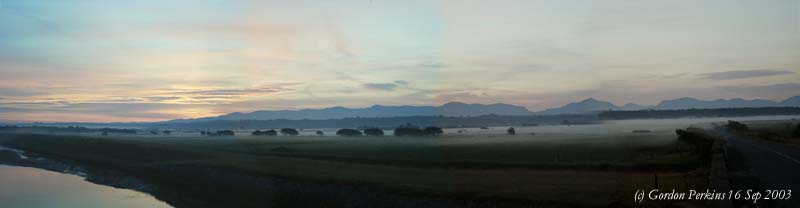
|
 "Met Office chart at 00 GMT on 19 September 2003.")
 "Autographic record of rainfall on 18-20 September 2003.") 19th: At midnight with a front over the Irish Sea and Anglesey there was light to moderate rain from 02 GMT. After a short break around dawn there was more rain from 0815 GMT giving a total of 8.6 mm (09 - 09 GMT). With the front hardly moving but seeming to pivot on Anglesey, further rain, moderate to heavy at times, continued for the next 33 hours with hardly a break. Total rain for the day was 32.5 mm (24.0 h duration). Capel Curig reported {40 mm 18 - 18 GMT}. [Rain 32.5 mm; Max 15.1C; Min 14.8C; Grass 14.3C]
19th: At midnight with a front over the Irish Sea and Anglesey there was light to moderate rain from 02 GMT. After a short break around dawn there was more rain from 0815 GMT giving a total of 8.6 mm (09 - 09 GMT). With the front hardly moving but seeming to pivot on Anglesey, further rain, moderate to heavy at times, continued for the next 33 hours with hardly a break. Total rain for the day was 32.5 mm (24.0 h duration). Capel Curig reported {40 mm 18 - 18 GMT}. [Rain 32.5 mm; Max 15.1C; Min 14.8C; Grass 14.3C] "Met Office chart at 12 GMT on 29 September 2003.")
 "Autographic record of heavy rainfall on 28/29 September 2003.") 29th: Low (998 mb) was just S of Iceland and more fronts were lying to the NW. The first rain (9.0 mm) ceased by 0130 GMT but there was a shower (2.4 mm) at 0430 GMT. It was raining again at 1200 GMT and became heavy from 1530 - 1700 GMT before easing to moderate to heavy until 0445 GMT when it stopped. In this fall of 16.5 h duration 55.4 mm fell and was the largest daily fall in September to be recorded at this station on the 25-year record and the most in the UK. A similar large fall was recorded nearby on 21 September 1935 (54.6 mm) and a larger 82.6 mm on 19 September 1946. [Rain 55.4 mm; Max 14.3C; Min 6.2C; Grass 3.5C]
29th: Low (998 mb) was just S of Iceland and more fronts were lying to the NW. The first rain (9.0 mm) ceased by 0130 GMT but there was a shower (2.4 mm) at 0430 GMT. It was raining again at 1200 GMT and became heavy from 1530 - 1700 GMT before easing to moderate to heavy until 0445 GMT when it stopped. In this fall of 16.5 h duration 55.4 mm fell and was the largest daily fall in September to be recorded at this station on the 25-year record and the most in the UK. A similar large fall was recorded nearby on 21 September 1935 (54.6 mm) and a larger 82.6 mm on 19 September 1946. [Rain 55.4 mm; Max 14.3C; Min 6.2C; Grass 3.5C]
1st: A sunny start with just a little cloud to the S behind the mountains. There was thick smoke haze but visibility was just good. Pressure was 1010 mb with low (996 mb) W of Brest and associated fronts and rain in the Channel. The weakened front was to the N while Atlantic-high (1033 mb) extended a ridge towards N Scotland. The day kept sunny with a light E/NE'ly breeze. The night was clear with an orange coloured new moon low in the W. [Rain 0.0 mm; Max 16.7C; Min 10.3C; Grass 6.3C]
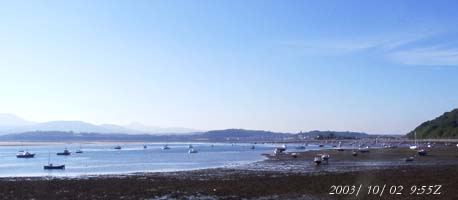
 "View across the Menai Strait near low water. Frontal cloud to the S with cloud capping the Snowdonia Mountains on 2 October 2003.") 2nd: There was heavy overnight dew and slight mist across the fields at dawn. Pressure was 1013 mb in a ridge of high-pressure across central UK from unchanged Atlantic-high (1033 mb). The morning was sunny in smoke haze with frontal cloud still to the S and to the NE with a little cirrus overhead. In the afternoon visibility deteriorated to poor as the haze intensified. Anglesey (Valley) with {11.1 h} was the sunniest place reported in the UK. The night was clear at first, with heavy dew on the grass, but after patchy cloud at time frontal cloud had encroached by next morning. [Rain trace; Max 16.9C; Min 8.5C; Grass 5.9C]
2nd: There was heavy overnight dew and slight mist across the fields at dawn. Pressure was 1013 mb in a ridge of high-pressure across central UK from unchanged Atlantic-high (1033 mb). The morning was sunny in smoke haze with frontal cloud still to the S and to the NE with a little cirrus overhead. In the afternoon visibility deteriorated to poor as the haze intensified. Anglesey (Valley) with {11.1 h} was the sunniest place reported in the UK. The night was clear at first, with heavy dew on the grass, but after patchy cloud at time frontal cloud had encroached by next morning. [Rain trace; Max 16.9C; Min 8.5C; Grass 5.9C]
 "Frontal cloud bands moving SE across Anglesey. View is from the Cob at Malltraeth at 0655 GMT on 3 October 2003. Digital Photo (c) Gordon Perkins.") 3rd: A murky dawn, with little or no surface wind, and there was a little drizzle before 09 GMT. Pressure was low (979 mb) NE of Iceland and here was hardly changed at 1012 mb. At sunrise over the Snowdonia Mountains two bands of frontal cloud were moving SE across Anglesey and the Irish Sea. After the brief clear slot between the clouds, reflected in Malltraeth Pool, the morning remained dull and damp with the drizzle dying out and a light N/NW'ly wind setting in. The afternoon was brighter but remained mostly cloudy. Along the W coast there were some brief sunny spells before becoming cloudier again. The night kept cloudy but dry. [Rain 0.1 mm; Max 14.3C; Min 9.8C; Grass 7.8C]
3rd: A murky dawn, with little or no surface wind, and there was a little drizzle before 09 GMT. Pressure was low (979 mb) NE of Iceland and here was hardly changed at 1012 mb. At sunrise over the Snowdonia Mountains two bands of frontal cloud were moving SE across Anglesey and the Irish Sea. After the brief clear slot between the clouds, reflected in Malltraeth Pool, the morning remained dull and damp with the drizzle dying out and a light N/NW'ly wind setting in. The afternoon was brighter but remained mostly cloudy. Along the W coast there were some brief sunny spells before becoming cloudier again. The night kept cloudy but dry. [Rain 0.1 mm; Max 14.3C; Min 9.8C; Grass 7.8C]
4th: Mostly cloudy at dawn the sky was beginning to clear at 09 GMT. Pressure 1015 mb was rising with filling low (981 mb) moving E in the Norwegian Sea. Mid-Atlantic high (1039 mb) was W of Ireland while low (1005 mb) N Italy had fronts over the Alps bringing fresh snow and S France. Here the morning was bright (10.2C at 09 GMT) with the N'ly wind freshening with showers, becoming wintry, over the Snowdonia Mountains where temperatures were 1-2C on the summit of Yr Wyddfa. In the afternoon cumulus clouds were well-developed and showers heavier. At 23 GMT there was a shower of large ice pellets accompanied by a 2C fall in temperature. [Rain 3.4 mm; Max 13.1C; Min 8.3C; Grass 5.8C]
5th: More showers with small ice pellets after midnight died out before rain showers continued after dawn. Over the mountains early showers of snow whitened some slopes for a while before melting. Pressure was 1021 mb with a NW'ly breeze. After a cold night with a minimum of 5.5C, lowest since 15 May (4.6C), the temperature at 09 GMT was 7.3C. The morning continued with short sunny spells and frequent showers that were of ice precipitation over the mainland mountains. From 1515 GMT there was light to moderate rain until 2130 GMT, amounting to 8.7 mm, followed by frequent showers (last moderate at 0345 GMT. [Rain 11.4 mm; Max 13.1C; Min 5.5C; Grass 2.8C]
6th: Overcast with low ragged clouds and more light showers around 09 GMT. Pressure was 1008 mb with deepening low (978 mb) near the Faeroes and fronts North Sea to English Channel and N France. Here we were still in the showery NW'ly airstream with the North Wales coast in the firing line. Showers were also penetrating deeply into England through the Cheshire gap. The day kept overcast and dull with slight showers at 12 and 15 GMT. Visibility was generally good, with cloud was hugging the mountain summits, but only moderate showers. The night remained cloudy. [Rain 0.4 mm; Max 12.0C; Min 7.3C; Grass 6.6C]
7th: Overcast at dawn but signs of clearing from 08 GMT but blustery showers restarting. Pressure 1008 mb was rising with filling lows (984 mb) Faeroes and (982 mb) North Sea moving away with Atlantic-high (1037 mb). The day was a mixture of sunshine and light showers. By dusk it was cloudier with 2.7 mm of light rain falling from 0045 to 0330 GMT followed by a rapid temperature rise. [Rain 3.2 mm; Max 14.1C; Min 8.7C; Grass 7.1C]
 "Former hurricane Kate SE of Greenland with associated frontal cloud over the UK. NOAA 16 image at 1418 GMT on 8 October 2003.") 8th: A dull morning with a fairly uniform cover of stratus cloud giving hill fog as low as 2000 ft on the Snowdonia Mountains. Pressure was 1015 mb with a warm front lying down the spine of the UK associated with former hurricane Kate (970 mb) lying SE of Greenland. The day kept overcast here with the WNW'ly wind keeping orographic cloud overhead. It was sunless but it was brighter along the W coast especially in the afternoon. Occasional breaks were seen before midnight. [Rain 0.1 mm; Max 16.3C; Min 9.3C; Grass 6.5C]
8th: A dull morning with a fairly uniform cover of stratus cloud giving hill fog as low as 2000 ft on the Snowdonia Mountains. Pressure was 1015 mb with a warm front lying down the spine of the UK associated with former hurricane Kate (970 mb) lying SE of Greenland. The day kept overcast here with the WNW'ly wind keeping orographic cloud overhead. It was sunless but it was brighter along the W coast especially in the afternoon. Occasional breaks were seen before midnight. [Rain 0.1 mm; Max 16.3C; Min 9.3C; Grass 6.5C]
9th: Kate (970 mb) SW of Iceland that brought gale-force winds to Scotland had fronts lying to the NW and off the E coast of Scotland and England. High pressure (1029 mb) to the SW in the Atlantic was declining. Pressure here 1018 mb had risen a little but it was still a cloudy and dull scene. The overnight minimum was 11.6C, the warmest of the month. The wind had backed SW'ly force 5 and it was a mild 13.2C (dewpoint 11.3; RH 88%) rising to 14.6C. The day kept cloudy, dull and sunless but dry into the evening. [Rain 1.1 mm; Max 14.6C; Min 11.7C; Grass 10.4C]
 "Widespread formations of orographic waves clouds. NOAA 16 image at 1355 GMT on 10 October 2003.") 10th: A spell of light rain at 0030 GMT marked the passing SE of a weak front. At dawn the sky started to clear and by 09 GMT (pressure 1017 mb) it was sunny with a light to moderate W'ly wind. Visibility was good but there was thick haze with cirrus above and cirrostratus to the W. There was cumulus to the S with more cumulus developing over Anglesey during the morning. In the afternoon there were extensive formations of orographic wave clouds prior to becoming mainly cloudy later in the afternoon and into the evening and night. [Rain 0.0 mm; Max 16.3C; Min 8.0C; Grass 4.5C]
10th: A spell of light rain at 0030 GMT marked the passing SE of a weak front. At dawn the sky started to clear and by 09 GMT (pressure 1017 mb) it was sunny with a light to moderate W'ly wind. Visibility was good but there was thick haze with cirrus above and cirrostratus to the W. There was cumulus to the S with more cumulus developing over Anglesey during the morning. In the afternoon there were extensive formations of orographic wave clouds prior to becoming mainly cloudy later in the afternoon and into the evening and night. [Rain 0.0 mm; Max 16.3C; Min 8.0C; Grass 4.5C]
11th: A red sky at sunrise prior to seeing more orographic waves in cirrus and cirrostratus clouds over the weather station before 09 GMT. Pressure was 1023 mb and the wind a light W'ly. Visibility was very good in clear air with the day mainly sunny. The temperature rose to 17.6C, the warmest day of the month. It was cloudier by dusk. [Rain 0.0 mm; Max 17.6C; Min 7.6C; Grass 5.5C]
12th: After a mainly cloudy night the sky was clearing by dawn to give another red sunrise. By 09 GMT it was cloudier again but being fairly thin it remained bright in the morning. The wind was a light SE'ly in the lee of the Snowdonia Mountains but it was a lot windier in Chester. The afternoon was sunnier with the cloud thinning even more, but not clearing, before thickening again later as frontal cloud encroached from the W. [Rain 2.6 mm; Max 16.0C; Min 11.6C; Grass 9.3C]
13th: Drizzle and light rain from 0130 GMT led to 2.6 mm accumulated by 09 GMT. A slow-moving front was lying down the Irish Sea giving rain along western coasts. Pressure was high (1036 mb) over Scandinavia with Atlantic-low (975) well to the W of Ireland. Here pressure was steady on 1019 mb and it was calm with light rain and mist. The rain became intermittent after 10 GMT before dying out after noon but the day was sunless. There was a further spell of light rain from 20 - 2130 GMT. [Rain 0.8 mm; Max 13.6C; Min 10.3C; Grass 8.3C]
14th: From dawn the sky started to clear and was 6 oktas by 09 GMT. Pressure 1023 mb was rising with high (1040 mb) intensified over Norway and Atlantic-low (977 mb) having tracked NW to be SW of Iceland. Here the wind was light SE'ly and, with the frontal cloud to the W weakening, the morning mostly sunny with stationary wave clouds overhead. The afternoon was sunnier and warm with a maximum of 17.3C. The night was partially cloudy but dry. [Rain 0.0 mm; Max 17.3C; Min 8.8C; Grass 6.3C]
15th: A deep red sunrise, after a minimum of 6.2C a chilly start to the day and the light Ely wind gently blowing autumn-coloured leaves off the trees and ripe conkers from the horse chestnuts. In the absence of small boys to collect them and squirrels to eat them (the greys have not been seen for nearly 2 years following extermination to encourage return of reds) jays are picking them up, taking them away and hiding them under leaves. I expect we will have several seedling horse chestnuts appearing next year. Pressure 1027 mb continues to rise and at 09 GMT the temperature had risen to 9.7C. The morning was bright but kept mostly cloudy until the afternoon when it was mostly sunny. Valley reported {3.8 h} sunshine but further along the coast at Llandudno it remained grey and cold in the strong E'ly wind {Colwyn Bay 0.2 h sunshine}. Here, more in the lee of the mountains, it was pleasantly warm, max 15.4C with RH as low as 52%, with a little E/SE or no wind. Mostly clear at night and windier for a time before becoming calm.. [Rain 0.0 mm; Max 15.4C; Min 6.2C; Grass 4.0C]
16th: A bright and sunny start to the day with patches of mist or shallow fog in some low-lying areas near dawn. Despite the clear cool night there was little or no dew formation; with relatively dry air being transported from continental Europe 2.4 ml had evaporated from the Piche tube in the last 24-h. Pressure 1029 mb remains high and it was a sunny day with good but hazy visibility. In the afternoon thick smoke haze was seen in Liverpool Bay. A clear dry night. [Rain 0.0 mm; Max 16.6C; Min 6.0C; Grass 2.0C]
17th: After a clear colder night there was dew on the grass despite the E'ly breeze. The temperature at 09 GMT was 8.9C but it was sunny in a cloudless sky. Dark smoke (pollution) haze had increased and was visible all around, including the Menai Strait and Caernarfon Bay, and up to mountaintop height (3500 ft). The day kept sunny with just a few clouds seen over the mountains. After a blood red sunset the sky was a dark peach colour with shades of azure blue above. [Rain 0.0 mm; Max 12.7C; Min 5.8C; Grass 1.7C]
 "Low NW of Finisterre and vortex in the Med. Frontal cloud N of Scotland, with following showers, and stratiform cloud to the E and North Sea. NOAA 16 image at 1405 GMT on 18 October 2003.") 18th: With the main high-pressure centre (1033 mb) near Krakov (Poland) at midnight there was still a ridge extending over Scotland. Low (998 mb) was W of Cape Finisterre and by morning here was 1020 mb and falling slowly. A sunny day and with the sun rising over the mountains at 0710 GMT and setting at 1650 GMT there was 9.7 h unbroken sunshine. Aspatria (Cumbria) with 10.1 h reported the most. Smoke haze was not quite as thick today. Another fine sunset and towards the end of 2.5 h of peach and azure twilight, with the wind easing, several bats were seen flying low over the field W of the weather station. With the weather turning colder they will soon be hibernating for the winter and, with plenty of insects on the wing, perhaps taking a last meal. A clear night. [Rain 0.0 mm; Max 14.1C; Min 5.4C; Grass 1.0C]
18th: With the main high-pressure centre (1033 mb) near Krakov (Poland) at midnight there was still a ridge extending over Scotland. Low (998 mb) was W of Cape Finisterre and by morning here was 1020 mb and falling slowly. A sunny day and with the sun rising over the mountains at 0710 GMT and setting at 1650 GMT there was 9.7 h unbroken sunshine. Aspatria (Cumbria) with 10.1 h reported the most. Smoke haze was not quite as thick today. Another fine sunset and towards the end of 2.5 h of peach and azure twilight, with the wind easing, several bats were seen flying low over the field W of the weather station. With the weather turning colder they will soon be hibernating for the winter and, with plenty of insects on the wing, perhaps taking a last meal. A clear night. [Rain 0.0 mm; Max 14.1C; Min 5.4C; Grass 1.0C]
 "Weather chart at 06 GMT on 19 October 2003 showing approximate position of the cold front at 06 and 15 GMT.") 19th: A bright and sunny start to the day with pressure at 09 GMT fallen to 1015 mb with low (995 mb) near Cape Finisterre. The high (1026 mb) had declined further and was well away over the Black Sea. A weak cold front was over Scotland with some following showers while there was heavy rain over Brittany and Channel Islands. Almost clear sky at first but broken cloud encroached during the morning. There were good sunny spells at first in the afternoon but, with the cold front approaching Anglesey, the sky darkened by 15 GMT, and the E'ly wind freshened to f5 before backing NE'ly. There were a few spots of rain at 1640 GMT but insufficient to dampen the ground. It was a cold day with the mean temperature 8.1C lowest since 3 May. A solar flare erupted today near sunspot 484, one of the largest seen for many years and is still growing. Yesterday the spot was barely visible; now it is about 7 times wider than Earth. Major eruptions are possible that could trigger geomagnetic storms and lead to aurora, even disrupt communications, on earth. [Rain trace; Max 11.0C; Min 5.2C; Grass 1.8C]
19th: A bright and sunny start to the day with pressure at 09 GMT fallen to 1015 mb with low (995 mb) near Cape Finisterre. The high (1026 mb) had declined further and was well away over the Black Sea. A weak cold front was over Scotland with some following showers while there was heavy rain over Brittany and Channel Islands. Almost clear sky at first but broken cloud encroached during the morning. There were good sunny spells at first in the afternoon but, with the cold front approaching Anglesey, the sky darkened by 15 GMT, and the E'ly wind freshened to f5 before backing NE'ly. There were a few spots of rain at 1640 GMT but insufficient to dampen the ground. It was a cold day with the mean temperature 8.1C lowest since 3 May. A solar flare erupted today near sunspot 484, one of the largest seen for many years and is still growing. Yesterday the spot was barely visible; now it is about 7 times wider than Earth. Major eruptions are possible that could trigger geomagnetic storms and lead to aurora, even disrupt communications, on earth. [Rain trace; Max 11.0C; Min 5.2C; Grass 1.8C]
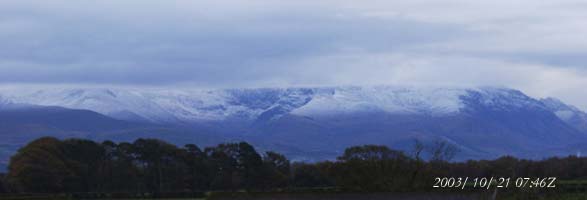 20th: With the cold front over the English Channel the sky was clearing leaving well-developed cumulus and cumulonimbus clouds with early flurries of snow around the summit of Yr Wyddfa. At 09 GMT pressure was unchanged at 1015 mb and there was a cold NE'ly wind with the temperature on 7.5C. The morning was mainly sunny with a snow shower seen to fall and settle on Carnedd Llewelyn soon after 11 GMT with a few spots of rain here at 1220 GMT. Further sunshine in the afternoon with a maximum of 9.2C, before a shower of rain and ice pellets at 1530 GMT. When the sky cleared in the evening the temperature dropped to 2.8C and 0.2C on the grass. [Rain 4.8 mm; Max 9.2C; Min 6.0C; Grass 4.6C]
21st: More rain and ice pellets soon after 10 GMT and rain at 05 GMT that fell as snow as low as 1500 ft over the Snowdonia Mountains. Pressure had fallen to 1010 mb within a complex low-pressure system over the UK. Further light rain from 09 GMT was falling as snow over the mountains with the temperature on Yr Wyddfa summit around -2C. Snow had fallen also in Scotland and on the Pennines. Convective clouds were well-developed in places, a funnel cloud was reported at Eye in Norfolk and {39 mm} rain fell in Margate. Sferics were recorded in the Irish Sea, off the E coast of England and the Channel. Here the day was dull with rain or drizzle at times but some heavy bursts were reported along the North Wales coast and at St Asaph in the afternoon. The day's maximum temperature was only 6.8C, the coldest of the month and the lowest recorded at this station on its 25-y record. Snow continued to fall on the mountaintops with fine particles of snow seen here around 2130 GMT. There were thunderstorms in Dublin with heavy rain and hail, that closed the airport for a time, and snow on the Wicklow Mountains. The was a spell of rain (sleet possible) here from 2330 - 0515 GMT that contributed most to the 6.9 mm accumulated during the day. [Rain 6.9 mm; Max 6.8C; Min 2.8C; Grass 0.2C]
22nd: A brighter morning with the sun starting to break through the clouds before 09 GMT. But there were well-developed cumulus cloud to be seen associated with troughs in Liverpool Bay (sferics seen later) and over Snowdonia. Wet snow was lying sparsely and melting at 1000 ft but on the summits, with temperatures around -2C, there were some accumulations at first but even these lessened through the day. Pressure 1009 mb had risen with low (1003 mb) near Brest. The morning was bright with some sunny spells with the wind light E'ly. The afternoon was cloudier as clouds invigorated by the still warm Irish Sea gave light showers of rain across Anglesey. The night remained mostly cloudy. [Rain 0.3 mm; Max 7.5C; Min 3.0C; Grass 1.4C]
 "A sunny view of the Menai Suspension Bridge, near low water, with snow on the mountains on 23 October 2003.") 23rd: The sky was clearing rapidly about 07 GMT leaving the only cumulus clouds to be seen far out over Liverpool Bay, probably over Cumbria. Pressure 1020 mb had risen with small high (1029 mb) midway between here and Iceland. Low pressure (1002 mb) N Biscay, France and the Mediterranean continues with unsettled and wet weather. It was a sunny morning but very hazy with a light E'ly wind. On the mountains snow was lying above 2700 ft but and was sparse and patchy down to 2000 ft in places. The afternoon continued sunny, with some passing clouds forming and drifting westward S of the Menai Strait, becoming cloudier for a while here after sunset before clearing again to give the first ground frost of the season. [Rain 0.2 mm; Max C; Min 4.1C; Grass 1.8C]
23rd: The sky was clearing rapidly about 07 GMT leaving the only cumulus clouds to be seen far out over Liverpool Bay, probably over Cumbria. Pressure 1020 mb had risen with small high (1029 mb) midway between here and Iceland. Low pressure (1002 mb) N Biscay, France and the Mediterranean continues with unsettled and wet weather. It was a sunny morning but very hazy with a light E'ly wind. On the mountains snow was lying above 2700 ft but and was sparse and patchy down to 2000 ft in places. The afternoon continued sunny, with some passing clouds forming and drifting westward S of the Menai Strait, becoming cloudier for a while here after sunset before clearing again to give the first ground frost of the season. [Rain 0.2 mm; Max C; Min 4.1C; Grass 1.8C]
 "Cumulus clouds over Porthaethwy where the streets were taken over for the annual Ffair Borth on 24 October 2003.") 24th: After a calm night thunder was heard at 0420 GMT as active shower clouds were driven in off the Irish Sea with the wind turned N'ly. Cumulonimbus clouds were seen in the vicinity and small ice pellets fell in a shower of rain close to 09 GMT. It was a little warmer on Yr Wyddfa summit (-0.2C) as wintry showers continued with snow cover mainly above 3000 ft with patches below. Light showers continued during the morning but it slowly brightened with a little sunshine appearing before 11 GMT. It was a good day for the annual Ffair Borth Menai Bridge Fair held for centuries and originally a 'hiring and horse fair' always held on the 24th (except a Sunday). Mostly sunny during the afternoon into the evening allowing the grass minimum to fall to 0.6C before showers developed after midnight. . [Rain 2.8 mm; Max 10.2C; Min 2.2C; Grass -1.4C]
24th: After a calm night thunder was heard at 0420 GMT as active shower clouds were driven in off the Irish Sea with the wind turned N'ly. Cumulonimbus clouds were seen in the vicinity and small ice pellets fell in a shower of rain close to 09 GMT. It was a little warmer on Yr Wyddfa summit (-0.2C) as wintry showers continued with snow cover mainly above 3000 ft with patches below. Light showers continued during the morning but it slowly brightened with a little sunshine appearing before 11 GMT. It was a good day for the annual Ffair Borth Menai Bridge Fair held for centuries and originally a 'hiring and horse fair' always held on the 24th (except a Sunday). Mostly sunny during the afternoon into the evening allowing the grass minimum to fall to 0.6C before showers developed after midnight. . [Rain 2.8 mm; Max 10.2C; Min 2.2C; Grass -1.4C]
25th: Moderate showers with some small ice pellets just after 03 GMT and rain showers at O5 and 09 GMT. High pressure (1036 mb) was to the W of Ireland and 1025 mb here. The wind was N'ly and bringing showers down the Irish Sea. Cloud and mist was at 2500 ft on the Snowdonia Mountains where temperatures were above freezing on the summits. The morning continued showery with a little sunshine breaking through by 1125 GMT. By afternoon an upper trough had developed to the NW and this brought some rain. At 2040 GMT there was moderately heavy rain and large ice pellets. The mainly cloudy night ensured a mild night. [Rain 2.6 mm; Max 12.3C; Min 4.5C; Grass 0.6C]
26th: A bright start to a day that had the occasional sunny spell. Towards dusk the sky almost cleared and with temperatures falling there was moderately heavy dew. [Rain 0.0 mm; Max 9.7C; Min 5.3C; Grass 3.3C]
27th: By dawn the overnight dew had frozen so that the fields looked white but soon melted as the sun rose. Pressure at 09 GMT was 1022 mb in a ridge across the UK. There were lows (978 mb) W of Iceland and (952 mb) N of the Arctic Circle near Jan Mayan. Fronts were to the NW the nearest was weak and over N Ireland and Scotland. But here it was sunny with a few broad contrails overhead drifting SW. Some cloud could be seen low to the W and hanging over the Snowdonia Mountaintops. The day was mostly sunny with a light S'ly wind. Partially cloudy at first at night becoming cloudier by morning as weak frontal cloud encroached. [Rain 0.0 mm; Max 11.7C; Min 3.5C; Grass -0.5C]
28th: Clouds were dark at first but there was no rain and by 09 GMT were breaking up giving some bright spells. Pressure 1013 mb had been falling slowly as high to the S declined and a following cold front was over N Ireland and Scotland where it was giving a little rain. Developing low (985) mb over Iceland was expected to move S. Towards noon it became cloudier and there was light rain that turned to heavy drizzle in the afternoon as a large area of rain moved SE. From 16 - 23 GMT there was intermittent light rain. One of the most powerful solar flares ever recorded erupted this morning near giant sunspot 486. The explosion hurled a coronal mass ejection directly toward Earth that might cause aurora displays. [Rain 2.5 mm; Max 10.5C; Min 5.7C; Grass 3.4C]
 "Anglesey was in a brief clear slot between 2 areas of rain. Weather chart at 06 GMT on 29 October 2003.")
 "Aurora display seen looking NW from Coleraine, N Ireland around 2200 GMT on 29 October 2003. Photo (c) Mike Tullet.")
 "Aurora display seen looking NW from Coleraine, N Ireland around 2200 GMT on 29 October 2003. Photo (c) Mike Tullet.")
 "Aurora display seen looking NW from Coleraine, N Ireland around 2200 GMT on 29 October 2003. Photo (c) Mike Tullet.") 29th: Still overcast at dawn but soon began to clear as a clear slot between fronts moved across from the Irish Sea. Pressure 992 mb was still falling with low (990 mb) just to the N closely associated with a cold front to the W. The wind was a light WSW'ly and there was some sunshine between the cumulus clouds with much cirrus above. By 1030 GMT some dark clouds approached and it began to rain and continued intermittently until 19 GMT but the cloud did not clear. A severe geomagnetic storm was generated tonight by the eruptions on the sun in recent days.
29th: Still overcast at dawn but soon began to clear as a clear slot between fronts moved across from the Irish Sea. Pressure 992 mb was still falling with low (990 mb) just to the N closely associated with a cold front to the W. The wind was a light WSW'ly and there was some sunshine between the cumulus clouds with much cirrus above. By 1030 GMT some dark clouds approached and it began to rain and continued intermittently until 19 GMT but the cloud did not clear. A severe geomagnetic storm was generated tonight by the eruptions on the sun in recent days.
 "Aurora display seen from Cumbria on the night of 30 October 2003. Photo (c) Anita Evans. Click to see larger image.") Aurora were seen in many parts around midnight from N Scotland to Lands End. Unfortunately it was cloudy here, but remarkable displays of green and red curtains of colour were seen in Coleraine, N Ireland and photographed by Mike Tullet about 2200 GMT. [Rain 3.7 mm; Max 8.2C; Min 4.7C; Grass 0.8C]
Aurora were seen in many parts around midnight from N Scotland to Lands End. Unfortunately it was cloudy here, but remarkable displays of green and red curtains of colour were seen in Coleraine, N Ireland and photographed by Mike Tullet about 2200 GMT. [Rain 3.7 mm; Max 8.2C; Min 4.7C; Grass 0.8C]
 "Lee-wave clouds just ahead of frontal cloud approaching from the SW on the afternoon of 30 October 2003. Looking S from the weather station.")
 "Aurora display seen from Coleraine, N Ireland on 30 October 2003. Photo (c) Mike Tullet.")
 "Aurora display seen from Cumbria on 30 October 2003. Photo (c) Anita Evans.") 30th: In the early hours the sky cleared and deposits of water on the grass had frozen and looked white. The minimum 2.1C and grass -1.6C were both coldest of the month. A sunny start with the sky briefly weakly red as the sun rose above the mountains. There was much cirrostratus cloud with spectacular cumulus-cap clouds spilling over the mountains. Cloud could also be seen low to the SW; there was a band of rain on a warm front over SW England and Ireland approaching South Wales. Pressure 985 mb had fallen with low (971 mb) to the NW with the wind here a light SE'ly. The morning was mostly weakly sunny through the thin high cloud. The front edged closer in the afternoon from the SW while some lee-wave clouds (in the SE'ly here) formed over the Menai Strait. By 1445 GMT the front reached here and it started to rain that continued, mostly light, through the night just cold enough for ice precipitation over the Snowdonia mountaintops. Another geomagnetic storm tonight with aurora seen again in Coleraine, and Cumbria where photographed by Anita Evans, they were deep red and bright. Cloudy here of course! [Rain 7.2 mm; Max 9.6C; Min 2.1C; Grass -1.6C]
30th: In the early hours the sky cleared and deposits of water on the grass had frozen and looked white. The minimum 2.1C and grass -1.6C were both coldest of the month. A sunny start with the sky briefly weakly red as the sun rose above the mountains. There was much cirrostratus cloud with spectacular cumulus-cap clouds spilling over the mountains. Cloud could also be seen low to the SW; there was a band of rain on a warm front over SW England and Ireland approaching South Wales. Pressure 985 mb had fallen with low (971 mb) to the NW with the wind here a light SE'ly. The morning was mostly weakly sunny through the thin high cloud. The front edged closer in the afternoon from the SW while some lee-wave clouds (in the SE'ly here) formed over the Menai Strait. By 1445 GMT the front reached here and it started to rain that continued, mostly light, through the night just cold enough for ice precipitation over the Snowdonia mountaintops. Another geomagnetic storm tonight with aurora seen again in Coleraine, and Cumbria where photographed by Anita Evans, they were deep red and bright. Cloudy here of course! [Rain 7.2 mm; Max 9.6C; Min 2.1C; Grass -1.6C]
 "Frontal cloud moving SE across Wales. Linear cloud over S Anglesey with orographic clouds in Cardigan Bay. NOAA 16 image at 1320 GMT on 31 October 2003.")
 "Lenticular lee-wave clouds over W Menai Straits seen from Llansadwrn under a cumulonimbus cloud on 31 October 2003.") 31st: Pressure was at its lowest 0972 mb either side of midnight and was rising 0979 mb at 09 GMT. Low (976 mb) was off Brest with its associated front across Wales edging SE. It was a wet morning and misty with poor visibility but began to improve after noon leaving a dark linear cloud over Llansadwrn and S Anglesey (see satellite image at 1320 GMT). As the front retreated lenticular lee-wave (orographic) clouds (photo 1331 GMT) could be seen over the western Menai Strait and Caernarfon Bay. They could also be seen on the satellite image in Cardigan Bay. The sky gradually cleared after a shower at 1830 GMT but, with the geomagnetic storm subsided, there were no aurora to be seen! [Rain 2.0 mm; Max 9.4C; Min 2.8C; Grass 1.5C]
31st: Pressure was at its lowest 0972 mb either side of midnight and was rising 0979 mb at 09 GMT. Low (976 mb) was off Brest with its associated front across Wales edging SE. It was a wet morning and misty with poor visibility but began to improve after noon leaving a dark linear cloud over Llansadwrn and S Anglesey (see satellite image at 1320 GMT). As the front retreated lenticular lee-wave (orographic) clouds (photo 1331 GMT) could be seen over the western Menai Strait and Caernarfon Bay. They could also be seen on the satellite image in Cardigan Bay. The sky gradually cleared after a shower at 1830 GMT but, with the geomagnetic storm subsided, there were no aurora to be seen! [Rain 2.0 mm; Max 9.4C; Min 2.8C; Grass 1.5C]
1st: Between early showers at 09 GMT cloud and mist was on the lower slopes (1000 ft) of the Snowdonia Mountains. Pressure 997 mb had risen in a minor Atlantic-ridge but low (973 mb), now SW of Iceland, is moving rapidly E towards NW Scotland. The morning was showery and bright at times with the afternoon drier with a maximum of only 9.0C. At 18 GMT the temperature had fallen to the 24-h minimum of 5.7C. As pressure continued to fall by evening the SW'ly wind had strengthened to strong to gale-force. There was moderate to heavy rain from 2030 GMT that accumulated 18.5 mm, the third largest fall of the month. [Rain 18.5 mm; Max 11.3C; Min 7.0C; Grass 4.5C]
 "Low W Scotland with gales in the Irish Sea. Weather chart at 00 GMT on 2 November 2003.")
 "Rapidly melting agglomerated hailstones up to 15 mm diameter (calipers set on 10 mm) at 09 GMT on 2 November 2003.") 2nd: At midnight the low (996 mb) was off the Western Isles of Scotland with gale force winds in the Irish Sea. Heavy rainfall continued until 03 GMT when it became showers with the temperature rising to 11.2C between 04 and 05 GMT, maximum for the past 24-h. At 09 GMT, as an active cold front went over, there was a shower of rain and 10 mm diameter hailstones, some 5 mm diameter hail was agglomerated in pieces up to 15 mm diameter. Sferics were reported over Snowdonia and moved S sporadically during the day. Pressure was 982 mb with the rain moved SE and strong winds into the Bristol and English Channel. The day had some sunshine with further rain showers frequently with ice pellets in a blustery SW'ly force 4/5. [Rain 7.9 mm; Max 11.6C; Min 5.7C; Grass 3.7C]
2nd: At midnight the low (996 mb) was off the Western Isles of Scotland with gale force winds in the Irish Sea. Heavy rainfall continued until 03 GMT when it became showers with the temperature rising to 11.2C between 04 and 05 GMT, maximum for the past 24-h. At 09 GMT, as an active cold front went over, there was a shower of rain and 10 mm diameter hailstones, some 5 mm diameter hail was agglomerated in pieces up to 15 mm diameter. Sferics were reported over Snowdonia and moved S sporadically during the day. Pressure was 982 mb with the rain moved SE and strong winds into the Bristol and English Channel. The day had some sunshine with further rain showers frequently with ice pellets in a blustery SW'ly force 4/5. [Rain 7.9 mm; Max 11.6C; Min 5.7C; Grass 3.7C]
3rd: Showers continued after midnight with more ice pellets and 5 mm hailstones. Pressure reached its lowest (about 0983 mb) and by 09 GMT was rising on 995 mb. Crepuscular rays were seen looking towards the Carneddau Mountains that were obscured in cloud and mist. Thunderstorms were occurring along the English Channel in gale to storm-force winds. Here the sky cleared and with cumulus clouds diminishing through the day kept dry. The wind veered W'ly in the early hours but was still a brisk force 5 and kept W'ly all day. In the night the wind backed S'ly and strengthened by morning. [Rain 0.0 mm; Max 12.0C; Min 7.6C; Grass 5.4C]
 "Autumn colours continue to develop on a beech tree near the weather station on 4 November 2003.") 4th: Low (967 mb) was SW of Iceland and winds in the NW of the UK were fresh to strong. Rain-bearing fronts were near W of Scotland and Ireland. Pressure here was 1017 mb and the wind S'ly force 6/7 and it was a mild 11.3C at 09 GMT, the coolest it would be or the next 24-h. With cloud moderately high it was bright at times during the morning. Autumn leaf colours on local trees are now well developed and, despite the strong winds, many have not yet fallen. Denser cloud encroached by mid-afternoon and it was windier with the S'ly pushing force 7/8 with gales over high ground. The night remained mostly cloudy but dry with the wind moderately only a little. [Rain 0.0 mm; Max 15.4C; Min 5.2C; Grass 0.7C]
4th: Low (967 mb) was SW of Iceland and winds in the NW of the UK were fresh to strong. Rain-bearing fronts were near W of Scotland and Ireland. Pressure here was 1017 mb and the wind S'ly force 6/7 and it was a mild 11.3C at 09 GMT, the coolest it would be or the next 24-h. With cloud moderately high it was bright at times during the morning. Autumn leaf colours on local trees are now well developed and, despite the strong winds, many have not yet fallen. Denser cloud encroached by mid-afternoon and it was windier with the S'ly pushing force 7/8 with gales over high ground. The night remained mostly cloudy but dry with the wind moderately only a little. [Rain 0.0 mm; Max 15.4C; Min 5.2C; Grass 0.7C]
5th: A mild night and by dawn the cloud was beginning to break-up. By 09 GMT when it was mostly sunny the temperature was a warm 15.2C. Pressure was 1018 mb as the high (1038 mb) to the E intensified while pressure remained low (967 mb) in mid-Atlantic. To the W of Ireland there was weak frontal moving E. The day was sunny with the SSE'ly wind moderating to force 3/4 in the afternoon. The temperature rose here to a remarkable 18.7C, warmest of the month (RH 47%), beating the previous record of 17.3C on November 17th 1997 by 1.4C. At Abergwyngregin 19.1C was observed, probably the warmest place in the UK, but not up to the highest 20.6C recorded at Aber on 5 November 1946. {Lochcarron, Highland 17.9C, Hereford 18.1C}. Later frontal cloud moved across, there was a little drizzle (21-22 GMT) with the S'ly wind strengthening again to force 7/8 and to gale force 8 before midnight, moderating afterwards. [Rain trace; Max 18.7C; Min 11.3C; Grass 9.5C]
 "A sunny morning on the Menai Strait near high water on 6 November 2003. Looking SSW across the Strait towards Penrhyn Castle.") 6th: Just before dawn it was almost calm and with the sky clearing, with frontal cloud now to the E, there was heavy dew and mist in some low-lying areas. With the sun risen the temperature rose to over 15C the mist soon cleared giving a sunny morning. Pressure 1024 mb continued to rise with filling low (959 mb) SW of Ireland moving N deflected by the blocking-high (1041 mb) E of the Baltic. A patch of cloud moved across after noon but when this cleared away the temperature rose to 17.5C {Northolt 18.6C}, but Aber reported 18.9C at 09 GMT on the 7th being credited to the 6th's maximum! The SSE'ly wind was much lighter today. By dusk it was partially cloudy with a little mist forming on the fields but all cleared later. [Rain 0.0 mm; Max 17.5C; Min 8.6C; Grass 4.6C]
6th: Just before dawn it was almost calm and with the sky clearing, with frontal cloud now to the E, there was heavy dew and mist in some low-lying areas. With the sun risen the temperature rose to over 15C the mist soon cleared giving a sunny morning. Pressure 1024 mb continued to rise with filling low (959 mb) SW of Ireland moving N deflected by the blocking-high (1041 mb) E of the Baltic. A patch of cloud moved across after noon but when this cleared away the temperature rose to 17.5C {Northolt 18.6C}, but Aber reported 18.9C at 09 GMT on the 7th being credited to the 6th's maximum! The SSE'ly wind was much lighter today. By dusk it was partially cloudy with a little mist forming on the fields but all cleared later. [Rain 0.0 mm; Max 17.5C; Min 8.6C; Grass 4.6C]
 "A clear view of Snowdon (Yr Wyddfa), across the tree-lined Menai Strait showing autumn colours, from Brynsiencyn on 7 November 2003. Some patchy cloud did not stop it being warm (near 20C) in a Fohn-like wind.") 7th: At 01 GMT the temperature was 13.1C and 8.3C on the summit of Yr Wyddfa! But there were fluctuations as the light variable direction breeze came and went and the minimum thermometer reset at 18 GMT read 10.4C. The 24-h minimum was 9.6C as this was recorded at 09 GMT on the 6th. An almost clear sky with sunshine and little or no wind in the morning but there was patchy moderately high cloud at times from noon. Another warm day for November with the maximum reaching 18.1C with relative humidity falling to 35% in a spell of Föhn-like SE'ly wind, the lowest of the month . Mostly the wind was ENE/Ely and places to the SW had better Föhn conditions with warmer temperatures and even lower humidity (Aber 19.2; Llanbedr, Gwynedd 19.6C and 21% RH at 15 GMT; Capel Curig 17C and 29%). Mostly clear and cooler at night. [Rain 0.0 mm; Max 18.1C; Min 9.6C; Grass 5.0C]
7th: At 01 GMT the temperature was 13.1C and 8.3C on the summit of Yr Wyddfa! But there were fluctuations as the light variable direction breeze came and went and the minimum thermometer reset at 18 GMT read 10.4C. The 24-h minimum was 9.6C as this was recorded at 09 GMT on the 6th. An almost clear sky with sunshine and little or no wind in the morning but there was patchy moderately high cloud at times from noon. Another warm day for November with the maximum reaching 18.1C with relative humidity falling to 35% in a spell of Föhn-like SE'ly wind, the lowest of the month . Mostly the wind was ENE/Ely and places to the SW had better Föhn conditions with warmer temperatures and even lower humidity (Aber 19.2; Llanbedr, Gwynedd 19.6C and 21% RH at 15 GMT; Capel Curig 17C and 29%). Mostly clear and cooler at night. [Rain 0.0 mm; Max 18.1C; Min 9.6C; Grass 5.0C]
 "Billowing cumulus clouds capping the Snowdonia Mountains in an E/ly wind on the morning of 8 November 2003. Seen from near the weather station that was mainly sunny.") 8th: A bright start with a moderate E'ly wind. Pressure was 1023 mb with high pressure maintained to the E and low to the W with cooler air being brought from the E. The morning was sunny at times, with cumulus clouds capping the Snowdonia Mountains, but it was much cooler with a maximum of 9.6C. The afternoon and evening were cloudier but it remained dry, with a few clearer spells at night, with a touch of ground frost by morning. [Rain 0.0 mm; Max 9.6C; Min 5.4C; Grass 0.2C]
8th: A bright start with a moderate E'ly wind. Pressure was 1023 mb with high pressure maintained to the E and low to the W with cooler air being brought from the E. The morning was sunny at times, with cumulus clouds capping the Snowdonia Mountains, but it was much cooler with a maximum of 9.6C. The afternoon and evening were cloudier but it remained dry, with a few clearer spells at night, with a touch of ground frost by morning. [Rain 0.0 mm; Max 9.6C; Min 5.4C; Grass 0.2C]
 "Frontal cloud S UK and France with vortex of low W of Ireland. NOAA 16 image at 1319 GMT on 9 November 2003.") 9th: A bright but very hazy morning with a little sunshine at times. Pressure was 1013 mb but there were low-pressure centres to the W and SW with associated rain-bearing frontal cloud to the S. The day was mostly bright and dry here becoming cloudier after dusk. After a shower at 1930 GMT there was an hour of light rain from midnight before it began to clear. [Rain 1.7 mm; Max 13.5C; Min 4.5C; Grass -0.2C]
9th: A bright but very hazy morning with a little sunshine at times. Pressure was 1013 mb but there were low-pressure centres to the W and SW with associated rain-bearing frontal cloud to the S. The day was mostly bright and dry here becoming cloudier after dusk. After a shower at 1930 GMT there was an hour of light rain from midnight before it began to clear. [Rain 1.7 mm; Max 13.5C; Min 4.5C; Grass -0.2C]
10th; After a mild night and a little red sky at dawn, the sky was covered with swirling cirrus clouds. Cloud on a trough was, however, seen to the W and by 10 GMT it was cloudier with well-developed cumulus clouds giving showers to the S over Snowdonia. Pressure was 1020 mb with high (1042 mb) still E Baltic with weak lows (1001 mb) NW off Ireland and (1007 mb) Iberia. The day was bright with a little sunshine. The sky was almost clear over Anglesey as the sun set but cumulus clouds continued over Snowdonia. The night was mostly clear with dew on the grass. {Prestatyn 16C; Aberporth 22.2 mm}. [Rain 0.0 mm; Max 14.2C; Min 7.8C; Grass 4.5C]
11th: It was cloudier towards dawn and there was a red 'sailors' warning' sky as the sun rose. Complex low pressure (968 mb) to the W with associated frontal triple point SW Ireland. A large area of rain, affecting Ireland and W Scotland, moving slowly up the Irish Sea brought light rain on the W coast of Anglesey in the morning and light rain here by 14 GMT. Apart from an early glimpse the day was sunless and remained overcast until after midnight. [Rain 1.5 mm; Max 12.6C; Min 6.5C; Grass 1.5C]
 "Cloud top temperatures on NOAA 12 image at 1650 GMT on 12 November 2003. Vortex S of Iceland with deeply convective clouds to W of the UK, old frontal cloud to the E with new low just into the SW. Arrow points to Anglesey.") 12th: After a shower of rain at 0030 GMT the sky started to clear as the front moved away eastwards. By dawn it was almost cloudless and the temperature dropped to its lowest 5.4C and 0.6C on the grass. At 09 GMT frontal could just be seen receding to the E while cumulus clouds were forming, above mist, on the lower slopes of the mainland mountains. Pressure 1015 mb had risen in a weak ridge from southern high-pressure. The day was mostly sunny, with just a few passing clouds, with a light W'ly wind. Towards dusk clouds, that were deeply convective, moved across from the W to give rain showers with a heavy one at 2050 GMT giving 4.5 mm in about 1 h. [Rain 4.5 mm; Max 13.4C; Min 5.4C; Grass 0.6C]
12th: After a shower of rain at 0030 GMT the sky started to clear as the front moved away eastwards. By dawn it was almost cloudless and the temperature dropped to its lowest 5.4C and 0.6C on the grass. At 09 GMT frontal could just be seen receding to the E while cumulus clouds were forming, above mist, on the lower slopes of the mainland mountains. Pressure 1015 mb had risen in a weak ridge from southern high-pressure. The day was mostly sunny, with just a few passing clouds, with a light W'ly wind. Towards dusk clouds, that were deeply convective, moved across from the W to give rain showers with a heavy one at 2050 GMT giving 4.5 mm in about 1 h. [Rain 4.5 mm; Max 13.4C; Min 5.4C; Grass 0.6C]
 "Rapidly deepening low SW of Ireland frontal cloud and rain over UK. NOAA 16 image at 1413 GMT on 13 November 2003.")
 "Eye of the storm SW of Ireland. NOAA 16 image at 1413 GMT on 13 November 2003.") 13th: A grey and misty start to the day. Pressure was 1019 mb with high pressure (1030 mb) France and rapidly deepening low (996 mb) to the SW on track towards us. By noon the low had deepened to (981 mb) and was SW of Ireland. The morning was overcast and dull and, as cloud thickened as the low approached, there were spells of rain from 1300 GMT. Rain continued, intermittently moderate to heavy, into the night with strengthening S'ly wind (force 6/7). [Rain 9.2 mm; Max 11.5C; Min 5.5C; Grass 0.0C]
13th: A grey and misty start to the day. Pressure was 1019 mb with high pressure (1030 mb) France and rapidly deepening low (996 mb) to the SW on track towards us. By noon the low had deepened to (981 mb) and was SW of Ireland. The morning was overcast and dull and, as cloud thickened as the low approached, there were spells of rain from 1300 GMT. Rain continued, intermittently moderate to heavy, into the night with strengthening S'ly wind (force 6/7). [Rain 9.2 mm; Max 11.5C; Min 5.5C; Grass 0.0C]
 "Weather chart at 06 GMT on 14 November 2003.")
 "A fine picture of the eye of the storm in the Irish Sea between Anglesey and the Isle of Man: NOAA 16 image at 1402 GMT on 14 November 2003.")
 "Tidal elevation at Liverpool Gladstone Lock: Courtesy of the Proudman Oceanographic Laboratory.") 14th: At midnight the low (986 mb) was centred in Galway Bay while pressure here was 1000 mb and continued falling. The wind reached gale force 8 with gusts of 60 mph around dawn but were stronger around all coasts with Valley reporting f9. At 09 GMT pressure was 993 mb and it was blustery with light showers, that were in circulation within the storm system, the wind veering SSW'ly force 7. The wind continued force 7/8 and the wind veered more to SW by noon when the low (987 mb) was near the Isle of Man. Pressure was lowest 990 mb here about 13 GMT. On the high tide about 1350 GMT there was a tidal surge of about 1 m observed at Malltraeth Cob where Cefni River water was held back. No flooding was reported as the tide was between the spring of 9.3 m on the 8/9th and the next of 10.0 m on the 24th. At Gladstone Lock, Liverpool, the Proudman Oceanographic Laboratory (POL) measured a surge of c. 0.5 m on a predicted tide of 8.2 m at 1400 GMT that continued past the delayed low water. The following high was reduced showing how storms can both increase and decrease the height of water causing problems for navigation. Winds were strong in Cardigan Bay (gusts up to 65 mph) while Holyhead Coastguard observed a gust of 82 mph. Ferry sailings across the Irish Sea were curtailed with fast services kept in port. Speed restrictions were in force on the Britannia Bridge while the Dee and Connahs Quay bridges, in Flintshire, were closed. In the afternoon it continued showery with the wind veering WNW'ly and moderating force 6. At night the wind continued to abate, it was quiet before midnight, and the sky to clear towards dawn. We have had worse (better?) storms but the interesting thing about this one was how well the numerical models picked up on it, on the 9th, and so accurately predicted its track. [Rain 5.2 mm; Max 10.2C; Min 8.2C; Grass 7.3C]
14th: At midnight the low (986 mb) was centred in Galway Bay while pressure here was 1000 mb and continued falling. The wind reached gale force 8 with gusts of 60 mph around dawn but were stronger around all coasts with Valley reporting f9. At 09 GMT pressure was 993 mb and it was blustery with light showers, that were in circulation within the storm system, the wind veering SSW'ly force 7. The wind continued force 7/8 and the wind veered more to SW by noon when the low (987 mb) was near the Isle of Man. Pressure was lowest 990 mb here about 13 GMT. On the high tide about 1350 GMT there was a tidal surge of about 1 m observed at Malltraeth Cob where Cefni River water was held back. No flooding was reported as the tide was between the spring of 9.3 m on the 8/9th and the next of 10.0 m on the 24th. At Gladstone Lock, Liverpool, the Proudman Oceanographic Laboratory (POL) measured a surge of c. 0.5 m on a predicted tide of 8.2 m at 1400 GMT that continued past the delayed low water. The following high was reduced showing how storms can both increase and decrease the height of water causing problems for navigation. Winds were strong in Cardigan Bay (gusts up to 65 mph) while Holyhead Coastguard observed a gust of 82 mph. Ferry sailings across the Irish Sea were curtailed with fast services kept in port. Speed restrictions were in force on the Britannia Bridge while the Dee and Connahs Quay bridges, in Flintshire, were closed. In the afternoon it continued showery with the wind veering WNW'ly and moderating force 6. At night the wind continued to abate, it was quiet before midnight, and the sky to clear towards dawn. We have had worse (better?) storms but the interesting thing about this one was how well the numerical models picked up on it, on the 9th, and so accurately predicted its track. [Rain 5.2 mm; Max 10.2C; Min 8.2C; Grass 7.3C]
15th: The sky was clearing over Anglesey early and the temperature lowest 5.3C just before 09 GMT. Dew had formed and there were misty views of the mountains. Pressure had risen to 1010 mb with our low (992 mb) in the N North Sea. Low (1001 mb) was a little more S, off Cape Finisterre, than predicted while the Atlantic-ridge was to the W of Ireland. The morning soon had sunny spells with the temperature rising to 10.6C later. The afternoon was mainly sunny to but there was a shower of rain at 1830 GMT. There were clear periods at night with the temperature on the grass falling to -1.9C. [Rain 1.6 mm; Max 10.6C; Min 5.3C; Grass 0.8C]
16th: Before dawn showers moved across and there was moderate rain and small ice pellets at 0630 GMT. After dawn the sky cleared and gave a sunny start, but there were cumulus clouds in the vicinity. Crepuscular rays and showers continued over Snowdonia where precipitation was of ice, possibly snow, on the summits that remained covered in cloud all day. Pressure 1018 mb had risen as a ridge of high pressure moved rapidly across. The day was sunny at times with showers not far away but keeping dry here. The night was clear at first with a slight ground frost before, with pressure starting to fall, the temperature rose and it became overcast as fronts encroached from the W . [Rain 5.2 mm; Max 11.5C; Min 2.3C; Grass -1.9C]
17th: Ahead of the front there was moderate rain from 03 GMT until 08 GMT that had given way to drizzle by 09 GMT. In the low cloud (100% RH) visibility was very poor but it was warmer with the 11.3C the highest of the past 24-h. The triple point of the frontal system was charted at 06 GMT in the Irish Sea just off Anglesey. The wind was light SW'ly and pressure steady on 1015 mb. The morning kept very murky in the low cloud and drizzle. In the afternoon light rain between 1245 - 1500 GMT contributed most towards the 2.3 mm accumulated in the 24-h. The night was similar with low cloud and mist persisting. Humidity was near 100% and evaporation from the Piche was zero! [Rain 2.3 mm; Max 12.5C; Min 4.0C; Grass -0.9C]
18th: Overcast and grey, but the cloudbase had lifted a little and humidity at 0900 GMT was falling at 94%. It was a mild 12.5C and the wind a moderate SW'ly. Pressure was 1017 mb with low (986 mb) W of Cape Wrath. We were in warm sector air, between warm front E coast and cold front W of Ireland, that gave a temperature range of only 1.5C through the day. The day was dull and overcast but a little drier in the afternoon becoming windier later. For most of the night the SW'ly wind was rattling the slates but did not exceed force 6/7. The minimum temperature was 11.5C, joint warmest of the month. [Rain 0.5 mm; Max 13.0C; Min 11.5C; Grass 11.0C]
19th: Grey and overcast but the wind had moderated and was W'ly force 4/5. Pressure was 1017 mb with a large complex low-pressure area to the N and a frontal system over the Irish Sea. From 08 GMT there was heavy drizzle or light rain that ceased soon after 09 GMT but the morning kept overcast and dull with the wind lessening veering WNW'ly by 13 GMT. As the front pivoted, and became slow-moving across Anglesey a small low developed, the wind turned S'ly fell light then calm by 18 GMT. At 19 GMT the wind was strengthening from the SSW and was force 5/6 through the night. There was continuous light to moderate rain from 14 GMT that accumulated the largest fall of the month 27.7 mm, of 19.3 h duration, by morning. Again the minimum did not fall below 15.0C, joint warmest of the month. [Rain 27.7 mm; Max 12.3C; Min 11.5C; Grass 10.8C]
 "Aurora display seen from Coleraine, N Ireland at 1800 GMT on 20 November 2003. Photo (c) Mike Tullet. Click to see larger image.")
 "Frontal cloud very slowly clear to the SE, clearing over Ireland and Coleraine, with following showery airflow to NW. NOAA 12 image at 1655 GMT on 20 November 2003.") 20th: A gloomy and wet start to the day. Low (986 mb) was S of Iceland with associated cold front over Ireland. Pressure here was 1008 mb with the erratic front and low point (1007 mb) slow-moving, in uncertain direction, still in the vicinity. At 09 GMT it was still raining (temperature 10.3C the day's maximum) with another 3 mm falling by midmorning when it eased. There was standing water and pools forming on nearby fields with roads awash. A coronal mass ejection from sunspot 484, one of a trio of large sunspots now turned to face Earth again, swept past and triggered another strong geomagnetic storm. Cloud cover continued here until about 1930 GMT when breaks began to appear revealing orange, and green coloured diffuse aurora through thinning cloud. Intense aurora were again seen in Coleraine (N Ireland), where it cleared earlier, at 1800 GMT and photographed by Mike Tullet. Widespread orange aurora were seen again here overhead about 2100 GMT and brighter green to the N about 2345 GMT and as far S as Athens on the Mediterranean. The interplanetary magnetic field near Earth is tilted sharply south at the moment and if it continues could result in more geomagnetic storms. Temperature fell through the day, with the slow passing SE of the cold front, and with the sky clear at night on the grass dropping to -1.2C, but frost did not form becoming cloudier later. [Rain 3.0 mm; Max 10.3C; Min 9.6C; Grass 9.2C]
20th: A gloomy and wet start to the day. Low (986 mb) was S of Iceland with associated cold front over Ireland. Pressure here was 1008 mb with the erratic front and low point (1007 mb) slow-moving, in uncertain direction, still in the vicinity. At 09 GMT it was still raining (temperature 10.3C the day's maximum) with another 3 mm falling by midmorning when it eased. There was standing water and pools forming on nearby fields with roads awash. A coronal mass ejection from sunspot 484, one of a trio of large sunspots now turned to face Earth again, swept past and triggered another strong geomagnetic storm. Cloud cover continued here until about 1930 GMT when breaks began to appear revealing orange, and green coloured diffuse aurora through thinning cloud. Intense aurora were again seen in Coleraine (N Ireland), where it cleared earlier, at 1800 GMT and photographed by Mike Tullet. Widespread orange aurora were seen again here overhead about 2100 GMT and brighter green to the N about 2345 GMT and as far S as Athens on the Mediterranean. The interplanetary magnetic field near Earth is tilted sharply south at the moment and if it continues could result in more geomagnetic storms. Temperature fell through the day, with the slow passing SE of the cold front, and with the sky clear at night on the grass dropping to -1.2C, but frost did not form becoming cloudier later. [Rain 3.0 mm; Max 10.3C; Min 9.6C; Grass 9.2C]
21st: A cloudy dawn and a slight shower about 0830 GMT, as a weak showery trough moved across, then a little brighter by 09 GMT. The cloud was thin and high, Carneddau visible (no snow) but Snowdon was shrouded in cloud. It was calm and had been so since midnight. Pressure 1009 mb was rising with low (994 mb) filling S of Iceland high (1034 mb) well to the SW off Newfoundland. Yesterday's front was still giving rain in the S and SE. The morning slowly brightened here and was mostly sunny by noon; it was cloudier later in the afternoon, with a few spots of rain, as another showery trough arrived. By evening the sky was clear and there was heavy dew and later ground frost. A plume of dust has been moving from N Africa and has reached Biscay, N France, the English Channel and Kent but did not reach here this time. [Rain trace; Max 10.1C; Min 3.5C; Grass -1.2C]
22nd: Cloudy before dawn and a dull morning followed. With shallow low (993 mb) just off the Western Isles pressure here was 1004 mb. Cloud was moderately high (Carneddau clear, Snowdon just visible at times) with some cirrus to be seen and there was little (NE smoke drift) or no wind. Frontal cloud and rain was still lying Lands End to East Anglia and remained there all day. Here as the cloud thinned and dispersed it became mainly sunny and this led to a clear night with heavy dew that froze white on the grass. Inland and further E it was colder, in Chester after a maximum of 4.5C there was an airfrost down to -1.1C with parts of central England as low as -5C.. Aurora were seen in Scotland and Orkney. {Farnborough, Heathrow & Guernsey 27 mm; Odiham 30 mm} [Rain trace (fr); Max 8.9C; Min 3.2C; Grass -1.8C]
23rd: On the grass the minimum was -2.5C, joint lowest of the month. Sunshine from sunrise over the Carneddau Mountains, topped with a little cloud and a dusting of snow on Llewelyn. Some cloud also low to the W otherwise a clear sky. The Western Isles low had almost lost it's identity and pressure here was hardly changed at 1006 mb. Low (994 mb) in the Bay of Biscay had slow-moving fronts N France and S England, where it was still raining, while high (1026 mb) was mid-Atlantic. But low (971 mb) in the Denmark Strait, with frontal system W of Iceland, dominates our weather next week. The morning was sunny and calm but cumulus clouds developed in the afternoon clearing again by sunset. [Rain trace (fr); Max 10.2C; Min 2.4C; Grass -2.5C]
 "Orographic wave clouds over the Irish Sea generated by the Wicklow Mountains. Frontal cloud clearing the SE with more approaching from the NW. NOAA 16 image at 1350 GMT on 24 November 2003.") 24th: Clear and calm overnight with heavy (0.4 mm) frozen dew on the (grass minimum -2.5C, joint lowest of the month) but cloudier after dawn. At 09 GMT the temperature was 4.2C and was the lowest of the next 24-h. Pressure had risen to 1009 mb in a transient ridge from Atlantic-high, with frontal lows to the SE edging further away, and rain in E Sussex and Kent dying out. Low (964 mb) W of Iceland had associated frontal systems approaching NW Scotland and Ireland and pressure fell slowly through the day. There were showers of snow leaving dustings above the Idwal slabs and on the Glyders where temperatures kept a little below freezing most of the day. The morning was mostly cloudy, with little (WNW) or no wind, with the temperature rising to 8.5C at noon when it was brighter. With strengthening SW'ly wind in the afternoon the temperature began to fall to 6.8C. There were showers from 20 GMT and the wind reached f6/7 before midnight. [Rain 5.5 mm; Max 10.3C; Min 2.5C; Grass -2.5C]
24th: Clear and calm overnight with heavy (0.4 mm) frozen dew on the (grass minimum -2.5C, joint lowest of the month) but cloudier after dawn. At 09 GMT the temperature was 4.2C and was the lowest of the next 24-h. Pressure had risen to 1009 mb in a transient ridge from Atlantic-high, with frontal lows to the SE edging further away, and rain in E Sussex and Kent dying out. Low (964 mb) W of Iceland had associated frontal systems approaching NW Scotland and Ireland and pressure fell slowly through the day. There were showers of snow leaving dustings above the Idwal slabs and on the Glyders where temperatures kept a little below freezing most of the day. The morning was mostly cloudy, with little (WNW) or no wind, with the temperature rising to 8.5C at noon when it was brighter. With strengthening SW'ly wind in the afternoon the temperature began to fall to 6.8C. There were showers from 20 GMT and the wind reached f6/7 before midnight. [Rain 5.5 mm; Max 10.3C; Min 2.5C; Grass -2.5C]
25th: Light to moderate rain from 03 - 05 GMT as a warm front passed with the 24-h maximum at 06 GMT credited to the 24th. It was a dull and damp morning in a temperature of 7.7C at 09 GMT. Pressure 1000 mb with low (966 mb) SW Iceland, with front just to the SE of here. We were into a showery airflow with troughs over Ireland and W Scotland. It turned showery in the afternoon and, with strengthening SW'ly wind, continuous light to moderate rain that was heavy at times. The wind was strongest f6/7 before midnight and the rain continued until 0630 GMT accumulating 22.0 mm, the second largest daily fall of the month, of 12.5 h duration. {Capel Curig 19.8 mm} [Rain 22.0 mm; Max 9.6C; Min 4.2C; Grass 2.1C]
 "Weather chart at 06 GMT on 26 November 2003.") 26th: With the low (975 mb) NW Scotland pressure here was lowest 980 mb around 06 GMT. As the cold front passed temperature fell and was lowest 4.2C at 09 GMT and following showers fell as wet snow on the mountains There was a sprinkling as low as 2500 ft on the Carneddau, Yr Wyddfa was cloud covered with temperatures below freezing from 0530 GMT (-1C at 09 GMT). There were cumulus clouds in the vicinity during the morning and were well-developed to the NE and S. Winds were strong to gale around coasts to SW, English Channel and S North Sea. There was a tidal surge on the high tide (9.8 m Liverpool), just after noon, and with recent rains water in the River Cefni was held back at Malltraeth. The day was mostly sunny with showers of rain and ice pellets (from 1440 GMT). Over the mountains wintry showers continued with snow flurries as low as 1000 ft including near Ogwen Cottage in the Nant Ffrancon Pass. The day's maximum of 6.5C was lowest of the month. Further showers including ice pellets just before midnight. [Rain 1.1 mm; Max 6.5C; Min 4.2C; Grass 2.1C]
26th: With the low (975 mb) NW Scotland pressure here was lowest 980 mb around 06 GMT. As the cold front passed temperature fell and was lowest 4.2C at 09 GMT and following showers fell as wet snow on the mountains There was a sprinkling as low as 2500 ft on the Carneddau, Yr Wyddfa was cloud covered with temperatures below freezing from 0530 GMT (-1C at 09 GMT). There were cumulus clouds in the vicinity during the morning and were well-developed to the NE and S. Winds were strong to gale around coasts to SW, English Channel and S North Sea. There was a tidal surge on the high tide (9.8 m Liverpool), just after noon, and with recent rains water in the River Cefni was held back at Malltraeth. The day was mostly sunny with showers of rain and ice pellets (from 1440 GMT). Over the mountains wintry showers continued with snow flurries as low as 1000 ft including near Ogwen Cottage in the Nant Ffrancon Pass. The day's maximum of 6.5C was lowest of the month. Further showers including ice pellets just before midnight. [Rain 1.1 mm; Max 6.5C; Min 4.2C; Grass 2.1C]
 "Castell Caernarfon Castle and Pont yr Aber the Aber Swing Bridge caught in a sunny moment between dark cumulus clouds on 27 November 2003.") 27th: A shower of ice pellets at 0115 GMT, then with the sky clearing from dawn water deposits froze on the grass (-2.3C) while the minimum fell to 1.6C, the coldest of the month. At 09 GMT the sun had not risen above towering backlit cumulus clouds over Snowdonia but by 0930 GMT it was sunny. More cumulus to the W otherwise clear overhead. Snow was lying lightly at 2700 ft but could be seen at 1200 ft near Cwm Idwal. Pressure 997 mb was rising in an Atlantic-ridge with the low (973 mb) to the N over the Faeroes. The day had some good sunny spells keeping dry here and in Caernarfon. Cloudy at times during the night but clear spells resulted in ground frost. Pressure reached it highest 1005 mb while the wind W'ly at midnight had backed S'ly by morning. [Rain trace (fr); Max 9.0C; Min 1.6C; Grass -2.3C]
27th: A shower of ice pellets at 0115 GMT, then with the sky clearing from dawn water deposits froze on the grass (-2.3C) while the minimum fell to 1.6C, the coldest of the month. At 09 GMT the sun had not risen above towering backlit cumulus clouds over Snowdonia but by 0930 GMT it was sunny. More cumulus to the W otherwise clear overhead. Snow was lying lightly at 2700 ft but could be seen at 1200 ft near Cwm Idwal. Pressure 997 mb was rising in an Atlantic-ridge with the low (973 mb) to the N over the Faeroes. The day had some good sunny spells keeping dry here and in Caernarfon. Cloudy at times during the night but clear spells resulted in ground frost. Pressure reached it highest 1005 mb while the wind W'ly at midnight had backed S'ly by morning. [Rain trace (fr); Max 9.0C; Min 1.6C; Grass -2.3C]
28th: Cloudier since dawn, but still bright at 09 GMT when the temperature was 7.0C, the minimum for the next 24-h. Pressure was 1004 mb with complex low pressure and fronts to the W replacing the ridge that was moving E. The morning was soon dull with thickening cloud but brightened again before noon. On the W coast there were spells of drizzle as low cloud gradually moved in reaching here by 16 GMT. It was windier f5/6 by evening with drizzle at times later in low cloud. [Rain 1.4 mm; Max 11.3C; Min 2.4C; Grass -2.0C]
 "Met Office chart at 06 GMT on 29 November 2003.")
 "Rainbow seen looking NNE from the weather station on 29 November 2003.") 29th: A dull and damp start with light rain from 08 GMT. Pressure 991 mb was falling with developing frontal low (990 mb) in St George's Channel that moved NE towards Anglesey and the Isle of Man. The wind had backed SSE'ly and was light at first; visibility was poor to moderate. We were in the middle of a large rain area stretching Cape Wrath to Brittany, heavier and more widespread to the N. By 1020 GMT the sky began to clear and soon after a rainbow was seen at the weather station. At 1050 GMT the wind rapidly strengthened to force 6/7 in a squall before settling down to a mainly cloudy day. Within the low pressure there was a tidal surge observed at Malltraeth Cob ( +0.6m POL, Gladstone Lock tidal gauge) on the high tide near 15 GMT, but being off the spring there was no flooding reported. Clearer sky was seen in the W later in the afternoon but was slow to clear here. [Rain 4.2 mm; Max 12.6C; Min 7.0C; Grass 5.8C]
29th: A dull and damp start with light rain from 08 GMT. Pressure 991 mb was falling with developing frontal low (990 mb) in St George's Channel that moved NE towards Anglesey and the Isle of Man. The wind had backed SSE'ly and was light at first; visibility was poor to moderate. We were in the middle of a large rain area stretching Cape Wrath to Brittany, heavier and more widespread to the N. By 1020 GMT the sky began to clear and soon after a rainbow was seen at the weather station. At 1050 GMT the wind rapidly strengthened to force 6/7 in a squall before settling down to a mainly cloudy day. Within the low pressure there was a tidal surge observed at Malltraeth Cob ( +0.6m POL, Gladstone Lock tidal gauge) on the high tide near 15 GMT, but being off the spring there was no flooding reported. Clearer sky was seen in the W later in the afternoon but was slow to clear here. [Rain 4.2 mm; Max 12.6C; Min 7.0C; Grass 5.8C]
30th: A calm mostly cloudy morning with pressure 999 mb rising. It was a little colder (5.2C at 09 GMT) and fresh slight snow was seen at 2800 ft just under the cloudbase on Carnedd Llewelyn. The day remained overcast, and sunless, with drizzle from noon turning to light rain until 17 GMT. During the day another low developed near Lands End, tracking towards Brittany. The were further slight showers here after midnight. [Rain 3.4 mm; Max 7.0C; Min C; Grass C]
1st: Pressure 1004 mb was rising but it was still a dull and damp scene. Deepened low (992 mb) was over Brittany, with a warm front extending NE giving moderate to heavy rain over France and S England as far N a Birmingham and Norwich. Extensive showers were occurring NE Scotland to NE England. Here just cloudy at first, with a moderate NE'ly wind, but light rain reached here at noon and continued until it became patchy and died out after 19 GMT. During the evening the NE'ly wind was strong, with the rest of the night cloudy but dry with the moderating by morning. [Rain 8.8 mm; Max 9.5C; Min 2.6C; Grass -2.0C]
2nd: A cloudy dawn, with the past 24-h maximum of 9.5C, and still overcast at 09 GMT with frontal cloud in the vicinity, poor visibility in mist. Pressure 1012 mb continued to rise with the low (1003 mb) filling near Brest. Pressure is high to the SW (1033 mb Atlantic) and NE (1038 mb Europe). By 1030 GMT the sky started to clear and it became mainly sunny with good views across to the Snowdonia Mountains. With the mostly E'ly breeze there were orographic wave clouds in the vicinity most of the day. A mainly clear evening led to moderate dew and a slight ground frost. From 22 GMT the temperature began to rise, it was calm with mist but became overcast by dawn. [Rain trace; Max 10.0C; Min 7.0C; Grass 5.9C]
 "Low pressure Biscay with Atlantic-high establishing in the west. Weather chart at 06 GMT on 3 December 2003.") 3rd: Dull and overcast and murky towards 09 GMT when there was a shower of light rain. Pressure 1024 mb continued to rise with Atlantic-high (1033 mb) approaching from the W and Russian-high (1037 mb) squeezing low pressure to the S further filling (Biscay 1006 mb). Storms and heavy rain in SW France led to severe flooding alone the River Rhone. Montpellier was cut off by rising water and 4 Nuclear Power Stations were shut down as a precaution. Dust was being raised over N Africa and moving across the Mediterranean towards France. Here there was a frontal occlusion, with some rain mainly over the Irish Sea, that kept the morning dull and misty. The afternoon kept overcast was a little brighter but a glimpse of a blood red setting sun, with mist coloured pink, was seen at 1655 GMT. During the evening the sky cleared for a time but it kept mild with cloud returning later. [Rain 0.4 mm; Max 9.2C; Min 4.5C; Grass -0.2C]
3rd: Dull and overcast and murky towards 09 GMT when there was a shower of light rain. Pressure 1024 mb continued to rise with Atlantic-high (1033 mb) approaching from the W and Russian-high (1037 mb) squeezing low pressure to the S further filling (Biscay 1006 mb). Storms and heavy rain in SW France led to severe flooding alone the River Rhone. Montpellier was cut off by rising water and 4 Nuclear Power Stations were shut down as a precaution. Dust was being raised over N Africa and moving across the Mediterranean towards France. Here there was a frontal occlusion, with some rain mainly over the Irish Sea, that kept the morning dull and misty. The afternoon kept overcast was a little brighter but a glimpse of a blood red setting sun, with mist coloured pink, was seen at 1655 GMT. During the evening the sky cleared for a time but it kept mild with cloud returning later. [Rain 0.4 mm; Max 9.2C; Min 4.5C; Grass -0.2C]
 "Under grey skies Christmas lights were being put up outside the Post Office in Beaumaris on the morning of 4 December 2003.")
 "Mock sun photographed overlooking Caernarfon Harbour at 1621 GMT on 4 December 2003.") 4th: Overcast and hazy to start the day with a mild 7.7C and a light E'ly wind. Pressure 1033 mb was still rising as high pressure (1036 mb)
4th: Overcast and hazy to start the day with a mild 7.7C and a light E'ly wind. Pressure 1033 mb was still rising as high pressure (1036 mb)  "The moment of sunrise over the Carneddau Mountains photographed from Llansadwrn Weather Station on 5 December 2003. Click to see larger image.") built over Ireland (and Anglesey). Visibility was poor in thick smoke haze but was beginning to improve as breaks began to appear in the stratiform cloud by 1130 GMT. As the cloud further dispersed the day became sunny. Twenty minutes after sunset a mock sun, and weak sun pillar, were observed at Caernarfon. Ice crystals in what was left of the cloud, over the Irish Sea towards Dublin, and numerous contrails were lit up in the sky. Later the sky took on a dark peach and turquoise colour that lasted over an hour. Although the night was clear there was no frost, but there was heavy overnight dew on the grass (measured 0.7 mm 1700 - 0900 GMT). [Rain trace dew; Max 8.5C; Min 6.0C; Grass 3.1C]
built over Ireland (and Anglesey). Visibility was poor in thick smoke haze but was beginning to improve as breaks began to appear in the stratiform cloud by 1130 GMT. As the cloud further dispersed the day became sunny. Twenty minutes after sunset a mock sun, and weak sun pillar, were observed at Caernarfon. Ice crystals in what was left of the cloud, over the Irish Sea towards Dublin, and numerous contrails were lit up in the sky. Later the sky took on a dark peach and turquoise colour that lasted over an hour. Although the night was clear there was no frost, but there was heavy overnight dew on the grass (measured 0.7 mm 1700 - 0900 GMT). [Rain trace dew; Max 8.5C; Min 6.0C; Grass 3.1C]
 "The moment of sunset looking across Anglesey photographed from Gaerwen on 5 December 2003.")
 "Smoke haze in the western Menai Strait seen against Snowdonia Mountain backdrop on 5 December 2003.")
 "At sunset smoke haze seen in across the Menai Strait in the Llanberis Pass against Snowdonia Mountain backdrop (Snowdon - Yr Wyddfa on rt.) on 5 December 2003.") 5th: A mostly clear sky with pre-dawn peach colouration and a little cirrus and cirrostratus. The sun was caught at the moment of sunrise 0839 GMT, some 30 minutes after published sunrise times, over the Carneddau Mountains, between C. Llewelyn and C. Dafydd. There were contrails zigzagging amongst the thin cloud over the mountaintops. Pressure continues high 1032 mb within high (1036 mb) central UK to W of Ireland. Low (1002 mb) now near the Strait of Gibraltar. The day was mostly sunny with some thin high cloud and little NE'ly or no wind. There was moderate inversion smoke haze in the Menai Strait and thicker in Caernarfon Bay with the mountaintops clearer. The maximum temperature was 11.3C but it was a remarkable 9.6C on the summit of Snowdon at 1530 GMT. It was cloudier at sunset but some clear spells before midnight. Soon after there was heavy drizzle and mist as frontal cloud appeared before turning drier by morning. [Rain 0.3 mm; Max 11.3C; Min 5.2C; Grass 3.0C]
5th: A mostly clear sky with pre-dawn peach colouration and a little cirrus and cirrostratus. The sun was caught at the moment of sunrise 0839 GMT, some 30 minutes after published sunrise times, over the Carneddau Mountains, between C. Llewelyn and C. Dafydd. There were contrails zigzagging amongst the thin cloud over the mountaintops. Pressure continues high 1032 mb within high (1036 mb) central UK to W of Ireland. Low (1002 mb) now near the Strait of Gibraltar. The day was mostly sunny with some thin high cloud and little NE'ly or no wind. There was moderate inversion smoke haze in the Menai Strait and thicker in Caernarfon Bay with the mountaintops clearer. The maximum temperature was 11.3C but it was a remarkable 9.6C on the summit of Snowdon at 1530 GMT. It was cloudier at sunset but some clear spells before midnight. Soon after there was heavy drizzle and mist as frontal cloud appeared before turning drier by morning. [Rain 0.3 mm; Max 11.3C; Min 5.2C; Grass 3.0C]
6th: Overcast at dawn the sky was showing signs of clearing at 09 GMT although frontal cloud was still in the vicinity. Pressure was 1031 mb with the intensified high (1038 mb) drifting N. The wind was light E'ly and in the lee of the mountains there were a few bright spells and some orographic clouds seen during the morning. Less cloudy in the afternoon and, with the sky clearing before sunset, frost on the ground by morning despite the E'ly wind. [Rain 0.0 mm; Max 8.4C; Min 5.1C; Grass 1.0C]
7th: Overnight minimum temperatures (air 0.8C and grass -4.5C) were the lowest so far this winter. With frontal cloud well to the N and S there was an almost clear sky at dawn within the high pressure area (1037 mb), now centred over the North Sea. Here unchanged at 1031 mb at 09 GMT with a temperature of 3.2C. On the summit of Yr Wyddfa the AWS was reporting -5.7C quite a change from recent days. In a descent of dry cold air the summit temperature was -9.2C at 1045 GMT. Temperatures kept well below freezing until 1845 GMT. The day here was sunny with the f3 SE'ly wind lessening and soon calm or light and variable. A clear and cold night with bright moonlight. [Rain 0.0 mm; Max 8.0C; Min 0.8 C; Grass -4.5C]
 "Arrival of clear edged frontal cloud at 1514 GMT on 8 December 2003.") 8th: The first airfrost (-2.5C) of the winter, the last was on 10 April (-1.3C), and the lowest grass minimum (-9.2C) of the year so far beating the -9.0C on 15 February. With fairly dry air (relative humidity overnight was a maximum 86%) white frost was minimal, and mainly water frozen on grass in shaded areas, but there was a little hoar frost. The sky was clear still clear with pressure 1031 mb starting to fall but in a ridge from the high (1034 mb) that had drifted SE to Europe. Frontal cloud to the S, associated with low pressure (1005 mb) in the Bay of Biscay, was moving northwards. The morning was clear, cold and sunny (maximum 4.8C) until the frontal cloud arrived just after 15 GMT. It was still cold enough for the temperature to fall to 1.8C at dusk but then it warmed to 8.0C at 03 GMT before falling again. [Rain 0.0 mm; Max 8.0C; Min -2.5C; Grass -9.2C]
8th: The first airfrost (-2.5C) of the winter, the last was on 10 April (-1.3C), and the lowest grass minimum (-9.2C) of the year so far beating the -9.0C on 15 February. With fairly dry air (relative humidity overnight was a maximum 86%) white frost was minimal, and mainly water frozen on grass in shaded areas, but there was a little hoar frost. The sky was clear still clear with pressure 1031 mb starting to fall but in a ridge from the high (1034 mb) that had drifted SE to Europe. Frontal cloud to the S, associated with low pressure (1005 mb) in the Bay of Biscay, was moving northwards. The morning was clear, cold and sunny (maximum 4.8C) until the frontal cloud arrived just after 15 GMT. It was still cold enough for the temperature to fall to 1.8C at dusk but then it warmed to 8.0C at 03 GMT before falling again. [Rain 0.0 mm; Max 8.0C; Min -2.5C; Grass -9.2C]
9th: Some breaks in the moderately high cloud (Snowdon, no snow, was in the clear!) resulted in a red sky at dawn. It was much warmer at 6.1C at 09 GMT. Pressure was 1014 mb with the high (1031 mb) now well to the SE with complex low pressure to the W. The morning kept mostly cloudy with a light S/SE'ly wind and it was brighter in the afternoon the sky mostly cleared by dusk. Grass has been growing well in the garden and it was necessary to mow the lawns around the weather station today. Growth on nearby fields has also been substantial where cattle, not yet housed for the winter, are still grazing on the firm ground. The night clear at first clouded over by dawn. [Rain 0.0 mm; Max 9.7C; Min -1.1C; Grass -7.1C]
10th: Overcast, with cloudbase about 2800 ft on the mountains, good but very hazy visibility. Pressure was 1014 mb with high pressure to the S; fronts associated with low (975) near Jan Mayan Island were affecting the NW with rain into Scotland and N Ireland. It was a mild 8.6C in a light S'ly breeze. The afternoon kept cloudy and the wind becoming SSW strengthened to f4. Later as a frontal low moved in from the SW pressure started to fall and the wind reached f6. There was rain from 23 GMT that turned moderate to heavy between 01 - 04 GMT. [Rain 10.6 mm; Max 9.4C; Min 4.6C; Grass 0.8C]
11th: Overnight rain had become intermittent and stopped by 07 GMT. Low (1000 mb) was near St George's Channel. Cloud was low and visibility only moderate but the the wind veered and N and become light. There was a small clearance just before 09 GMT when pressure was 1002 mb but started to rise soon afterwards as a ridge of high pressure moved across from the W. The temperature 9.1C was the warmest of the next 24-h as cooler clearer air from the N. The morning kept mainly cloudy with orographically enhanced cloud over the S of the island. To the N it was much clearer and the Isle of man reported {6.1 h} sunshine. By afternoon it was brighter and before dusk the sky cleared giving a good view of Venus low in the sky to the SW. {Capel Curig 22 mm}. [Rain 2.1 mm; Max 9.1C; Min 8.0C; Grass 7.2C]
 "A wedge of cool clear air over the Irish Sea gave a suuny day in the Isle of Man. Orographic cloud over S Anglesey and Wales. NOAA 16 image at 1359 GMT on 11 December 2003.") 12th: Overnight the temperature was at its lowest about 02 GMT (air 2.0C; grass 0.0C) before starting to rise as frontal cloud encroached from the W. With the arrival of warm moist air at 0530C the temperature soon rose 4C and it began to rain lightly (2.1 mm by 09 GMT). Pressure 1012 mb had been falling slowly since midnight with complex low pressure to the W of Ireland. The morning kept dull with slight rain at times. There was low cloud and mist on the mountaintops of Snowdonia where, overnight, it had been just cold enough to see some sleet or snow. Rain continued through the day and became moderate to heavy at times from 15 GMT until 0530 GMT the next morning. The 26.1 mm accumulated was the second wettest day of the month while with a maximum of 11.7C was also the warmest of the month. It was colder to the N in Scotland with heavy snow reported in Sutherland but it did not reach Snowdonia where, even on the summit of Snowdon, temperatures were not less than 7C overnight. [Rain 26.1 mm; Max 11.7C; Min 2.0C; Grass 0.0C]
12th: Overnight the temperature was at its lowest about 02 GMT (air 2.0C; grass 0.0C) before starting to rise as frontal cloud encroached from the W. With the arrival of warm moist air at 0530C the temperature soon rose 4C and it began to rain lightly (2.1 mm by 09 GMT). Pressure 1012 mb had been falling slowly since midnight with complex low pressure to the W of Ireland. The morning kept dull with slight rain at times. There was low cloud and mist on the mountaintops of Snowdonia where, overnight, it had been just cold enough to see some sleet or snow. Rain continued through the day and became moderate to heavy at times from 15 GMT until 0530 GMT the next morning. The 26.1 mm accumulated was the second wettest day of the month while with a maximum of 11.7C was also the warmest of the month. It was colder to the N in Scotland with heavy snow reported in Sutherland but it did not reach Snowdonia where, even on the summit of Snowdon, temperatures were not less than 7C overnight. [Rain 26.1 mm; Max 11.7C; Min 2.0C; Grass 0.0C]
13th: At midnight low (976 mb) was to the N of Scotland. Dull, grey and misty with poor visibility but the rain had ceased with associated fronts moving slowly S. Pressure was 1004 mb with the wind light W'ly and it was a mild 11.0C (100% RH), but thereafter it turned cooler. There was a little sunshine in the afternoon then some showers between 1630 - 1730 GMT. [Rain 1.0 mm; Max 11.0C; Min 7.7C; Grass 7.0C]
14th: Overnight it was clear at times but became overcast before dawn. Pressure here 1017 mb was rising with high pressure (1029 mb) to the W of Ireland and moving closer through the day. The wind was NW'ly and it kept mostly cloudy with just a little brightness around noon. Later there were a few light showers and it was cold enough to fall as snow on the summits of the Snowdonia Mountains. [Rain 0.8 mm; Max 9.2C; Min 5.0C; Grass 2.3C]
15th: Some clear spells overnight allowed the temperature to fall to 2.8C and give a touch of ground frost (-0.1). Pressure was 1029 mb with the high pressure (1031 mb) centred at the head of the Severn Estuary. But the day remained overcast with the cloudbase lifting in the afternoon and revealing a sprinkling of snow on the summits (3100 ft) of the Snowdonia Mountains. There was a glimpse of sunshine as the sun set heralding some clearer weather moving in from the W. Some clear spells in the night at first with a ground frost. [Rain 0.0 mm; Max 7.3C; Min 2.8C; Grass -0.1C]
16th: Cloudier after midnight then a red sky after dawn but no sunshine seen. A sprinkling of snow was seen on mountaintops over 3100 ft. The day remained overcast with the SW'ly wind strengthening in the afternoon to force 4/5. There was a little light rain or drizzle around western coasts of the island in the afternoon but it remained dry here. Cloudy at first at night but after midnight it began to disperse. [Rain 0.0 mm; Max 8.3C; Min 1.8C; Grass -1.2C]
 "Sunrise over the Carneddau Mountains on 17 December 2003.") 17th: The sky was cloudless before dawn and there was a touch of frost on the grass. Before sunrise the almost cloud-free sky had a beautiful alpine-type light - the sun behind the mountains at this time of year means that the sky is quite bright. By sunrise there was a little cloud just above the Carneddau Mountains and some cirrostratus and contrails to the E. Comparison with the photograph taken on 5 December shows the extent that the sun rises further S in the 12 days. It rises much nearer C. Dafydd on this day than C. Llewelyn, that is already bathed in sunlight, and being near the solstice it furthest point of apparent travel. There is no need to go to Stonehenge! Pressure was 1020 mb with high (1033 mb) continental Europe drifting slowly SE. The day was sunny and with the temperature on Yr Wyddfa summit reaching 4.3C in the afternoon and with the meagre snowfall disappeared. Here the 8.0C was accompanied by 53% relative humidity, the lowest recorded in the month. A clear evening and night followed with bright stars and the moon on it's last quarter. [Rain 0.0 mm; Max C; Min 2.6C; Grass -1.0C]
17th: The sky was cloudless before dawn and there was a touch of frost on the grass. Before sunrise the almost cloud-free sky had a beautiful alpine-type light - the sun behind the mountains at this time of year means that the sky is quite bright. By sunrise there was a little cloud just above the Carneddau Mountains and some cirrostratus and contrails to the E. Comparison with the photograph taken on 5 December shows the extent that the sun rises further S in the 12 days. It rises much nearer C. Dafydd on this day than C. Llewelyn, that is already bathed in sunlight, and being near the solstice it furthest point of apparent travel. There is no need to go to Stonehenge! Pressure was 1020 mb with high (1033 mb) continental Europe drifting slowly SE. The day was sunny and with the temperature on Yr Wyddfa summit reaching 4.3C in the afternoon and with the meagre snowfall disappeared. Here the 8.0C was accompanied by 53% relative humidity, the lowest recorded in the month. A clear evening and night followed with bright stars and the moon on it's last quarter. [Rain 0.0 mm; Max C; Min 2.6C; Grass -1.0C]
18th: A clear dawn with frost on the grass then thin high cloud developed across the sky. Pressure was 1015 mb with high (1033 mb) Bosnia. Low pressure to the N had associated frontal cloud near NW Scotland. But the morning was bright with hazy sunshine with the temperature reaching 8.0C. There was little or no wind. The afternoon saw the cloud thicken as frontal cloud slowly encroached. The evening and night were cloudy. [Rain 0.7 mm; Max 8.0C; Min 2.2C; Grass -1.7C]
 "Shallow fog glows golden at sunset on 19 December 2003.") 19th: Low cloud fog, drizzle and light rain from 06 GMT began to lift a little after 09 GMT but the front over the Irish Sea was slow to clear. Atlantic-high (1025 mb) was extending a ridge across to the UK and here at 1016 mb was just starting to rise but a low was developing near Iceland. There was a wet deposition of light grey coloured dust. Subsequent trajectory analysis showed that this dust had been transported from North Africa. The morning was moderately foggy with some drizzle at times with little or no wind. The afternoon was brighter with the sky clearing before sunset with a touch of ground frost. Shallow fog formed across the fields at sunset imparting a golden glow to the foggy scene. [Rain 1.9 mm; Max 8.2C; Min 3.7C; Grass 0.1C]
19th: Low cloud fog, drizzle and light rain from 06 GMT began to lift a little after 09 GMT but the front over the Irish Sea was slow to clear. Atlantic-high (1025 mb) was extending a ridge across to the UK and here at 1016 mb was just starting to rise but a low was developing near Iceland. There was a wet deposition of light grey coloured dust. Subsequent trajectory analysis showed that this dust had been transported from North Africa. The morning was moderately foggy with some drizzle at times with little or no wind. The afternoon was brighter with the sky clearing before sunset with a touch of ground frost. Shallow fog formed across the fields at sunset imparting a golden glow to the foggy scene. [Rain 1.9 mm; Max 8.2C; Min 3.7C; Grass 0.1C]
20th: At midnight with the low (1002 mb) between Iceland and NW Scotland warm frontal cloud had encroached resulting in a rise in temperature. By 03 GMT it was close to yesterday's maximum (8.2C) before cooling to be 6.2C at 09 GMT. It was a dull and damp morning with intermittent light rain or drizzle and poor visibility. Most of the UK was rain and was heaviest from the Midlands to N England. Pressure at noon had fallen to 996 mb as the deepening low tracked towards the North Sea. The frontal cloud began to clear at 15 GMT this leading on to frequent light showers of ice pellets notably at 1608, 1718 and 2010 GMT. With temperatures falling by the end of the afternoon to below freezing on the mountaintops precipitation fell as snow. By 18 GMT the low now (980 mb) was in the North Sea and winds had reached gale force around the coasts. Here pressure 999 mb was rising with NW'ly winds of force 6/7 through the night. [Rain 8.3 mm; Max 7.2C; Min 3.1C; Grass -0.1C]
21st: Further showers and some spells of rain and ice pellets continued after midnight. By morning snow was lying at 1800 ft on the Snowdonia Mountains and as low as 1200 ft near Cwm Idwal. Pressure 1007 mb had risen and the wind had moderated; there were cumulus clouds in the vicinity being driven off the Irish Sea by the N'ly wind. The morning had frequent rain showers that later turned wintry here as well as over Snowdonia. There was notably sleet at 1130 GMT, slight to moderate ice pellets at 1400 GMT and snow pellets at 1530 GMT. By evening the showers eased and it was dry until morning. [Rain 2.1 mm; Max 6.0C; Min 3.5C; Grass 1.2C]
 "High to SW with close isobars and strong winds in North Sea. Weather chart at 06 GMT on 22 December 2003.") 22nd: The sky had cleared at dawn and at 08 GMT there was a red sky over the Snowdonia Mountains with 4 oktas cloud cover. Snow was lying at 1500 ft but with frequent showers sprinklings were seen at lowers levels. The chance of seeing the winter solstice sunrise near Carnedd Dafydd was dashed as another batch of showers were driven off the Irish Sea on the still N'ly wind. There were snow pellets at 0820 GMT and a flurry of snow at 0900 GMT before more snow pellets. Pressure was 1024 mb with high pressure (1040 mb) to the SW. Low (1000 mb) W of Iceland had associated fronts approaching us from the NW. By noon it was bright with glimpses of sunshine but the temperature did not rise above 4C, it become overcast later. There was light a spell of rain by evening on the warm front with rising temperatures from 17 GMT. [Rain 3.1 mm; Max 8.2C; Min 2.1C; Grass 0.1C]
22nd: The sky had cleared at dawn and at 08 GMT there was a red sky over the Snowdonia Mountains with 4 oktas cloud cover. Snow was lying at 1500 ft but with frequent showers sprinklings were seen at lowers levels. The chance of seeing the winter solstice sunrise near Carnedd Dafydd was dashed as another batch of showers were driven off the Irish Sea on the still N'ly wind. There were snow pellets at 0820 GMT and a flurry of snow at 0900 GMT before more snow pellets. Pressure was 1024 mb with high pressure (1040 mb) to the SW. Low (1000 mb) W of Iceland had associated fronts approaching us from the NW. By noon it was bright with glimpses of sunshine but the temperature did not rise above 4C, it become overcast later. There was light a spell of rain by evening on the warm front with rising temperatures from 17 GMT. [Rain 3.1 mm; Max 8.2C; Min 2.1C; Grass 0.1C]
23rd: A dull and misty start to the day with a little light rain during the morning turning a little drier in the afternoon. Pressure was 1023 mb and the wind was W'ly force 2. The day was sunless. [Rain 1.0 mm; Max 9.7C; Min 2.1C; Grass 0.5C]
24th: Low to moderate stratiform cloud gave another dull sunless day. Pressure was 1025 mb and the wind light SW'ly that strengthened during the night to force 6/7. [Rain 0.4 mm; Max 9.5C; Min 8.2C; Grass 7.1C]
 "SKIRON dust load forecast for 00 GMT on 25 December 2003.") 25th: Christmas day was dull with mist under the uniform stratiform cloud. Pressure was 1015 mb with low (979 mb) SW Iceland and associated frontal cloud over the UK. There was a little light rain from 06-07 GMT that washed out some light coloured dust (orange/ light brown when wet). A further fresh deposition (same colour) was seen about 15 GMT soon after rain had restarted. Trajectory analysis showed that the dust was blown off the NW African coast into the Atlantic then over Northern Ireland to reach Anglesey. Dustfalls are unusual in December. The afternoon turned wet in the fresh to strong SW'ly wind: there was rain from 14 GMT that turned moderate to heavy rain later and continued until 0130 GMT. After a lull there was further moderate to heavy rain from 03 GMT. The daily rainfall of 32.5 mm was the wettest day of the month. [Rain 32.4 mm; Max 9.8C; Min 8.6C; Grass 7.5C]
25th: Christmas day was dull with mist under the uniform stratiform cloud. Pressure was 1015 mb with low (979 mb) SW Iceland and associated frontal cloud over the UK. There was a little light rain from 06-07 GMT that washed out some light coloured dust (orange/ light brown when wet). A further fresh deposition (same colour) was seen about 15 GMT soon after rain had restarted. Trajectory analysis showed that the dust was blown off the NW African coast into the Atlantic then over Northern Ireland to reach Anglesey. Dustfalls are unusual in December. The afternoon turned wet in the fresh to strong SW'ly wind: there was rain from 14 GMT that turned moderate to heavy rain later and continued until 0130 GMT. After a lull there was further moderate to heavy rain from 03 GMT. The daily rainfall of 32.5 mm was the wettest day of the month. [Rain 32.4 mm; Max 9.8C; Min 8.6C; Grass 7.5C]
 "Met Office chart at 06 GMT on 26 December2003.")
 "Streak of dust of north African origin deposited in Llansadwrn on 26 December 2003.") 26th: Moderate rain was still falling and continued heavy at times with fresh SSW'ly wind until 1545 GMT. With a further 15.3 mm rain the total in this episode was 47.7 mm. It had been the warmest night of the month with a minimum of 8.7C. The temperature range has been small since noon on the 23rd with a very flat trace on the thermograph. The low (981 mm) was now S of Iceland and pressure here 996 mb still falling. Water was standing on fields and there was local flooding of main and secondary roads in the area. With a tidal surge (about 0.5 m (POL; Liverpool Gladstone Lock Gauge) on the 9.4m tide at 1314 GMT), shores and salt marshes of local estuaries were inundated as rivers were also high following the heavy rains. There was a minor clearance at 16 GMT with cumulus shower clouds in the vicinity as the wind backed NW'ly and it turned cooler. There were showers of ice pellets at 2152 GMT and 7 mm hail at 2208 GMT that almost covered the ground. Showers that included ice pellets continued after midnight. {Shap Fell 84.4 mm} [Rain 19.0 mm; Max 9.0C; Min 8.7C; Grass 8.1C]
26th: Moderate rain was still falling and continued heavy at times with fresh SSW'ly wind until 1545 GMT. With a further 15.3 mm rain the total in this episode was 47.7 mm. It had been the warmest night of the month with a minimum of 8.7C. The temperature range has been small since noon on the 23rd with a very flat trace on the thermograph. The low (981 mm) was now S of Iceland and pressure here 996 mb still falling. Water was standing on fields and there was local flooding of main and secondary roads in the area. With a tidal surge (about 0.5 m (POL; Liverpool Gladstone Lock Gauge) on the 9.4m tide at 1314 GMT), shores and salt marshes of local estuaries were inundated as rivers were also high following the heavy rains. There was a minor clearance at 16 GMT with cumulus shower clouds in the vicinity as the wind backed NW'ly and it turned cooler. There were showers of ice pellets at 2152 GMT and 7 mm hail at 2208 GMT that almost covered the ground. Showers that included ice pellets continued after midnight. {Shap Fell 84.4 mm} [Rain 19.0 mm; Max 9.0C; Min 8.7C; Grass 8.1C]
 "Weather chart at 06 GMT on 27 December 2003.") 27th: There was light snow lying at 1400 ft across the Snowdonia Mountains and in places down to 1200 ft. The sky was clearing after a recent shower (there was a sparse covering of hail on grass) but pressure 991 mb was still low with the deepening low (963 mb) over the Norwegian Sea. Another low (986 mb) was developing to the W tracking towards Malin Head. The morning was bright with a light W'ly breeze; the afternoon saw some sunshine and showers. The night clear at first, with ground frost, became cloudier later. [Rain 1.1 mm; Max 4.8C; Min 2.5C; Grass 0.0C]
27th: There was light snow lying at 1400 ft across the Snowdonia Mountains and in places down to 1200 ft. The sky was clearing after a recent shower (there was a sparse covering of hail on grass) but pressure 991 mb was still low with the deepening low (963 mb) over the Norwegian Sea. Another low (986 mb) was developing to the W tracking towards Malin Head. The morning was bright with a light W'ly breeze; the afternoon saw some sunshine and showers. The night clear at first, with ground frost, became cloudier later. [Rain 1.1 mm; Max 4.8C; Min 2.5C; Grass 0.0C]
 "Sun obscured by thin cloud above snow on the Carneddau Mountains on 30 December 2003. Click to see larger image.") 28th: The sky was starting to clear after a light shower of snow pellets and rain at 0900 GMT. Pressure 1000 mb was rising and the E'ly wind backed N'ly through the morning. Pressure was high (1027 mb) to the SW with lows (979 mb) of NE Scotland, where snow was falling, and (983 mb) Netherlands/ N France. A bright day with some sunny spells with snow seen as low as 800 ft on the N slopes of the Snowdonia Mountains. Some clear spells at night with a ground frost. [Rain 0.0 mm; Max 5.0C; Min 0.0C; Grass -2.8C]
28th: The sky was starting to clear after a light shower of snow pellets and rain at 0900 GMT. Pressure 1000 mb was rising and the E'ly wind backed N'ly through the morning. Pressure was high (1027 mb) to the SW with lows (979 mb) of NE Scotland, where snow was falling, and (983 mb) Netherlands/ N France. A bright day with some sunny spells with snow seen as low as 800 ft on the N slopes of the Snowdonia Mountains. Some clear spells at night with a ground frost. [Rain 0.0 mm; Max 5.0C; Min 0.0C; Grass -2.8C]
 "Weather chart at 06 GMT on 29 December 2003.")
 "Front clearing S leaves cirrus and contrails in the sky over a sunny Beaumaris on 29 December 2003.") 29th: A dry and cold start to the day with any cloud over Anglesey clearing southwards by 0900 GMT leaving cirrus and contrails in the sky. Pressure was 1003 mb with low (994 mb) near Lands End. This had brought stormy weather in the Bay of Biscay and heavy rain or sleet in the English Channel and S coast and South Wales. The day was mostly sunny with a light NE'ly breeze. We are still able to pick lettuces from the garden plot, little gem and the red leaved salad bowl. After a peach coloured sunset the night under clear sky was cold with frost. [Rain 0.0 mm; Max 4.5C; Min 0.3C; Grass -3.0C]
29th: A dry and cold start to the day with any cloud over Anglesey clearing southwards by 0900 GMT leaving cirrus and contrails in the sky. Pressure was 1003 mb with low (994 mb) near Lands End. This had brought stormy weather in the Bay of Biscay and heavy rain or sleet in the English Channel and S coast and South Wales. The day was mostly sunny with a light NE'ly breeze. We are still able to pick lettuces from the garden plot, little gem and the red leaved salad bowl. After a peach coloured sunset the night under clear sky was cold with frost. [Rain 0.0 mm; Max 4.5C; Min 0.3C; Grass -3.0C]
 "Frontal cloud to W and S, clear view of snow cover in Scotland. NOAA 16 image at 1344 GMT on 30 December 2003.")
 "Closer view of snow in N Scotland. MODIS AQUA image (Ch 1-4-3) at 1245 GMT on 30 December 2003.") 30th: After the second coldest night of the month there was white frost on the ground (-5.6C) with a little hoar frost on low plants and bushes. An airfrost (-1.8C) as well so, with the temperature still -0.5C at 09 GMT, the garden birds were in attendance early waiting to be fed after I complete observations. A robin, one of several in the garden, waiting at the shed gets a few crumbs straight away the other must wait. The water baths were also frozen over and these will need defrosting and replenishing. Flocks of lapwing (50 - 100) have seen near Malltraeth and Llanbedrgoch in the last weeks. Redwing sometimes appear on nearby fields but we have not seen any brambling this winter. Catkins are beginning to appear on hazel in the garden. Thin high cloud thickened during the morning with frontal cloud over Ireland moving into the Irish Sea. There was a line of rain already over Ireland, and snow in Northern Ireland, but pressure 1015 mb here within the ridge of UK high pressure (1016 mb) intensified through the day (1018 mb at 18 GMT). The rain petered out and although radar showed patchy echoes over North Wales none appeared to reach the ground. It was the coldest day of the month with a maximum of 2.5C and with a minimum of -1.8C the mean was only 0.3C, coldest since December 2000. Snow was reported in parts of N England and Scotland during the day. Later in the afternoon here the cloud thinned and cleared in the night to give air (-1.2C) and ground (-4.3C) frosts. [Rain 0.0 mm; Max 2.5C; Min -1.8C; Grass -5.6C]
30th: After the second coldest night of the month there was white frost on the ground (-5.6C) with a little hoar frost on low plants and bushes. An airfrost (-1.8C) as well so, with the temperature still -0.5C at 09 GMT, the garden birds were in attendance early waiting to be fed after I complete observations. A robin, one of several in the garden, waiting at the shed gets a few crumbs straight away the other must wait. The water baths were also frozen over and these will need defrosting and replenishing. Flocks of lapwing (50 - 100) have seen near Malltraeth and Llanbedrgoch in the last weeks. Redwing sometimes appear on nearby fields but we have not seen any brambling this winter. Catkins are beginning to appear on hazel in the garden. Thin high cloud thickened during the morning with frontal cloud over Ireland moving into the Irish Sea. There was a line of rain already over Ireland, and snow in Northern Ireland, but pressure 1015 mb here within the ridge of UK high pressure (1016 mb) intensified through the day (1018 mb at 18 GMT). The rain petered out and although radar showed patchy echoes over North Wales none appeared to reach the ground. It was the coldest day of the month with a maximum of 2.5C and with a minimum of -1.8C the mean was only 0.3C, coldest since December 2000. Snow was reported in parts of N England and Scotland during the day. Later in the afternoon here the cloud thinned and cleared in the night to give air (-1.2C) and ground (-4.3C) frosts. [Rain 0.0 mm; Max 2.5C; Min -1.8C; Grass -5.6C]
 "Low SE Iceland with frontal cloud and heavy rain moving SE. NOAA 16 image at 1333 GMT on 31 December 2003.")
 "Weather chart at 18 GMT on 31 December 2003.") ¤31st: Becoming cloudier from dawn it was overcast by 0900 GMT. The temperature had risen to 2.1C (RH 73%) and there was a slight SSE'ly air off the mountains. Pressure was 1025 mb with high central England (1029 mb) to S Norway (1031 mb). Low (979 mb) was S of Iceland will associated fronts lined up to the W. The morning was dull with little or no wind but the S'ly wind strengthened during the afternoon. By 17 GMT it was blowing gale force 8 with gusts of force 9 and had begun to rain. There was moderate to heavy rain until 0030 GMT. On Fair Isle, Shetland, Dave Wheeler reported a wind speed of 64 kt (74 mph) sustained over 10 min, just on hurricane force 12! {Capel Curig 40 mm 24-h from 18 GMT}. [Rain 17.0 mm; Max 7.0C; Min -1.2C; Grass -4.3C]
¤31st: Becoming cloudier from dawn it was overcast by 0900 GMT. The temperature had risen to 2.1C (RH 73%) and there was a slight SSE'ly air off the mountains. Pressure was 1025 mb with high central England (1029 mb) to S Norway (1031 mb). Low (979 mb) was S of Iceland will associated fronts lined up to the W. The morning was dull with little or no wind but the S'ly wind strengthened during the afternoon. By 17 GMT it was blowing gale force 8 with gusts of force 9 and had begun to rain. There was moderate to heavy rain until 0030 GMT. On Fair Isle, Shetland, Dave Wheeler reported a wind speed of 64 kt (74 mph) sustained over 10 min, just on hurricane force 12! {Capel Curig 40 mm 24-h from 18 GMT}. [Rain 17.0 mm; Max 7.0C; Min -1.2C; Grass -4.3C]
|
|
These pages are designed and written by Donald Perkins © 1998 - 2003 Document dated 11 February 2003 http://www.llansadwrn-wx.co.uk
|
 Top of page