
Llansadwrn (Anglesey) Weather
Diary 2000

|
|
Llansadwrn (Anglesey) Weather
|
|
1st: The New Year started sunny with little or no wind. There had been a ground frost overnight (-0.8C) and there were frozen water deposits on the grass and thin ice on water. It was misty and visibility was moderate to poor but the first rays of the sun appearing over the top of the Carneddau mountains was seen at 0858 GMT. By 1300 GMT the temperature had risen to 7.5C and it was soon to rise further to 8.0C, the maximum of the day. It was sunny most of the day with only a little patchy cloud at 1550 GMT, nearly 7-h sunshine; sunset was at 1610 GMT. There was a clear sky with a SW'ly force 4 wind at 2200 GMT. [Rain 0.2 mm; Max 8.0C; Min; 3.1C; Grass -0.8C]
2nd: The day dawned with low cloud and light drizzle but there were signs of clearer weather at 0900 GMT. The morning was then bright and dry but became cloudier and windier later. A deep low in the Atlantic was moving NE and brought S'ly wind to gale force for a while in the evening. It was reported that a gust of 114 mph was recorded on Rona a small island to the NW of Cape Wrath in Scotland. [Rain 7.3mm; Max 10.1C; Min 3.3; Grass 0.1C]
3rd: A bright start to the day with a lot of cirrus, stratocirrus and some patchy cumulus clouds. There was mist and low thin cloud on the mountaintops through which the sun could be seen rising. It became cloudier later remaining dull, but dry, throughout the afternoon. It became windier, SW force 5-6, with showers later in the night. [Rain 3.0 mm; Max 7.7C; Min 5.0C; Grass 1.8C]
4th: After early showers at dawn there were low ragged clouds with a S'ly force 6. Thunder was first heard at 1025 GMT. At 1111 GMT there was a heavy squall with the wind veering W'ly and accompanied by ice pellets. This was soon followed by sleet and then snow for a while ( 3.7 mm since 0900 GMT). The temperature in the screen fell rapidly from 7.6C to 2.6C, although outside a minimum of 1.7C was registered on a digital probe, as the cold front passed. The grass minimum fell to 0.2C. Valley (Anglesey) reported gusts of 46 mph, a thunderstorm and snow at 0950 GMT. A tornado was reported from north-east Anglesey. At 1300 GMT the temperature had risen to 4.3C and the wind had veered further to WNW but eased to force 4. In the clearance following passage of the front the afternoon became sunny. Some cumulus clouds remained over the Snowdonia mountains. [Rain 3.9; Max 8.7; Min 4.0C; Grass 0.2C]
5th: A blustery start to the day. A S'ly force 7 wind was bring along showers of rain in the morning. It was mild with the temperature reaching 9.6C before 1300 GMT and going on to reach a maximum of 10.7C about 20 GMT, the highest of the month. Relative humidity was 74%, one of the 2 lowest readings of the month. The Piche evaporimeter recorded 2.2 mls over the 24-h period, the highest evaporation of the month. The afternoon was increasingly windy with the S'ly at gale force well into the evening. The HSS ferry to Ireland was cancelled. There was a shower of rain about 2000 GMT and the wind eased before midnight. [Rain 2.0 mm; Max 10.7C; Min 2.6C; Grass 0.2C]
6th: A dull start to the day with some light showers of rain. The cloud was low and ragged but there were signs of it clearing and it became bright by mid-morning. Another mild day with the temperature reaching 9.3C before 1300 GMT. There were very dark cumulus clouds to the S, with the sun behind the edges were outlined white and strong upward crepuscular rays were seen. Later in the afternoon the sky cleared and it was sunny but well developed cumulus clouds remained over the mountains. With the clearer sky it went cooler, at 1800 GMT the temperature had fallen to 4.0C. Later it became windier. [Rain 0.4 mm; Max 9.3C; Min 7.5C; Grass 5.6C]
7th: There was a red sky over the mountains at 0800 GMT. It was windy SW'ly force 6 with a temperature of 9.0C at 0900 GMT. The morning remained dry but the low cloud obscured any view of the mountains. At 1300 GMT it was blowing SSW'ly force 8 and the Britannia Bridge had been closed to high-sided vehicles. Valley was reporting mean wind speeds of 42 mph and gusts of 60 mph. At 1430 the wind had increased to force 9 and in one of the strong gusts 2 slates were removed from the roof of my house and were flung onto my car, parked only minutes before, damaging one of the doors! The gale continued for a while but eased when it started raining about 1600 GMT, in all a period of 4.2-h accumulating 8.2 mm. At 22 GMT there was a shower, which included some ice pellets and a small but rapid drop in temperature. [Rain 8.5 mm; Max 9.4C; Min 3.5C; Grass -0.5C]
8th: The sky had cleared by dawn, only 2 oktas mainly hanging over the mountains partially obscuring the summits. The morning was bright with good sunny spells. There was more cloud around 1430 GMT but the cleared later giving a clear view of the new moon low in the western sky and a starlit night. [Rain 0.0 mm; Max 7.3C; Min 4.6C; Grass 1.7C]
9th: It was almost calm first thing in the morning with just a little cumulus clouds on the horizon to the NE, SW and over the mountains to the S. There had been a slight hoarfrost and there was thin ice on water. The morning was sunny with just a little patchy cloud drifting over from the N from time to time. Around 1300 GMT there were some well-developed cumulus in the vicinity but it remained dry and they later dispersed. There was a red and then golden sunset at 1600 GMT but it was already freezing on the grass (-1.9C) but the minimum fell only to 1.8C. The new moon was later again seen setting in the west. By 2230 GMT cloud was encroaching and the temperature began to rise reaching 6.6C by morning. [Rain 0.0 mm; Max 7.6C; Min 1.6C; Grass -2.2C]
10th: After a calm night it began to become windy about 07 GMT. Another red sky over the mountains to the SE at 0808 GMT with a 'shepherd's warning'. The morning was mainly dry with just some specs of rain on the SSW'ly force 5 wind. By 1300 GMT it was raining slightly and this continued during the afternoon. During the night the rain was heavier and by morning had accumulated 25.8 mm over 16-h duration. [Rain 25.8 mm; Max 9.0 C; Min 1.8C; Grass -1.9C]
11th: It was still raining at 0900 GMT with a SW'ly force 5. Visibility was very poor. The rain eased and turned to drizzle during the morning before accumulating another 5 mm by 1200 GMT. The wind increased to gale force 8 at times in the afternoon and evening. Ferries to Dun Laoghaire from Holyhead were delayed or cancelled. A fishing boat with 7 crew, attempting to reach shelter, was reported missing off the Isle of Man. There was further moderate to heavy rain in the night accumulating 40.6 mm by morning over 21-h duration. This was the largest 24-h fall of the month and since the 40.7 mm on 10 January 1984. The previous largest fall was 44.2 mm on 8 December 1983. [Rain 40.6 mm; Max 9.2C; Min 6.5C; Grass 5.5C]
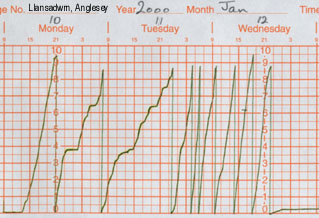 12th: Continuous moderate rain through the night and still falling at 0900 GMT. It was calm with very poor visibility. The ground is absolutely waterlogged with large pools of water on the surrounding fields. The percolate in lysimeter had overflowed 2 collecting vessels and there was water in the bottom of the receiver. This had to be absorbed by sponge and retained for measurement, at least the gale had ceased! The heavy rainfall on completely saturated soils has led to considerable runoff and flooding of roads to Llansadwrn. The river Cadnant draining into the Menai Strait was a torrent and flowing over the road at Llandegfan making it impassable. The A5111 at Llanerchymedd was reported flooded and the A5 to Holyhead was partially flooded in several places in the afternoon. At Gaerwen and Llanbedrgoch the floodwater reached all across the road. At Beaumaris the moat at the Castle had overflowed forming a large lake into Castle Street, threatening parts of the town and the local fire service was attending with pumps. The road between Beaumaris and Menai Bridge at Gallows Point was blocked by a landslide and fallen tree caused by the heavy rain. The A55 Expressway between Abergwyngregyn and Talybont was flooded and the A498 at Nant Gwynant was impassable to smaller vehicles. It was reported on TV that Capel Curig (Gwynedd) had recorded 137 mm rain in the 42-h to 1200 GMT. For the comparable period here the total was 70 mm. Further moderate rain in the afternoon added another 11.5 mm by 1800 GMT, 19.5 mm in total since 0900 GMT. Rainfall at Capel Curig since 09 GMT on Monday totals 163 mm. Here the total was 86 mm. It was still raining but turned to sleet for a while (the temperature at 21 GMT was 3.0C) but ceased before midnight. This added another 1.5 mm to the total for the day of 28.5 mm over 15.5-h duration. Over the 3 days 10-12th there was a total of 94.9 mm about the average rainfall for January. [Rain 28.5 mm; Max 6.3C; Min 5.9C; Grass 5.5C]
13th: The sky had cleared somewhat after midnight and there was a ground frost (-1.7C) with frozen water deposits on the grass and a thin layer of ice on water. Fresh snow had fallen on the mountains, moderate falls over the summits but a slight covering down to 1000 ft especially in the Nant Ffrancon Pass. It was a bright and sunny morning with a light N'ly breeze. Although still bright cumulus clouds became more developed in the afternoon producing some showers in the area. One shower containing ice pellets fell here about 15 GMT. It became cloudier from 1630 GMT with a shower of rain. Later the cloud thinned and the moon could be seen through the cloud at 1800 GMT. [Rain 3.3 mm; Max 6.0C; Min 0.7C; Grass -1.7C]
14th: A slight night ground frost (-0.2C). Signs of the cloud clearing and there were sunny spells throughout the day. The light wind remained N or NE'ly and it felt cold even in the sun. The maximum only reached 5.2C, the lowest of the month. A dry day. [Rain 0.0 mm; Max 5.2C; Min 1.4C; Grass -0.2C]
15th: The cloud was clearing from the NE and it was soon sunny with a light NE'ly breeze. With no rain since before 1800 GMT on the 13th, and a drying wind, it was beginning to feel drier underfoot this morning. Walking on grass was not the soggy experience of the last week and even fallen leaves in the wood looked drier. It was a sunny afternoon, which ended with a golden sunset. Ronaldsway (Isle of Man) recorded 7.1 h sunshine, the highest in the UK in the 24-h to 1800 GMT. Under the clear sky the temperature fell rapidly soon giving a heavy dew followed by a ground frost (-3.0C), but it became cloudy around 2230 GMT leading to a temperature rise. [Rain 0.0 mm; Max 6.1C; Min 2.5C; Grass 0.8C]
16th: It had been cold overnight with the minimum down to 0.1C. This was to be the lowest of the month. On the grass the minimum was -3.0C, the lowest of the month. The day was overcast as cloud within the high-pressure area (1043 mb) remained all day. There were periods of slight drizzle and the visibility was very poor with little or no wind. [Rain 0.5 mm; Max 6.5C; Min 0.1C; Grass -3.0C]
17th: There was a hint of some breaks in the cloud first thing in the morning but it soon thickened again giving another overcast day and no sunshine. It was very dull with a fine drizzle at times, anticyclonic gloom! [0.3 mm; Max 7.6C; Min 3.5C; Grass 1.7C]
18th: It was very gloomy at dawn with a moderate fog and continuous fine drizzle. There was no improvement in the afternoon with visibility remaining poor with a very light N-NE'ly wind. [Rain 0.4 mm; Max 7.0C; Min 5.2C; Grass 2.0C]
19th: Clearer today, the good visibility and higher cloud base gave views of the mountain summits. There was still snow lying above 3000 ft with extensive patches on the north-facing slopes of Ysgolion Duon. The thinner cloud gave a bit brighter day with little or no wind. A very red sun appeared below the cloud sheet near sunset. [Rain tr; Max 6.9C; Min 4.7C; Grass 4.2C]
20th: A very dark morning with very fine drizzle at 0900 GMT. The temperature was at its lowest (3.7C) for the past 24-h. Drizzle or light rain continued in the afternoon. The sky cleared by 2200 GMT, the moon (nearly full) was very bright. An eclipse of the moon occurred about 0445-0500 GMT but it was foggy and all I could see was an eerie orange glow in the sky. [Rain 0.9 mm; Max 6.0C; Min 3.7C; Grass 3.3C]
21st: The overnight fog had cleared and there had been a slight ground frost (-0.3C). There was slight drizzle and rain in the morning and further drizzle in the afternoon. The sky cleared somewhat in the evening giving a clear view of the full moon. The was a shower of rain overnight. [Rain 2.1 mm; Max 6.0C; Min 2.7C; Grass -0.3C]
22nd: There was ragged and broken cloud first thing and a squally shower just after 0900 GMT. This made a roaring noise in the trees for several minutes (force 6-7). There were further squally showers in the morning before becoming bright with sunny spells by noon. The afternoon was sunny but the wind had increased (NNE force 5). Cloud remained over the mountain summits. There was still a lot of snow patches to be seen giving about a 50% cover on some northern slopes. [Rain 1.3 mm; Max 7.3C; Min 4.0C; Grass 0.7C]
23rd: There had been an undulating temperature pattern overnight, 2 warm with max about 4.3C and 3 cold mins about 2.1C. The observations at 0900GMT were just out of the last of the cold periods. Alternating clear and cloudy periods probably caused these. The day remained clear and sunny with only a light N-NE'ly breeze. [Rain 0.6mm; Max 6.0C; Min 2.1C; Grass -1.0C]
24th: With the high pressure (1026 mb) still dominating the weather the cloud and drizzle had returned today. A little brighter by 1400 GMT. Little or no wind, very variable throughout the day, and almost no sunshine until near sunset when there was a spectacular sunset at 1645 GMT. There were snow showers over the mountains giving a slight covering on the peaks. [Rain tr; Max 6.0C; Min 1.1; Grass 0.6C]
25th: Huge high-pressure area dominating the UK and Europe (1029mb). A bright morning with a narrow band of clouds stretching along the length of the Snowdonia range as seen from here. Spectacular broad crepuscular rays seen as the sun was just rising above the cloud band at 0915 GMT. Fresh snow had fallen on the mountains. The morning and afternoon was quite sunny and, with little or no wind, was very pleasant out of doors. The maximum was 8.7C but at Red Wharf Bay 9.3C was recorded, the highest known in the UK on the day. Relative humidity was 74%, one of the 2 occasions of the month. Following a good sunset, with the sky partly clear, the temperature fell to a minimum of 0.5C and there was a ground frost (-2.4C). By 1900 GMT it had become cloudier and the temperature rose again. [Rain 0.0 mm; Max 8.7C; Min 0.5C; Grass -2.4C]
26th: The morning seemed bright at first, with broken high cloud overhead, but it soon was cloudier. By afternoon the clouds had darkened but there was no rain. A break in the clouds occurred from the W later and brought sunshine for a while. It became misty across the fields before dusk. [Rain 0.0 mm; Max 5.8C; Min 1.5C; Grass -2.0C]
27th: The thermograph trace showed recent undulating temperatures as patchy cloud passed over. At 0900 GMT there was altocumulus overhead 5 oktas and it had been clearing in the last hour. The morning was bright with some sunny spells but the afternoon was cloudier. At 1800 GMT the barometer was falling (1025 mb) and it had become windier. [Rain 1.0 mm; Max 7.3C; Min 1.3C; Grass -2.0C]
28th: The morning brought rain in a SW'ly force 6. Pressure was reading 1011 mb as a low S of Iceland was deepening and tracking E. During the morning the wind reached gale force and the Britannia Bridge was closed to high-sided vehicles. Some ferryboats from Holyhead were cancelled. Two bands of slight-moderate rain associated with warms fronts passed over during the day accumulating 8.6 mm. The temperature rose through the night, the maximum occurring at 0900 GMT on the 29th. [Rain 8.6 mm; Max 9.6C; Min 3.0C; Grass 0.8C]
29th: Pressure was steady at 994 mb at 0900 GMT and it was still windy, W'ly force 6. Although the wind moderated during the day ferries were again cancelled or delayed. Pressure began to rise slowly during the morning and was 996 mb at 1300 GMT, the maximum had reached 10.1C. In the afternoon there was at first drizzle then a band of rain from 03 GMT accumulated 4.2 mm by morning.[Rain 4.2 mm; Max 10.1C; Min 5.5C; Grass 4.8C]
30th: Another dull but mild morning. The temperature was 9.0C having varied little from noon yesterday. It was breezy in the SW'ly wind with slight drizzle around noon. In the afternoon it became windier, SW'ly force 6-7. A small temperature range during the day, 9.0C at 0900 GMT to the max of 10.1C and falling to 8.5C overnight produced a very flat looking thermograph trace. [Rain 0.8 mm; Max 10.1C; Min 7.1C; Grass 5.0C]
31st: Very dull from dawn and misty too. The overnight minimum was 8.5C, the highest of the month. By 1045 GMT fog had developed but visibility had improved to very poor by 1300 GMT. Slight drizzle at times in the afternoon and again became windier later SW'ly force 5-6. Another very flat thermograph trace, 8.5C-9.1C-9.5C-8.3C. [Rain 1.0 mm; Max 9.5C; Min 8.5C; Grass 8.1C]
Return to top of page
Return to home page
1st: It continued quite windy but dry throughout the night. Several rumbles of thunder were heard at 0318 GMT. The temperature at 09 GMT was 8.3C, the 24-h minimum and the highest of the month. It started to rain at 07 GMT and continued until 16 GMT accumulating 9.3 mm by 1800 GMT when it was misty. The road to Llanbedrgoch was flooded again. It was mild with a maximum of 9.2C. [Rain 9.5 mm; Max 9.2C; Min 8.3C; Grass 7.6C]
2nd: The sky was clearing to give a sunny morning. The wind had decreased and there had been a ground frost (-1.2C), frozen water deposits were melting on grass and plants in the garden. There was cloud over the mountains and it remained there all day, this obscured any view of the summits. It became cloudier by 1300 GMT but this cleared again to give a sunny afternoon and a clear evening. Some bluebell leaves have appeared in the wood, some are about 4 cm tall. [Rain 0.0 mm; Max 9.4C; Min 2.2C; Grass -1.2C]
3rd: It was bright at first but was soon cloudier and it began to rain later. The rain continued in the afternoon but there was a bright spell and a glimmer of sunshine later. At 17 GMT there was drizzle followed by slight rain through till morning. The temperature had risen throughout the day, the minimum was at 09 GMT and the maximum 9.3C from 03-08 GMT on the 4th. [Rain 12.6mm; Max 9.3; Min 3.7; Grass 0.3C]
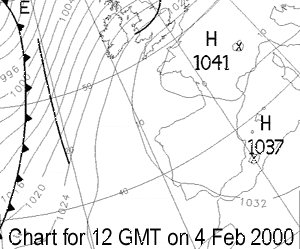 4th: It was moderately foggy with low cloud at dawn. Fine drizzle was being blown along in the SSW'ly force 6 wind. A pool of water had appeared in the old 'cricket' field next to the house. The ground is still saturated and any rain is enough to flood fields cause runoff on to the roads. Intermittent slight drizzle during the day with the wind remaining a S-SW'ly force 6. Visibility poor or very poor. Amounts of rainfall were small but when it dried significant deposits of a yellow-orange dust was found on top of the screen, edge of greenhouse glass, a garden table and the outlets of the raingauge funnels. This looked similar to the Saharan-type dust seen previously. The dust was also reported from Lisburn, Co. Antrim; Brampton, NE Cumbria; Wigan and Leeds. The synoptic chart indicates a S-SW'ly flow of air from N. Africa and suggests its likely origin. [Rain 0.4 mm; Max 9.5C; Min 5.9C; Grass 4.5C.
5th: Deposits of dried-out yellow-orange dust deposited yesterday still evident. The cloud was higher over the mountains this morning and there was a spectacularly vivid red sky at 0737 GMT. Could the dust in the atmosphere have enhanced the red sky? Volcanic dust and some pollutants can do this. The morning remained cloudy and the SSW'ly force 5-6 persisted. Later there was intermittent drizzle. There was some light rain in the evening and it became less windy. It remained mild. [Rain 3.4 mm; Max 9.4C; Min 8.0C; Grass 7.3]
6th: Light rain had just started at 0900 GMT but became intermittent. The S'ly force 4 increased during the morning and was force 7 at 1300 GMT. The afternoon was blustery with slight rain on the wind. Gale warnings were in operation for northern Britain and Irish Sea fast ferries were already being cancelled. Pressure fell to 1002 mb before starting to rise again in the evening. Gusts of over 70 mph were reported from stations N of here. The sky had cleared by 22 GMT when the barometer was reading 1009 mb. [Rain 6.7 mm; Max 10.0C; Min 7.7C; Grass 6.8C] 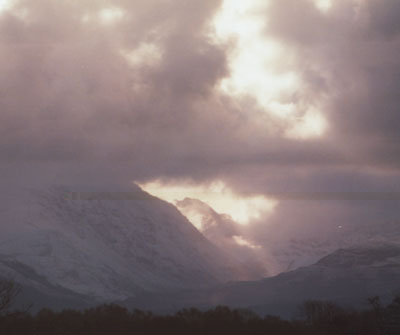 7th: It was again very windy with the SSW'ly at force 6-7 and with moderate rain made the 0900 GMT observations interesting! The rain eased but it continued blustery with strong gusts during the morning. After the rain it became bright and quite sunny for a while and the maximum temperature reached 10.5C. Colwyn Bay recorded 3.9 h of sunshine the most in the UK. but I do not think we had as much here (Valley recorded 1.9 h). There was a blustery shower at 1615 GMT then it was dry until 05 GMT when there was 3 h of light rain. [Rain 4.1; Max 10.5C; Min 4.7C; Grass 2.2C]
8th: A slight shower at 0900 GMT then it soon brightened. There was a sudden squally shower at 1135 GMT, the wind blew over dustbins and garden paraphernalia here and in Llandegfan. At Llanbedrgoch there was a 10-min hail shower (at least 5-mm according to the Postmaster) which covered the ground. There were further showers at Pentraeth and here about 1340 GMT (snow pellets and a few flakes of snow) and at Pentraeth only at 1430 GMT some ice pellets. There was a temperature drop of at least 4.5C during this episode. Spherics were recorded in the area and thunder was heard at Pentraeth. A thin covering of snow was deposited on the mountain summits during the afternoon. About 2130 GMT there was a slight shower of ice pellets at this station. In between the showers it had been quite a sunny day with Valley recording 5.4 h and Colwyn Bay 4.5 h. The Isle of Man was the UK highest with 6.8 h, all to 1800 GMT. [Rain 0.3; Max 9.7C; Min 6.1C; Grass 5.5]
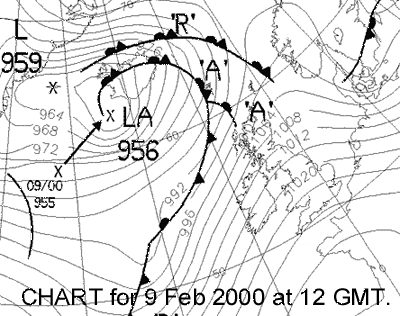 9th: There was a slightly pink sky at dawn and the morning remained largely cloudy with one or two bright and sunny spells. The wind was a gusty force 5-6 SW'ly which increase towards evening. At 2100 GMT pressure was 1010 mb and it was blowing a gale (force 8) with strong gusts (Valley was reporting gusts of 54 mph) which were throwing around a lot of tree debris. The gale continued until well after midnight and eventually became more S'ly. Valley was reporting gusts of 60 mph and pressure dropped to 997 mb at 05 GMT. A 4-h band or rain from 0230 GMT deposited 14.7 mm by morning. [Rain 14.7 mm; Max 9.6C; Min 3.5C; Grass 1.0C]
10th: Since 06 GMT the temperature had fallen 4C to 3.4C as the cold front had passed. The wind had veered to the WNW by 0900 GMT. There was a chink of blue sky visible to the N-NW and this soon spread over to give a largely sunny day. Relative humidity fell to 59%, one of the two occasions during the month. A covering of fresh snow had fallen on the mountains and was lying as low as 1500 ft in the Nant Ffrancon pass at Ogwen Cottage. At 1300 GMT cloud was hanging over the snow-covered Carnedd Llywelyn and Ysgolion Duon. The barometer was rising through the day and had reached 1018 mb at 1800 GMT. The sky was still relatively clear with a band of decaying cumulus clouds on the western horizon and over the mountains. It was a quiet night and no rain in the 24-h period. [ Rain 0.0; Max 7.7C; Min 9.6C; Grass 2.9C]
11th: The day soon became sunny, visibility was good although it was very hazy. A thin covering of snow could be seen lying on the mountains above 2000 ft. After dark it became increasingly windy, the SSW'ly was strong to gale most of the evening and became stronger after midnight. Valley was reporting a mws of 44 mph and gusts of 55 mph. Two short bands of rain from 02 GMT resulted in 14.7 mm accumulated over only 2.8 h. This was exactly the same 24-h amount as recorded on the 9th, but was of shorter duration. [Rain 14.7mm; Max 9.6C; Min 3.0C; Grass -1.0]
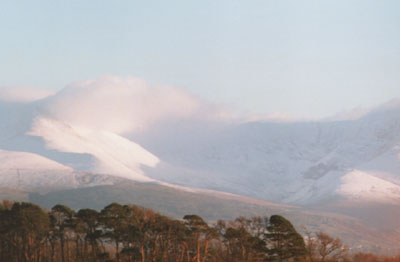 12th: Ice pellets had fallen in the night after midnight. The morning was bright with sunny intervals. Cloud was high over the mountains and a thin covering of fresh snow had fallen on the summits and down to 1700 ft in places. The temperature had reached the maximum for the day (6.6C) just before noon. The afternoon, bright at first, became showery with ice pellets at 1600 GMT and sleet later before the sky cleared later in the night. [Rain 3.0 mm; Max 6.6C; Min 3.0C; Grass 0.5C]
13th: An almost clear sky brought a sunny day. It was cold at first with an overnight ground frost (-2.2C) and some thin ice formed on a bird water trough. It was calm but a light NNW'ly breeze set in later. Valley reported 8.6 h sunshine, the highest along the North Wales coast but was exceeded by Scarborough (N. Yorkshire) with 9.0 h. A clear sky in the evening led to an early ground frost (-2.5C). [Rain 2.4 mm; Max 9.1C; Min 0.6C; Grass -2.2C]
14th: There was intermittent slight rain at first. The S'ly wind soon veered SW'ly and there was driving drizzle and poor visibility for a while. It began to clear from the NW at 1230 GMT when it became sunny. Bt 1300 GMT the temperature had risen to 12.2C and was to soon reach 12.8C, the highest of the month, before the mist and rain returned later in the afternoon. [Rain 5.2C; Max 12.8C; Min 1.2C; Grass -2.5C]
15th: There had been a touch of ground frost overnight (-0.5C). The morning was cloudy with a light SW'ly wind. Band of moderate rain from 14 GMT lasting 4.1 h. Rate of fall remarkably constant at 1.8 mm per h. The evening was cloudy but the cloud was thin and at 2000 GMT a double halo around the moon was seen. The moon almost full and very bright at present as its orbit is nearest the earth for many years. The inner ring probably 22deg and the outer possibly 46deg showed slight coloration. [Rain 7.3; Max 6.9; Min 2.7C; Grass -0.5C]
16th: Another ground frost and in good visibility fresh snow could be seen on the mountains down to 2000 ft. The was a slight shower of rain in the morning which was dull. The afternoon was brighter with sunny intervals at first but became cloudier by 1600 GMT. The maximum for the day was 5.5C, the lowest of the month. Later the sky cleared. [Rain 0.0 mm; Max 5.5C; Min 0.8C; Grass -1.9C]
17th: There was slight hoarfrost at first but it soon melted. The morning was sunny but it became cloudier in the afternoon with rain from 16 GMT, which turned showery in the night. [Rain 7.1 mm; Max 8.8C; Min 0.4C; Grass -3.4C]
18th: The morning was showery, the afternoon was drier and brighter with a little sunshine. The barometer reached a low of 999 mb during the day. The evening and night was partly cloudy with a shower of rain (1 mm) around 03 GMT. [ Rain 1.7 mm; Max 8.5C; Min 0.9C; Grass -1.7C]
19th: The sky was clear overhead but there was a bank of clouds hovering over the mountains. Visibility moderate at first soon became very good with clear views of the Lleyn Peninsular. Thin snow could be seen on Snowdon and the Carneddau Mountains down to 2800 ft. The was a spectacular sky after a cloudless sunset. Grading from blue above through gold then orange. [Rain 0.0mm; Max 7.4C; Min 3.6C; Grass 1.9C]
20th: There had been a slight air frost (0.4C), rare this winter and the only one in the month. A moderate ground frost (-4.6C) was the lowest recorded in the month. This produced moderately thick ice on the bird water troughs. There was a lot of cirrus clouds overhead at 0900 GMT, it became cloudier but the morning remained bright. The sun could be seen through the clouds most of the day. There was some cumulus cloud development to the S over the mountains. It was windier later with a period of rain from 22 GMT of 3.5-h duration. [Rain 4.2mm; Max 8.4C; Min -0.4C; Grass -4.6C]
21st: It was a sunny day with a light W-NW'ly breeze. The maximum rose to 10.2C and the relative humidity fell to 59% for the second time in the month. There was a very golden sunset lighting lenticular altocumulus clouds in the west. Valley reported 8.5 h sunshine but this was exceeded by the Isle of Man (8.6h) and Prestatyn 9.2h (the UK highest). [Rain 0.0mm; Max 10.2C; Min 1.6C; Grass -1.5C]
22nd: It was almost overcast but the cloud was high and all the mountain summits were clearly visible for once. A little snow could be seen on the summits of Snowdon and Crib Goch, Y Garn and the Glyders around Cwm Idwal, and the Carneddau. The summits of Dafydd, Llywelyn and Foel Fras were illuminated by a band of crepuscular rays. During the afternoon the cloud was a little lower over the summits. In Llansadwrn there were a few spots of rain. Many autumn sown fields of cereals in the area have wet patches in which the plants have not germinated or have died. [Rain tr; Max 8.4C; Min 0.5C; Grass -3.5C]
23rd: Slight rain at times and poor visibility in the morning. The afternoon was no better with drizzle and periods of rain from 21 GMT. [Rain 2.9mm; Max 10.0C; Min 4.3C; Grass 3.7C]
24th; Some signs of clearing first thing but it was soon duller. The cloud was high and thin with the sun shining weakly through at times. It was very hazy. Rain and some ice pellets in the evening. [Rain 2.5mm; Max 7.6C; Min 3.5C; Grass 0.0C]
25th: There had been a ground frost overnight with a slight glaze of ice on the concrete paths. A sunny day, it was very hazy and visibility was moderate improving to good later in the afternoon. The sky was still clear at 22 GMT but it became cloudy later in the night with showers of rain from 05 GMT; [Rain 1.1mm; Max 9.5C; Min 0.5C; Grass -3.9C]
26th: Another sunny start to the day the showers having cleared away. During the afternoon it became cloudier and the SW'ly wind soon increased to force 6-7. It was to blow a gale before midnight, Valley reporting mws of 40 mph and gusts of 52 mph. A period of rain from 18-19 GMT and moderate rain from 05 GMT. [Rain 5.4 mm; Max 9.8C; Min 3.8C; Grass 1.0C]
27th: The gale continued after midnight with Valley reporting mws of 44 mph and gusts of 54 mph. It was still raining with gale force wind at 09 GMT. The wind moderated but the rain continued until 17 GMT. The old cricket field opposite the house had large pools of water on it all day. There was some more rain in the night and this brought the 24-h total to 25.4 mm, the largest of the month. [Rain 25.4 mm; Max 9.7C; Min 5.2C; Grass 3.7C]
28th: There had been a slight fall of ice pellets after midnight. The morning was bright clearing to give sunny spells during the morning. Fresh snow had fallen on the mountains down to 2000 ft and near the road at Ogwen Cottage. The afternoon was sunny but became cloudier later. [ Rain 7.0mm; Max 7.8C; Min 4.1C; Grass 1.9C]
29th: There was a period of rain from 01-08 GMT, which accumulated 7.0 mm. As the rain ceased it became moderately foggy for a while but was clearing by 0900 GMT. It remained cloudy and there was a shower of rain at noon. The afternoon was sunnier for a time then there was another shower. By 22 GMT the sky was clear and there was to be a slight ground frost (-0.1C). [Rain 1.8mm; Max 8.0C; Min 4.8C; Grass 3.0C]
Return to top of page
Return to home page
1st: A clear sky overnight with little of no wind resulted in only a touch of ground frost (-0.1C). The morning was bright with sunny intervals but there was a slight shower of rain. At 1300 GMT there were quite active looking cumulus clouds to the S and W. A thin sprinkling of fresh snow could be seen on the mountains down to 2750 ft adding to patches remaining from previous falls. At 1455 GMT there was a moderate shower of ice pellets followed by sleet which fell as snow on the mountains as low as 1000 ft. Further shower of ice pellets at 1635 GMT. The day's maximum was 8.2C one of the two lowest of the month. At 2200 GMT the sky had cleared and there was a ground frost before cloud and rain from the NW. [Rain 7.4 mm; Max 8.2C; Min 2.5C; Grass -0.1C]
2nd: Continuous moderate rain at first and becoming windier. Heavier spells of rain around noon shown on the new rainfall radar pictures available online from the BBC weather pages. Wind SW'ly force 6-7 during the afternoon and very poor visibility at times. Rainfall at Capel Curig to 18 GMT was 43 mm, the largest fall reported in the UK. There was further moderate rain in the night bringing the 24-h fall here to 15.8 mm over 9.3-h duration, the largest fall of the month. As the soil is still saturated runoff from the fields resulted in flooded roads, especially at Llanbedrgoch near the Post Office. The 'cricket' field opposite the house again had large pools of water on it throughout the day. [Rain 15.8 mm; Max 9.2C; Min 1.8C; Grass -1.7]
3rd: There had been a touch of ground frost (-1.0C) as the sky cleared following the rain. The sky was clear overhead but a bank of clouds and mist was obscuring the mountains. It became cloudier by 11 GMT but remained dry. The maximum of the day was 8.2C and along with that on the 1st being the lowest of the month. Slight deposits of dust were seen when surfaces had dried. These looked similar in colour to that deposited on 4th February and thought to be of Saharan origin. The possibility of it being from the Icelandic volcano Hekla remains, but unlikely owing to its colour. The afternoon was sunny and when the cloud had cleared away from the mountains snow could be seen around 3000 ft on the summits of Snowdon and the Carneddau. It became cloudier towards dusk, with moderate sunset colours, and there was a shower of rain and ice pellets at 1845 GMT. [Rain 0.6 mm; Max 8.2C; Min 2.5C; Grass -1.0C]
4th: A calm morning with weak sunshine. Smoke could be seen in the Menai Strait. There had been an overnight frost (-1.6C, the lowest and only of the month) and a moderate ground frost (-5.8C, the lowest in March since 1995) with hoarfrost deposits on the grass and vegetation. There had also been a slight fall of small (1-2 mm) snow pellets. It was soon sunny, cumulus clouds began to develop as the temperature rose to 9.5C and the relative humidity fell to 57%, the lowest of the month. The afternoon remained sunny in the light N-NW'ly breeze. It was partly cloudy by 2200 GMT.[Rain 0.0 mm; Max 9.5C; Min -1.6C; Grass -5.8C]
5th: A sunny start to the day, a ground frost (-3.5C) but the air temperature kept just above freezing (0.3C). It became windy, SW'ly force 5 and this helped to dry the ground a little more. Leaves on the ground in the wood were also drying and blowing around. Cumulus clouds were scudding by. Moderate snow could be seen at 3000 ft especially on the flatter tops of the Carneddau, and Snowdon. Slight snow also down to 2800 ft in places. The afternoon, sunny at first, turned cloudy by 1500 GMT. It remained windy, SW'ly force 5-6, and there was drizzle by 2200 GMT. [Rain 0.4 mm; Max 9.1C; Min 0.3C; Grass -3.5C]
6th: A dull morning and it soon became moderately foggy. This was to clear later and it became sunny by noon reaching 10.7C by 1300 GMT and soon reaching 11.7C. It was not to last and mist rolled in again in the afternoon from time to time and there were spots of rain at 1615 GMT. [Rain 5.7 mm; Max 11.7C; Min 4.6C; Grass 3.9C]
7th: A band of rain from 04-06 GMT amounting to 5.7 mm. Fog and low stratus cloud with occasional drizzle followed. A miserable day. [Rain 0.4 mm; Max 10.3C; Min 8.0C; Grass 7.7C]
8th: Moderate fog at first but improved to poor visibility later in the morning. The afternoon was dull and damp with fine spots of drizzle on the wind (SW'ly force 4). The leaves of hawthorn and the white flowers of blackthorn are appearing in the hedgerows. [Rain 0.4 mm; Max 11.6C; Min 8.5C; Grass 8.3C]
9th: With the wind in the W the murky weather showed signs of clearing. It became brighter during the morning but the mountains remained obscures in cloud and mist. The afternoon was bright at first but there was a period of light rain from 16-19 GMT accumulating 4.0 mm. The minimum of 8.8C was the highest of the month. [Rain 4.0 mm; Max 12.9C; Min 8.8C; Grass 6.4C]
10th: Back to the murky weather with cloud hanging low over the mountains. Fine drizzle for a while in the morning with visibility moderate to poor. Another day without any sunshine. Further drizzle at 2100 GMT but an unmeasurable amount, the bottle being dry next morning, but contained traces of dust. There had been a further slight deposition of dust, which looked 'plaster pink' in colour suggesting it was of Saharan origin. [Rain tr; Max 9.6C; Min 7.8C; Grass 7.3C]
11th: A brighter morning with signs of clearing at 09 GMT. There were some sunny spells, especially in the afternoon, and it felt warm as there was little or no wind. It was cloudier before dusk but cleared again by 2200 GMT. [Rain nil; Max 11.5C; Min 7.0C; Grass 6.1C]
12th: A slight ground frost overnight (-0.9C]. By 09 GMT any frozen water deposits had melted. Deposition of water on the grass had been heavy. Although there were signs of the cloud thinning the morning remained overcast. During the afternoon it was brighter with even a few sunny spells. Again little or no wind so it felt pleasant out of doors although the maximum reached only 9.8C. It became cloudier later and there was a short spell of drizzle around 1930 GMT. Deposition of dust had been reported in N. Ireland during the afternoon but none was seen here. [Rain tr; Max 9.8C; Min 3.8C; Grass -0.9C]
13th: A cloudy start to the day. Visibility was poor it being very hazy. From time to time it appeared brighter. By 1300 GMT the temperature had reached 13.6C and this was the maximum for the day and the highest of the month. It was soon cloudier and there were a few spots of rain by 1500 GMT and 0.5 h light rain from 1600 GMT.A deposit of dust occurred, visible on dried surfaces the next morning, light orange in colour suggesting it was again of Saharan origin. [Rain 0.5 mm; Max 13.6C; Min 7.7C; Grass 5.8C]
14th: It was beginning to clear and the morning was bright with thin cloud cover. Visibility was good but it was hazy. Cloud remained on the summits of the Snowdonia Mountains. The cloud was thick enough later in the afternoon to deposit a little rain but the raingauge bottle was dry on the following morning. [Rain tr; Max 10.2C; Min 6.7C; Grass 6.0C]
15th: An intensifying area of high pressure (1036 mb) was settled over the UK. Unfortunately there was a lot of cloud around and the day remained cloudy. The temperature did not vary a lot during the next 24-h and there was no rain. [Rain 0.0 mm; Max 8.9C; Min 2.6C; Grass -0.3C]
16th: Overcast and calm. In the garden the ground was drier and leaves in the wood were also dry on the surface. It remained dull except for 1 or 2 small breaks in the afternoon, these soon closed over again. There was some drizzle around 2200 GMT. [Rain tr; Max 10.6C; Min 6.5C; Grass 6.3C]
17th: Again overcast and very dull. The gloom continued with slight drizzle around noon. Another deposit of dust, of likely Saharan origin, probably about the time of the drizzle. When wet the dust looks light orange in colour, but when collected on filter paper and dry looks like unpainted 'pink wall plaster'.
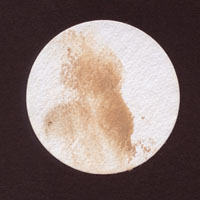
It remained cloudy and dull into the evening. A period of rain from 03 GMT for 3.9h deposited 3.3 mm.[Rain 3.3 mm; Max 10.2C; Min 7.1C; Grass 6.5C]
18th: The mist and cloud was clearing slowly in the morning. By 1000 GMT the temperature had risen to 12.2C and this went on to reach 13.1C. The afternoon was quite sunny and the cloud gradually cleared the summits of the Carneddau Mountains but not of Snowdon. The mountains had been largely obscured for the past 12 days. The sky was clear at 2200 GMT and this led to a slight ground frost (-1.0C). [Rain 0.0 mm; Max 13.1C; Min 7.4C; Grass 6.4C]
19th: Cloudy again by morning, the sun did show through rather thick cloud around 0900 GMT but it did not begin to clear until 1600 GMT. After dark the sky was clear and low lying fog developed for a few hours. This had cleared by 2000 GMT before clouding over again. There was heavy dew but the grass minimum did not drop below 0.2C. [Rain 0.0 mm; Max 10.8C; Min 3.5C; Grass -1.0C]
20th: Another dull morning with 8 oktas cloud cover. There was a layer of smoke haze in the Menai Strait but the mountaintops were visible in clearer air above about 2500 ft. The day remained dull with little or no wind. [Rain 0.0 mm; Max 9.6; Min 3.6C; Grass 0.2C]
21st: At first there were one or two breaks in the cloud, these soon disappeared and it was another dull overcast but dry day. [Rain 0.0 mm; Max 10.5C; Min 4.7C; Grass 1.6C]
22nd: Sunny today, the first for 10 days! Visibility was poor because of haze and there was very heavy dew on the grass. It remained cool as there was a NE'ly breeze off the sea but in Llandegfan on the south facing slope of the Menai Strait it felt quite warm. Anglesey turned out to be the sunniest in the UK with 9.5h. The first chiff-chaff of the season has arrived, 5 days earlier than last year, and was singing strongly in a willow tree in the garden. [Rain 0.1 mm; Max 10.1C; Min 2.6C; Grass 0.1C]
23rd: A slight shower at 0630 GMT was to set the pattern for the day. A deposition of Saharan dust was seen during the afternoon following the showers of rain and before a prolonged shower in the afternoon. There were further showers and slight rain from 06 GMT the next morning. [Rain 4.1 mm; Max 11.2C; Min 4.4C; Grass 2.0C]
24th: Following the showers and slight rain earlier there were signs of a clearance. The morning remained showery but the afternoon and evening was sunny. Anglesey had 8.3h sunshine but this was exceeded by Falmouth with 8.8h. With the spell of drier weather ploughing of nearby fields was well underway. Work in gardens was also being started now that the ground can be worked once again. [Rain 2.9mm; Max 11.1C; Min 6.6C; Grass 3.4C]
25th: A sunny start to the day and this was to continue all day. A thin covering of snow had fallen on the mountains of Snowdonia during the night and was lying as low as 2500 ft in places. Some well-developed cumulus clouds were seen to the south during the afternoon but it did not rain here. The sky was clear at 2200 GMT and there was a slight ground frost (-0.3C). Rain 1.4 mm; Max 10.5C; Min 3.3C; Grass 1.7C]
26th: A dull start to the day and there was to be slight rain before noon. In the afternoon the sky cleared and the rest of the day was sunny. [Rain 2.5mm; Max 9.6C; Min 3.3C; Grass -0.3C]
27th: Another sunny start to the day. There was heavy dew on the grass but the grass minimum had only dropped to 2.0C. Anglesey was clear but there were clouds to the NE and cumulus over the mountains with crepuscular rays in the Nant Ffrancon Pass. The day remained sunny but there was cool NE'ly wind. Anglesey was the sunniest reported with 11.4h. The first bluebell flower has appeared in the wood, much earlier than last year. [ Rain 0.0; Max 9.3C; Min 4.3C; Grass 2.0]
28th: Bright at first but soon cloudier. There was a cold NE'ly wind and by noon the temperature was only 6.7C. The afternoon remained cloudy but began to clear towards evening. At 2100 GMT the sky was clear, with bright stars, leading to a slight ground frost (-0.6C). It became cloudier before morning. [Rain 0.0; Max 8.4C; Min 3.4C; Grass 1.1C]
29th: Cloudy at first but becoming sunny by mid morning. The afternoon was sunny and it became less windy towards dusk. A clear sky at night led to a ground frost (-2.7C) by next morning.[Rain 0.0; Max 10.1C; Min 2.0C; Grass -0.6C]
30th: There was hoarfrost on the ground early but this soon disappeared in the sunshine. Small cumulus clouds developed around 0900 GMT and lasted for about 10 mins then disappeared. Some cloud was also spilling over the mountaintops at first. The rest of the day was sunny and cloudless. It was hazy and there was a cool breeze keeping the maximum down to 8.9C. The night was clear the minimum falling to 0.0C and to -3.7C on the grass. [Rain 0.0; Max 8.9C; Min 0.5C; Grass -2.7C]
31st: There was moderate hoarfrost making the grass in the fields look white. By 0900 GMT it was becoming cloudier with some cumulus to the S and cirrus and cirrostratus overhead. With several days of dry weather the ground has been drying out and the surface was dry for the first time. Pressure was declining as a low near Iceland was drifting towards NW Scotland. It remained bright until mid afternoon when it became murky and there were some fine spots of drizzle about 1900 GMT. A band of rain from before midnight resulted in 4.8 mm by morning.[Rain 4.8 mm; Max 10.0C. Min 0.0C; Grass -3.7C]
Return to top of page
Return to home page
1st: A dismal start to the day, poor visibility and slight rain that stopped just before 0900 GMT. The day remained overcast with little or no wind. There was further rain in the afternoon and about 2100 GMT, which also included some ice pellets. [Rain 2.7 mm; Max 9.1C; Min 4.6C; Grass 3.7C]
2nd: Early low lying inversion fog was clearing before 0900 GMT but remained in the Menai Strait and around some headlands. The mountaintops were clearly visible above the fog. During the day there were spells of drizzle or light rain that turned to moderate rain from 1800 GMT. From 1500 GMT the temperature fell slowly from near the maximum (9.2C) to 1.8C at 0900 GMT on the 3rd. The rainfall of 13.1 mm over 15.8-h duration was the most in the month. [Rain 13.1 mm; Max 9.2C; Min 4.6C; Grass 0.5C]
3rd: Continuous slight rain with intermittent sleet or snow from 0630 GMT. There were large pools of water again on the old cricket field opposite the house. The recent drier weather not having reduced the soil water content by very much. Strong NE'ly wind led to disruption of Irish Sea ferry crossings to Ireland. The HS ferries were cancelled and conventional craft were delayed. The Britannia Bridge was closed to high-sided vehicles. Rain here had been falling as snow above 500 ft on Snowdonia and Cheshire. There was 1 in of snow reported from Bethesda in the Nant Ffrancon Pass and the A5 at Ogwen Cottage was difficult. There was deep snow reported at Blaenau Ffestiniog. The Horseshoe pass near Llangollen became particularly hazardous and the road was closed. Worst hit was NE Wales with roads shut and homes without electricity. At Bwlchgwyn near Wrexham electricity was off all day. Sleet or snow showers continued here all day but amounts of precipitation were small. There were showers of ice pellets later in the day starting at 1840 GMT and going on until midnight. The day time temperature struggled to reached 2.4C while the 24-h maximum of 3.5C, at 09 GMT on the 4th, was the lowest maximum in April recorded at this station since records started in 1979. [Rain 0.9 mm; Max 3.5C; Min 1.8C; Grass 1.3C]
4th: A sunny start to the day but with a strong NE'ly wind. Temperature at 0900 GMT was 3.5C, the maximum for the last 24-h. The morning continued sunny but with some snow flurries later in the day. It became less windy towards evening. Clear conditions enabled good views of the snow covering the Snowdonia Mountains. The snow stretched all across from the east, where it was thickest, to the Rivals Mountains (Yr Rifl) on the Lleyn Peninsular in the west. Valley recorded 9.2h sunshine for the day. [Rain tr; Max 7.3; Min 1.5C; Grass -0.4C]
5th: An area of high pressure extending from Ireland was building across the UK. Pressure (1019 mb) was rising and it was a sunny morning and very clear air. There was frost on the ground early with the grass minimum down to -2.6C. Views across Anglesey to the mountains, still covered with snow, and to the Lleyn Peninsular were stunning. The snowline was around 800 ft: snow was thickest on the summits of Carnedd Llywelyn, Foel Fras and eastwards but thinner at lower levels. There was a sprinkling of snow still remaining on Yr Eifl on the Lleyn Peninsular. It was very sunny all day with Colwyn Bay recording the highest sunshine in the UK for the day with 11.9h, Valley 11.8h. [Rain nil; Max 9.0C; Min 1.0C; Grass -2.6C]
6th: Another sunny start to the day with an early extensive hoarfrost, the grass minimum of -3.7C was the lowest of the month. The temperature at 0900 GMT was 8.1C and there was hardly any wind. The wind remained variable from the NE, off the sea, and sometimes S-SE'ly. The lysimeter was dripping as a result of the melting of frost deposition although water had not been added since 0900 GMT on the 5th, there having been no rain. The day remained largely sunny although a little cloud built up from time to time as a result of the convergence of cool air off the sea and warmer air from the S. Relative humidity was 43% for a large part of the day, the lowest of the month. The maximum rose to 13.5C, one of the highest in the UK. Leuchars in Scotland reported 14C. The evening and night were clear leading to another ground frost (-1.6C). A display of Northern Lights (Aurora) was seen from Anglesey, and other southern parts of Britain, around 00 GMT. Alistair Read reported a 'grand display...red band with some curtain displays of white/green lights varying in intensity'.[Rain nil; Max 13.5C; Min 1.1C; Grass -3.7C]
7th: The day dawned sunny with an extensive ground frost (-1.6C). There were many cirrus clouds overhead and it was very hazy, views of the mountains and the Lleyn very blurred today. At noon the temperature was 10.9C but the afternoon became even hazier and, with thin cloud, the sun was obscured. There was a front approaching from the NW and the cloud thickened but it remained dry. [Rain nil; Max 12.1C; Min 2.2C; Grass -1.6]
8th: Bright at first but with thick haze visibility was poor. Clouds were fragmented cumulus with cirrus above. It became dull by noon and later dark and murky with a few spots of fine rain. Rain over Scotland moving south was petering out as it reached here. The wind a light SW'ly in the morning moved to the NE as brighter weather arrived later in the day. Before dusk it had become dull again. [Rain tr; Max 10.1C; Min 4.4C; Grass 2.0C]
9th: There were heavy spots of rain about 0730 GMT but these did not wet the ground completely. It made no difference to the soil, which for the third morning in succession was recorded as dry. It became bright for a time later but soon turned cloudier until later in the afternoon when it brightened. The evening and night had a hazy clear sky with a slight touch of frost on the grass by morning. [Rain nil; Max 8.9C; Min 4.5C; Grass 2.2C]
10th: A golden red sunrise over the mountains to the east just before 06 GMT set the seen for the day. A cloudless sky at 0900 GMT, the first of the year, but it was hazy with smoke in the Menai Strait obscuring the mountains. Pressure was 1020 mb. The wind was a light NE'ly but the maximum reached 11.1C before noon. The afternoon, sunny at first, became cloudier later and remained dry. The barometer had fallen to 1014 mb at 1830 GMT. A 6-h band of rain from 23 GMT accumulated 6.8 mm. [Rain 6.8 mm; Max 11.1C; Min 2.8C; Grass -0.1C]
11th: Early rain ceased about 06 GMT then there was a sign of the sky clearing but this did not last. The morning remained dull with spots of rain and a slight shower of ice pellets at 1055 GMT. In the afternoon there were further showers of rain and sleet, which fell as snow on the mountains of Snowdonia. Further showers before and after midnight of rain and ice pellets. [Rain 4.0 mm; Max 6.6C; Min 3.9C; Grass 1.7C]
12th: The day was dull with slight rain at first. It became windier later and there was further rain from 1630-1830 GMT. [Rain 1.1 mm; Max 8.5C; Min 3.0C; Grass 1.7C]
13th: At dawn it was raining slightly and the day remained very dull with intermittent slight rain. The forecast for the week had been deteriorating and hopes of a fine sunny day for Friday (when Gordon our son was being married in Conwy) were fading. The forecast for Wales was not good but my digital 'Oregon Barometer' was forecasting a sunny day! The family was disbelieving but the analysis chart was showing better weather to the north and it was likely to reach the North Wales coast by the morning. [Rain 0.9 mm; Max 5.8C; Min 4.5C; Grass 3.3C]
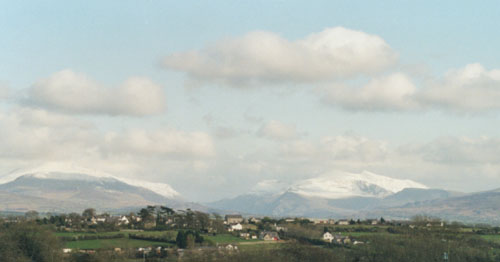 14th A bright start to the day, and a clearance from the North, enhanced my forecasting reputation enormously. The day was sunny with just a chance of showers over the mountains at first but this receded as the day went on. The morning and afternoon was sunny, although there was a cool NE'ly breeze. Snow was lying down to about 2000 ft in places on the Snowdonia Mountains. Valley (Anglesey) reported 7.6 h sunshine and Ronaldsway (Isle of Man) 9.8 h, the highest in the UK for the day. [Rain nil; Max 8.5C; Min 3.7C; Grass 2.2C]
15th: A bright start to the day with frost on the ground early. With some good sunny spells, and very light wind, the temperature reached 10.3C, with a relative humidity of 47%, about 1130 GMT. Some cumulus clouds were bubbling up however and it became cloudier after noon. At noon the temperature had dropped to 7.7C and soon to 4.3C. There was a slight shower of snow pellets, and then further snow pellets and some snow flakes intermittent for about 1 h from 1305 GMT. The afternoon was dull at first with further intermittent slight rain. Later it was brighter and the sky cleared before nightfall. [Rain 0.3 mm; Max 10.3C; Min 0.6C; Grass -3.3C]
16th: Another bright start to the day, an overnight ground frost (-2.6C) had melted by 0900 GMT. The minimum of 0.5C was the lowest of the month. There was a change of wind direction, the N-NE'lies of the past 7 mornings had given way to a S'ly. The temperature at 0900 GMT was 8.8C, the warmest of the month so far. It was soon cloudier with very slight showers. This was to be the pattern of the day with further spots of rain with only a few bright spells, but the temperature kept around 10C (max 11.1C) until 19 GMT. There was a band of rain from about 03 GMT that accumulated 8.0 mm by morning. [Rain 8.0 mm; Max 11.1C; Min 0.5C; Grass -2.6C]
17th: A wet start to the day with moderate rain. This had eased by 1100 GMT but there was intermittent drizzle later. At noon the temperature was only 5.1C, with slight drizzle, and it was only to rise to 5.6C during the day. The lowest since the 3rd, and April 1992. Further rain in the afternoon, about 1 mm by 1700 GMT. The temperature at 0900 GMT the next morning was 6.5C, having just started to rise, this was the 24-h maximum for the 17th. [Rain 5.8 mm; Max 6.5C; Min 3.2; Grass 2.8C].
18th: A band of rain from 04-06 GMT had cleared away and it was becoming bright with some sunshine. This had fallen as snow on the mountains down to 2000 ft. During the morning at times it was cloudier with slight showers of rain. By noon the temperature had reached 10.7C and the afternoon was sunny with a maximum of 11.4C. The light SSW'ly wind backed to the NE later and at dusk the sky was clearing leading to a slight ground frost (-0.7C). [ Rain tr; Max 11.4C; Min 3.8C; Grass 1.4C]
19th: At 0130 GMT there was low lying fog across the fields but this had cleared by dawn. The morning was sunny and warm in a light S'ly breeze. By noon the temperature had reached 13.6C, this was to rise to 14.0C with a relative humidity of 45% just before frontal cloud moved across. There were some heavy spots of rain at 1500 GMT and further showers in the night. [Rain 0.7 mm; Max 14.0C; Min 3.1C; Grass -0.7C]
20th: Bright at dawn but there were cumulus clouds building aver the mountains. By 0900 GMT there was a shower of rain in progress and the day continued showery. The minimum of 9.4C was the highest of the month. The afternoon was windy with the S'ly increasing to force 6-7 at times. There was a shower with ice pellets at 1419 GMT. It was quite sunny with Valley reporting 9.0 h sunshine, the highest reported in the UK for the day to 18 GMT. [Rain 2.5 mm; Max 13.9C; Min 9.4C; Grass 7.8C]
21st: The morning was showery with bright and sunny spells. Showers were to be the pattern for the day, but amounts of precipitation were small. There was a longer spell of rain in the night that contributed most to the 24-h total of 4.4 mm. [Rain 4.4 mm; Max 13.2C; Min 8.2C; Grass 6.7C]
22nd: The rain was clearing away and the morning was bright. In the afternoon there was some dark looking cumulus clouds hanging around and eventually there were some spots of rain. The temperature rose to 14.5C, the highest this year so far. At 1553 there was a short shower of ice pellets. The sky began to clear later and at 21 GMT it was cloudless. The wind was a warm S-SW'ly and the temperature remained above freezing even on the grass. [Rain 0.1 mm; Max 14.5C; Min 7.1C; Grass 4.7C]
23rd: There was a sunny start to the day but it soon became cloudier. By 0900 GMT it was dull and, although bright at times with sunny interludes, the morning remained on the dull side with patchy cloud. A cumulonimbus cloud had developed and there was a shower at 1330 GMT, but it was not heavy and did not last long. Later it became sunny again for a while. Valley reported 11.7 h sunshine, the highest in the UK ( 24-h to 18 GMT). [Rain 2.4 mm; Max 13.3C; Min 7.5C; Grass 3.8C]
24th: Early rain had just ceased by 0900 GMT. The cloud was beginning to thin and it became brighter through the morning. There was plenty of cumulus around in the afternoon and a few deposited some drops of rain. These were clearing away by 1500 GMT and it became sunny and warm with the temperature reaching 15.1C. Cloud had cleared from the summits of the Snowdonia Mountains and patches of snow could be still seen above 2500 ft. By 2100 GMT there was moderate to heavy rain which more or less persisted to 0900 GMT the next day, accumulating 11.4 mm over 7.3-h duration. Rain 11.4mm; Max 15.1C; Min 6.6C; Grass 3.0C]
25th: Low cloud and continuous moderate rain at first eased soon after 0900 GMT. There was standing water on grass and soil plot. Through the morning cloud and mist was being driven along at low level through the Menai Strait from NE to SW. In the afternoon it was occasionally bright but there were several showers of light rain. [Rain 1.3mm; Max 13.7C; Min 7.6C; Grass 6.6C]
26th: The morning was dull with slight rain or drizzle at times. By noon the temperature was only 10.7C. The afternoon remained mainly dull, with slight rain of drizzle, but there was a bright spell when the temperature rose to 13.0C. From 1800 GMT it began to clear but turned misty for a while. [Rain 5.3mm; Max 13.0C; Min 8.2C; Grass 7.3C]
27th: There was a heavy shower of rain about 04 GMT amounting to 3.8 mm. At 0900 GMT there were signs of the sky clearing but it remained mostly dull at first with a few spots of rain from time to time. There was a little more blue sky at noon but there was another light shower later on. Towards evening the sky had cleared a little more. [Rain tr; Max 12.3; Min 5.8C; Grass 2.6C]
28th: The sky had remained clear overnight but the minimum had kept up to 5.0C while on the grass it was 1.3C. There was very heavy dew. Just before 0900 GMT cumulus cloud began to form overhead and later there was quite active looking clouds over central Anglesey. There was a little light rain around 1500 GMT then a long spell from 2300 GMT until 0900 GMT the next day as a rain area moved from the SE to NW across Wales. Anglesey was on the northernmost edge. Rainfall was 7.1 mm over 10.5-h duration. [Rain 7.1mm; Max 13.2C; Min 5.0C;Grass 1.3C]
29th: It was calm with continuous slight to moderate rain at dawn until 0900 GMT when the pressure was 1012.7 mb. The morning remained murky with slight drizzle at times. At noon the pressure was rising slightly and the afternoon, while dull at first, became clearer as the wind became SW'ly. By 1800 GMT the sky had become cloudless. Pressure at 2100 GMT was 1017.4 mb. [Rain tr; Max 13.7C; Min 8.0C; Grass 7.5C]
30th: A sunny start to the day and with only a very light NE'ly breeze it felt quite warm. An area of high pressure was extending from Norway to Scotland and the west. By noon the temperature had risen to 15.1C and it was to go on to rise to 16.5C, the highest of the month. Some cumulus clouds were seen to the SW and some sea fog was blowing into Red Wharf Bay. Here being more inland and at 107 m it remained cloudless, although hazy, with maximum sunshine. Valley reported 12.6 h of sunshine, most was atExmouth (14.0 h). [Rain nil; Max 16.5C; Min 6.1C; Grass 1.6C]
Return to top of page
Return to home page
1st: A sunny morning. At 0900 GMT it was calm with a temperature of 15.0C, dew point 7.8C. Pressure was at 1027 mb. A slight deposit of dust, light in colour, was seen on the hailpad. There was some cirrostratus to the S/SW and cumulus built up during the day over the Snowdonia Mountains. Here it remained sunny and the maximum reached 17.0C. During the afternoon the cumulus dispersed and the sky cleared. Valley reported a maximum of 18C and 13.9 h sunshine; the most sunshine was at Tiree (14.3 h) as the west enjoys a taste of early summer weather. [Rain nil; Max 17.0C; Min 7.8C; Grass 3.3C]
2nd:Sunny with thick haze. This looked slightly coloured, especially looking towards Liverpool Bay. With the bright sunshine that the west coast has enjoyed the last days the pollution smoke probably contains ozone. Quite high concentrations are formed in the west of Wales and Scotland when it is sunny. The temperature at 0900 GMT was 14.0C. By 1000 GMT the temperature was not rising much due to a cool NE'ly breeze off the sea but did reach 15.3C by noon. During the afternoon there was some weak cumulus cloud development over the mountains and to the N and NE of here for a while, but soon dispersed. It became less hazy and the wind decreased in the evening. [Rain nil; Max 16.7C; Min 8.1C; Grass 3.9C]
3rd: Another sunny day with cloudless sky at 0900 GMT. Later cloud was seen streaming off to the west of the mainland mountaintops. A cool day with the maximum only reaching 13.3C in a NE'ly breeze reaching force 4 at times. There was a little cumulus cloud passing by around 1500 GMT but this cleared later and gave clear skies again. [Rain nil; Max 13.3C; Min 7.4C; Grass 5.8C]
4th: A lot of tree pollen and bud scales were lying on the screen roof at 0900 GMT. The wind was still NE'ly with 6 oktas cloud cover and the temperature was a cool 8.3C. Later in the morning the sky cleared but the temperature at noon was only 11.3C. The afternoon and evening remained clear but hazy and the maximum reached 12.3C. [Rain nil; Max 12.3C; Min 7.5C; Grass 5.6C]
5th: Another sunny start to the day. Visibility was good but there was smoke pollution. At noon the visibility had deteriorated to poor and there was a little cloud to the NE and SW of the station. During the morning the temperature had risen to 14.3C and in the afternoon some cumulus clouds built up and later dispersed. It remained very hazy. There were many thunderstorms over France and Spain but had not yet reached the S coast of England. The first Anglesey grown potatoes of the season were on sale at Llanbedrgoch, a week earlier than last year, at £1.50 per kilo (68p per pound). At Brynsiencyn, asparagus was on sale for £2.50 for 340g. [Rain nil; Max 15.5C; Min 5.3C; Grass 3.6C]
6th: Sunny but with poor visibility in the thick haze. There was still a cool NE'ly breeze but the temperature was to go on to reach 19.5C. There was some cumulus cloud development early in the afternoon but this later dispersed. [Rain nil; Max 19.5C; Min 9.5C; Grass 7.4C]
7th: It had been a warm night with a minimum of 11.2C. At 0900 GMT there was some cloud to the S, otherwise clear. Visibility was poor in the thick haze. The NE'ly breeze remained light and the temperature reached 19.8C about 1300 GMT. There was more cloud development in the afternoon and for a while looked quite threatening to the S. It remained bright and sunny here but there was a shower, only spots of rain not enough to wet the ground or person, around 1500 GMT. It was later to clear to sunny again by the evening. [Rain tr; Max 19.8C; Min 11.2C; Grass 8.7C]
8th: Another warm night with a minimum of 10.5C. At 0900 GMT it was sunny and the temperature was 16.7C with a dew point of 8.6C (RH 59%). The wind was a light NNE'ly and the grass was dry! There were moderate deposits of tree pollen and bud scales. A sunny afternoon with the usual cool N-NE'ly breeze. Some small cumulus appeared to the S but again soon dispersed. Later the wind lessened and it became calm in the evening. At 1700 GMT the temperature of the dry soil at 5cm depth was 25.0C. [Rain nil; Max 18.6C; Min 10.5C; Grass 8.8C]
9th: A cloudless sky at 0900 GMT and although there was a breeze off the sea the temperature was 16.6C. The day continued sunny but the visibility was poor in the very thick haze. Early in the afternoon cumulus was seen over the mountains to the S for a while but these dispersed later. Storms over N France were moving along the Channel to the NE but there were only a few isolated showers over Britain including one in mid Wales and Snowdonia. [Rain nil; Max 19.5C; Min 10.5C; Grass 8.2C]
10th: Another cloudless start to the day but fog or low cloud could be seen in Red Wharf Bay. The morning was sunny with some haze but by noon the fog or low cloud had extended to here. This gradually thinned and later it was sunny again. In the evening the sky cleared as the wind veered E'ly and freshened to force 4. It remained windy until morning. [Rain nil; Max 17.3C; Min 9.7C; Grass 8.1C]
11th: A cloudy morning with the wind still a force 4 E'ly. There were several layers of cloud comprising cumulus, altocumulus and cirrus. There was heavy deposition of tree pollen on flat surfaces. By noon it was windier and several lee-wave clouds could be seen in the lee of the Snowdonia Mountains. Rainfall radar showed that showery rain had passed the station by, moving centrally up the Irish Sea. Lee-wave clouds still could be seen in the afternoon. It had become cloudier by 1500 GMT and there was a rumble at 1654 GMT but was thought not to be thunder. Spherics were not recorded in the area but the system may not register the odd occurrence. [Rain nil; Max 16.2C; Min 9.5C; Grass 8.4C]
12th: There have been 13 days without measurable rainfall. The hygrograph trace indicated that the relative humidity had dropped to 49% at 0400 GMT. The wind now E'ly could have been for a while SE'ly, off the mountains, resulting in the low humidity observed. A partially cloudy but bright morning with sunny spells when the temperature rose to 18.5C. The afternoon the sky cleared for a time and the temperature rose to 19.5C, we still have not recorded a 20C this year! By 1600 GMT the sky had become overcast and there was a little rain (0.2mm) about 0330 GMT on the 13th. [Rain 0.2mm; Max 19.5C; Min 8.9C; Grass 7.4C]
13th: The soil and paths were quite dry after the slight rain shower but the grass was wet. The wind was S'ly and there was weak hazy sunshine. The overnight minimum was 12.5C, the highest of the month. There were cumulus clouds in the vicinity and by noon it was quite murky although the temperature had risen to 18.7C. The afternoon remained murky at first, with fleeting glimpses of the sun raising the maximum to 19.5C, and gradually cleared to give a sunny evening. It was a clear moonlit night with a low mist across the fields by midnight. [Rain nil; Max 19.5C; Min 12.5C; Grass 11.3C]
14th: Early tufted and spiral cirrus clouds were diminishing by 0900 GMT. The temperature was a warm 19.5C equal to yesterday's maximum in a light SE'ly breeze with good visibility. There was a nice lenticular lee-wave cloud to be seen to the S of here. The wind remained a S-SE'ly and increased to force 3 by noon. The temperature went on to reach 24.1C by early afternoon. The first 20C, or more, and the highest of the month and year so far. Cloud encroached from the west by 1500 GMT but it remained warm. [Rain nil; Max 24.1C; Min 11.6C; Grass 8.5C]
15th: Rainfall radar showed rain in the Irish Sea just clipping west Anglesey in the night. It was trying to be bright early but soon was very murky with poor visibility. The grass was almost dry but there had been slight dew. The temperature rose to 15.7C before declining and there was the odd spit of rain felt on the skin. Temperature at noon was 13.6C. The afternoon continued dull at first before clearing from the west by 1400 GMT with good visibility. It was then sunny and the maximum reached 18.1C. By 1830 GMT it had become cloudier again. [Rain tr; Max 18.1C; Min 11.8C; Grass 8.8C]
16th: It was overcast but dry, including the grass at 0900 GMT. It was cooler with a temperature of 13.0C. By 1115 GMT there were the first spots of rain and the day remained dull, windy at times, with periods of rain. Pressure reached a low of 1006 mb at 1700 GMT before clearer weather appeared from the S. There was a further period of rain from 1100-0400 GMT. By morning 5.9 mm of rain had accumulated, over 9.6-h duration, the first substantial amount for 17 days. [Rain 5.9mm; Max 13.2C; Min 10.4C; Grass 9.4C]
17th: A bright start to the day in a blustery SW'ly wind force 5 at times. Much cooler with a maximum of only 11.7C. The afternoon had sunny spells but was showery. There were further heavier showers in the evening and before midnight, when the air temperature dropped to 6.2C, with slight ice pellets. There were further showers through the night. Total rainfall amounted to 8.3 mm, over 9.1-h duration, was the most during the month. [Rain 8.3mm; Max 11.7; Min 6.2C; Grass 5.6C]
18th: With the wind from the WNW the temperature at 0900 GMT was 8.7C. A slight shower was in progress but there were signs of the sky clearing. The wind remained WNW'ly and became force 3-4 by noon when the temperature had risen to 12.0C. There were good sunny spells in the afternoon but there was a shower later in the night. [Rain 0.4mm; Max 14.7C;Min 7.2C; Grass 6.0C]
19th: There were signs of the sky clearing in a NNW'ly wind, with a temperature of 9.8C, at 0900 GMT. Visibility was good, but there was cloud and mist on the summits of the Snowdonia Mountains. The morning was bright with occasional sunny spells. The afternoon was sunnier and by evening there was an almost clear sky. [Rain 0.1mm; Max 14.1C; Min 7.3C; Grass 6.5C]
20th: The overnight sky was clear and moonlit with the grass minimum falling to 3.5C. Cloud soon encroached from the west and by 0900 GMT it was overcast with slight rain. A very slow moving band of rain was crossing Ireland and affecting western coasts. The day remained murky with rain, heaviest around 1400 GMT, and with very poor visibility. A slow clearance began about 1800 GMT. Rainfall amounted to 3.8mm over 4.9-h duration. [Rain 3.8mm; Max 11.5C; Min 6.9C; Grass 3.5C]
21st: Slight rain and drizzle early was dying out and by 0900 GMT there was a break in the cloud cover. This was just a 'flash in the pan' as there were further slight rain or drizzle during the morning. After noon it became brighter and then quite sunny later when the wind had become NE'ly. [Rain 0.4mm; Max 15.4C; Min 6.6C; Grass 3.8C]
22nd: Overnight slight rain (1.5-h duration) from 01 GMT had already dried on concrete by 0900 GMT. Pressure had risen to 1015 mb as a weak ridge was affecting southern parts of Britain. There were cumulus clouds in the vicinity during the morning, which was mainly sunny and dry. Relative humidity fell to 48%, the lowest of the month. During the afternoon the sky cleared and by 1700 GMT was almost cloudless; with very good visibility there were stunning views to be seen across the Menai Strait to the Snowdonia Mountains and the Lleyn Peninsula. A local saying that if it is very clear it will soon rain was proved correct as there was cloud and rain from just before 01 GMT. [Rain 7.3mm; Max 15.0C; Min 8.0C; Grass 5.7C]
23rd: Overnight moderate rain had accumulated 7.3 mm by 0900 GMT and it continued until 1400 GMT. Visibility deteriorated to moderate fog during the morning. Total rainfall in this spell was 15.3 mm over 12.1-h duration. The sky did not brighten until 1600 GMT when there was an improvement in visibility and cloud began to lift. The evening was sunny. [Rain 8.0mm; Max 12.2C; Min 8.0C; Grass 7.0C]
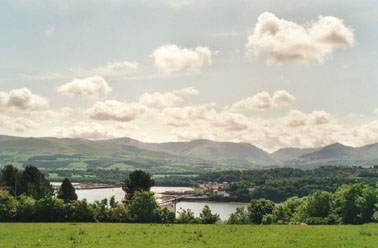
24th: The overnight minimum had fallen to 6.0C and 2.3C on the grass, fairly cool for the time of year. The morning was bright with sunny spells. There were moderately active looking cumulus clouds in the vicinity at first, but there was no rain. Before noon the clouds were dispersing giving clear views across the Menai Strait towards Bangor and Snowdonia. In the afternoon cirrus replaced the cumulus and the maximum rose to 14.4C. [Rain 5.9mm; Max 14.4C; Min 6.0C; Grass 2.3C]
25th: Showers of ice pellets in the night about 01 GMT and 0620 GMT. The morning continued showery with some brighter periods but at noon there were dark active cumulus in the vicinity. At 1344 GMT there was thunder and a short heavy shower including ice pellets during which the temperature fell 4C to 7.5C. On the summit of Snowdon the temperature fell to -0.6C. Showers cleared away for a while later in the afternoon. A moderate shower at 2100 GMT included some hail over 5mm diameter. [Rain 2.2mm; Max 12.3C; Min 6.8C; Grass 4.7C]
26th: Continuous slight rain or drizzle in the morning. A brief respite 13-15 GMT before more of the same. The day maximum was only 10.5C, the lowest of the month. In all there was 6.0-h rainfall duration but only amounting to 3.8 mm. [Rain 3.8mm; Max 10.5C; Min 6.1C; Grass 3.5C]
27th: A bright start to the day but there were dark cumulus clouds in the vicinity at 0900 GMT. Cloud was just on the summits of the Snowdonia Mountains but his lifted off and the morning became quite sunny. Some active looking cumulus formed over the mountains around 1300 GMT but diminished later to give a sunny afternoon. It was a much better day here than had been forecast, but it was rather cool. There was a shower of rain and ice pellets at 2130 GMT. [Rain 0.2mm; Max 12.7C; Min 5.4C; Grass 3.2C]
28th: Some well-developed cumulus clouds around in the morning becoming cloudier by noon. Visibility was very good with clear views across Anglesey and the mainland. The sky cleared later to give a sunny end to the day and a cool night. Showers of rain at 03 GMT. [Rain 0.5mm; Max 13.5C; Min 4.6C; Grass 2.3C]
29th: The grass was wet from overnight showers but the soil surface was just dry enough to record as dry. The overnight minimum had fallen to 4.4C and to 1.3C on the grass, both lowest of the month and since 28 April. Pressure had risen to 1014.6mb and the morning was generally sunny and dry but with cumulus clouds in the vicinity. During sunny spells in the afternoon the temperature rose to 15.9C, the highest since the 15th. Valley (Anglesey) reported 14.4h sunshine in 24-h to 1800 GMT, the most in the UK. [Rain nil; Max15.9C; Min 4.4C; Grass 1.3C]
30th: Sunny at first with some cumulus high over the Snowdonia Mountains to the S. It turned cloudier by noon with very dark clouds to the S and W which produced a heavy shower in Pentraeth and Llanbedrgoch, but none at this station. The sky cleared later and the afternoon and evening was sunny. [Rain nil; Max 14.6C; Min 5.9C; Grass 2.6C]
31st: Weakly sunny through 6 oktas of cirrostratus cloud at 0900 GMT. Visibility was very good with the cliffs well picked out on the mainland mountains. It cloud became denser by noon and the S'ly breeze had increased to force 3. There was some rain from 1545 GMT and by evening the wind was force 5 at times. There were 3 periods of rain, heaviest from 22-01 GMT, which accumulated 6.2 mm over 9.2-h duration by morning.[Rain 6.2mm; Max 16.3C; Min 5.6C; Grass 2.1C]
Return to top of page
Return to home page
1st: A dull start to June with slight rain ceasing just before 0900 GMT. The day remained cloudy with intermittent slight rain or drizzle. The wind a S'ly force 3 increased S-SW'ly force 7 shredding and removing leaves and leafy twigs from trees, and beating down garden plants. RH remained above 90% for the 24-h period. Rainfall total was a small 1.0mm, but Capel Curig (mainland mountains) reported 41mm in the 24-h to 1800 GMT. [Rain 1.0mm; Max 13.7C; Min 10.8C; Grass 10.1C]
2nd: Overcast with spots of rain soon becoming continuous moderate then intermittent, accumulated 9.5mm over 8.7h duration, the most in a day in the month. Visibility remained poor or very poor throughout the day under the low fragmented clouds. RH again above 90% for the 24-h period. [Rain 9.5mm; Max 14.5C; Min 11.9C; Grass 11.6C]
3rd: The maximum for the 2nd (14.5C) occurred at 0800 GMT. By 0900 GMT the temperature had fallen to 13.8C and this was to be the maximum for the 3rd. Slight rain and drizzle at first, periods of moderate rain turning again to drizzle in the afternoon, poor visibility. Another 24-h with RH above 90%. [Rain 5.7mm; Max 13.8C; Min 11.8C; Grass 11.2C]
4th: The minimum (9.7C) was at 0800 GMT ending 23 h of falling temperature. Rarely, the grass minimum was higher having fallen to 10.2C. Dull at first but becoming brighter with a glimpse of the sun from time to time. The relative humidity fell to 80% by noon, and soon 76%, the lowest for three days. The day remained dry and the grass surface had even dried by 1500 GMT. [Rain nil; Max 15.0C; Min 9.7C; Grass 10.2C]
5th: Again 8 oktas of cloud somewhat higher today, but the mainland mountain summits remained covered. Visibility was good with a slight haze. It sky became very dark for a while but brightened towards noon. Things were looking up as the relative humidity at 0900 GMT was 87% and this fell to 76% by noon. There were small breaks in the cloud but it struggled to clear any more until late afternoon. The evening was sunny! [Rain tr; Max 14.6C; Min 8.4C; Grass 5.8C]
6th: At dawn it was dull, there was a bright period followed by an unmeasurably slight shower before 0900 GMT. By 10 GMT it brightened as the SW'ly wind veered W'ly. At noon the temperature had reached 15.8C with an RH of 66%. During the afternoon there was a slight shower but this cleared to give a sunny evening. [Rain tr; Max 16.7C; Min 9.3C; Grass 7.6C]
7th: At dawn it was cloudy but this soon cleared leaving lenticular cirrus to the SW at 0900 GMT. There were a few weak cumulus clouds to the S. A ridge of high-pressure was traversing S Britain but fronts over Ireland were moving NE. It became cloudier during the morning but as it was thin the sun was not totally obscured and the temperature rose to 15.5C by noon. The cloud was high and the mountain summits were cloud-free although the view was hazy. During the afternoon the cloud thickened and there was slight rain shower around 1930 GMT. [Rain 0.1mm; Max 15.5C; Min 7.3C; Grass 4.8C]
8th: The sky was clearing before 0900 GMT and the morning had some sunny spells. The wind was a force 5 S-SSE'ly and for a while it felt warm, however it was cloudier again by noon. There were showers at first in the afternoon but then these cleared away and it became bright and sunny for a while before turning cloudy again in the evening. There was rain by morning. [Rain 4.1mm; Max 15.0C; Min 11.0; Grass 9.4C]
9th: There was continuous moderate rain at 0900 GMT. An area of rain was covering Wales and several hours were forecast. The rain turned slight to drizzle for a while before becoming moderate again around noon. There was 5.5-h rainfall duration measuring 5.1 mm. The totals for the event commencing 0315 GMT on the 8th was 9.3 mm over 10.6 h. There was a bright interval in the evening but the daytime temperature reached only 9.5C. The day's maximum did not occur until 0900 GMT on the 10th. [Rain 5.1mm; Max 13.0C; Min 9.0C; Grass 7.6C]
10th: Overnight the minimum had fallen to 7.0C and to 4.0C on the grass, both the lowest of the month. Fair weather cumulus were being driven along with a force 4 SW'ly at 0900 GMT. The morning became sunnier before once turning cloudier by noon. The afternoon again turned sunnier with a maximum of 15.3C but remained windy, force 6 at times. It was cloudier again from 1600 GMT as a thin rain band crossed the Irish Sea and deposited 0.9mm rain from 1715 GMT. [Rain 0.9mm; Max 15.3C; Min 7.0C; Grass 4.0C]
11th: A cloudy, dull and windy day. The force 4 SW'ly became a blustery force 6 in the afternoon and there was a slight shower which did not wet the rain collection bottle. [Rain tr; Max 14.5C; Min 8.3C; Grass 6.3C]
12th: Another dull start to the day. Although pressure was continuing to rise slowly (1020mb) a deepening low to the NW (978mb) would bring severe gales to Scotland. The ground and grass was dry in the force 5-6 S'ly wind. The overnight temperature had dropped to only 11.9C and 11.6C above the grass. The afternoon was windier and though brighter for a while the low cloud and mist soon returned with drizzle later. The wind a force 6-7 SSW'ly was tearing leaves from trees and damaging summer flowering plants in the garden. The evening was blustery. [Rain 1.3mm; Max 16.6C; Min 11.9C; Grass 11.6C]
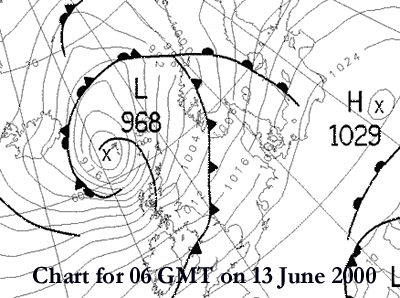 Return to top of page
Return to home page
1st: A cloudy dawn with slight rain from 07 GMT (0.3mm). It was calm at 0900 GMT with some spots of rain still falling in poor visibility. It remained overcast but did become brighter during the morning and the highest temperature of the day (18.9C) was reached soon after noon. It had just started raining, however, as a band of rain which had moved up through Wales had arrived and appeared to remain stationary here for a while. Amount of rain was small (0.9mm) over 1.2-h duration. By 1730 GMT it had brightened and the sun appeared fleetingly but there was no clearance until nightfall (2130 GMT). The night became clear and starlit and, with no moon, the northern sky was palely lit above the horizon until after midnight. [Rain 0.9mm; Max 18.9C; Min 13.2C; Grass 11.5C]
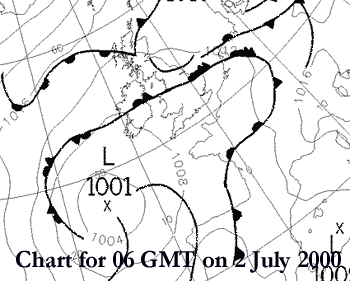 2nd: Pressure was low to the SW and the gradient was slack over the UK. It had clouded over by dawn but brightened just before 0900 GMT. There was a very light NE'ly wind and visibility moderate although hazy. It was cloudier by noon before a period of frontal rain, moderate at first, deposited 4.0mm over 3.1-h duration. The afternoon brightened eventually with the usual glimpse of the sun before the sky became overcast once more. At Chester a heavy thunderstorm in the evening caused flooding in the centre of City. [Rain 4.0mm; Max 16.7C; Min 11.4C; Grass 8.5C]
3rd: There was a slight shower of rain around dawn and chinks of blue sky appeared in the low cloud around 0900 GMT. The temperature (16.7C) had already equalled yesterday's maximum. The morning remained cloudy and there was rain from 11 GMT. At noon the temperature was 18.3C and it was very murky with poor visibility. The rain ceased in the afternoon becoming bright and sunny for about 2 h before becoming cloudier again by evening. At Colwyn Bay there was heavy thundery rain causing flooding of some roads and at Llanrwst (Conwy Valley) heavy rain caused flooding and damage to walls in the town. In Chester, for the 2nd evening, there was a heavy thunderstorm. [Rain 1.3mm; Max 19.0C; Min 12.7C; Grass 10.4C]
4th: Overcast and dull but still feeling reasonably warm in the light NE'ly breeze, the overnight minimum was 14.0C. Temperature at 0900 GMT was 16.3C (dew point 14.4C) and visibility was poor in thick haze. The morning became brighter with a little sunshine but by noon dark clouds were threatening to the S. By afternoon the dark clouds had receded and it became mostly sunny with a maximum of 19.2C in patchy thin cloud. Later it became misty. [Rain nil; Max 19.2C; Min 14.0C; Grass 12.5C]
5th: There was thick fog at 02 GMT this thinning to very poor in mist at dawn. By 0900 GMT it was becoming sunny with only thin cumulus clouds overhead. By noon (17.2C dewpoint 14.3C) it was cloudier with threatening cumulus clouds to the S over the mainland mountains. There was a localised heavy thundery shower at the Britannia Bridge at 14 GMT but it remained dry here. Coastal fog had affected Valley (Holyhead) and Aberporth during the day. During the night it once more became foggy. [Rain nil; Max 19.8C; Min 12.6C; Grass 11.6C]
6th: A shallow depression was over the Irish Sea, with weak fronts moving SE. There was a change of wind direction from the NE'ly of past days to the SW at 0900 GMT. There were towering cumulus clouds over Snowdonia to the S and to the W. Overhead there was thin patchy altocumulus. The maximum during the morning was 19.0C and was not to be exceeded during the day. Before noon it became cloudier and murky and the NE'ly wind had resumed. Towering cumulus clouds were still in the vicinity, but again it kept dry and bright at times into the evening before becoming cloudier overnight. [Rain nil; Max 19.0C; Min 12.0C; Grass 9.5C]
7th: A dull start to the day and it was cooler (12.5C, dewpoint 9.8C at 0900 GMT), but the cloud was lifting and the visibility was good. During the morning the cumulus clouds started to disperse and cleared the summits of the Snowdonia Mountains, and it became sunny with good visibility in a clearer airstream. The afternoon was sunny at first but cloudier from 15 GMT and more so by evening. By 19 GMT the wind was SSW'ly. [Rain 0.3mm; Max 16.3C; Min 11.7C; Grass 10.6C]
8th: A slight shower at 03 GMT and another just before 0900 GMT. The wind was NW'ly and there were cumulus shower clouds in the vicinity and the summits of the Snowdonia Mountains were cloud covered. There were some bright and sunny spells during the morning. In the afternoon the wind turned to a SSW'ly force 4, there was drizzle then rain from 1530-2115 GMT amounting to 5mm. [Rain 5.2mm; Max 16.2C; Min 11.4C; Grass 11.0C]
9th: Pressure was falling (999mb) as a deepening depression (992mb) over the N of the UK was moving slowly E. There was intermittent slight rain or drizzle during the morning but the afternoon was dry though cloudy and hanging low over the mainland mountains. By evening it brightened and there were a few sunny spells. An area of rain, moving from the N, brought rain from midnight amounting to 13mm by morning. [Rain 13.5mm; Max 16.8C; Min 12.5C; Grass 12.4C]
10th: Pressure dropped to 992mb between midnight and 04 GMT, this was very low for the time of year. Overnight rain stopped at 0845 GMT but there was a fresh N'ly wind, strong enough to be bringing down twigs and leaves from nearby trees. At 0900 GMT the temperature was 11.0C and the morning remained cloudy. Before noon the temperature had reached only 12.9C. It was to rise to 14.1C in the afternoon, during an occasional sunny spell, the lowest of the month. It kept dry but it remained windy, force 6 gusting force 7 at times. In exposed places on the island some damage to trees, especially ash that tends to be rather brittle, was being done. [Rain 1.3mm; Max 14.1C; Min 10.0C; Grass 9.5C]
11th: Early rain and a shower about 07 GMT cleared away to give sunny spells during the morning. Visibility was very good but there was cloud on the summits of the Snowdonia Mountains. Some passing clouds looked dark but there was no rain. The NE'ly wind increased to force 5 by noon. The afternoon was partly cloudy, when it felt cold in the wind, but the maximum reached 15.3C when sunny. The thermograph trace was quite jagged responding to the sunny and cloudy conditions. By evening the wind had dropped. The night was partly cloudy. The sky became overcast by morning. [Rain nil; Max 15.3C; Min 8.7C; Grass 7.5C]
 12th: In a clear spell the temperature on the grass dropped to 5.7C, the lowest of the month. Cloudy at dawn, then a few small breaks in the cloud but it did not clear. The morning was warmer than yesterday reaching 15.7C by noon. Despite the cloudy afternoon the temperature rose to 16.7C as the NW'ly wind backed to S-SW'ly. During the evening there was a spell of fine drizzle followed by an 8-h period of rain from 2030 GMT amounting to 3.5mm. [Rain 3.5mm; Max 16.7C; Min 9.1C; Grass 5.7C]
13th: Early rain and drizzle had ceased by 0900 GMT. The minimum and grass minimum thermometers read the same (12.0C). The morning remained dull but the cloud thinned and it brightened with one or two small patches of blue during the afternoon. There was a shower of rain at 23 GMT. [Rain 0.7mm; Max 16.4C; Min 12.0C; Grass 12.0C]
14th: In the NW'ly wind the day remained cloudy. There were occasional bright spells, when the cloud thinned and veiled glimpses of the sun appeared. [Rain nil; Max 16.7C; Min 10.9C; Grass 9.8C]
15th: It was partly cloudy at dawn but soon became overcast by 0900 GMT. The sky began to clear before noon when the temperature had reached 16.0C. There were cumulus clouds in the vicinity but they did not look threatening and it remained dry. There were some sunny spells later. On the mainland Snowdon remained covered in cloud once again, disappointing visitors who had made the journey to the top on the narrow gauge rack and pinion railway. Today was St. Swithin's day and it did not rain! [Rain nil; Max 17.2C; Min 10.0C; Grass 7.6C]
16th: Pressure was slowly rising (1022 mb) as the Atlantic high, which seems to have been there for ages, was edging closer. Cloudy at first but sunnier later in the morning. At noon there were again cumulus clouds all around but the afternoon remained mostly sunny. The cloud slowly dispersed clearing the mountaintops by late afternoon. The evening and night was clear with a full moon. No aurora was seen although the possibility had been forecast. [Rain nil; Max 17.5C; Min 9.8C; Grass 7.9C]
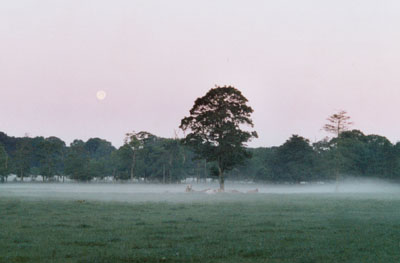 17th: There was shallow mist over the fields at 04 GMT as the moon was setting to the SW. The pinkish colour of the sky and moon is the result of light passing through the atmosphere containing pollution smoke. The mist had cleared away by 0900 GMT leaving moderate dew on the grass. The minimum temperature had dropped to 8.5C one of the 2 coolest night in the month (5.8C on the grass) the coldest since 25 June. The day was moderately sunny although there were clouds to the S and W, and on the summits of Snowdonia. At dusk there was further shallow mist across the fields. [Rain nil; Max 18.5C; Min 8.5C; Grass 5.8C]
18th: Another cool night with a minimum of 8.5CA sunny start to the day with just a little cloud low to the S and W and cirrus overhead. During the day a strong sea breeze front developed across Anglesey NW-SE as air off the sea from the NE converged with that from the SW. It persisted from about 10 GMT to after 18 GMT. Valley (Anglesey) recorded the most sunshine in 15.4h (24-h to 18 GMT). [Rain nil; Max 21.2C; Min 8.5C; Grass 5.9C]
19th: Another sunny day. At 0900 GMT there were some small cumulus over the mountains to the S, patches of lenticular cirrostratus to the SW and a little altocumulus overhead. During the morning it became cloudier but the temperature reached 21.0C at noon with 56% RH. The maximum reached 22.1C during the afternoon, the highest of the month, and the sky cleared towards evening. [Rain nil; Max 22.1C; Min 10.7C; Grass 8.3C]
20th: A cloudy start to the day with pollution smoke visible to the S and in Liverpool Bay. The sky was clearer (3 oktas) before noon but the smoke intensified particularly in Liverpool Bay as viewed across Malltraeth marsh towards Red Wharf Bay. The afternoon had patchy cloud from time to time with a maximum of 19.1C whereas on the west coast, at Aberffraw, it was clear and warmer. Temperature of the sea at 1m from the shore was 18C but it was up to 21C nearer the shore. [Rain nil; Max 19.1C; Min 12.7C; Grass 11.2C]
21st: The day started sunny with a cloudless sky. At 0800 GMT pollution smoke was seen to 3000ft to the S-SW. By 0900 GMT small cumulus clouds had developed in Red Wharf Bay and over Snowdon and the Carneddau Mountains. The clouds over the mountains increased during the day but did not look very active. The afternoon remained sunny and the pollution smoke intensified. Later the cloud dispersed leaving dark smoke to a clearly defined boundary layer of clear air at a height of 5000ft at 1900 GMT looking towards Snowdonia. Valley (Anglesey) recorded 14.7h sunshine (24-h to 18 GMT). The night had a clear sky. [Rain nil; Max 20.2C; Min 9.3C; Grass 6.2C]
22nd: Pressure was declining (1026mb) as the anticyclone drifts N over Scotland. It was a warm night with a minimum of 14.5C, the warmest of the month. A sunny start to the day with a temperature of 18.0C at 0900 GMT. The grass was dry except in shady places. The day was sunny, hazy with a little cirrus and became windier in the afternoon force 4/5 NE'ly. Towards evening the wind lessened veering more E-ESE'ly. The maximum here was 21.5C but at Llanbedr (west coast of Gwynedd), in the lee of the Snowdonia Mountains, a maximum of 27C was reported, the highest in the UK. [Rain nil; Max 21.5C; Min 14.5C; Grass 12.5C]
23rd: Another sunny start to the day with some cirrostratus over Liverpool Bay and patchy cirrus above. The wind was ESE'ly and there was also cloud spilling over the Snowdonia Mountains and into the Nant Ffrancon Pass. Visibility was good but with thick haze the western part of the Lleyn Peninsular and Bardsey Island was obscured all day. During the afternoon the high cirrostratus increased edging towards the west coast of Anglesey which remained clear, Valley was the sunniest in the UK recording 14.7h (24-h to 18 GMT). [Rain nil; Max 19.5C; Min 11.5C; Grass 9.5C]
24th: Pressure continued to decline slowly (1015mb). A bright start to the day but became cloudier as 0900 GMT approached. Liverpool Bay looked very dull and there was a cool ENE'ly wind (14.3C dewpoint 12.6C). For the 3rd morning the grass was dry. Towards noon the sky began to clear and the afternoon was generally sunny with a maximum of 18.0C but it was very hazy. In the evening it was cloudier and became dull. [Rain tr; Max 18.0C; Min 11.8C; Grass 8.5C]
25th: A misty murky dawn with some fine drizzle at 0630 GMT. The morning remained misty with light drizzle at times. The afternoon was similar at first until the cloud thinned later and eventually one or two blue patches appeared. This clearer sky did not last long and the evening and night became overcast. [Rain tr; Max 16.0C; Min 13.1C; Grass 12.4C]
26th: Early drizzle turned to a period of light rain around 0900 GMT before easing in about an hour. There was a shower just before noon when the cloud appeared thinner and it was occasionally bright. During the afternoon there was a break in the clouds and the temperature popped up to 21.0C. It was soon cloudy again with a little more drizzle around 16 GMT. The evening and night was partly cloudy. [Rain 1.2mm; Max 21.0C; Min 11.3C; Grass 9.4C]
27th: A sunny start to the day with cumulus and altocumulus of 5 oktas. At 0900 GMT the temperature was 18.0C and overhead 2 buzzards were circling. It was cloudier before noon, with good but hazy visibility, when the temperature had reached 20.8C. The sky cleared during the afternoon and became sunny for a while before a heavy thundery shower at 1736 GMT (4.8mm in a few minutes). The evening and night remained overcast. [Rain 5.5mm; Max 20.8C; Min 12.3C; Grass 8.6C]
28th: It was misty with very poor visibility at dawn but improved to moderate by 0900 GMT. It had been a warm night with a minimum of 14.2C. The low fragmented cloud was slow to clear until just before noon. The temperature was 18.0C and there were moderately developed cumulus in the vicinity but were towering to the S. The afternoon became sunnier (maximum 21.0C) and the cumulus clouds continued to tower over central Snowdonia then later more so to the E and W. Anglesey had a clear sky much of the time with sunshine until dusk. Later in the night it was cloudier. [Rain 0.1mm; Max 21.0C; Min 14.2C; Grass 12.1C]
29th: There was a slight shower at 05 GMT and there was a misty start to the day with very poor visibility. By 0900 GMT the mist was clearing and the cloud appeared to be breaking up but there was soon a moderate shower. There was further light rain around noon then a heavy thundery shower at 1225 GMT. The localised deluge lasted for 12-15 minutes and accumulated 16.2mm, equivalent to an average of 65mm per hour. This led to a lot of standing water around the house. On the road outside traffic was almost brought to a halt. This was nearly the greatest 24-h fall in the UK on the day as Lough Fea reported 19.1mm. Later in the afternoon the sky cleared and it was sunny into the evening. [Rain 18.4mm; Max 19.3C; Min 13.9C; Grass 12.4C]
30th: A sunny start to the day but cumulus clouds were already towering over Snowdonia at 0900 GMT. In a light SW'ly and a temperature of 18.7C fair-weather cumulus were passing quickly overhead. By noon the temperature had risen to 21.2C, the day's maximum. The afternoon remained mostly sunny but there were some dark clouds from time to time and a spot or two of rain. The evening turned cloudier and there was slight rain from 2100 GMT becoming moderate from 03 GMT. By morning 7.4mm rain had accumulated over 7.8-h duration. [Rain 7.8mm; Max 21.2C; Min 12.7C; Grass 9.8C]
31st: Another warm night with a minimum of 14.3C. A dull start to the day with thick mist and slight rain that was showing signs of clearing away just before 0900 GMT. It soon turned back to rain and there were 4mm between 09-11 GMT as a front moved across from Ireland. Further thundery bursts of rain continued until 17 GMT when it became drier until 21 GMT when there was a further shower. In all 6.6mm accumulated over 6.3-h duration. Valley reported heavy rain in the morning returning a total of 35mm in the 24-h to 1800 GMT; 28.4mm 09-09 GMT. The sky cleared later in the night. [Rain 6.6mm; Max 17.4C; Min 14.3C; Grass 13.4C]
Return to top of page
Return to home page
1st: There was an almost clear sky at dawn but it became cloudier by 0900 GMT. There was a weak low over Rockall expected to move E'wards. The morning was bright with some sunny spells; cumulus clouds could be seen to the S and here they were passing by and dispersing. By noon the temperature had risen to 18.5C and Anglesey had become almost clear of cloud. Over Snowdonia towering cumulus remained during the afternoon. It was windy, the S'ly reaching force 4-5 at times. [Rain 11.9C; Max 19.6C; Min 13.2C; Grass 11.7C]
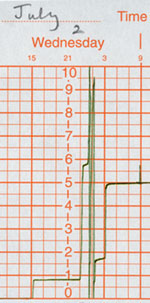 2nd: There was moderate to heavy rain from 0445-06 GMT. At 0900 GMT the clouds were low and ragged and a few small breaks soon appeared. The sky had not cleared by noon but it remained dry. The afternoon was bright with occasional glimpses of the sun and a few spots of rain. It was again windy with a SW'ly force 5-6. There was a shower around 16 GMT and a period of moderate to heavy rain from 23-03 GMT. At its heaviest from 00-0120 GMT 21.7mm fell at an average rate of 16mm per hour. Rainfall over the 24-h period was 25.2mm over 4.3h. [Rain 25.2mm; Max 17.7C; Min 13.7C; Grass 13.2C]
3rd: Heavy overnight rain had stopped but the sky was very dark and the morning remained murky with poor visibility. At noon it was the same, with a temperature of 14.8C, but the sky began to clear by 15 GMT to give some sunny spells the temperature rising to 18.9C. [Rain nil; Max 18.9C; Min 11.8C; Grass 11.4C]
4th: At 0900 GMT the cloud appeared to be breaking up and lifting from the tops of the mainland mountains. This was just 'a flash in the pan' as it soon was overcast and dull once more. By noon the temperature was 15.5C, the daytime maximum. The afternoon remained very dull with a little drizzle. By evening the sky was clearing and 'pile-of-plates' clouds were seen to the north of the mountains at 1930 GMT. The maximum for the 24-h of 16.5C was one of the 2 lowest of the month. [Rain tr; Max 16.5C; Min 10.6C; Grass 7.2C]
5th: Overnight the sky had cleared and at dawn it was cloudless except for patchy cloud low over Liverpool Bay. It was sunny at first with the temperature rising to 16.5C by 0900 GMT, the maximum for the past 24h. It became cloudier for a while but then cleared except for some patchy thin high cloud. The afternoon was sunny at first, the temperature reaching 20.8C, before it became cloudier from the west around 15 GMT. There was drizzle from 1730 GMT then a period of light rain for 1.6h to 1930 GMT. [Rain 0.7mm; Max 20.8C; Min 13.1C; Grass 9.5C]
6th: It was a warm night with a minimum of 15.4C. There was drizzle from 0730 GMT but it had ceased by 0900 GMT. The temperature was 17.2C but the sky was overcast and dull. Visibility was good, but the cloud remained low and unbroken except occasionally a break appeared overhead during the afternoon. The maximum for the day was 20.7C around 15 GMT. There were a few spots of rain then a slight shower around 17 GMT. [Rain 0.3mm; Max 20.7C; Min 15.4C; Grass 15.3C]
7th: Another warm night with a minimum of 15.0C. There was fog between 05-0630 GMT and was thick (less than 100m) between 0530-0600 GMT. At 0900 GMT visibility was still very poor and there was intermittent slight drizzle for a time. The day remained overcast and very dull. The sky brightened in the evening but did not clear. [Rain 3.3mm; Max 18.1C; Min 15.0C; Grass 13.6C]
8th: There was rain from 05 GMT, moderate at times, that continued until 10 GMT before turning to drizzle. It became calm around noon and the cloud was lifting. A heavy shower at 1245 GMT deposited 3.8mm rain in a few minutes. During a sunny spell the temperature rose to 20.6C. After a further slight shower the sky was clearing by 1800 GMT. [Rain 4.0mm; Max 20.6C; Min 14.7C; Grass 13.4C]
9th: A cloudy start to the day but visibility was good. The temperature at 0900 GMT was 17.7C in a fresh S'ly wind. A weak low to the NW was tracking E'wards. There were some bright and occasionally sunny periods with light blustery showers during the morning. A period of rain in the afternoon died out later but it remained damp and misty into the night. [Rain 7.0mm; Max 17.8C; Min 14.4C; Grass 13.3C]
10th: Spells of drizzle or light rain from first light. Another miserable misty day with intermittent slight drizzle. The clouds remained fragmented and low, it brightened a little later in the afternoon but the gloom soon returned. [Rain tr; Max 17.5C; Min 14.5C; Grass 14.2C]
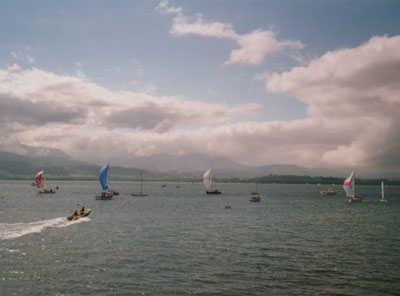 11th: There were signs of the sky clearing just before 0900 GMT. Visibility was good and there were soon some sunny spells. At Beaumaris boats taking part in the annual Menai Strait's Regatta Fortnight were racing along in a force 4 SSW'ly. The clearance continued until, at 14 GMT, the sky became cloudless. The temperature rose to 21.0C. Later frontal cloud could be seen encroaching from the west and it reached here about 18 GMT. [Rain tr; Max 21.0C; Min 13.4C; Grass 11.2C]
12th: It was overcast at dawn with some spots of drizzle from time to time. Small patches of rain were moving northwards over the Irish Sea. There was an Atlantic low (980mb) to the W of Scotland with an associated cold front over Ireland. As the front moved across in the afternoon there was a period of rain lasting until 21 GMT (9.8mm over 6.4h). It was wetter at Valley (Anglesey) where 16.3mm were recorded to 1800 GMT, the most in the UK. [Rain 9.9mm; Max 18.1C; Min 13.4C; Grass 11.0C]
13th: A misty start to the day. Although the mist was clearing at 0900 GMT the morning remained dull and overcast. At noon, although still cloudy, the temperature was 19.8C in a light SSE'ly breeze. There was a brief bright spell when the temperature rose to 20.3C before a spell of rain commenced at 14 GMT accumulating 7.2mm by 20 GMT. A further spell from 05 GMT accumulated a further 4.5mm by 0900 GMT the next day. Rainfall 7.9-h duration. [Rain 11.7mm; Max 20.3mm; Min 15.7C; Grass 15.2C]
14th: Low pressure over N. Scotland and complex fronts along the spine of the UK. Rain and fog between 07-09 GMT eased a little before further light rain and drizzle during the morning. The overnight minimum was 15.9C, the highest of the month. The rain ceased and the sky began to clear after 1500 GMT. The rest of the afternoon was bright and sunny. It was wetter along the North Wales coast. In the 24-h to 1800 GMT Colwyn Bay had 16mm rain while Prestatyn recorded 29mm, close to the UK highest total of 30mm at Crosby (Liverpool, Sefton). [Rain 4.5mm; Max 17.7C; Min 15.9C; Grass 15.2C]
15th: It was a cooler night with a minimum of 11.5C. But it was cloudy before dawn and, although it was bright around 0900 GMT, it was soon raining in a brisk SW'ly wind. It was a wet start for the first day of the annual Anglesey Show held at Mona. Brighter though showery weather arrived by 1330 GMT. During the afternoon cloud was clear of the summits of Snowdonia and visibility was very good. A moderately active cumulus cloud had developed overhead around 1530 GMT, which resulted in a light shower. Anglesey had a bright and occasionally sunny end to the day. For the 24-h ending 1800 GMT Capel Curig (Gwynedd) reported 16mm rain, the largest fall in the UK. [Rain 4.4mm; Max 18.5C; Min 11.5C; Grass 9.6C]
16th: There was a weak low (1005mb) to the west of Ireland and with higher pressure over France (1022mb) there was a SW'ly airflow over the British Isles. It was a cloudy start to the day but by 0900 GMT breaks were appearing in the cloud. The morning was generally sunny with the wind, a force 3 SSW'ly, soon increasing to force 4-5. A heavy and prolonged shower to the S at 1230 GMT resulted in only a few spots of rain here. Later the sky cleared and it was a sunny end to the day with less wind towards dusk. [Rain tr; Max 18.8C; Min 10.6C; Grass 8.3C]
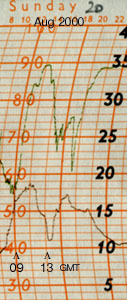 17th: It had been a cool night with heavy dew on the grass. There were active cumulus clouds in the vicinity as early as 08 GMT. The morning was sunny and the cumulus became less threatening as the day progressed. The afternoon was also sunny with rapidly passing fair-weather cumulus clouds in a WSW'ly force 4-5. [Rain nil; Max 18.8C; Min 10.6C; Grass 7.3C]
18th: Pressure was low (1009mb) with slack gradients over the British Isles. A sunny morning with very good visibility looking towards the cloud-free summits of Snowdonia. There were small passing cumulus with more active clouds to the S. By noon the temperature had risen to 19.0C and the relative humidity had fallen to 52%. Soon afterwards 19.4C was reached but then a cool NE'ly breeze off the sea lowered temperature and raised humidity. Clouds formed overhead as a sea breeze front developed as the cool moist air from the NE met the warmer and drier SW'ly. The afternoon was partly cloudy but on the beach at Aberffraw, on the west coast of Anglesey, it remained sunny and warm. To the SE of here a band of rain, moderate-heavy in the SW (Ross-on-Wye 18mm in 24-h to 18GMT) passed by during the day. An outlier of this rain reached here about 18GMT but only resulted in 0.8mm rain. [Rain 0.8mm; Max 19.4C; Min 10.3C; Grass 6.2C]
19th: A bright and sunny start to the day but at 0900 GMT (14.5C in a light NW'ly breeze) there were already towering cumulus clouds just to the S of here. Visibility was good but there was cloud on the summits of Snowdonia. With an Atlantic high (1030mb) S of Greenland, pressure was still low (1008mb) over the UK with slack gradients and fronts lying on the Welsh border and to the SE. During the morning there was a slight shower of rain then a heavy shower, including ice pellets, between 1113-1122 GMT which accumulated 3.7mm. The afternoon was mainly cloudy but there were frequent sunny spells. A waterspout was reported offshore at Colwyn Bay during the afternoon. Cloud dispersed during the evening and the night was clear and moonlit. [Rain 3.7mm; Max 18.6C; Min 10.8C; Grass 9.5C]
20th: Clear skies and calm overnight with a minimum of 8.8C and 6.5 on the grass led to heavy dew. The minimum of 8.8C was one of the 2 lowest of the month. With a low (999mb) S of Norway and Atlantic high (1033mb) drifting closer pressure had risen here (1015mb). A sunny start, with almost clear skies, but by 0830 GMT cumulus clouds were bubbling up to the SW over the Lleyn Peninsular. On Anglesey cumulus development continued with cumulonimbus clouds seen to the N. During the morning there were heavy thunderstorms off the NE Anglesey coast and Amlwch. An eyewitness situated in sunshine at Mynydd Bodafon described purple coloured cloud in an arc from Wylfa Head, out to sea, to Llanddona with double forked lightning and loud thunder. Cold downdraughts of air were reported at Amlwch and Mynydd Bodafon. An observer at Red Wharf Bay described seeing limited cloud vortex rotation and the wind veering from NW to NE. Thunder was heard and lightning seen from 1130-1140 GMT. At this station a temperature drop of 8C occurred from 1140-1320 GMT, the most rapid fall of 3.5C started at 1300 GMT. Heavy rain from 1300 GMT including moderate hail, with some stones estimated to be between 10-15mm diameter (MO code 6, TORRO size 2 H0), almost covered the ground but no damage has been reported. Rain and hail, heaviest over a period of 10 min with the total event lasting less than 20 min, accumulated 10.3mm. This was almost the largest fall in the UK as Aviemore reported 10.9mm in 24-h to 1800 GMT. On the west coast of Anglesey, from Newborough to Holy Island, it remained sunny most of the day with Valley returning 14.1h sunshine in the 24-h to 1800 GMT, the highest in the UK. At 1825 GMT slow moving showers of rain along the Menai Strait from Bangor towards Conwy produced, with the sun low in the W, an incomplete but vivid rainbow with secondary arc lasting at least 30 min. [Rain 10.7mm; Max 17.9C; Min 8.8C; Grass 6.5C]
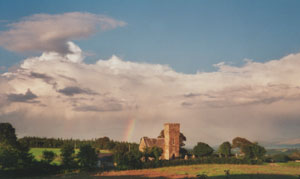 21st: Clear starlit sky at times overnight (minimum 9.0C) but a little rain from 07-08 GMT of 0.4mm. Atlantic low (1009mb) west of Ireland. At 0830 GMT there were cumulonimbus clouds to the N of Anglesey and soon to the S and SW of the station. On the Lleyn Peninsular it was reported that before 06 GMT Pwllheli, and neighbouring villages of Chwilog, Llanbedrog, Llangybi and Y Ffôr had rain and hail over nearly 2h that caused local flooding and accumulations of level hail several cm deep and, in places, 30cm or more. Some shops in Pwllheli were under several feet of water causing £thousands of damage. Roads became impassable including the B4345 (Y Ffôr to Chwilog) and the A499 (Llanbedrog to Abersoch). Several bridges and walls were washed away. At this station at 0900 GMT it was calm with a temperature of 11.8C (dewpoint 11.2C) with 4 oktas cloud cover. The morning was bright and sunny at times between the dark clouds. Later another dark cumulonimbus approached from the S and there was light rain from 1230 GMT. At 1253 GMT there was heavy thunder and lightning, some closeby at 1330 GMT temporarily disrupting the electricity supply. The last thunder and lightning was at 1338 GMT. There was a temperature drop of 5C and 9.2mm rainfall. Later in the afternoon the sky cleared giving some sunny spells. [Rain 9.2mm; Max 17.5C; Min 9.0C; Grass 6.8C]
22nd: Pressure was rising (1019mb) as a ridge was approaching N Scotland with low (1004mb) to the SW of the British Isles. With a little cirrostratus low to the W and NE the sky at 0900 GMT was clearing to give a sunny morning. By noon the temperature had reached 19.5C and this was to go to 20.3C during the afternoon. There was some cumulus development to the SW over Anglesey, but this soon dispersed. The evening was clear leading to early heavy dew. [Rain nil; Max 20.3C; Min 9.6C; Grass 7.4C]
 23rd: A cloudless and sunny, but hazy, start to the day. With a ridge of high pressure (1027mb) over Scotland pressure had risen to 1025mb, low (1000mb) was still to the SW. Temperature at 0900 GMT was 17.2C in a light ENE'ly breeze. It was a sunny morning; by noon the temperature had risen to 20.9C and there were cumulus clouds bubbling up to the S and SW. The afternoon was sunny with a maximum of 22.0C, but cumulus clouds formed at Aber Menai on the west coast of Anglesey and slowly moved northwards along the coast to Aberffraw by 1500 GMT. Here it dispersed, after a display of upward and downward crepuscular rays, before reforming briefly about 1700 GMT. During the day the wind remained a light E'ly with the wind offshore on the west coast being strong enough to just overcome the usual W'ly sea breeze on this part of the island. It is likely that convergence of W'ly and E'ly airflows caused the cloud formation. On the beach at Aberffraw during the afternoon there was good surf with 2-3m waves on an incoming tide. [Rain nil; Max 22.0C; Min 11.8C; Grass 8.8C]
24th: An almost clear sky at dawn and at 0900 GMT just a little cirrostratus low to the N and NE over Liverpool Bay. There was heavy dew on the grass. It was a sunny day with the thin high cloud to the N-NE only slowly encroaching during the day. A cool NE'ly off the sea kept the maximum to 20.3C. There was no cumulus cloud development today on the west coast of Anglesey. [Rain nil; Max 20.3C; Min 11.4C; Grass 8.6C]
25th: A sunny start to the day but pressure had fallen here to 1021mb as high 1025mb was centred in the S'rn North Sea. At 0900 GMT the temperature was 20.0C (dewpoint 14.9C). Cumulus clouds could be seen far to the S. The morning was sunny and warm with the temperature reaching 24.7C before noon, the highest maximum of the month. The relative humidity was 48%, the lowest of the month. At noon clouds had just reached here from the S and there were spherics and just off the Pembrokeshire coast. During the afternoon rain and spherics moved N'wards up the Irish Sea and here the cloud thickened but the cloudbase remained high, well over the summits of Snowdonia. It became increasingly murky and calm (later SE'ly) with a few large spots of rain by 1500 GMT. There was 0.8mm rain between 16-19 GMT. At 1730 GMT strong crepuscular rays were seen to the W over Gaerwen. During the afternoon there was a deposition of light orange Saharan-type dust visible the next day dried on my car that was garaged at 1745 GMT. Similar deposition was reported in Chester. Thunder was heard at 2119 GMT becoming stronger by 2142 GMT when lightning was also seen. There was heavy thunder and lightning until 2215 GMT and further TL as other cells passed until well after midnight. There were 2.5h of moderate to heavy rain during the storm (heaviest at midnight about 7mm in 15min),, which accumulated 14.4mm. Total rainfall for the 24-h was 15.3mm over 5.6h. [Rain 15.3mm; Max 24.7C; Min 12.4C; Grass 9.8C]
26th: An overcast start to the day with thick haze giving moderate to poor visibility. It had been a warm night with a minimum of 15.6C. With a low 1006mb over the Irish Sea the cloud was thinner at 0900 GMT with occasional glimpses of the sun. There was a force 4 S'ly breeze and a temperature of 16.9C. A moderate deposition of light orange Saharan-type dust was seen dried on the raingauge, screen roof and garden furniture. Deposition during the past 24-h seems to have been widespread with reports coming from London, E. Yorkshire and Swansea. At noon with a temperature of 18.1C there were dark clouds in the vicinity and poor visibility in haze. During the afternoon the cloud thinned and it became bright with the occasional sunny spell. From 20 GMT there was a moderate shower with other showers later in the night. [Rain 3.2mm; Max 18.8C; Min 15.6C; Grass 14.5C]
27th: The morning was mostly cloudy with some bright spells. There was low pressure 1004mb to the N of Scotland and high pressure 1024mb to the S over France. The afternoon became increasingly sunny as the cloud dispersed over Anglesey. It remained cloudy over Snowdonia where there were well-developed cumulus clouds. At dusk the sky was clear and at 2100 GMT the stars were shining brightly but it was cloudy by morning. [Rain tr; Max 18.4C; Min 12.2C; Grass 10.5C]
 28th: There were some spots of rain just before 0900 GMT as a shower passed to the S of the station and it looked very dark over the sea to the NE. Pressure was rising (1017mb) but there was a low (1005mb) to the SW of Ireland and another (1014mb) in the North Sea across to Anglesey . A waterspout was reported seen off the coast just after 09 GMT at Moelfre . It moved towards Puffin Island then on to West Shore near the Great Orme at Llandudno before moving N out to sea and dispersing. The waterspout and large black cloud appeared to have been visible for up to 15 minutes from Anglesey, including Moelfre and Beaumaris, and the A55 coast road between Llanfairfechan and Llandudno. The waterspout had a well-defined rotating column swirling and lifting up spray from the sea. There were no reports of damage or of the waterspout becoming a tornado over land. At about the same time another waterspout was seen along the coast at Llantwit Major in South Wales. At this station, during the morning, there were active cumulus in the vicinity but it remained dry with a few sunny spells with a maximum of 17.7C. It became cloudier again before noon and there were a few spots of rain. The afternoon was cloudy and quite dark with a temperature near 16C, but clear sky could be seen over Red Wharf Bay where it was sunny from 15 GMT.[Rain 0.2mm; Max 17.7C; Min 11.2C; Grass 9.2C]
29th: Pressure had risen (1022mb) as a high to the NW of Scotland was extending a ridge across the UK. The sky was almost cloudless at first with just a little cirrostratus low to the S and W. The overnight minimum of 8.8C was one of the two lowest (with the 20th) of the month. Just before 0900 GMT it was calm but soon some small cumulus clouds developed over Treffos to the SW and there was a light breeze from the NE. It had been a cool night with heavy dew and a minimum of 8.8C with 6.6C on the grass. The day was sunny with a light N-NE'ly breeze which kept the temperature to 18.5C. On the west coast of Anglesey between Aber Menai and Malltraeth a lot of cumulus clouds, dark at times, developed during the afternoon but there was no rain. [Rain nil; Max 18.5C; Min 8.8C; Grass 6.6C]
30th: Another heavy dew overnight but the minimum kept up to 10.2C, 7.6C on the grass. A sunny start to the day although it was very hazy. By 0900 GMT, with a temperature of 15.8C, there were cumulus clouds building to the S. The morning was sunny and the relative humidity dropped to 56% when the temperature reached 19.5C. By noon it was cloudier and although there were glimpses of sunshine, when the temperature reached 19.9C, in the afternoon it was mostly cloudy. It was sunnier in the N of the island and Valley reported 13.0h sunshine in 24-h to 18 GMT, just below the highest UK record, 13.2h, in the Isle of Man. Overnight it was cloudy. [Rain 0.4mm; Max 19.9C; Min 10.2C; Grass 7.6C]
31st: It was windier by dawn and there were showers by 06 GMT. At 0900 GMT pressure had fallen to 1008mb as a low (987mb) to the W of Scotland tracked SE. The wind, S'ly force 5, was bringing down leaves from the trees giving the day a very autumnal look. A cold front in the Irish Sea crossed during the day bringing a period of rain that totalled 4mm. The afternoon was windy, becoming SW'ly force 6-7 at times. The day's maximum temperature reached only 16.5C, one of the 2 lowest (with the 4th) of the month. About 17 GMT the sky cleared giving about 2h sunshine before cumulus clouds appeared once again. [Rain ; Max ; Min 12.9C; Grass 10.1C]
Return to top of page
Return to home page
1st: An overcast start to the day with a light WSW wind. Pressure had fallen to 1000mb with a low 992mb near Malin Head (N Ireland) moving E. There were showers in the morning but it had brightened by the afternoon. Further heavy shower at 15 GMT and 02 GMT the next morning. [Rain 2.7mm; Max 18.2C; Min 12.0C; Grass 10.0C]
2nd: A ridge of high pressure 1020mb was moving E across the UK. Pressure had risen to 1010mb and the wind was light NNE. The early low cloud and mist cleared during the morning giving a few sunny spells. The afternoon was sunnier and clearing skies gave a clear evening and a starlit night. The new moon could be seen low in the W around 20 GMT. The Isle of Man was the sunniest place in the UK reporting 10.6h in the 24-h to 18 GMT. [Rain nil; Max 18.0C; Min 11.0C; Grass 8.2C]
3rd: A clear night led to heavy dew on the grass. At 0900 GMT there was 5 oktas cloud cover, mainly altocumulus but some cumulus was puffing up to the S, and was almost calm (N'ly <1). Pressure had risen further to 1022mb with the high-pressure area centred to the N Scotland extended to N Ireland and N Wales. A sunny day, it felt warm in the sunshine when sheltered from a cool NE'ly breeze. Clear sky in the evening led to early heavy dew. [Rain nil; Max 18.6C; Min 9.7C; Grass 6.4C]
4th: Overcast sky with many cirrus and cirrostratus clouds. With high pressure (1025mb) now centred on the Channel but sinking S, there were warm and cold fronts over Ireland. The cloud became somewhat thicker during the day but it remained bright until the evening. The warm front moved across in the night giving rain from 01-0630 GMT. [Rain 5.6mm; Max 19.0C; Min 9.0C; Grass 6.7C]
5th: Overnight the temperature fell to a minimum of only 14.3C. At dawn there was driving light rain and mist that lasted to 07 GMT. There were a few openings in the ragged low cloud around 0900 GMT but the sky was slow to clear. Only later in the afternoon as the fronts cleared away did the cloud lift and the sky cleared for a while giving a little sunshine. By evening the sky was overcast again. There was a shower of rain about 21 GMT and a period of rain from 0330-06 GMT. [Rain 4.6mm; Max 19.1C; Min 14.3C; Grass 13.9C]
6th: A bright start to the day with patchy cloud. With lows between Iceland and Scotland (994mb) and in the North Sea (995mb) pressure here was rising (1010mb) as a weak ridge of high pressure crossed the UK. Temperature at 0900 GMT was 13.5C (dewpoint 10.0C) with a force 3 NW'ly. During the morning there were good sunny spells and by noon the temperature had reached 16.0C. There were moderate cumulus clouds in the vicinity but the afternoon remained dry and sunny reaching 17.7C. Places bordering the Irish Sea did well for sunshine with Valley (Anglesey) recording 8.9h in the 24-h to 1800 GMT, the most in the UK. [Rain 2.4mm; Max 17.7C; Min 12.8C; Grass 11.5C]
7th: Since midnight the temperature had been rising, from the minimum of 10.7C to 15.5C at 0900 GMT, during passage of a warm front. There was light rain from 0630 GMT, which became intermittent. A deep low (962mb) was close to Iceland bringing strong winds to the NW and Scotland. During the morning there were periods of drizzle and it became windier, SW'ly force 6. At Aberdaron (Lleyn) the wind reached 53 mph. By noon the cloud was low and visibility was very poor. There was light rain about 16 GMT then the sky cleared to patchy clouds. The sky became overcast again later in the night when there was a period of drizzle about 01-02 GMT.[Rain 1.2mm; Max 16.7C; Min 10.7C; Grass 8.4C]
8th: A grey and damp start to the day with cloud and mist low over the mountains of Snowdonia. The Iceland low was moving NE and filling (972mb) but there was a long, and wavy, front from Scandinavia through S England to the Atlantic. A blanket of cloud over S Britain gave light showers in the morning. The cloud lifted in the afternoon giving 1 or 2 bright spells in which the temperature rose to 16.3C. By evening, although less windy, the sky was overcast again. [Rain 0.1mm; Max 16.3C; Min 11.6C; Grass 9.5C]
9th: The sky partially cleared about 04 GMT and there was sufficient cooling for low-lying mist to form across the fields. By 0900 GMT it was overcast again and calm. The blanket of cloud, covering most of S Britain, was still in place. At times it was thinner and it became bright but others it was thick enough to give a few spots of rain. In the afternoon an area of rain which had been over S Ireland moved across and gave a little rain. Later there was a period of heavier rain from 23 GMT lasting 6h. This coincided with passage of a warm front and rise in temperature from 12.9C to a nearly constant 16.5C. [Rain 7.6mm; Max 16.8C; Min 10.4C; Grass 8.0C]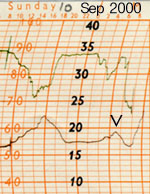 10th: A dull start to the day but pressure was relatively high (1022mb). At 0900 GMT it felt a warm 16.8C in a S'ly breeze. The morning was slow to brighten but by afternoon it had became quite sunny. The temperature rose to a maximum of 22.0C. An almost clear sky in the evening led to early heavy dew on the grass although the temperature kept up to 17.2C before rising again. [Rain nil; Max 22.0C; Min 12.9C; Grass 12.8C]
11th: At 04 GMT the temperature had risen to 19.1C in a SE'ly Föhn-like wind off the mountains. This ceased briefly and the temperature fell, in fairly clear skies, to the overnight minimum of 16.2C at 0645 GMT. This was the highest minimum of the month and the highest minimum recorded at this station in September records since 1979. Previous highest was 15.9C in 1984. By 0900 GMT the SE'ly had resumed and the temperature had risen to 21.3C (dewpoint 15.5C). It was becoming cloudier as cloud approached from the S and W. Pressure was falling as the was a deepening low (1009mb) over W Ireland with an associated cold front moving NE brought storms with hail at Omagh in Northern Ireland. During the morning the cloud began to burn-off and by noon it had become sunny and warm. The temperature was soon to reach 24.3C, the highest of the month, before it became very hazy that reduced visibility to poor. Along the North Wales coast at Hawarden (Flintshire) 29C was recorded, the warmest in the UK. Later it became murky as cloud increased from the W. It remained dry here but there were storms and heavy rain in N England. The daily mean of 20.3C was the highest in September on record at this station beating the 20.1C set in 1999. [Rain tr; Max 24.3C; Min 16.2C; Grass 12.9C]
12th: A dull and damp day with periods of slight drizzle and poor or very poor visibility. It became drier later in the afternoon as pressure rose but the sky remained overcast. There was a small temperature range of only 1.3C. [Rain tr; Max 15.5C; Min 14.2C; Grass 13.4C]
13th: A ridge of high-pressure 1015mb with weak gradients over the UK maintaining overcast skies with a slight SE'ly wind. The cloud was high and thinning at 0900 GMT making it brighter in the past hour with a temperature of 14.4C. The morning was occasionally bright, a few breaks appeared in the cloud early in the afternoon and the temperature reached 16.5C. Later the sky became overcast again and the cloud was thick enough to give a few spots of rain around 17 GMT. In the night there were spells of light rain or drizzle. [Rain 0.4mm; Max 16.5C; Min 11.5C; Grass 8.9C]
14th: The sky was clearing at 0900 GMT after passage of a weak cold front. Despite a forecast of rain, even local flooding, the day turned out to be quite warm and with only patchy high cloud the temperature reached 18.3C. The S of Anglesey benefited from being N of the Welsh Mountains on this occasion being cloudier on the N coast. In afternoon sunshine in the neighbouring village of Llandegfan I saw 10-12 Red Admiral butterflies feeding on rotting fruit fallen from a plum tree. By evening the sky was overcast but still dry. [Rain 1.5mm; 18.3Max C; Min 12.1C; Grass 10.6C]
15th: There were showers before dawn and at 0900 GMT continuous light rain within a low (1006mb) centred over the Severn estuary. In very poor visibility the temperature was 12.2C. Later in the morning it was drier with one or two small breaks in the cloud. At noon visibility had improved to good although cloud was low on the mountaintops. During the afternoon there was a further period of light rain. Thunderstorms and heavy rain were reported from Cornwall, South Wales, Hampshire and Sussex. At Walderton (West Sussex) 84mm rain was reported in the 24-h to 1800 GMT. Flooding was reported in several places including Portsmouth. During the evening there were further storms along the south coast of England. [Rain 1.4mm; Max 15.5C; Min 12.0C; Grass 11.5C]
16th: Pressure was rising (1015mb) as the low moved off into the North Sea and a ridge built across the UK. It was a dull and damp start to the day with the wind a light NW'ly. Cloud was hanging low over the mountains of Snowdonia but visibility was good. A miserable day remaining very dull. About 1800 GMT it began to drizzle then there was a short spell of light rain that accumulated 1.1mm. Later in the night the sky partially cleared, the nearly full moon was visible around 1330 GMT, before becoming overcast again by dawn the next day. [Rain 1.1mm; Max 15.5C; Min 10.7C; Grass 7.5C]
17th: Just before 0900 GMT there was some brightness, as the sky seemed that it would clear, although cloud and mist was still hanging low over the mountains of Snowdonia.. The morning had occasional bright spells but it was overcast and dull by noon. The afternoon became murky and there was light rain from 13 GMT until 17 GMT that accumulated 7.7mm. During passage of a cold front SE'wards a further spell of rain from 21 GMT (heavy about 0130 GMT) lasted 6.6h accumulated a further 14.7mm. In all 22.4mm in the 24-h period. From 0030 GMT the temperature fell 5C from 14.0C to the overnight minimum of 9.0C. [Rain 22.4mm; Max 15.0C; Min 11.5C; Grass 8.0C]
18th: It was overcast at dawn but by 0900 GMT the sky had rapidly cleared to 2 oktas after the cold front. There was a low 989mb just NW of Cape Wrath (1001mb here), the temperature was 11.0C in a light W'ly breeze. The day was sunny with some cumulus clouds mainly over the mountains to the S. By noon the temperature had reached 15.2C that was the maximum for the day. Visibility was very good in the clear air with good views of Snowdonia and the Lleyn peninsular in the afternoon. It was a good drying day as the relative humidity fell to 62%. [Rain nil; Max 15.2C; Min 9.0C; Grass 7.3C]
19th: Overnight the sky was mostly clear with bright stars. Around 02 GMT the moon was partially obscured by thin cloud but did not diminish the bright moonlight. The minimum fell to 6.1C, the lowest of the month and the lowest since 4.4C on 29 May; on the grass it was 2.2C, the lowest since 2.1C on May. There was heavy dew on the grass in the morning. It became cloudier by 0900 GMT, when it was also calm. Pressure was steady at 1001mb with the now complex low 990mb still to the W of the Outer Isles off Scotland. The morning was sunny in partial thin high cloud and the temperature reached 16.6C with a relative humidity of 45% at 1045 GMT. The afternoon remained sunny but with a NE'ly breeze off the sea. At Aberffraw on the west coast of the island there was an onshore light breeze. Sea temperature was 17C on a high tide with moderate waves. At 14 GMT a veil of thin cloud passed the sun and a complete coloured 22deg halo, with arc of contact, was seen for several minutes. Numerous swallows were hunting for insects flying low over the beach. The sky later became cloudier and eventually overcast by evening. Rain commenced around 21 GMT and there were heavier bursts in the night from 0250 GMT for an hour. Total rainfall by morning was 32.2mm, the largest fall in the month and second largest of the year so far. Valley to the NW of the island had more rain, in the 24-h to 1800 GMT on the 20th, 44mm was recorded. [Rain 32.2mm; Max 16.6C; Min 6.1C; Grass 2.2C]
20th: There was intermittent slight rain at dawn but this had almost stopped by 0900 GMT. The low to the W of Scotland had deepened (986mb) but pressure here had risen slightly (999mb) and the cloud was lifting. The day was mainly dull and damp. Some brightness early in the afternoon, when the temperature rose to 13.8C, the lowest maximum of the month, and again later towards evening when there was a glimpse of the sun. Overnight it was chilly with a clear sky and bright moon and stars. [Rain 0.2mm; Max 13.8C; Min 8.4C; Grass 7.1C]
21st: The low to the W of Scotland had further deepened (977mb) but moved out into the Atlantic S of Iceland. Lows 994 and 996mb were approaching to the SW of the UK. It was cloudier by dawn as rain-bearing clouds approached on fronts from the SW. The band of rain split over the Irish Sea passing to the N and S, here it was mainly sunny with just a few slight showers passing by during the day. The maximum reached 17.1C. The afternoon was windier, S'ly force 5, there were plenty of beech leaves being blown off nearby trees. In the night there was rain from 01-04 GMT. [Rain 6.0mm; Max 17.1C; Min 7.2C; Grass 2.8C]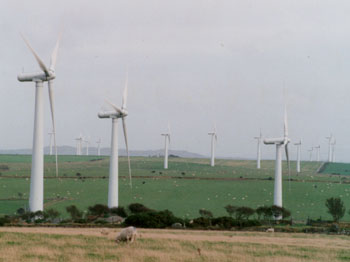 22nd: The overnight rain had cleared but cloud was still low giving mist over the mountains. Low fast moving cumulus clouds were overhead and it was gusty at times in the force 4 SSW'ly wind. During the afternoon it was cloudier, but bright, with moderately thick high cloud. The maximum during the day was 16.8C. It was a good day for power generation at the 3 Anglesey wind-farms to the north of the island with mean wind speeds of about 20mph. During the night there was 5.2mm rain from about 0230-0300 GMT. [Rain 5.2mm; Max 19.0C; Min 11.8C; Grass 9.8C]
23rd: A grey dawn but becoming brighter and rapidly warmer. The temperature at 0900 GMT was 19.0C, the maximum for the past 24-h, in a moderate SSE'ly breeze. The morning became sunnier and before noon the temperature reached 22.0C. There was patchy thin high cloud in the afternoon with a maximum of 23.2C and relative humidity of about 60-65%. The sky cleared for a while in the evening but was cloudier later in the night. [Rain nil; Max 23.2C; Min 10.6C; Grass 5.8C]
24th: At dawn there was a bit of red sky but it was soon overcast and dull. It had been a warm night with the minimum of 14.7C occurring at 0900 GMT. A low 995mb was to the W of Scotland with an associated slow-moving front lying N-S along western coasts. Before noon there was slight rain and this was intermittent with drizzle during the afternoon. At 2130 GMT there was a period of heavier rain, as the front passed that contributed most to the 24-h total of 5.8mm over 3.8h duration. Temperature range in the day was only 0.6C. [Rain 5.8mm; Max 15.3C; Min 14.7C; Grass 13.3C]
25th: At dawn there was a low mist on the fields. The sky had been clear, after the passage of the front and rain, and there was heavy dew. Cloud had then formed including some cumulus that was clearing again by 0900 GMT. The morning was bright and sunny in a light SW'ly breeze. By noon the temperature was 17.5C (RH 62%), the afternoon was sunny at first when the maximum of 19.5C occurred. From mid afternoon cloud encroached as fronts moved across from the W; there was 6h of rain from about 17 GMT. [Rain 5.2mm; Max 19.5C; Min C; Grass C]
26th: The day dawned overcast with an early shower. The rest of the day had spells of either drizzle or light rain. There was one bright spell in the afternoon when the sun shone momentarily but it kept on raining. The wind E'ly at first veered S/SSW'ly later. There was a period of rain from 19-23 GMT. [Rain 8.5mm; Max 16.4C; Min 12.7C; Grass 11.8C]
27th: A dull start to the day with low cloud and mist over the mountains. The temperature at 0900 GMT was 14.1C, this was to be the day's maximum. There was rain before noon and with falling pressure (996mb) the S'ly wind reached gale force 8 for a while around 14 GMT. Valley reported a maximum gust of 54 mph. A large branch was broken off an ash tree near Merddyn y Groes. By 17 GMT the wind had eased. There were heavy bursts of rain in the afternoon and in the 24-h to 1800 GMT over 22mm had accumulated. Capel Curig in the same period reported 38mm, the largest fall in the UK. By morning the 09-09 GMT fall at this station was 24.5mm over 11.2-h duration. [Rain 24.5mm; Max 14.1C; Min 11.2C; Grass 10.0C]
28th: With a low 972mb to the W of Ireland pressure here was 993mb and falling. There was a clear slot after the frontal rain of yesterday. The temperature at 08 GMT was 8.5C the overnight minimum. At 0900 GMT cloud cover was 2 oktas with cirrus above and some cumulus to the S over Lleyn. The morning was sunny and while it was cloudier around noon this cleared away again to give a sunny afternoon with a maximum of 16.3C. It was windy, with the S'ly reaching force 5-6, before easing before nightfall. RH was around 76% and with the fresh breeze resulted in 2.7ml evaporation from the Piche. Around 1800 GMT there were cumulus clouds in the vicinity, with showers falling over the mountains, but there was no rain here. [Rain nil; Max 16.3C; Min 8.5C; Grass 6.2C]
29th: A bright start to the day but there were dark cumulus clouds in the vicinity. Temperature at 0900 GMT was 13.6C with 79% relative humidity. Pressure remained low (994mb) with a complex of lows to the W over N-S over Ireland. There were good sunny spells with a maximum of 19.5C. Later in the afternoon it was cloudier but the sky clearing during the night. [Rain nil; Max 19.5C; Min 10.4C; Grass 9.0C]
30th: Low 997mb was situated over Pembrokeshire at 06 GMT. Pressure here was 1002mb and rising. An almost clear sky at dawn with heavy dew on the grass. With an E'ly wind the station was in the lee of the mountains and the cloud broke up giving sunshine most of the day. Some cumulus was seen to the SW around 1530 GMT, this soon dispersed but it became very hazy. The night was clear and starlit. [Rain nil; Max 18.2C; Min 10.0C; Grass 6.6C]
Return to top of page
Return to home page
1st: The sky was almost clear at dawn. There was heavy dew with an overnight minimum of 9.2C. Soon cloud low in the W encroached and by 0900 GMT there were 7 oktas cover with a S'ly force 3 wind. It remained overcast all day and there was a shower by 1515 GMT. A succession of showers followed during the evening and night, none particularly heavy. [Rain 7.0mm; Max 14.1C; Min 9.2C; Grass 5.7C]
2nd: The day's minimum of 10.5C was the highest, and only 10C or more, of the month. Low cloud with mist or fog over the mountains persisted with a moderate NW'ly wind. There were one or two small breaks in the cloud from time to time; a glimpse of the sun in the afternoon gave a maximum of 14.5C with 60% relative humidity. The evening was clearer at first with a good view of the new moon low to the SW at 19 GMT. The sky was a pinkish colour due to atmospheric pollution. The minimum for 2/3rd of 8.8C occurred at 20 GMT during a clear spell when there was heavy dew. It soon became cloudier and the temperature rose through to morning. [Rain 0.4mm; Max 15.3C; Min 10.5C; Grass 9.5C]
3rd: There was a little rain at 04 GMT and with the temperature still rising the maximum for the past 24-h was 15.3 at 0900 GMT. The wind was strong from the S and there were ragged low clouds that tended to break-up during the morning. There was a low 985mb just to the W of Ireland pressure here was 1008mb at noon; the temperature had reached 18.3C and soon reached 18.8C, the highest of the month. During the afternoon the wind reached gale force 8 with strong gusts at times. With Valley reporting gusts of 50 mph the electricity supply was disrupted between 1400-1500 GMT. The evening was windier (gusts at Valley to 66mph) for a while before a spell of rain around 21 GMT. Irish Sea ferry crossings were disrupted. Later the wind eased and the sky cleared. [Rain 2.5mm; Max 18.8C; Min 8.8C; Grass 5.5C]
4th: Clear at dawn but soon cloudier for a while. Low 977mb was NW of Scotland. Pressure was rising (1016mb) and the temperature at 0900 GMT was 11.3C (DP 7.8C) in a moderate W'ly breeze that soon backed SW'ly. The cloud cleared again only to give way to more cloud and a succession of slight showers and sunny intervals throughout the day. The temperature had risen to 14.6C by noon, this was the maximum for the day. Rain fell from 17 GMT, was moderate to heavy from 1900-2300 GMT and followed by showers. [Rain 17.0mm; Max 14.6C; Min 7.6C; Grass 3.2C]
5th: With high-pressure to the S and lows to the NW and NE there was a NW'ly flow of air over the UK. Signs of clearing, after overnight rain and a distant rumble of thunder around 03 GMT, with poor visibility at dawn, becoming good albeit hazy at 0900 GMT. There were short but moderately heavy showers during the day in a light NW'ly wind. In the afternoon (15 GMT) there was a large cumulonimbus cloud to the SE of here and hail was reported at Pentraeth. It was cooler with a maximum of 13.5C. The sky cleared at night and, in the absence of moonlight, bright stars. Aurora was forecast but none seen here. [Rain 1.8mm; Max 13.5C; Min 6.4C; Grass 2.6C]
6th: Clear sky overnight with a minimum of 4.6C. On the grass the temperature fell to 0.5C with heavy dew. Pressure had risen (1028mb) as a ridge of high-pressure was crossing the UK. There were several fronts to the W over Ireland. It became cloudier after dawn and crepuscular rays were seen over Bangor at 0900 GMT. The morning was dull with little or no rather variable wind. The afternoon was bright at first and in a short sunny spell the temperature reached 12.8C, much cooler than of late. A band of rain from midnight to 04 GMT resulted in 6.4mm by morning. [Rain 6.4mm; Max 12.8C; Min 4.6C; Grass 0.5C]
7th: A dull and damp morning but by noon the temperature had risen to 14.5C the maximum for the day. During the afternoon there was drizzle and spells of light rain; there was a moderately heavy shower at 20 GMT and the temperature declined steadily through the night falling to 5.1C at 07 GMT the next day. [Rain 1.8mm; Max 14.5C; Min 9.2C; Grass 8.2C]
8th: After dawn the sky was clearing but there were well-developed cumulus clouds in the vicinity. There were several showers during the day but later, in the afternoon, it was sunnier when the temperature rose to 12.6C. At 2100 GMT the sky was clear with bright stars but later a front brought cloud then rain from 04 GMT. [Rain 6.2mm; Max 12.6C; Min 5.1C; Grass 1.3C]
9th: Pressure was falling rapidly (994mb) as a low S of Iceland deepened. During the morning pressure continued to fall (987mb) and the S'ly wind reached gale force with moderate to heavy rain at times. Irish Sea ferries out of Holyhead were cancelled. Later the wind veered W'ly and moderated becoming brighter with showers. There was a further period of moderate to heavy rain from 1915-0700 GMT (total rainfall was 12.3mm over 13.0-h duration). [Rain 12.3mm; Max 11.6C; Min 5.6C; Grass 1.9C]
10th: A grey and dull start to the day; ragged low clouds and misty on the mountains. Low pressure (973mb) was centred over Scotland. The wind was fresh to strong WNW'ly at 0900 GMT with a temperature of 8.1C and pressure 982mb. The morning became brighter with 1 or 2 sunny spells and the temperature struggled to reach 10.9C by noon. In the afternoon it became sunnier as the cloud lifted, cleared the mountaintops and the relative humidity fell to 62%. By 1800 GMT pressure had fallen further to 974mb. [Rain 0.4mm; Max 11.0C; Min 7.2C; Grass 5.4C]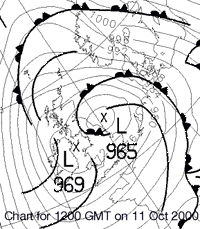 11th: Under a clear sky the overnight minimum dropped to 3.9C and on the grass to -0.2, the first ground frost of the autumn. Low pressure still anchored over the UK; pressure here bottomed out about 967mb just before 0900 GMT but had only risen to 970mb by 1700 GMT. A shower around 0630 GMT set the scene for the day: bright with sunny spells and occasional showers from dark looking cumulus clouds. Little or no wind as near the centre of the depression. The temperature reached 12.7C around noon. The sky was clear at 21 GMT but there were 3 prolonged and heavy showers of about 3mm each later in the night . [Rain 9.8mm; Max 12.7C; Min 3.9C; Grass -0.2C]
12th: The sky was clear at dawn and low lying mist (shallow fog) formed on nearby fields at 0640 GMT. Cumulus clouds approached; there was a shower and the mist had cleared by 0700 GMT. The day continued showery with 1 or 2 bright spells, even a glimpse of sunshine during the afternoon, before another shower at 18GMT. Slow moving areas of rain in the south of Britain deposited large amounts of rain on Sussex and parts of Kent causing severe flooding. Plumpton (E. Sussex) had 144mm in the 24-h to 1800 GMT. [Rain 2.3mm; Max 12.0C; Min 6.2C; Grass 1.5C]
 13th: Pressure was rising (1008mb) as a weak ridge of high pressure moved across from the W. There was a shower in the hour before 0900 GMT. Wind was a light N'ly and the day remained bright with patchy cloud. At noon the temperature was 13.7C, the daytime maximum. By evening it was overcast and there was continuous rain from 2200 GMT (7.2mm over 11.3-h duration). [Rain 7.2mm; Max 13.7C; Min 9.3C; Grass 8.0C]
14th: It had been raining all night and was still raining at 0900 GMT. Visibility was very poor with a temperature of 12.1C. A slow moving warm front was stationed over the W. There was light to moderate rain, or drizzle, throughout the day that accumulated 15.3mm over 7.5-h duration by 1630 GMT. As the front cleared away a strip of clear sky appeared in the W. The night was calm with a clear sky and a bright moon that made heavy dew on the grass look white, like frost. Capel Curig reported 21mm rainfall in the 24-h to 1800 GMT, it was not far behind here with 19mm. [Rain 15.3mm; Max 13.2C; Min 9.2C; Grass 6.5C]
 15th: With clear sky there was a golden sunrise. At 0900 GMT it was sunny with almost clear sky except a few cumulus clouds to the S over Lleyn. The day remained sunny with some patchy cloud during the afternoon. Towards evening bands of stratocumulus clouds moved across from the west and were dramatically lit by the setting sun. One band was too low in the sky to be lit red and looks grey. [Rain tr; Max 15.3C; Min 7.1C; Grass 2.5C]
16th: After a mostly clear night cloud was encroaching from the W and brought a slight shower at 0900 GMT. There was a low 998mb in the North Sea and pressure was falling (1003mb). The morning had a few breaks in the cloud, with further slight showers, but missing most of a band of rain tracking N of here. A cold front passed at 1300 GMT, marked by a short burst of rain and a 4C temperature fall from 14.3C; was followed by clearer skies and a little sunshine. [Rain 0.4mm; Max 14.3C; Min 7.1C; Grass 2.0C]
17th It was clear overnight and the minimum fell to 5.5C, 0.4C on the grass with moderate dew. An Atlantic low (959mb) to the SW of Iceland was moving E'wards and associated fronts were set to cross from the W. A golden sunrise led to a sunny start to the day but cloud could be seen low in the west. Soon after 0900 GMT the cloud reached here and it became overcast and there was a little rain. To the E it remained sunny! This was the lower end of the first warm front that gave substantial rain to W Scotland. A second front arrived around 1300 GMT and with the S'ly wind increasing to force 5-6. From 15 GMT there was blustery intermittent rain and winds that increased to gale force 8 in the evening. Valley reported mws of 45 mph with gusts of 54 mph around 20 GMT. Pressure (1005mb) was lowest around midnight when the filling low (963mb) was S of Iceland. [Rain 3.9mm; Max 13.3C; Min 5.5C; Grass 0.4C]
18th: The wind eased after midnight; a final cold front past over around 04 GMT and the temperature fell by 3C. Pressure was rising (1010mb) and at dawn the skies were showing signs of clearing. The morning was bright and breezy, with good drying in 74% RH; the S'ly becoming more SW'ly and force 5 by noon. The afternoon was sunny and the temperature rose to 14.8C. The Snowdonia Mountains remained obscured and topped with cumulus clouds; one strayed over here and we caught a shower just before 1700 GMT. [Rain 0.9mm; Max 14.8C; Min 9.5C; Grass 6.7C]
19th: A shower at 07 GMT soon cleared away leading to an almost clear sky by 0900 GMT. There were still some cumulus to the S, W and NE but here a sunny morning in a light SW breeze. Another good drying day with an RH of 60%. The afternoon was similar and with just a few passing clouds the temperature reached 13.2C. [Rain 0.3mm; Max 13.2C; Min 7.8C; Grass 3.9C]
20th: Despite a shower in the night (03 GMT) the grass was dry at 0900 GMT. There was a S'ly breeze and a relative humidity of 78%. The morning was showery and rainbows could be seen. A heavy shower at 10 GMT resulted in 6.8mm falling in minutes and a 2C fall in temperature. This was to be the only rain of the day other showers passing by the station. [Rain 6.8mm; Max 13.0C; Min 6.8C; Grass 1.3C]
21st: It was calm at first and the morning soon became bright and sunny. Pressure (1019mb) was rising slowly. The cloud was high and good views of the Snowdonia Mountains could be seen. The afternoon was sunnier when the temperature reached 14.7C and the relative humidity 58%, the lowest of the month.. Towards evening the cloud dispersed completely giving a clear starlit night. [Rain nil; Max 14.7C; Min 6.6C; Grass 2.5C]
22nd: With a clear sky overnight the temperature on the grass fell to -0.7C. There was a red sky just after dawn and pressure was falling (1021mb). The morning was sunny but it did cloud over during the afternoon and it became windier (S'ly force 5-6 at times). There was a moderately heavy shower in the night around 02 GMT followed by more slight showers before morning. There was 2.4mm evaporation from the Piche tube in the 24-h period. [Rain 6.5mm; Max 12.5C; Min 4.2C; Grass -0.7C]
23rd: Pressure was low S of Iceland (992mb) and a trough W of Ireland (990mb). A showery but sometimes sunny morning with a moderate SW'ly wind. The afternoon was cloudier but kept dry. There were further showers from 20 GMT that carried on through the night. [Rain 4.7mm; Max 13.7C; Min 9.0C; Grass 6.3C]
24th: A dull morning with a W'ly wind bringing slight rain before noon when the temperature was 10.5C. Pressure was falling (1014mb) and during the afternoon it became windier with the backing SSW'ly reaching force 5-6 by 16 GMT. During the evening the wind reached gale force 8 with gusts of 58 mph being reported at Valley. After midnight the wind eased and pressure was at it lowest (995mb). The temperature rose to the 24-h maximum of 12.4C and there was a period of heavy rain around 01 GMT. [Rain 13.3mm; Max 12.4C; Min 8.8C; Grass 6.8C]
25th: At 0900 GMT there were a few breaks in the cloud and pressure was rising (1004mb). The wind had veered to WNW'ly and was force 4. The day was bright with a few sunny spells in the afternoon. There were 2 light showers about 19 GMT and 03 GMT the next morning. [Rain 0.5mm; Max 12.3C; Min 9.2C; Grass 8.2C]
26th: There was a complex low (992mb) in the N North Sea and an Atlantic low (971) W of Ireland. It had become cloudier since dawn when there were active cumulus clouds over the Snowdonia Mountains. There was a slight shower here at 0910 GMT but the morning was then bright with sunny spells. At noon the temperature was 11.0C and there were dark cumulus clouds in the vicinity. During the afternoon the cloud was higher and there were hazy views across the Straits towards the mountains. Towards dusk it was overcast as warm frontal rain approached from S Ireland. The first slight rain was about 17 GMT but moderate to heavy rain started at 2100 GMT and continued until past 0900 GMT on the 27th. Total rain was 29.6mm over 12-h duration while Capel Curig (Gwynedd) reported 41mm in the same period. Amounts in the 24-h to 1800 GMT were 30.8mm here and 51.6 mm at Capel Curig. Several roads and low-lying fields on Anglesey were partially flooded; more extensive flooding was reported at Porthmadog and Aberglaslyn (Gwynedd) during the day. [Rain 29.6mm; Max 13.2C; Min 7.2C; Grass 3.0C]
27th: The maximum for the 26th of 13.2C occurred at 0900 GMT towards the end of the frontal rain. It was soon to clear and there was a short period of clear sky before it became partly cloudy before noon. Before noon, in the bright sunshine, the temperature had reached a maximum of 14.5C. The afternoon was sunny but visibility remained poor, with thick haze, obscuring any view of the mainland mountains. Bt 21 GMT the sky had almost cleared but was to become overcast before dawn with the approach of a warm front. Heavy rain from 0630 GMT amounting to 8.1 mm by 0900 GMT. [Rain 9.3mm; Max 14.5C; Min 8.8C; Grass 7.9C]
28th: The heavy spell of rain from 0730 GMT continued until 1000 GMT and accumulated 15.4mm. Pressure was falling quickly (997mb) and was to fall to 989mb by noon. There was a vigorous low (992mb) SW of Iceland and another complex low (982mb) just to the W of Ireland and with forecasts of imminent severe weather. At 0900 GMT it was almost calm with a slight SE'ly wind, by noon it had veered to S'ly force 7 with strong gusts. The temperature rose to 14.6C. 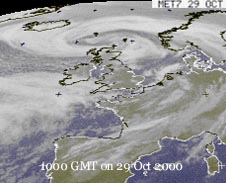
During the afternoon the then SW'ly reached gale force 8 with gusts of 60 mph. Ferries crossing the Irish Sea were disrupted and speed restrictions were in force on the Britannia Bridge. There were some short heavy showers with hail reported at Valley. Pressure was lowest (993mb) between 16-17 GMT. Winds remained near gale force throughout the night. More severe weather was reported from NW Scotland with gust exceeding 70 mph at Malin and 77 mph in Shetland. Winds were also severe (gusts exceeding 60 mph) along the south coast of England and at Bognor Regis (Sussex) at about 1615 GMT a tornado injuring 5 people, snapped several trees, overturned several caravans and damaged houses. There was also a report of a car being lifted into the air. [Rain 9.5mm; Max 14.6C; Min 8.3C; Grass 4.0C]
29th: The low 959mb was situated just NW of Cape Wrath at 0600 GMT; heavy rain was falling over NW Scotland. Pressure here was rising at 994 mb and the sky clearing in the hour to 10900 GMT. Wind was WSW'ly force 6, it was bright with brief sunny spells with cumulus clouds in the vicinity. The cloud-base was just on the top of the Carneddau Mountains but the view was hazy. During the morning the temperature struggled to reach 9.5C, the lowest maximum of the month, and was the coldest since 17th April. At 1300 GMT the temperature began to fall, with the onset of heavy rain, reaching 6.0C. On the summit of Snowdon (which was obscured) the automatic equipment was reporting 0.2-0.8C. It looked to be snowing on the Carneddau Mountains. Pressure was falling again and by 1500 GMT was 988mb. Heavy rain moderated about 17 GMT turning sleety by 19-20 GMT. Moderate rain resumed at 2300 GMT and was heavy from 03-04 GMT, falling vertically as it was almost calm, before moderating and turning to sleet before dawn when the temperature was about 3C. On the summit of Snowdon the temperature -5C. Here there was 35.8mm rain over 16.0-h duration. The week 23-29th has been very wet with a total of 102.7mm rainfall. [Rain 35.8mm; Max 9.5C; Min 7.9C; Grass 6.1C]
 "Autographic record of rainfall during the week 23-29 October 2000.") 30th: The overnight minimum of 2.9C was the lowest of the month. Low 958mb was over Merseyside at 06 GMT with another (960mb) centred to the W of Scotland. With tightly packed isobars over the Channel storm force winds gusting to 90-100 mph were affecting South Wales (Mumbles Head 97mph) and the coast of southern England from Sussex to Kent and N France. At 0900 GMT with a clearing sky snow could be seen as low as 1500ft on the Carneddau Mountains of Snowdonia. Almost calm since the small hours but a WNW'ly wind force 5-6 had begun by 0930 GMT. Temperature was 5.5C (dewpoint 4.6C) but rose to 9.5C by 1030 GMT, joint lowest maximum of the month. During the morning there was a shower (3mm) .
30th: The overnight minimum of 2.9C was the lowest of the month. Low 958mb was over Merseyside at 06 GMT with another (960mb) centred to the W of Scotland. With tightly packed isobars over the Channel storm force winds gusting to 90-100 mph were affecting South Wales (Mumbles Head 97mph) and the coast of southern England from Sussex to Kent and N France. At 0900 GMT with a clearing sky snow could be seen as low as 1500ft on the Carneddau Mountains of Snowdonia. Almost calm since the small hours but a WNW'ly wind force 5-6 had begun by 0930 GMT. Temperature was 5.5C (dewpoint 4.6C) but rose to 9.5C by 1030 GMT, joint lowest maximum of the month. During the morning there was a shower (3mm) .
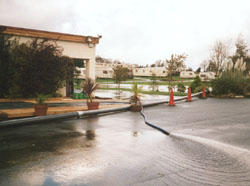
Thousands of trees had been brought down as far N as the Midlands. Train services S of Birmingham, including South Wales and into the London area and Kent, were seriously disrupted due to fallen trees. The service to Heathrow was also affected. Landslips were also affecting trains in Scotland. The Port of Dover was closed to all shipping stranding several ferries, with 6000 passengers aboard, standing off in the Channel. The 7,300-tonne tanker Ievoli Sun, with a cargo of 6,000 tonnes of toxic chemicals, went aground at Guernsey and the crew of 14 was taken off by helicopter. Flights to and from Heathrow and Gatwick were disrupted. Power lines were down and many thousands were without electricity. Heavy rain was also affecting S Britain, several rivers were on flood alert, and flooding was reported from several places. On Exmoor several roads were washed away and at Taunton the river was at its highest for 40 years threatening to flood the town. In Cardiff parts of the city centre were flooded and homes were damaged in Merthyr. A man was blown off the Rosslaire ferry and although rescued he died later. In North Wales there was flooding at Ruthin, Pentre and Welshpool. The River Dee had burst its banks.
Here on Anglesey the temperature had fallen to 6C by 15 GMT and it was windy, but no greater than a force 7 W'ly. The Ty Newydd Country Club at Llanbedrgoch was partially flooded during the day and pumps were used to lower the water level. The evening was overcast and there was a shower (4mm) about 21 GMT. The sky cleared between 03-04 GMT giving a touch of ground frost (-0.9C) before clouding over again before dawn. [Rain 8.5mm; Max 9.5C; Min 2.9C; Grass 2.0C]
 31st: Low 960mb SW Norway was keeping a NW'ly airflow across the British Isles. Pressure here was 987mb and rising with some breaks in the sky. There were active cumulus clouds in the vicinity and the morning was showery. At Beaumaris, looking across the Menai Strait towards the mountains, a constantly changing display of strong crepuscular rays was seen from 1030 GMT for at least an hour. At Benllech the main road and some properties were flooded.
The upper reaches of the River Severn had burst its banks and Shrewsbury was flooded with several feet of water. The chemical carrying tanker had been refloated but later sank 11 miles off Alderney under tow to the French port of Cherbourg. Believed to be carrying a cargo of 4000 tonnes of styrene and other chemicals it is possible that this could result in serious chemical pollution of these waters. It has been reported that 6 people have died as a result of the storm.
The afternoon continued showery and windy. At 2100 GMT there was a heavy shower of rain and ice pellets. There were further showers throughout the night. [Rain 2.6mm; Max 9.8C; Min 5.0C; Grass -0.9C]
Return to top of page
Return to home page
1st: There was a shower of 5mm hail after midnight. The day dawned dull with a WSW'ly wind that became force 6 by 0900 GMT. The morning was bright, with a glimpse of sunshine, and showers. During a heavy burst at 1240 GMT the temperature fell 2C from the day's maximum of 9.5C. In the afternoon there were some dark towering cumulus clouds in the vicinity. Against the sun these had striking white edges and strong upward crepuscular rays. At 1540 GMT under a very dark cloud there was a moderate shower of elongated hail that measured between 7-10mm (max diameter MO code 6; TORRO 2). At 1547 GMT there was thunder and lightning nearby and at 1700 GMT a further flash of lightning over Red Wharf Bay and a rumble of thunder about 5 seconds later. This was followed by a shower of rain and ice-pellets at 1747 GMT. Many parts of the country continue to be affected by flooding including York, Shrewsbury and Bewdley. [Rain 8.7mm; Max 9.6C; Min 5.0C; Grass 2.0C]
2nd: There were no further showers after midnight. It was overcast at dawn but at 0900 GMT the sun was seen through thinner patches. The wind was SE'ly force 2-3 at first and backed N-NE'ly later. There were showers in the morning before a period of light rain in the afternoon. When this started to clear about 16 GMT the cloud lifted to reveal a slight fall of fresh snow above 2750ft on the Carneddau Mountains adding to the patches that remained. The summits above 3000ft had looked uniformly snow covered. Later in the evening there was some light rain then the sky cleared again after midnight. Floodwater from the River Severn continues to affect several areas. Water levels were rising at Worcester during the day and patients and staff in part of a hospital had to be evacuated. [Rain 6.0mm; Max 7.2C; Min 4.8C; Grass 0.3C]
3rd: There was a clear spell around 03-04GMT sufficient to result in ground frost (-1.9C). It became cloudier again before dawn and this gave a little rain around 0730 GMT. With a low 976mb in the N North Sea pressure here was 991mb. At 0900 GMT there was a light NW'ly and cumulus clouds in the vicinity that later produced showers of rain. Cloud was hanging low over the Snowdonia Mountains; it was seen later that fresh snow had fallen over the summits. The afternoon had some good sunny spells with the occasional shower. There was a period of rain in the evening that later gave way to showers. Floodwater was still affecting many parts of Yorkshire with water levels along the Rivers Ouse and Derwent very high. As floodwater on the River Severn was moving further downstream it was still affecting Shrewsbury and Worcester and began to affect Tewkesbury and threaten Gloucester. A party of bird-watchers on Bardsey Island since October 21st, unable to leave because of rough seas, was finally able to cross to the mainland today in calmer weather. Rain 3.1mm; Max 9.7C; Min 3.0C; Grass -1.9C]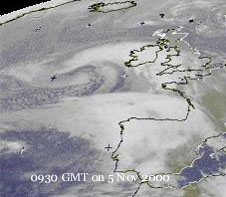 4th: There was a moderate shower of rain and ice pellets just after midnight. There was another slight shower before the sky partly cleared giving a minimum of 4.0C and a little ground frost (-0.8C) before morning. Low 983mb was to the N of Scotland maintaining a NW'ly airflow. Although pressure (1004mb) was still rising here, another rapidly deepening low in mid-Atlantic is expected to bring strong winds and further heavy rainfall across the country over the next 2 days. At 0900 GMT there were towering cumulus all around and soon just a few spots of rain. The morning and afternoon had some good sunny spells with a maximum of 11.0C. A mainly cloudy night with a few clear spells. In Yorkshire it was reported that some floodwater had lapped over retaining walls but at Gloucester the defences prevented the City centre being flooded. [Rain tr; Max 11.0C; Min 4.0C; Grass -0.8C]
5th: Low 991mb N Shetland was filling but deepening Atlantic low 977mb 150 miles off S Ireland was moving quickly E. Pressure here (998mb) at 0900 GMT was falling and there was a light SE'ly wind. With approaching warm front rain, from the SW, cloud was spilling over the tops of the Snowdonia Mountains. The sky became very dark around noon but it did not start raining until about 14 GMT. The rain slight to moderate at first became moderate to heavy and continued all night accumulating 30.4mm of 18.0-h duration. Other 24-h rainfall totals were 28mm at Valley, 33mm at Nantmor, 36mm at Moel-y-Crio, 67mm at Lake Vyrnwy, 79mm at Ruthin and 83mm at Abergwyngregyn. The wind slowly backed NE'ly and became strong to gale force later. The A55 Expressway became flooded near Talybont (Bangor) during the evening and had to be closed for a time. Ferries out of Holyhead were cancelled. [Rain 30.4mm; Max 7.5C; Min 3.3C; Grass -1.4C]
6th: Low 965mb was now over Brittany. Pressure 974mb, continuous moderate to heavy rain and gale force 8 and gusts to force 9 at 0900 GMT. The 'old cricket field' at Gadlys has several large pools of water standing on it. The wind and rain eased by about 14-15 GMT. The evening and night remained windy (force 5-6) but there was little more rain. The A5 at Corwen and the A525 between Ruthin and Denbigh were reported to be flooded. Flooding has also been reported from Ruthin, for the second time, and Mold (Flintshire) and along the banks of the River Dee. Several schools had to be closed in NE Wales. The Horseshoe Pass near Llangollen was closed following a landslip. Soil had slipped under the road leaving the unsupported tarmac intact for a while. After several vehicles had passed over the tarmac finally gave way. It is thought that repairs will take at least 3 months. At the foot of the Pass the owners of the Britannia Inn had a lucky escape when the Inn was hit by the massive slide. Near Tenbury Wells 2 people died when a falling tree struck their car. Flooding has occurred in Ukfield (Sussex) for the second time. [Rain 10.6mm; Max 9.0C; Min 4.6C; Grass 3.3C]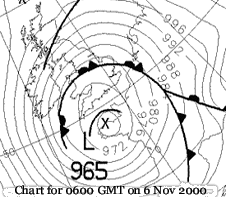
 "Satellite image 1000 GMT 6 Nov 2000. Courtesy of Ulm University.") 7th: The day began overcast with slight showers of rain and poor visibility. Pressure here was 981mb at 0900 GMT with the slow moving low (975mb) now centred near Dover and maintaining the NE airflow over the UK. The morning remained dull but there was no further rain until near 1300 GMT. The afternoon was wet and unpleasant in the N-NE'ly wind that was gusting to force 7 at times. Irish Sea ferry crossings were again in doubt or had already been cancelled. There was a period of light rain from 2230-0300 GMT before it became dry. A severe flood alert remained for the Lower Dee and householders were being advised to evacuate their houses. The Nant-y-Garth Pass near Ruthin remained closed and several other partially flooded roads were only passable with care. Near Rosset, on the Trevalyn Plain, floodwater continues to surround Almere Farm where the farmyard is under 3 feet of water. This years' flood, however, is not as deep as the 1946-47 flood that reached the top of the kitchen dresser. So far it has only reached to the top of the drawers! [Rain 3.2mm; Max 9.2C; Min 6.2C; Grass 5.4C]
7th: The day began overcast with slight showers of rain and poor visibility. Pressure here was 981mb at 0900 GMT with the slow moving low (975mb) now centred near Dover and maintaining the NE airflow over the UK. The morning remained dull but there was no further rain until near 1300 GMT. The afternoon was wet and unpleasant in the N-NE'ly wind that was gusting to force 7 at times. Irish Sea ferry crossings were again in doubt or had already been cancelled. There was a period of light rain from 2230-0300 GMT before it became dry. A severe flood alert remained for the Lower Dee and householders were being advised to evacuate their houses. The Nant-y-Garth Pass near Ruthin remained closed and several other partially flooded roads were only passable with care. Near Rosset, on the Trevalyn Plain, floodwater continues to surround Almere Farm where the farmyard is under 3 feet of water. This years' flood, however, is not as deep as the 1946-47 flood that reached the top of the kitchen dresser. So far it has only reached to the top of the drawers! [Rain 3.2mm; Max 9.2C; Min 6.2C; Grass 5.4C]
8th: Although still cloudy it was a dry start to the day. In a brisk N'ly wind and 77% relative humidity some of the paving, and surface grass, around the house had dried. The soil remained saturated and very soft to walk on. At 0900 GMT with little pressure change (988mb here) the low (977mb) was drifting N in the North Sea. High (1024mb) was in mid-Atlantic W of Ireland. By 1030 GMT we were into the start of a very showery day; there was a heavy burst that contained ice pellets. Heavy bursts of rain some with ice pellets continued, within continuous light rain, through the afternoon. The A55 Expressway was difficult at Abergele and almost closed near Abergwyngregyn during the evening due to surface water. It continued showery through the night but there were no ice pellets recorded after 2200 GMT. Total rainfall here was 24.4mm (12.3-h duration). At Silent Valley reservoir in the Mournes Co. Down 158mm rain was recorded in 48-h to 0900 GMT this morning. [Rain 24.4mm; Max 8.8C; Min 6.7C; Grass 5.5C]
9th: The overcast sky showed a hint of fragmenting at 0900 GMT but it was soon 8/8 again. Pressure was rising 1001mb with the low now complex and continuing to fill in mid North Sea and offshore Norway. An almost stationary occluded front was just lying NE of here. A slight shower early in the morning then dry until noon. The afternoon had continuous slight to moderate rain and by 1800 GMT another 12mm had accumulated and by morning 15.0mm. Total rainfall for the month so far is 101mm 83% of average. This precipitation was falling as snow on the Mountains of Snowdonia. Highest UK rainfall reported to 1800 GMT today was 42mm at the Isle of Man. [Rain 15.0mm; Max 7.6C; Min 6.5C; Grass 4.2C]
10th: The sky partially cleared after the band of rain and allowed the minimum to fall to 3.0C, -1.8C on the grass. By dawn it was becoming cloudier but a glimpse of the sun, with some red coloration, was seen rising over the mountains about 0730 GMT. Visibility was good and fresh snow could be seen on Snowdon and the Carneddau Mountains. There was a moderate covering above 3000ft and was thinner down to 2500ft. There were also good views across the island; Holyhead Mountain and the 400ft stack at the Anglesey Aluminium reduction plant could be seen. Low 997mb was now moving towards the Baltic but another, SW of Iceland (984mb), was forecast move SE and to bring more frontal rain to Wales and then the SE of England. There were just 1 or 2 showers in the morning but more rain, that had worked its way across the from Ireland, arrived about 1330 GMT. This gave slight rain at first but turned moderate to heavy from 16-22 GMT. In 24-h to 1800 GMT 16.3mm rain was recorded; from first indications this was the most in the UK (Colwyn Bay 13.7mm). [Rain 11.6mm; Max 10.5C; Min 3.0C; Grass -1.8C]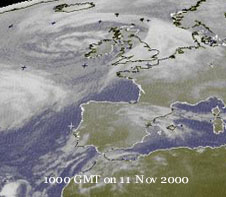 11th: With a low 984mb W Ireland pressure was falling here (0999mb) at 0900 GMT. After yesterday's fronts we were into a showery spell and windy of weather. After a slight shower in the morning, but heavier ones were in the vicinity and over the Mountains of Snowdonia, there were some clearer spells. Snow was seen lying over the tops (3000ft) of the Carneddau at 11 GMT. The afternoon had some vigorous showers with strong gusts from time to time with a few sunny spells. The showers continued in the evening, with a heavy one at 1900 GMT that included ice pellets and gusts of wind to force 8, and well into the night. [Rain 5.2mm; Max 10.2C; Min 5.2C; Grass 4.8C]
12th: Blustery showers early in the day. With the low 981mb over Malin and a high (1036mb) Newfoundland pressure was lowest here 987mb before 0900 GMT when it had started to rise. The wind was a fresh SW'ly with a temperature of 6.8C and, although there were towering cumulus clouds in the area, rain had kept away up to mid-morning. Precipitation had been falling as snow over the highest mountaintops in Snowdonia. By 1300 GMT the temperature had already past the highest of the day (9.2C). There was soon a slight shower then the afternoon was dry with a few sunny spells: the cloud did not completely clear away from the summits of Snowdonia. It was a dry night with some clouds but enough clear spells for the temperature on the grass to fall to -1.1C. [Rain 0.3mm; Max 9.2C; Min 6.3C; Grass 3.5C]
13th: A slight shower just before 0900 GMT set the scene for frequent showers during the morning. Low 982mb was over Shetland and the high 1029mb in mid-Atlantic moving E. Still under the influence of the Shetland low, and with pressure here 992mb, there was a W'ly airflow. There were outbreaks of showery rain at first before a trough brought moderate to heavy rain from 11-1730 GMT accumulating 17.8mm by 1800 GMT. After this rain the sky partially cleared and there was a slight ground frost (-1.3C). Another frontal trough brought a further spell of rain from 03-08 GMT bringing the total for the 24-h period to 25.2mm. The day was on the cool side with a maximum of only 7.6C in the morning. [Rain 25.2mm; Max 7.6C; Min 4.4C; Grass -1.1C]
14th: The overnight rain was just clearing away although the sky had dark and ragged low clouds. At 0900 GMT the wind was a light N'ly with a temperature of 5.8C. After a brief shower the morning became bright and sunny at times. Pressure at noon was 1001mb and rising slowly as a ridge of high pressure moved across from the W. There were well-developed cumulus clouds in the vicinity at first but these diminished later on; there was no more rain up to 1800 GMT. The mountains of Snowdonia remained obscured by cloud all day but the Lleyn Peninsular was clear. The sky cleared during the night, when the nearly full moon was visible, and there was a ground frost (-3.1C). [Rain 1.5mm; Max 8.7C; Min 3.5C; Grass -1.3C]
15th: The overnight minimum of 2.6C and -3.1C on the grass were the lowest of the month. The sky clouded over before dawn and there was light rain from 05-0830 GMT. The high pressure had moved off and a low 976mb over Iceland with warm and cold fronts becoming occluded in the N was to dominate the weather. At 0900 GMT pressure was 1006mb and falling and there was a light SW'ly wind. The morning was mainly dry the cloud lifting to reveal the snow capped Carnedd Dafydd and Carnedd Llywelyn Mountains. The frontal rain band encroached from the W during the afternoon giving light rain at first. By evening the wind had backed to S'ly and increased to force 7; the rain became moderate at 2100 GMT. Just before midnight the wind became gusty and veered NW'ly before easing to force 4 along, with the rain, about 01 GMT. Later the sky partially cleared to give a slight ground frost. [Rain 10.0mm; Max 9.0C; Min 2.6C; Grass -3.1C]
16th: It was a showery morning and with cumulus clouds in the vicinity. There was smoke in the Menai Strait but this soon cleared. At 0900 GMT pressure was 999mb and rising slowly; temperature was 4.2C. Pressure was low 981mb near Iceland and Atlantic high 1029mb was W of Portugal. The day turned bright with sunny spells but there were further showers later in the afternoon. A short shower around 1600 GMT contained ice pellets. [Rain 2.1mm; Max 8.9C; Min 3.7C; Grass -1.0C]
17th: There were showers of rain and ice pellets between 03-05 GMT. At 0900 GMT showers were continuing with a temperature of 5.0C. Pressure (1008mb) was rising slowly as the Iceland low was slowly filling (989mb) and the Atlantic high (1030mb) maintained W of Portugal. In a NW'ly wind the morning was bright at times but there was a further shower of rain and ice pellets about noon. The afternoon was duller with more rain showers; the mountains remained obscured in low cloud and mist all day. [Rain 1.7mm; Max 8.4C; Min 3.4C; Grass -0.6C]
18th: There were some breaks in the overnight cloud cover allowing the minimum to dip to 3.1C and give a slight ground frost (-1.3C). Unfortunately the sky was overcast around 0344 GMT when the Leonid meteors might have been visible. It was a grey start to the day with drizzle or light rain from 07 GMT. At 0900 GMT visibility was poor and deteriorating; the temperature had risen to reach yesterday's maximum of 8.4C. Pressure here was 1003mb and falling with low 979mb Faeroes and high 1020mb over France. The day remained misty with drizzle or light rain as a warm front moved in from the W. During the evening the rain turned showery and this continued until morning. In all rain duration was 12.2h with 11.6mm recorded. [Rain 11.6mm; Max 10.3C; Min 3.1C; Grass -1.3C]
19th: The frequent showers before dawn were diminishing in number and the sky clearing by 0900 GMT. Pressure here (0995mb) was falling slowly as low 974mb Shetland was drifting S. The morning was bright but there were fewer showers. This pattern continued through the night. [Rain 2.2mm; Max 8.3C; Min 5.0C; Grass 3.2C]
20th: Some clear spells overnight between showers allowed the temperature to fall to a minimum of 2.9C and -1.6C on the grass. Pressure had fallen further to 992mb as the low now filling (987mb) was now over Aberdeen. There were thunderstorms over N France. Here cumulus clouds were in the vicinity at 0900 GMT; these continued to develop and by mid-morning a cumulonimbus was developing to the S. In the afternoon after crepuscular rays were seen some black towering cumulus clouds deposited a shower of rain and ice pellets at 1400 GMT. There were showers (sleety at first) from 21 GMT until 07 GMT the next day. [Rain 5.2mm; Max 7.1C; Min 2.9C; Grass -1.6C]
21st: The sky was almost clear at dawn and this allowed the temperature on the grass to fall to -1.5C. Overnight fresh snow had fallen on the Snowdonia Mountains giving a thin covering as low as 2000ft in places. The wind had backed to the SE as low 980mb moved to SW Ireland. The morning soon became cloudier but was bright at times with a maximum of 6.8C. The afternoon was overcast with thin high cloud through which the sun loomed at first. In the evening the wind backed further, to ENE'ly force 4, as an area of rain on a cold front moved NE arriving here about 18 GMT. There were some ice pellets in the rain and the temperature (3.3C) was the lowest over the 24-h period. Rain continued, slight to moderate, until 03 GMT and was accompanied by a rise in temperature. [Rain 7.7mm; Max 6.8C; Min 3.0C; Grass -1.5C]
22nd: A grey overcast dawn but pressure (0982mb) was rising slowly. At noon low 0980mb was centred over the Tay Estuary with high 1023mb central Europe. After a slight shower just after 0900 GMT the morning was occasionally bright with a strengthening W'ly wind. The afternoon was brighter, with crepuscular rays seen over Brynsiencyn and Caernarfon. The maximum of 6.5C was the lowest of the month. Band of light to moderate rain from 00 GMT accumulated 13.8mm, over 10.5-h duration, by morning. [Rain 13.8mm; Max 6.5C; Min 3.3C; Grass 0.9C]
23rd: Continuous light rain at first easing just after 0900 GMT. Complex low-pressure area (986mb) centred over the Orkneys with frontal systems over the UK and near continent. Pressure here 0995mb and with very slack isobars there was little (variable) or no wind. During the morning the cloud lifted (a little drizzle around 1300 GMT when temperature had reached 6.7C) but it was not until the afternoon that the sky cleared. After a short very red sunset there was mist forming at 1600 GMT across the fields and in nearby valleys. The temperature on the grass fell to -2C before rising again later as it once more became cloudier with a shower of rain at 2030 GMT. Some clear spells in the night gave an undulating temperature trace of the thermograph. [Rain 1.4mm; Max 7.5C; Min 4.5C; Grass -0.1C]
24th: A shower of ice pellets at 0630 GMT but towering cumulus over the mountains seen after dawn were dispersing at 0900 GMT. Snow could be seen on all peaks above 3000ft but it was patchy below down to 2200ft. Low 971mb was 300 miles W of Ireland with a SW'ly airflow over the UK with pressure here 1001mb. There was rain from 1100 GMT, with a few more ice pellets at first, to 21 GMT. During the afternoon the S'ly wind increased to force 6. It was a dry night. Rainfall at Aberdaron (Lleyn) for the 24-h to 1800 GMT was 17.2mm, the largest in the UK. [Rain 8.7mm; Max 9.1C; Min 2.7C; Grass -2.5C]
25th: At 0530 GMT it was a clear starlit sky. The wind had backed to SSE force 4 and it had clouded over (8/8) by 0900 GMT when the maximum (9.1C) for the past 24-h was recorded. In the few hours without rain the surface of the grass had dried but not so the concrete. Several lows were in the Atlantic (968-972mb) moving towards the UK. Pressure here was 975mb and falling and the morning was bright and showery. At noon the wind was SSW'ly force 7 with gusts of 56mph being reported at Valley. At 1412 GMT thunder was heard and more approaching from the W at 1450 GMT. At 1458 GMT there was local heavy thunder and lightning with a moderate shower of 5mm-diameter hail and rain lasting 10min that accumulated 4mm when melted. During the storm the temperature plunged 5C. The last thunder was heard at 1540 GMT. After a short lull the SW'ly wind increased to force 9 with strong gusts. Valley was reporting gusts of 70mph between 17-20 GMT just before the pressure reached its lowest point of 0968mb. At Mumbles near Swansea gusts of 90mph had been reported. Rain recommenced about 1600 GMT and continued until 02 GMT; the 24-h total was 20.0mm over 9.7-h duration. [Rain 20.0mm; Max 9.8C; Min 5.2C; Grass 3.5C]
26th: A calmer start to the day but there were still ragged low clouds being driven on by the force 5/6 W'ly wind. With the low 0974mb now over Scotland pressure here (0987mb) was rising. The day was bright, even a glimpse of the sun from time to time, and dry! In the evening there were a few ice pellets, not enough to wet the raingauge bottle, the edge of a heavier shower at Gaerwen. The remainder of the night was dry with a clear sky and, in the absence of moonlight, bright stars. By morning it was partially cloudy again. [Rain tr; Max 8.4C; Min 4.9C; Grass 2.9C]
27th: Pressure (1005mb) was still rising slowly but Atlantic low 969mb and associated fronts, W of Lands End, was steaming this way. A fairy bright and dry start to the day with a temperature of 7.6C and light SW'ly wind. There was slight rain or drizzle from 1300 GMT. By 20 GMT the temperature had risen to 12.1C as warm air was drawn up from the Azores. The temperature was to remain near 12C through the night; there was moderate to heavy rain that accumulated 12.5mm by morning. [Rain 12.5mm; Max 12.1C; Min 5.5C; Grass 0.8C]
28th: By dawn the rain ceased for a while but it remained uniformly overcast with thick stratus cloud. At 0900 GMT with a force 6 S'ly wind the temperature was 12.1C. During the morning there was intermittent slight rain or drizzle and poor visibility. At noon elongated complex low 0983mb was W Ireland and the Bay of Biscay and still drawing warm air across the UK. Pressure here was steady at 0998mb. The afternoon remained damp and dismal. During the evening, in a SSE'ly force 6, the temperature began to rise and the relative humidity to fall. This was typical of a Föhn-like wind off the Snowdonia Mountains. By 2100 GMT, with the wind now force 7 to gale 8, the temperature reached 16.7C (the highest of the month) with an RH of 54% (the lowest of the month); this is the warmest November temperature on this date in the year in my records back to 1979. Soon after the temperature fell away a little but my digital thermometer that reacts faster the standard mercury reached 17.3C. The highest temperature recorded on this date is 17.0C at Ruthin in 1979; equalled today at Torquay (Devon) and Pentraeth but exceeded at Abergwyngregin where 18.0C was recorded. Valley reported a maximum of just 14.5C, the highest of the month. [Rain 3.2mm; Max 16.7C; Min 7.5C; Grass 3.8C]
29th: A slight deposit of light orange dust (possibly of Saharan origin) was seen at 0900 GMT. Wet deposits were on the bottom edge of the screen roof, leading edge of greenhouse glass and car windscreen. The latter was more easily seen when it had dried. Deposition occurred during the past 24-h probably during the afternoon of the 28th. The minimum temperature of 11.1C was the warmest of the month. With the low 0966mb now just off the W coast of Ireland, pressure here was 0988mb at 0900 GMT. With tightly packed isobars strong winds were expected; severe gale warnings had been issued and Irish Sea ferry crossings had been cancelled. The morning was deceptively bright and sunny but things wound up about noon with a series of blustery showers. The S'ly veered SSW'ly and by 1300 GMT was severe gale force 9 with very strong gusts. Two slates were lifted off the roof of the house and for about an hour it was unsafe to go outside. The wind eased during the afternoon and by 1600 GMT had reduced sufficiently (force 5/6) to allow repair work to be done. On the B5111, Llanerchymedd to Llangefni road, a lorry was blown off the road into a ditch. A gusts of 60 mph was reported from Valley but 70mph was reported from Capel Curig during the day. [Rain 0.2mm; Max 12.5C; Min 11.1C; Grass 9.6C]
30th: The clear sky overnight had become partially cloudy by dawn. There was a slight pinkness of the highest clouds as the sun rose from behind the mountains. Yesterday's low, (977mb) now near Iceland , was being rapidly replaced by yet another Atlantic low 964mb 300miles W of Ireland. Pressure had risen during the night but had started to fall again (1003mb) by 0900 GMT. The morning was overcast with a force 5 S'ly wind. There was slight rain from 1330 GMT; by 1700 GMT the SSE'ly wind had reached gale force with gusts of 60mph. There was another Föhn-like wind off the mountains giving temperatures of 12.8C at 2030 GMT and 13.5C at 2230 GMT, the day's maximum. [Rain 5.0mm; Max 13.5C; Min 6.5C; Grass 1.2C]
Total rain this month was 250.5mm, 217% of average, the wettest November on record. But it did not quite reach the record for the wettest month, which was 259mm in October 1967!
Return to top of page
Return to home page
1st: A showery start to December. Pressure here at 0900 GMT was 0991mb and, as low 0962mb moved NE to the W of Ireland, the wind veered from SSE to SW'ly during the day. There were some prolonged moderate showers in the morning with a few bright or sunny spells and a maximum of 12.5C. Around 1300 GMT a weak cold front passed and it became cooler (9.5C). During the afternoon it was windier (SW'ly force 5/6). There were a few more slight showers in the night; the wind reached gale force 8 with Valley reporting gusts of 55mph. [Rain 5.2mm; Max 12.5C; Min 10.0C; Grass 8.5C]
2nd: Overnight it had been fairly mild with a minimum of 8.4C with 7.3C on the grass. At Sennybridge the minimum was 3C, the lowest reported. Low 972mb to the NW of Scotland was filling and moving NE giving a S-SW'ly airflow across the British Isles. There were cumulus clouds around all day, there were some bright or sunny spells but several showers of rain. The mountains remained
obscured. Colwyn Bay with 14C had the highest reported temperature in the UK. [Rain 4.9mm; Max 10.1C; Min 8.4C; Grass 7.3C]
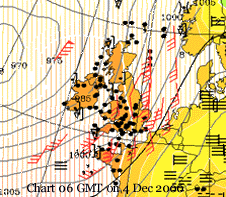 3rd: There were showers with ice pellets overnight between 03-06 GMT. At 0900 GMT we were into a clear slot although active looking cumulus clouds were all around in Liverpool Bay, the mountains of Snowdonia and to the W. The airflow was still S-SW'ly but there was another mid-Atlantic low (969mb) with associated fronts not far from S Ireland. The 0900 GMT temperature was the minimum for the next 24-h as it warmed to the maximum of 12.5C at 05 GMT in the night of 4/5th. The morning of the 4th soon became cloudier again and there were showers in the afternoon. It was windier in the evening with the S'ly at gale force 8 between 21-22 GMT with gusts of 50 mph. There was a band of moderate to heavy rain from 0630-0900 GMT on the 4th, amounting to 8.2mm, as an occluded front moved NE. [Rain 10.0mm; Max 12.5C; Min 6.2C; Grass 4.3C]
4th: The band of rain was just clearing at 0900 GMT. The overall grey low stratus cloud was beginning to thin and by 1030 GMT breaks had appeared. The Atlantic low now 964mb was still dominating the weather. Pressure here was 990mb with a temperature of 10.5C. The morning was bright for a while but it was cloudier by noon with a prolonged shower. During the afternoon the SSW'ly wind became force 7 with some further light rain. The night was also windy. [Rain 7.2mm; Max 13.2C; Min 7.2C; Grass 5.0C]
5th: At 00 GMT complex low 954mb was 150 miles W of S Ireland with am associated warm front over Wales. Before dawn the wind backed S'ly and reached gale force 8 between 05-07 GMT and the temperature rose to 13.2C, the maximum for the month (credited to the 4th). With only modest amounts of rain the waterlogged fields soon have standing water and the roads flood. During the morning,
with the amount runoff water, it became difficult to travel on the Pentraeth (Llansadwrn) to Beaumaris road. There was a heavy shower early in the afternoon before the sky cleared to give a little sunshine before nightfall. The sky was still clear at 2200 GMT but there were some showers later. [Rain 11.2mm; Max 11.9C; Min 9.9C; Grass 9.2C]
6th: By 06 GMT the low W of Ireland had filled to 966mb and was moving slowly NW. There had been a shower around 08 GMT and the temperature had fallen to 8.1C by 0900 GMT, the lowest of the past 24-h. Pressure here was 0994 mb with a S'ly wind. The morning was bright and sunny with good visibility. During the afternoon it became cloudier and there were slight showers from before dusk until 23 GMT. After midnight the sky began to clear [Rain 2.2mm; Max 11.1C; Min 8.1C; Grass 6.2C]
7th: The sky was still clear at 06 GMT but soon began to cloud over. At dawn there was still a bright band of light over the eastern Snowdonia Mountains. By 0900 GMT there was almost 8/8th of thin high cloud with low cloud beginning to spill over the mountaintops. The morning was rather dull with the sun just visible at times through the cloud. By 1300 GMT the light S'ly wind had backed SE'ly as the well-forecast vigorous Biscay low 974mb began to track N towards the Irish Sea. The afternoon became very murky with some light rain or drizzle as a large area of rain approached. There was heavy rain over the Channel Islands at 14 GMT and this spread to SW England by 16 GMT and S Wales by 17 GMT. Winds were gusting up to 70-80mph. Here during the night the wind was variable and light as the centre of the low moved over. There was moderate to heavy rain from 18-21 GMT and again next morning from 05 GMT onwards. [Rain 19.7mm; Max 10.5C; Min 7.9C; Grass 6.4C]
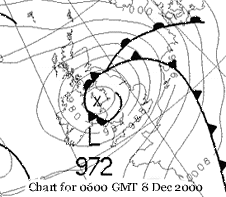 8th: At 0600 GMT low 972mb was centred on Anglesey. At 0800 GMT it was calm but within 5 minutes the barometer had kicked up and a S-SW'ly wind had risen. By 0900 GMT the wind was up to force 7. There was heavy rain, which accumulated 19.5mm, as the band of rain moved N. Another 4mm fell before 10 GMT. The road to Beaumaris became almost impassable being covered in 2 places by up to 30cm water. Surrounding fields were like lakes with torrents of water running down Red Hill into Beaumaris. As the wind reached gale force 8 by noon Irish Sea ferry crossings were being disrupted. In the West Country and South Wales there was severe overnight flooding following 50mm rainfall. In Taunton the river level was back to what is was a month ago, flooding some shops that had only just reopened. Elsewhere people were again being rescued from flooded buildings. About 90 people were evacuated from a flooded caravan park in Dawlish Warren. Two people died near Cheriton Fitzpane when their car was swept into a river and turned upside down. There was flooding at Abergavenny, including the railway line, and in North Wales in Mold and the Dee Valley. In Pembrokeshire, near St. David's, the River Alun had burst its banks. There were flood alerts in operation on 140 rivers including the Severn and Wye. Many roads were impassable and railway lines cut particularly in Devon, Cornwall and in South Wales. [Rain 4.0mm; Max 8.9C; Min 7.3C; Grass 6.5C]
9th: Yesterday's low with little change (973mb) was now over Shetland. There was a SW'ly showery airflow over most of the UK. Pressure had risen here to 994mb by 0900 GMT. After a short, but heavy, blustery shower the morning became bright and sunny with fast moving cumulus clouds in the force 5-6 SW'ly. The afternoon had a succession of showers, some merging to give longer spell
of rain, which continued into the night. [Rain 8.3mm; Max 10.2C; Min 7.3C; Grass 6.6C]
10th: There were 2 rumbles of thunder to the S over the mountains at 0823 GMT. There were active cumulus clouds around giving a succession of showers. During the morning there was a band of rain that gave 5mm by 1300 GMT. The afternoon was dull, but colder with a minimum of 6.6C, until before dusk when the sky looked brighter in the W. There was a further band of rain, however, from 20 GMT on a warm front giving the day's maximum of 11.7C about 02 GMT. The rain became moderate by 21 GMT giving another 8mm rain. Total rain by morning was 16.0mm over 9.4h. Before midnight the SW'ly wind reached gale force before midnight. [Rain 16.0mm; Max 11.7C; Min 7.5C; Grass 6.0C]
11th: The SW'ly continued at gale force with gusts of 50 mph until about 03 GMT. With low pressure in mid-Atlantic and high pressure over Europe the warm moist airflow was being maintained over the UK. Pressure here at 0900 GMT was 1005mb with a temperature of 10.7C. In continuous drizzle the relative humidity was at 100%. With the warm spell of weather over the last 2 weeks the soil temperatures have stopped the normal decline and returned to what they were 4 weeks ago. The day remained misty with drizzle at times. [Rain 11.3mm; Max 11.4C; Min 6.6C; Grass 4.6C]
12th: Depressions (4) lay in an arc to the W of the UK from S Iceland to SW Ireland. But low 979mb SW of Ireland, with associated fronts, moved NE bringing a large area of rain, that blanketed the Isles, and gale force winds. Here during the afternoon the S'ly wind was touching gale force. During the night the wind veered W'ly and strengthened as the low passed over (979mb about 2300
GMT); between 01-03 GMT reaching force with very strong gusts shaking the house. Valley reported gale force 9 and a gust of 74 mph; 82mph was reported from Aberdaron (Lleyn). The over SW England and Wales brought further flooding to some areas. Severe flood alerts were in operation in 7 places along the Rivers Vyrnwy, Wye and Severn. There was some flooding again
in Shrewsbury. At Worcester and Gloucester the river level had reached the top of the banks. There was extensive flooding in the Dyfed-Powys area including around Tregaron. The St. Asaph-Denbigh road was closed because of a landslide. The railway line between Llanrwst and Blaenau Ffestiniog was closed because of flooding. The high winds were also causing problems. In South Wales gusts of 93 mph were recorded at Mumbles and 77 mph in Cardiff where, in the city centre, scaffolding around a tall building collapsed. At Rhymney the roof of a block of flats was torn apart and inhabitants had to be evacuated. Overhead cables were brought down on the railway between Hitchin and Stevenage cutting trains between the North and London. Scores of trees
were blown down in the Midlands. High seas prevented 4 ferries from docking at Dover and the M20 was being used to stack lorries awaiting resumption of services. Most ferry services on the Irish Sea were disrupted or cancelled. Off the Cumbrian coast the Workington lifeboat had gone to the aid of a fishing boat. [Rain 8.9mm; Max 13.0C; Min 10.5C; Grass 9.4C]
13th: The low was now 965mb and to the NE of Scotland at 0600 GMT. This was giving a W'ly airflow but likely to veer to the NW later bring colder air from the N. Pressure here was rising at 1002mb at 0900 GMT and the temperature 8.5C, cooler than of late. The sky was 7 oktas covered with low ragged clouds with cumulus above. There were several troughs marked on the analysis chart
and at 1005 GMT there was a sharp shower of 5mm hail. The morning was bright at times but as pressure began to fall again the afternoon turned blustery with showers falling as hail and snow on the mountains of Snowdonia. During the afternoon and evening there were further showers of rain and ice pellets. After 2230 GMT it was dry until 0700 GMT when there was 2mm rain.
[Rain 6.2mm; Max 9.0C; Min 6.5C; Grass 4.4C]
14th: After an early rain shower there were signs of the sky clearing at 0900 GMT. With the low 965mb moved near the Norwegian coast pressure here was 1002 mb and the wind a light NW'ly. A light covering of fresh snow was seen on the Snowdonia Mountains as low as 2000ft. After a light shower the morning became bright then sunny and continued so into the afternoon. By 1500 GMT it was becoming cloudier again. There was a shower of rain and ice pellets at 2200 GMT. After the warm spell from the 28 November the mean temperature has returned more to a more normal 4.8C. [Rain 4.7mm; Max 6.5C; Min 3.0C; Grass 0.2C]
15th: There was a moderate shower of ice pellets at 05 GMT that covered the ground and when melted formed 3mm. By 0900 GMT the sky was clearing, and pressure (1011mb) rising, as a small ridge was moving in from the W. After a light shower of rain the day became bright and sunny. Fresh snow could be seen as low as 1000ft in the Ogwen Pass. Towards evening the sky became cloudier and there was some light rain. [Rain 0.5mm; Max 5.4C; Min 2.4C; Grass 0.2C]
16th: Overnight the minimum fell to -0.5C giving the first airfrost of the winter and only the third of the year (the last was on 4 March). At 0900 GMT the temperature had risen to 3.3C and there was a very light S'ly wind. Fresh snow had fallen on Carnedd Dafydd and the snowline was at 1500ft. There was thin patchy snow down to 1000ft at Ogwen Cottage. Low 987mb was over Sweden
and a ridge of high-pressure W of Ireland. An occluded front was lying down the Irish Sea and this gave a little rain together with a few ice pellets and sleet during the morning. There was a little rain around 17 GMT that took the rainfall total beyond 1454mm for the year, thus establishing 2000 with a new record for the wettest year! With 75 flood warnings and 7 serious warnings in operation
river levels in many parts of the UK are continuing to cause concern. In Gloucester, where the R. Severn levels remain high, as the time of high water in the Severn estuary approached the situation was described as 'serious' . But high water passed without breaching the banks. Many homes along the banks of the R. Thames in Berkshire and Oxfordshire, however, have again been flooded. [Rain
3.2mm; Max 6.0C; Min -0.5C; Grass -3.6C]
17th: Some slight showers at 05 and 07 GMT then with clearing sky at 0900 GMT there was a glimpse of the sun rising over Carnedd Dafydd. It was almost calm with a temperature of 2.5C. Some fresh snow had fallen overnight on the Snowdonia Mountains. The snowline (point where at least 50% cover at 09 GMT) was at 1500ft but as low as 1200ft near the A5 at Ogwen Cottage and Cwm Idwal.
The ridge of high pressure (1012mb here) was slow moving over the UK but Atlantic low 953mb, and associated fronts, are pushing in to the W. This gave very little rain here, just a prolonged spell of fine drizzle. Slight showers at 07 and 08 GMT the next day accumulated more in the raingauge. The Popocatepetl volcano near Mexico City has begun to erupt, potentially endangering 14000
people within a 20-mile radius have been evacuated. Volcanoes can affect the weather if enough fine material reaches the upper atmosphere. [Rain 0.4mm; Max 7.3C; Min 2.0C; Grass -0.9C]
18th: After the early showers it was a fine start to the day. Low 959mb, to the S of Iceland, had filled slightly. Visibility was very good and there was no wind with a temperature of 5.3C at
0900 GMT. The snow on the mountains had retreated to 1800ft but there were patches as low as 1500ft at the top of the Nant Ffrancon Pass. The morning was bright and the afternoon became sunny with a clearing sky at sunset resulting in some fine gold and purple colours. There was an early ground frost before it became cloudy and warmer later in the night. It was a dry day! The first since 21
October (57days). [Rain 0.0mm; Max 8.0C; Min 2.5C; Grass 0.2C]
19th: Low 981mb was anchored S of Iceland with fronts stationed over SW Britain and Ireland. A little red sky gave warning of the rain to come during the morning. It was light rain that lingered on into the evening accumulating 5mm by 1800 GMT. The night was cloudy but dry and relatively warm around 10C. Further eruptions today of Popocatepetl; there are now 2 plumes with fallout of ash.
[Rain 5.4mm; Max 11.8C; Min 2.2C; Grass -1.0C]
20th: The low S of Iceland (976mb) was still anchored but deepening again. The rain of yesterday had pushed NE'wards and was now affecting N Ireland and W Scotland. Pressure here was 1008mb and there was a light SSE'ly wind. The sky was clearing at 0900 GMT to give a dry, bright morning that was sunny at times. Our 'storm cocks', the mistle thrushes, started to sing in the treetops this
morning. A few spots of rain during the morning but the afternoon returned to bright and sunny. Although the maximum here was only 11.6C both Colwyn Bay and Prestatyn reported 13C, amongst the highest in the UK. [Rain tr; Max 11.6C; Min 9.6C; Grass 4.6C]
 21st: A calm start to the day with just a little high cloud. There was heavy dew on the grass but the temperature had only fallen to 1.1C. The sun appeared over the mountaintops at 0902 GMT; official sunrise here is supposed to be 0830 GMT but this does not take into account the Snowdonia Mountains. So we have 32 minutes less sunshine at the winter solstice. But the sun was very welcome
and it shone through haze and thin cloud all day, and not a drop of rain! The sky cleared at night, with no moonlight the stars were clear and bright. We have quite dark nights here with minimal extraneous light. [Rain 0.0mm; Max 9.3C; Min 5.4C; Grass 1.1C]
21st: A calm start to the day with just a little high cloud. There was heavy dew on the grass but the temperature had only fallen to 1.1C. The sun appeared over the mountaintops at 0902 GMT; official sunrise here is supposed to be 0830 GMT but this does not take into account the Snowdonia Mountains. So we have 32 minutes less sunshine at the winter solstice. But the sun was very welcome
and it shone through haze and thin cloud all day, and not a drop of rain! The sky cleared at night, with no moonlight the stars were clear and bright. We have quite dark nights here with minimal extraneous light. [Rain 0.0mm; Max 9.3C; Min 5.4C; Grass 1.1C]
22nd: The minimum held up but on the grass the temperature fell to -1.7C soon freezing the moisture. There was a slight deposition of hoarfrost on some grass and garden plants before morning. A cloudless start to the day with little or no wind with haze and some smoke in the Menai Strait. Calm at first with a gentle SE'ly wind later on. The morning was sunny with a maximum of
11.2C with a relative humidity of 65%, the lowest of the month. A cloudless afternoon and another gold and purple sunset at dusk with one or two small clouds just appearing in the west. A clear starlit night. [Rain 0.0mm; Max 11.2C; Min 2.1C; Grass -1.7C]
23rd: A clear sky at dawn but when the sun was appearing over the mountaintops at 0907 GMT there was some cloud to the S. There was a high (1030mb) over Hungary and Romania and another (1038mb) over Greenland. With low pressure (980mb) SW in the Atlantic a gentle SE'ly airflow was being maintained over the UK. The cloud to the S of here soon encroached and the rest of the day was rather dull; clearer sky could be seen over Liverpool Bay. Later in the afternoon the sky was red in the SW. At 1555 GMT the setting sun was a blood red colour, a result of the pollution smoke in the lower atmosphere. During the evening there was a spell of drizzle insufficient to wet the raingauge bottle. [Rain tr; Max 6.5C; Min 2.1C; Grass -1.7C]
24th: There was high pressure (1030mb) over Iceland and a low (985mb) W of Portugal where there were thunderstorms. There was an E'ly airflow over the UK. A cold front was lying near Carlisle and had already given snow on the Cairngorms. Pressure here was 1002mb at 0900 GMT with the wind ENE force 5: with a temperature of 3.5C snow was expected to fall over Snowdonia. Short spell of
drizzle and light rain in the morning and a longer spell in the afternoon. [Rain 1.0mm; Max 4.4C; Min 3.1C; Grass -0.2C]
25th: There was a complex low in the Bay of Biscay but with the Greenland high (1037mb) persisting the cold E-NE'ly airflow was continuing over the UK. At 0900 GMT with pressure at 1005mb the cloud was breaking up in a force 5 E'ly wind; the temperature was 2.3C (Dewpoint -0.4C). There was a fresh covering of thin snow as low as 1800ft on the northern slopes of the Snowdonia Mountains. In the Nant Ffrancon Pass there was a little at 1200 ft. The day was sunny at times with a maximum of 4.2C. About 1615-30 GMT there was a light deposition of columnar ice prisms and a little later of snow grains up to 1mm diameter. Both lots of crystals could be seen on the roof of the Stevenson screen and vehicles. The temperature at the time of deposition was near 1C. The night was clear with bright stars with the temperature falling to -0.5C. [Rain tr; Max 4.2C; Min 2.3C; Grass 0.6C]
26th: High pressure 1031mb over Greenland and complex low pressure (979mb) in the Bay of Biscay was keeping the cold E-NE'ly airflow across the UK. Pressure here (999mb) was falling slowly and the temperature at 0900 GMT was 2.0C (Dewpoint -1.1C). The bare soil surface was frozen with a slight covering of snow grains and vegetation had a slight deposition of hoarfrost.
The day was cloudy and there was a flurry of snow at 1000 GMT. There was moderate snow covering the eastern end of the Snowdonia range, particularly on Foel-Fras and Drum. The general snowline was at 1600ft. There were a few breaks on the cloud and in the afternoon spectacular gold and pink coloured crepuscular rays seen over Llangaffo at 15 GMT. The day's maximum was 3.0C with a relative humidity of 75%. In the evening there was a slight shower of snow pellets. [Rain tr; Max 3.0C; Min -0.5C; Grass -3.9C]
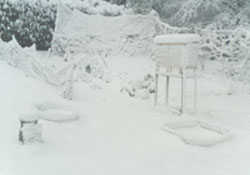 27th: A cold night with a minimum of -1.8C and -5.6 on the grass. There had been a slight shower of snow pellets that were still on the frozen ground at 0900 GMT. It was a crisp and bright morning with a temperature of -1.2C and dewpoint -3.7C (RH 83%). Pressure was high 1019mb over Iceland and low 984mb over France. A low 992mb Orkney and developing low in the Irish Sea, and associated cold front moving S, was expected to bring snow to W Scotland, N Ireland and later to N Wales. There were slight snow showers in the morning and moderate snow showers in the afternoon giving up to 2cm snow that remained until dusk. Maximum temperature 1.0C. Significant falls of snow (up to 15cm) were expected over high ground and on some low ground (as the ground temperatures have fallen it will settle) in the next 24-h. Winds had been forecast to increase and blizzard-like conditions were possible. At 2100 GMT the strengthening W or SW wind was reaching force 5-6. The front arrived at 2146 GMT with a bang! After hail (mixture of snow pellets and ice pellets) which pelted the windows for several minutes accumulating 6 cm on the window ledge, there was thunder and lightning close by. There followed a heavy snowstorm , initially the wind was force 5 giving blizzard-like conditions for a while. Heavy snow continued for an hour during which 14cm snow accumulated (16cm total on the ground). The snow moderated after that, but continued for about another hour. [Hail and snow (17.7mm); Max 2.2C; Min -1.8C; Grass -5.6C]
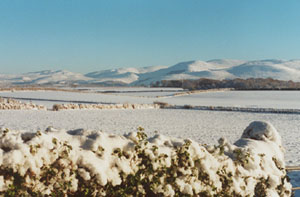 28th: Awoke to blanket of snow with bushes and trees looking very spectacular the branches covered with a few cm of snow. Another snow shower from 0830 GMT lasting until about 1000 GMT. The low 988mb was centred over Malin (N Ireland) with the front moving E on a line Carlisle, Cumbria to Brighton. At 0900 GMT pressure here was 992mb with the temperature still -2.0C (dewpoint -3.3C) and snowing; the observations were done in what has become rare conditions in recent years. The locks on the screen had frozen and had to be thawed out. Snow in the raingauge was melted and ground thermometers had to be uncovered to read them. Snow, which was crisp and dry, was lying between 17-20 cm depth, average 18.5cm. From 1100 GMT the sky was clearing and it became bright and sunny although the maximum only reached 0.7C for a short time, the lowest of the month. There were spectacular views in the afternoon of the Snowdonia Mountains, from Conwy to the Lleyn, covered in snow. There was snow down to sea level where the incoming tide was washing it away. There was inversion fog all day in the (River Cefni) valley between Malltraeth and Red Wharf Bay. The temperature at Pentraeth remained below zero all day reaching a maximum of -0.7C, very rare for Anglesey to remain below zero all day. Shallow fog was forming on some of the snow-covered fields from noon onwards and this later gathered up in the River Cadnant valley, to the S, of here forming an inversion. Here, it remained clear all day the snow remaining crisp and hardly melting (it was up to 19cm deep) at 1600 GMT and the snow-covered trees and hedgerows looked the same as first thing in the morning. Under the clear sky with the crescent moon low to the SW the temperature, above the snow, had fallen to -10.2C at 1600 GMT. Around 1700 GMT the minimum dropped to -4.7C, the lowest of the month, remaining below 4.5C for 7 hours.
 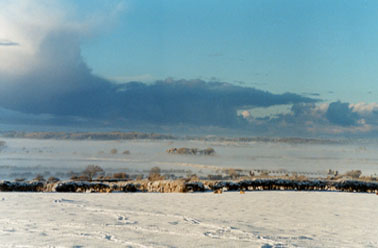 Over the UK the snow had caused problems for airports, railways and roads. One lane of the A55 Expressway was closed for a while when a Tesco transporter skidded and plunged over a flyover near St. Asaph; the driver escaped unhurt. The dual carriageway was reduced to one lane because of snow and ice. Untreated minor roads on Anglesey and Gwynedd were almost impassable most of the day. Liverpool and Manchester airports were closed for several hours as were Scottish airports and in N Ireland. Two crab fishermen from the Isle of Skye who did not return overnight were found safe during the day. One was rescued from the water clinging to a dinghy, a remarkable thing at this time of year; the other had managed to get ashore on a remote part of the island. [Snow 0.8mm; Max 0.7C; Min -3.7C; Grass -5.0C]
29th: Overnight the minimum was -4.7C and -10.6C just above the snow, both the lowest of the month and the year. There had been 1 or 2 flurries of snow and snow pellets and ice pellets before dawn. At 0900 GMT the sky was clearing, there were cumulus clouds in the vicinity, giving some sunshine later. The temperature was hovering around zero with a dewpoint of -1.8C. Remarkably the snow was still covering the trees looking similar to yesterday morning. Lying snow averaged 16cm. With an occasional puff of a breeze from the NNE, or disturbance by bird or squirrel, a little snow was falling from branches. Pressure was low (997mb) in the Severn Estuary (trough giving precipitation over SE England) and high (1016mb) S of Iceland; here it was 1000mb. A few sunny spells during the day when the maximum briefly reached 2.4C. Remarkably the snow was still on bushes and trees at dusk; there seemed to be a small thaw but little or no wind to disturb the branches. It was cloudier after dark but there was no precipitation reaching the ground here for a few hours, although rainfall radar was showing it over Anglesey and running in a ribbon over Snowdonia to S Wales. This sometimes happens, the radar displaying precipitation at a higher level; but it was probably reaching the ground over the mountains. A trough of low pressure over Wales was moving S; the ribbon-like pattern of precipitation was to continue all night till the following morning when it was still seen on the radar pictures. [Rain 2.0mm; Max 2.4C; Min -4.7C; Grass -10.6C]
 30th: Before midnight the temperature rose 2C to 0.5C then began to fall again suggesting passage of a front. After midnight there was some thunder and lightning that was reflecting widely off the snow covered ground. At the same time there was a shower of ice pellets followed by a spell of snow pellets and snow around 01 GMT. In the hour before 0900 GMT there were snow flurries with the temperature at 0.3C and dewpoint -0.9C. A further 1.5cm of pellets and snow had fallen in the night. Pressure was 1008mb and rising slowly. Snow depth was between 10-14cm deep. During the morning there was a little rain then a further snow flurry then in spells of sunshine the temperature began to rise. At 1300 GMT, with the temperature at 4.0C the day's maximum, a thaw had set in. The A55 Expressway was still reduced to single lanes between Menai Bridge and Llanfairfechan
but was then clear on to Chester. Minor roads were still difficult and the Crimea Pass, between Blaenau Ffestiniog and the Conwy Valley was closed because of snow and ice. After dark under a clear sky the temperature dropped again to below freezing. Above the snow the minimum fell to -6.6C and in the air to -0.5C. [Rain 1.1mm; Max 4.0C; Min -3.0C; Grass -9.3C]
30th: Before midnight the temperature rose 2C to 0.5C then began to fall again suggesting passage of a front. After midnight there was some thunder and lightning that was reflecting widely off the snow covered ground. At the same time there was a shower of ice pellets followed by a spell of snow pellets and snow around 01 GMT. In the hour before 0900 GMT there were snow flurries with the temperature at 0.3C and dewpoint -0.9C. A further 1.5cm of pellets and snow had fallen in the night. Pressure was 1008mb and rising slowly. Snow depth was between 10-14cm deep. During the morning there was a little rain then a further snow flurry then in spells of sunshine the temperature began to rise. At 1300 GMT, with the temperature at 4.0C the day's maximum, a thaw had set in. The A55 Expressway was still reduced to single lanes between Menai Bridge and Llanfairfechan
but was then clear on to Chester. Minor roads were still difficult and the Crimea Pass, between Blaenau Ffestiniog and the Conwy Valley was closed because of snow and ice. After dark under a clear sky the temperature dropped again to below freezing. Above the snow the minimum fell to -6.6C and in the air to -0.5C. [Rain 1.1mm; Max 4.0C; Min -3.0C; Grass -9.3C]
31st: At dawn the sky was overcast with uniform grey stratus cloud. The temperature had been rising and at 0900 GMT had reached 4.0C, dewpoint -1.9C. The wind was a light SSE'ly and the relative humidity was 66%. Most of the snow had gone from the trees although there was still 11cm lying on the ground. There was still snow on the beach at Pentraeth although it had disappeared from around Moelfre where less had fallen. Minor untreated roads in the area were still almost unusable due to compacted snow/ice. A deep Atlantic low (955mb) was west of Ireland and tightening isobars would bring windy conditions later in the day. There was also a low (989mb) in the Mediterranean. During the morning there was light rain, ice pellets and sleet as a long band of rain,
on an occluded front associated with the Atlantic low, moved into the UK from the west. This was giving snow at higher levels in Snowdonia, N England (including Chester, York and Warrington) later Scotland. Many Millennium and New Year events had to be cancelled. In the afternoon the wind backed more S'ly and increased in strength to storm force (Valley was reporting mean wind speeds of 56 mph. At Llanfairfechan (Gwynedd) such was the strength of the wind that several trees were brought down and a sports stand uprooted and blown over. The temperature began to rise and was near 6C at 1500 GMT and between 19-00 GMT reached 9.3C, the day's maximum. Some grass was beginning to appear under trees during the afternoon, where the snow had melted sufficiently. Such was the rapid thaw that almost all snow had melted by 23 GMT. [Rain 1.7mm; Max 9.3C; Min -0.5C; Grass -6.6C]
The year 2000 with 1484mm was the wettest in Llansadwrn records back to 1928, beating the previous record of 1452mm in 1954.
Go here for an analysis of the autumn's rainfall.Go here to view the daily observations.Go here to view monthly and annual statistics.Go here to view annual temperature and rainfall graphics. |